
Of all the various alternatives to heavy fuel oil - hydrogen, ammonia, LNG, etc - it was starting to look like methanol was going to be the shipping industry’s proposed answer to its decarbonisation problem. The maritime news cycle this entire year has been filled with stories about methanol dual-fuel vessels on order, not just from supposed industry leader Maersk but also from a range of other shipping companies. As recently as May of this year, methanol accounted for 70% of all alternative-fuelled newbuilds on order. But in a recent turn of events, it appears that – as one classification society executive put it – the Methanol ‘happy hour’ has come to an end. What happened? In this edition and the next we’re continuing to dig into the nuts and bolts of green shipping regulation, in order to trace how the market logics built-into regulations like FuelEU Maritime end up undermining the very point of the legislation itself. And – maybe – that’s the whole point.
This research builds on our film Methanol Blue from last year. We wanted to first follow-up on developments around FuelEU and alternative fuels since last summer, before digging into FuelEU’s sister legislation that will soon extend the use of Emissions Trading Systems (ETS) to maritime transport. We’ll go into ETS in the next issue, but we mention it here because FuelEU and Maritime ETS can be thought of as a kind of regulatory pairing where the former seeks to incentivise gradual uptake of so-called “clean” fuels like methanol, ammonia, and LNG, whilst the latter is designed to bring down emissions through a polluter-pays principle and cap-and-trade system. FuelEU Maritime and Maritime ETS are further linked by the fact that part of the revenue generated from the surrendering of emission allowances is supposed to be earmarked for the development of these “clean” fuels.
Over the course of the summer, liner giant Maersk has begun signalling a shift away from methanol toward LNG – AKA methane, a greenhouse gas with a planet-heating effect far more potent than carbon dioxide. According to the National Resource Defence Council, methane’s global warming impact is almost 30 times greater than that of carbon dioxide over a 30-year period. That LNG gets to even be remotely considered a ‘green’ alternative to heavy fuel oil belongs in the pantheon of greenwashing crimes. This swerve is remarkable given the following comments on LNG by Maersk’s head of decarbonisation Morten Bo Christiaensen just three years ago: “It’s a fossil fuel; it just doesn’t solve the problem. And if you do the analysis, it can actually be worse than burning bunker, because of the methane slip. Fundamentally it’s another fossil fuel, and we don’t want to invest in more fossil fuels.” (source).
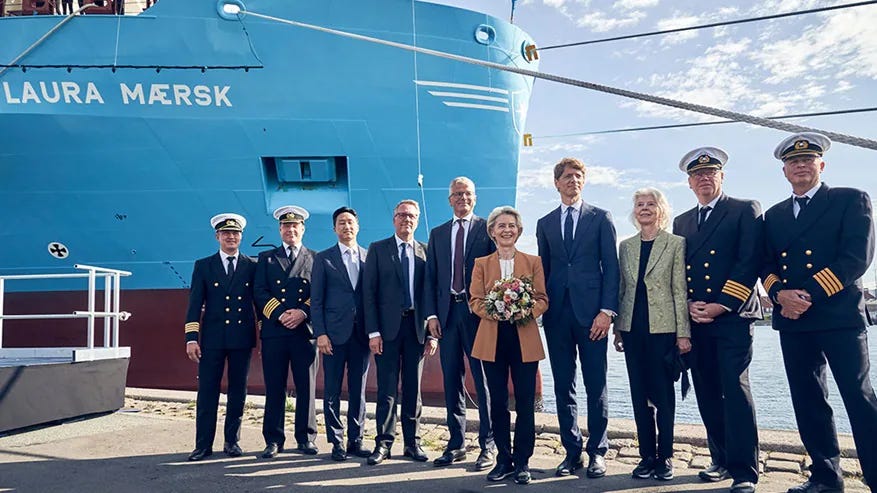
But the decision makes sense so long as Maersk’s ambition to ‘lead’ the industry’s green transition is read as having far less to do with any normative environmental ambition and everything to do with creating a competitive advantage for itself in a future regulatory environment of high non-compliance costs and carbon prices (in addition to, as we shall see later, juicy compensation mechanisms for anyone who happens to be willing to do the work of owning a couple massive dual-fuel vessels that can absorb the heavy fuel oil sins of others). But what happens if this anticipated regulatory environment is much weaker than expected? By retaining its methanol dual-fuel vessel orders whilst ordering more LNG vessels, Maersk hedges its bets in anticipation of a future scenario where shipping decarbonisation is essentially abandoned as a project or goal. And where Maersk goes, others follow. The sudden rise and fall of Methanol was further exacerbated with the announcement two weeks ago that Danish energy company Orsted was pulling the plug on its e-methanol plant in Sweden - the largest of its kind announced in Europe up until now - due to lack of demand and an unwillingness in the market to sign long-term uptake contracts.
So: those demanding the fuels complain of no supply, those supplying the fuels complain of no demand. One of the core pillars of EU green fuels regulation is the principle of technological neutrality, i.e. setting emission limits “without prescribing the use of any particular fuel or technology”, on the basis that the market is entrusted with figuring out the best way forward and needs no further public intervention. But as the above stories suggest, this principle is directly at odds with a parallel narrative about shipping decarbonisation, the ‘chicken-and-egg’ problem, according to which the regulator cannot mandate the use of a particular fuel without some degree of certainty that there is an extant market for it with sufficient supply, and the market does not want to supply such a fuel in the absence of a strong enough regulatory incentive.
The current market stalemate needs to be placed in its adequate regulatory context, but such an analysis also needs to go beyond the chicken-and-egg problem, which is a construct that ultimately allows both sides to claim innocence simultaneously. What is of particular interest to us, which we began to explore in our film and continue to explore further below, is how climate regulation like FuelEU Maritime creates or exacerbates this impasse by generating the very conditions that allow shipping companies to circumvent the true stakes of the climate crisis, not by ignoring climate regulation, but precisely by adhering to it, and using the market mechanisms baked into those very regulations to turn (rig?) the green transition into just another profit game.
While FuelEU has technically not yet started, preparations since last year have intensified in anticipation of the regulation going into effect. When we dug into FuelEU last year, we were particularly interested in the regulation’s various accounting, time-bending, and semantic loopholes, especially:
A ‘multiplier’ mechanism which between 2025 and 2033 allows the use of RFNBO (renewable fuels of non-biological origin) to be counted twice, which means what you think it means: the de-facto reduction of carbon intensity is only half of what it will look like on paper.
A roll-over and future banking mechanism which allows one to borrow a future compliance surplus to make up for non-compliance in the present.
And perhaps most interestingly, a ‘voluntary pooling’ mechanism, which allows companies to “pool the performances of different ships”, i.e. the over-compliance of one ship should be allowed to compensate for under-compliance of ships provided that the total pooled compliance is positive.
There is a moment in our film where Jacob reflects on the likely effects of voluntary pooling, predicting that it will probably generate a secondary market for leasing LNG or dual-fuel methanol ships (i.e. over-performing ships by the standard of the FuelEU regulation). One year later, this seems to be exactly what is happening: According to Lloyd’s List: “LNG and methanol dual-fuel vessels are to rake in millions in 2025 by pooling with non-compliant vessels under the FuelEU Maritime legislation, as overachieving vessels can buy compliance for non-compliant ships that would otherwise face hefty penalties.”
According to the European Commission, one LNG vessel can cover the compliance of 4 non-compliant vessels, whereas a vessel running on e-methanol can absorb the carbon sins of 40 vessels. Ahti Consulting, a Finnish consulting firm that will provide FuelEU and ETS compliance calculators, predict that it could go further than that, estimating that 65 Heavy Fuel Oil vessels could be covered by one methanol vessel. While the EU might just frame this as a rewarding incentive for “first-movers”, in effect this turns “green” ships into investment objects that will disproportionately benefit the usual liner giants (CMA CGM, MSC, Maersk) who have started developing their dual-fuel fleets since a few years back.
According to the same Lloyd’s List article, pooling can be arranged not just between shipping companies but also within them, meaning container shipping giants can apply the pooling mechanism to their own fleets. So if we take the fleet of, let’s say, Maersk, which in 2019 was 740 (and many of these do not have any port calls in Europe but let’s just suspend that for the sake of calculation), even assuming the entire fleet calls at a European port, Maersk would need just 19 methanol vessels to be covered under the pooling mechanism. As of August 2023, it has 25 methanol-enabled vessels on order – enough to cover their own asses and make millions from leasing out the rest (on top of the billions made off the back of the pandemic and currently being made from the Red Sea crisis). So far then, FuelEU Maritime seems to skew heavily in favour of liner giants, further consolidating an already highly oligopolised market through a regulatory competitive advantage. And lest we forget, one of the most ecologically devastating aspects of container shipping is the very size of the ships themselves, a development spearheaded by the same companies now claiming the green mantle.
Finally, one thing FuelEU Maritime pays scant attention to is that beyond their variation in carbon intensity, the varying chemical properties of different fuels have a range of other implications, especially for workers and worker safety. Although the Maersk Mc-Kinney Moller Center for Zero Carbon Shipping (Maersk’s green non-profit arm) classifies the “Onboard safety and operations” of e-methanol and bio-methanol as mature, which it defines as there being solutions available “with no or limited barriers remaining”, a recent fire safety study by Survitec showed that the firefighting methods developed for conventionally fuelled ships are wholly inadequate for dealing with methanol-based fires, with the product manager concluding that “a completely different approach is required if these ships are to remain safe”. There are currently 229 methanol vessels in the global orderbook.
No posts
Comments
Nothing yet. Say the first thing.
Sign in to join the conversation.