
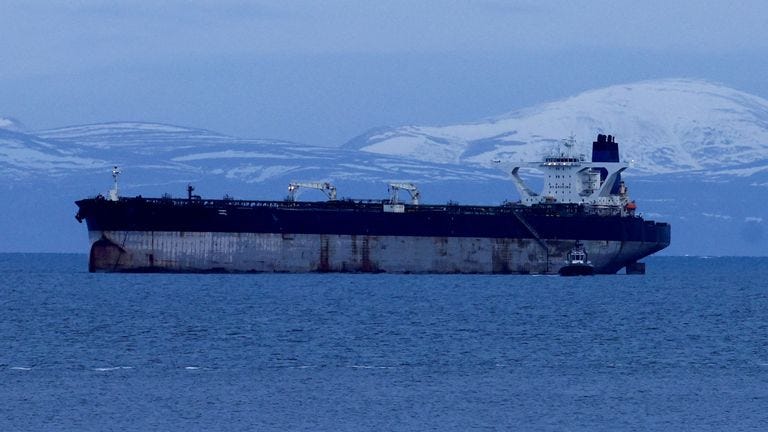
In recent months there’s been a lot of talk about the ‘dark’ fleet, or the ‘shadow’ or the ‘ghost’ fleet. For a while now I have felt that people use these terms without really examining their origins, nor the assumptions that come with invoking them. In what follows I go through some things that have been bothering me, both in specialist shipping media but also increasingly mainstream news platforms. I argue the following:
Despite being evoked constantly, the terms ‘shadow fleet’, ‘dark fleet’, etc. are seldom clearly defined, and the definitions that do exist are both vague and varied. This conceptual stretching becomes easily weaponised by hawkish US lobbies, and generally does a massive disservice to public understandings of how the shipping industry works.
The main ideological obfuscation at work in the use of the term ‘dark’ fleet is that it completely (and often intentionally) blurs the line between legality and projections of extraterritorial sovereignty (i.e. unilateral sanctions).
Paying attention to what kinds of vessels are *not* included in the dark fleet also tells us about the imperial/geopolitical foreclosures baked into the term.
The loose use of this term has set the discursive stage for the Trump administration to legitimise not only sanctions, but also outright seizures of vessels, increasingly outside of any legal framework.
1. How is the “dark”/“shadow” fleet defined (and by whom)?
The ‘dark’ in ‘dark’ fleet used to refer to the specific practice of vessels ‘going dark’ i.e. turning off their AIS transponders to avoid being detected, but increasingly the term seems to allude to a different kind of darkness, whose connotation is not so much technical as it is ideological, and the term ‘dark’ fleet has become increasingly interchangeable with the terms ‘shadow’ and ‘ghost’ fleet. It is sometimes invoked without being defined at all, and sometimes defined in rather vague terms, like the New York Times defining it as “a loose term used to describe a hodgepodge array of ships that obscure their locations or identities to avoid oversight from governments and business partners.”
Given that the ‘shadow’ fleet is a subject inextricable from geopolitical antagonisms that always also operate as information wars, it seems important to examine this definition a bit more closely. For example, it’s worth noting that the sources from the Wikipedia entry called “Iranian Shadow Fleet” come largely from either the US State Department, the US Treasury, or United Against Nuclear Iran, a hawkish neocon lobby chaired by Jeb Bush (US news organizations writing on ‘ghost’ fleets often take UANI as an authoritative source on the topic, quite literally tagging along). Given how heavily this term is pushed by such organizations, some critical examination and unpacking is really warranted as a bare minimum.
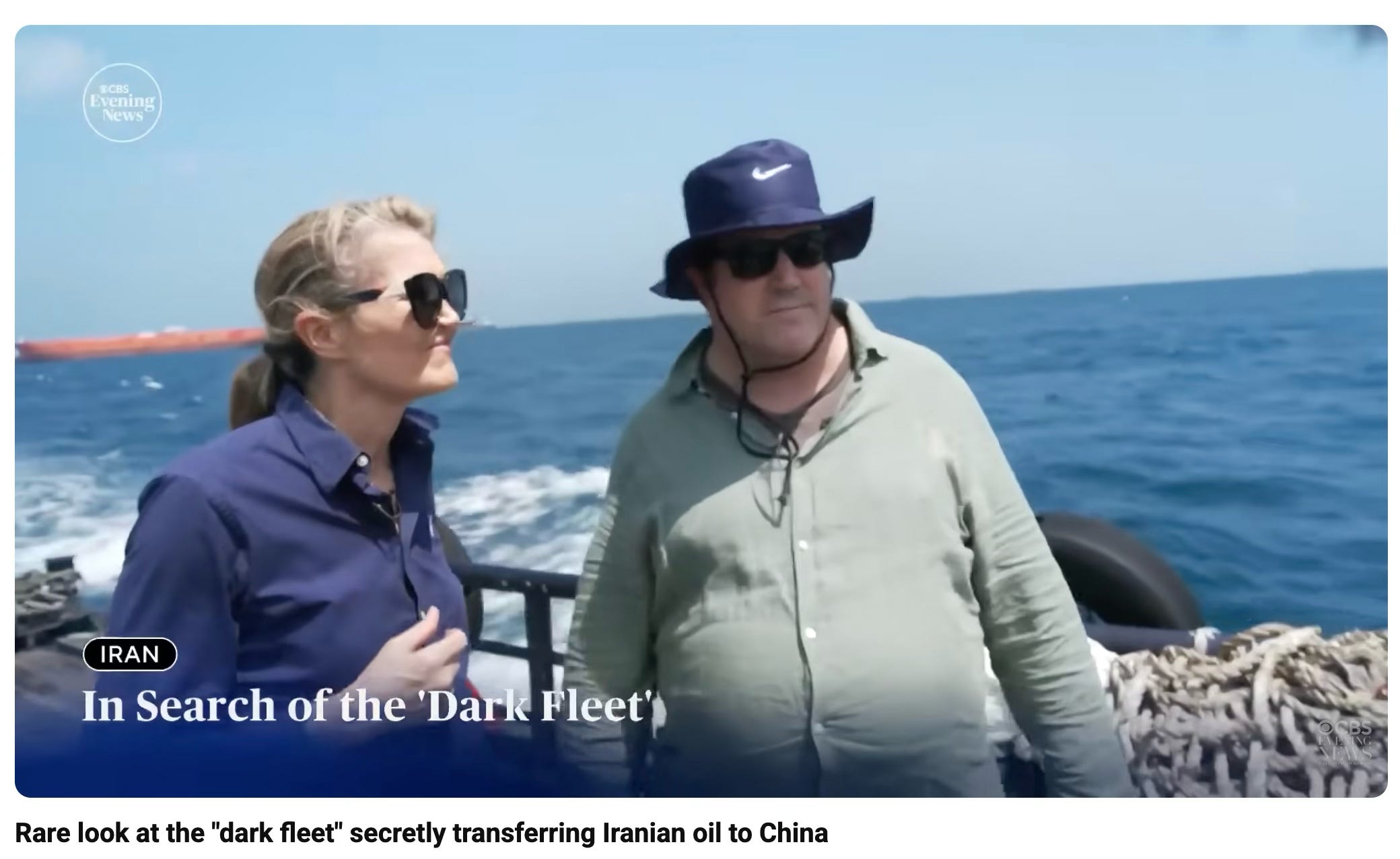
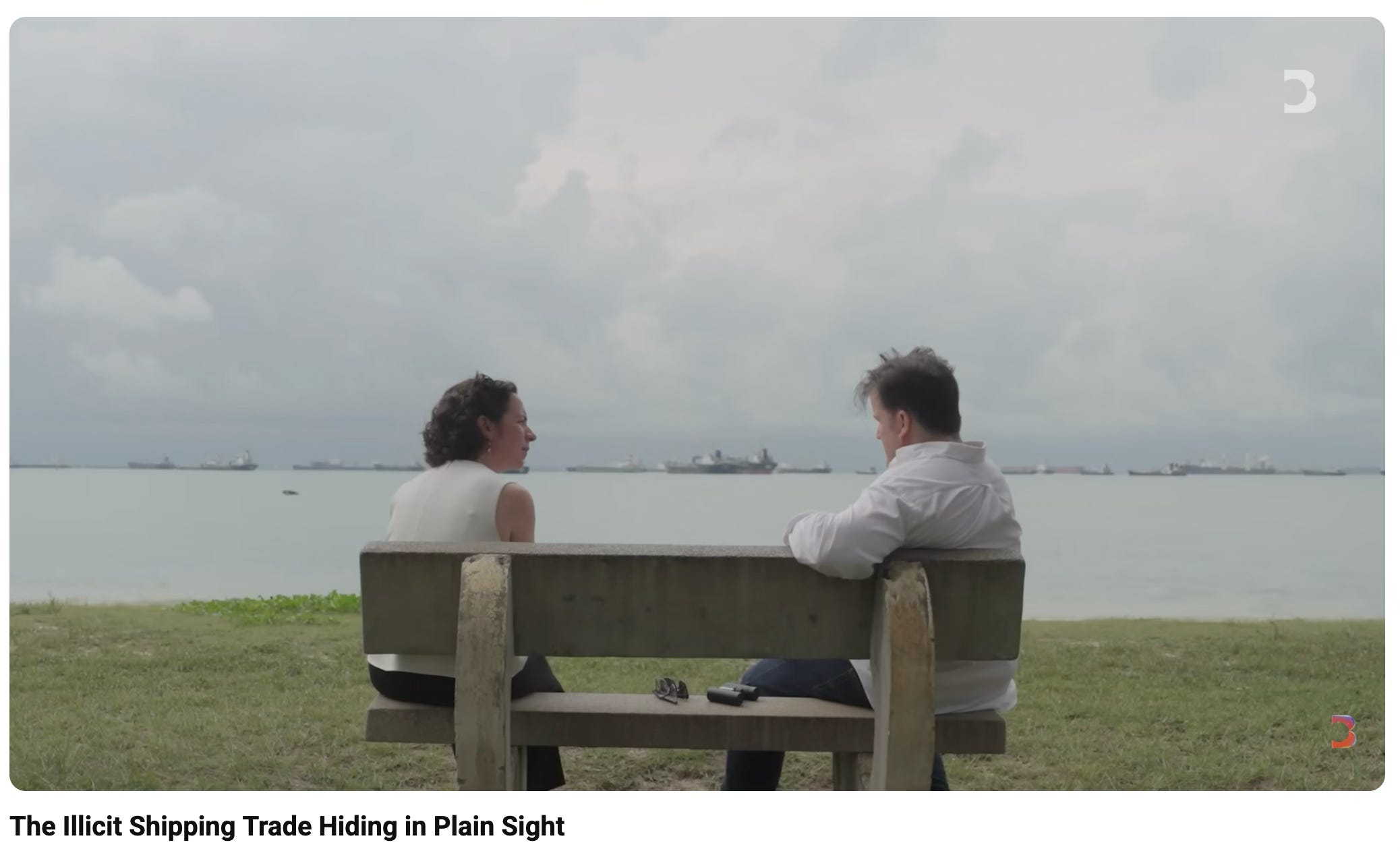
Definitions of the dark fleet
One of the challenges in defining the ‘shadow’ fleet is that even if you resort to shadowy terms like “opaque ownership structures”; “post-box addresses”; “obscure locations”; “shell companies”; “flags of convenience” and “flag hopping” (these are all taken from a definition given by The Atlantic Council), you just end up sounding like you’re describing the entire shipping industry. To claim, as UANI does, that “flag-hopping is a blight on legitimate maritime commerce” is disingenuous, since both the use of shell companies and the ability to re-flag overnight are two of the industry’s central organizing principles. So all of these definitional criteria are not just mystifying but downright unhelpful, especially to a larger audience.
Perhaps the most comprehensive attempt at a definition comes from Lloyd’s List, the industry’s oldest publication. In fact I would argue they basically coined the term. In an April 2023 report titled “Shifty Shades of Grey”, Lloyd’s List provides a ‘methodology’ which defines a tanker as part of the dark fleet if:
it is aged 15 years or over, anonymously owned and/or has a corporate structure designed to obfuscate beneficial ownership discovery
solely deployed in sanctioned oil trades
and engaged in one or more of the deceptive shipping practices outlined in US State Department guidance issued in May 2020.
Another definition given by the Kyiv School of Economics and picked up by the European Parliament’s research report on the topic casts a wider net: they depart completely from the ‘dark’ fleet having to be at all related to the practice of ‘going dark’ during sailing or loading operations, arguing instead that the dark/shadow fleet encompasses any vessel that “lacks Western insurance and belongs to a non-EU/G7+ company”. This definition seems to work more by proxy than by actually attempting to give the term any substantive meaning: making the definition hinge on insurance is an efficient move if you want to encompass the kinds of vessels that might be attempting to evade US or EU sanctions, as Western insurers usually do not underwrite cargo sanctioned by Western governments (though it’s not hard to find exceptions: an NYT-identified ‘shadow’ tanker engaged in spoofing activity near Russia called Alma - IMO number: 9235892 - is owned by an Irish company and insured by the American Club, a Western insurer) but the sheer scope and geopolitical underpinnings of this definition, which implies that the non-Western is, by definition, in the shadows, should give pause. This definition can also make it seem as though having a non-Western insurance would somehow be per se illegal, when actually it’s just that London remains the de facto insurance capital of the world (as I’ve written about elsewhere, most insurance clubs deploy contractual clauses to ensure any compensation disputes arising from oil spills or other environmental damage caused by tankers are settled exclusively in London arbitration courts).
When I started thinking about the use of these terms, I was mostly thinking about the ideological connotations of words like ‘dark’, and ‘shadow, but the term ‘fleet’ isn’t all that helpful either, especially when invoked with a country (the ‘Russian’ shadow fleet, the ‘Iranian’ shadow fleet), because it suggests a far greater degree of cohesion between different ships than is probably the case. There might very well be some strategic assembling of vessels for particular trades, but the shipping industry, in particular bulk trades like oil, is highly decentralized and fragmented, and a lot of this is probably just individual risk-taking by profit-seeking shipowners who smell opportunity and estimate that benefits outweigh risks. A recent FT piece on the ‘shadow’ fleet points to just this, citing a maritime analyst who says that “as long as there are barrels that need to move outside compliant channels, there will be operators willing to take on that risk — especially when freight rates and price dislocations increase the incentive”, a picture that is at odds with the impression of cohesion implicit in the suggestion that ‘ghost’ fleets are ‘Russian’ or ’Iranian’.
2. Locating the ‘shadow’ fleet between legality and projections of extraterritorial sovereignty: is the ‘shadow’ fleet engaged in illegal operations?
Amidst this flurry of vague definitions, in fall 2023 the IMO began drafting a resolution on ‘dark shipping’ which would include, for the first time, its own definition. When the discussion of ‘dark shipping’ was tabled at the IMO, Iran proposed amendments that took issue with the language used in the draft resolution, due to what it deemed were “controversial concepts and terms” like “dark ship” or “illicit,” which it argued lack universally accepted definitions within the member states or international law. In the final IMO resolution, the word ‘illicit’ was changed to ‘illegal’. ‘Illicit’ is a preferred term of US state bureaucracies when talking about these oil shipments, and they seem to quite intentionally avoid the term illegal, and this raises my next question, which is to better understand where exactly the ‘shadow’ fleet sits between legality and projections of (mostly US) extraterritorial sovereignty.
‘Illicit’ is a far more politically useful term for the US than illegal because the operations of the ‘shadow’ fleet are not always illegal. An FT piece on the Russian ‘shadow fleet’ from October 2024, which did a deep dive on some of the ownership structures of vessels transporting sanctioned oil out of Russia, does not use the language of sanctions evasion but rather states that the 4 million barrels of oil being moved every day on these vessels are “beyond the reach of the sanctions”. “It is not alleged”, the piece states, “that the transactions have broken any laws.”, And herein lies what to my mind is the crux of the obfuscatory mechanisms at work in terms like ‘dark’, ‘ghost’, and ‘shadow’ fleet: to engage in illegal activity in order to evade sanctions (which does happen!) is not the same as conducting transactions that fall beyond the reach of sanctions, and the terms ‘dark’, ‘ghost’, and ‘shadow’ fleet intentionally blur this distinction. Why does this distinction matter? Let’s take this tweet by UANI researcher Jemima Shelley from March 9th:
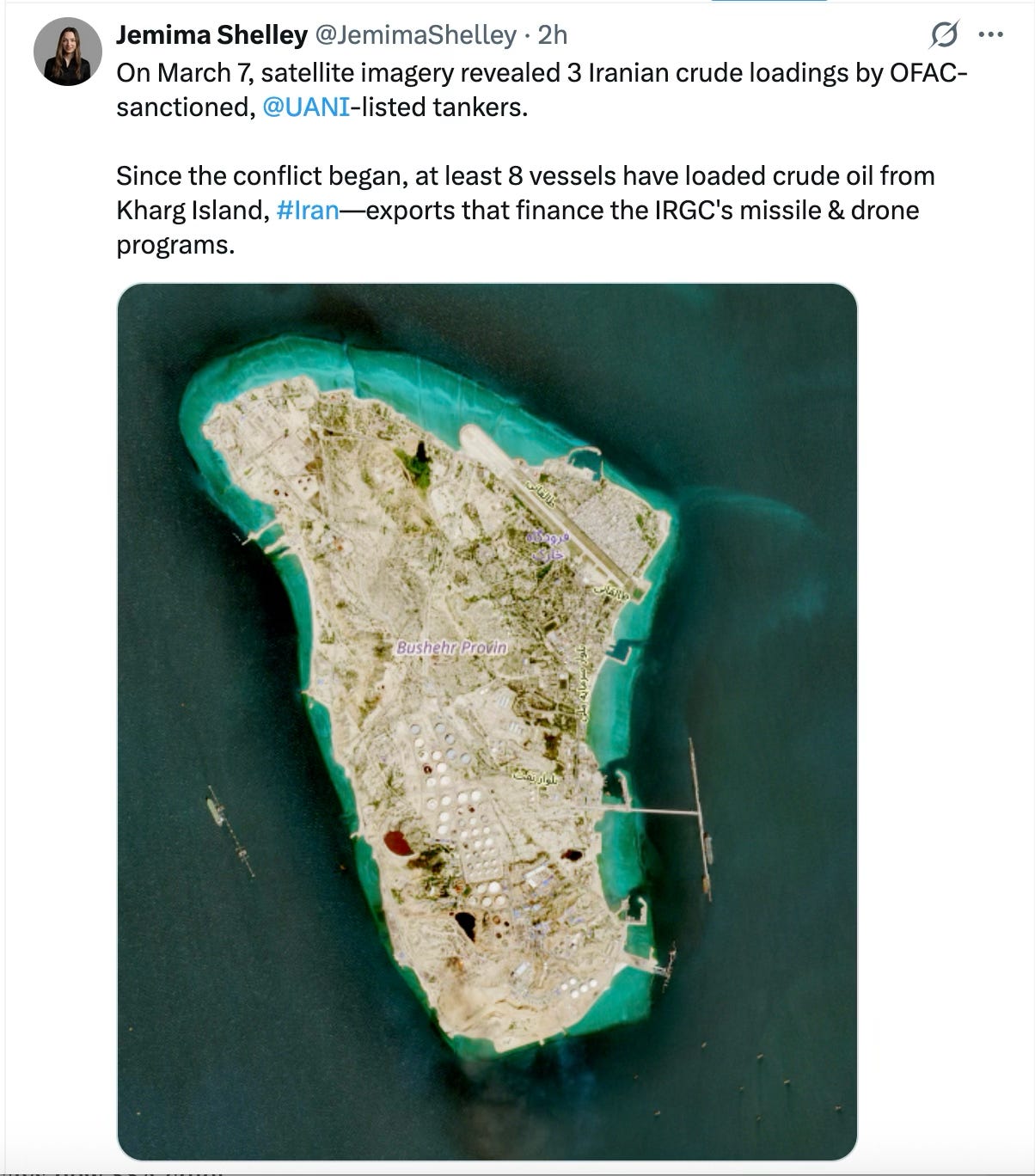
‘UANI-listed’ refers to the UANI’s ‘Iran Tanker Tracking’, which from what I can see just tracks every single oil shipment leaving Iran full stop, every single one of which UANI considers to be ‘clandestine’. It seems to me like UANI are driving an agenda to simply frame every single transaction that somehow involves Iran as illegal (though like the various US departments it always resorts to words like illicit and clandestine) regardless of the legal reach and applicability of US sanctions.
Assertions of the ‘illicit’ and ‘clandestine’ to name every single shipment that has somehow involves Iran, Russia, Venezuela, or China is obfuscating because it blurs the line between what constitutes sanctions evasion and what kinds of trades simply fall outside the very wide but perhaps not yet total (and perhaps receding) extraterritorial reach of the US sanctions regime. The vast definitional scope that the dark fleet moniker has taken on means one of two things: either the label’s vagueness is obfuscating, or, if it is accurate, it implies that there cannot be a single shipment between two countries on earth that falls outside the scope of US extraterritorial sanctions.
If you combine US-incorporated flag registries (chief among them Liberia and the Marshall Islands), dollar-denominated transactions, the use of US financial systems, the quasi-monopoly (90-95% market share) that the the US-sanction compliant International Group of P&I has on shipping insurance, and you add to that the corporate due diligence that US companies must carry out to comply with sanctions throughout their transnational supply chains, this actually strikes me as not entirely implausible. And in that case, perhaps the point becomes that we live in a world where one country’s unilateral sanctions can have such planetary and tentacular reach that no bilateral trade between anyone else is possible without depending in one way or another on a mechanism that falls under US jurisdiction. In any case, the ability to make this analytical distinction should still matter to us given the political and legal contestability of sanctions as well as the latent possibility of an emerging world order where countries find ways to decouple from the seemingly total reach of US-dominated financial, commercial, and legal infrastructures.
While they may not be driving as forceful an agenda as an organization like UANI, media outlets that have taken up the ‘ghost’/‘shadow’/‘dark’ fleet moniker have played a part in perpetuating this narrative insofar as they continuously evoke the term sanctions in the context of talking about the ‘dark’ fleet without ever caring to specify their legal scope or applicability. Those omissions end up doing a lot of ideological work.
3. The Geo-Imperial Foreclosures of the ‘Shadow’ Fleet
In its December 2023 definition of the ‘shadow’ fleet, the IMO goes beyond sanctions evasions to include also ships “engaged in other illegal activities”. When the IMO resolution was being passed, Iran was not the only member state to table an amendment. Another amendment, supported by the EU, the US, the UK, and Japan, sought to ensure that the resolution allow for situations in which ‘going dark’ (turning off AIS transponders) would be deemed legitimate for safety and security reasons. And this leads me to my third question, which is to think about which vessels are definitionally foreclosed from being considered ‘dark’ or ‘shadow’ vessels.
In their piece on the “global shadow fleet”, The Atlantic Council offer up the valuable insight that “shadow vessels by definition operate in the shadows”. The only problem with this is that defining ships possibly engaged in illegal activities by their need to hide assumes that there is someone they need to be hiding from in the first place. But of course, not everyone has to bother hiding their transgressions of the law, no matter how blatant, no matter how violent.
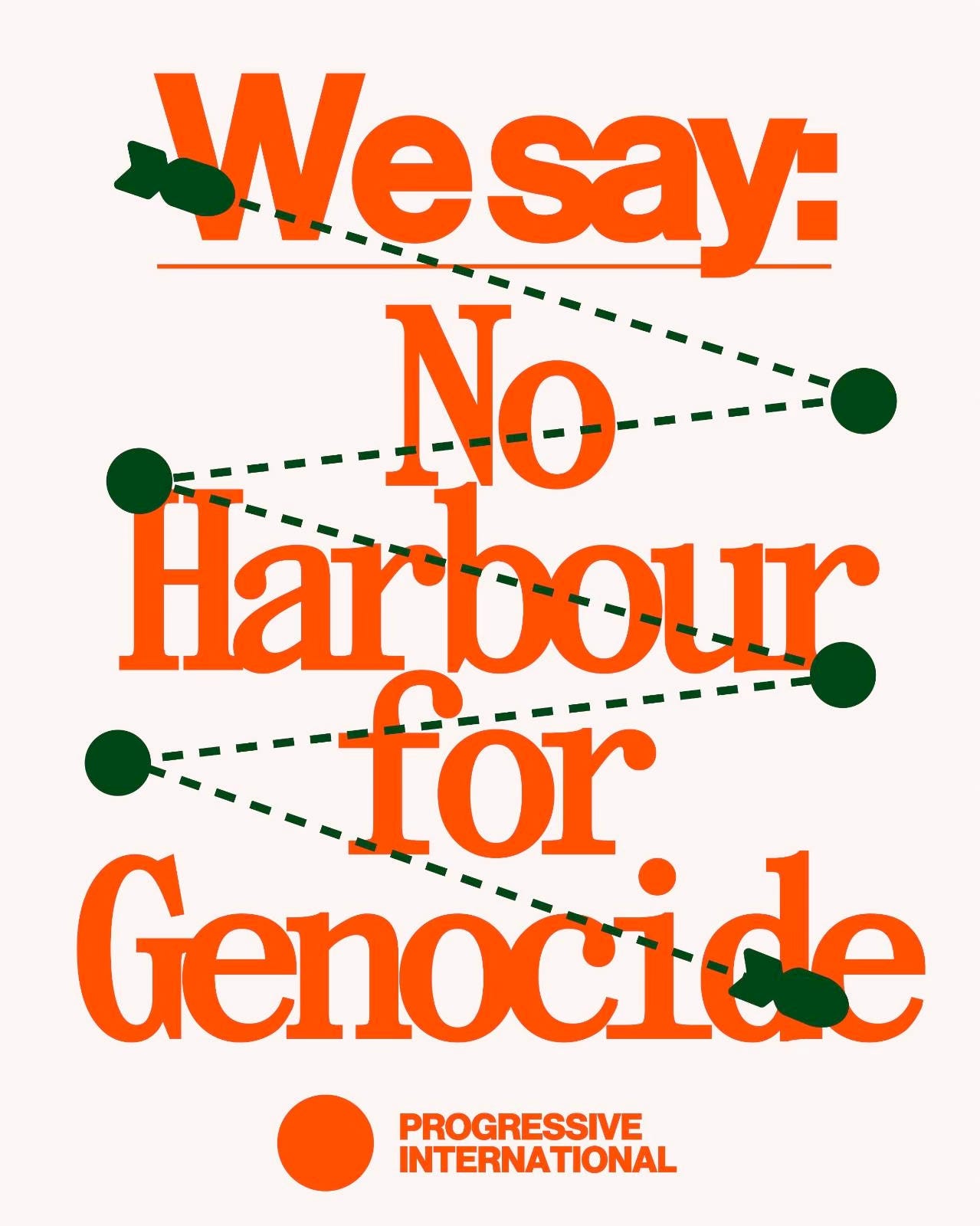
Around the time I started thinking about the shadow fleet question (late summer/early fall 2024), Palestine organizers from Houston to Piraeus were tracking oil and arms shipments fueling the genocide in Gaza under the No Harbour for Genocide campaign, which started with a mobilization against the US tanker Overseas Santorini, a vessel carrying military jet fuel from the US to Israel that went ‘dark’ on July 31st 2024 to avoid being detected between Algeciras and Ashkelon, where it was expected do arrive 7 days later. These shipments were of course unsanctioned, but as far as licitness and legality are concerned, these were shipments that were directly and materially enabling a genocide, and any assistance in facilitating the shipments would be in contravention of states’ international legal obligations to prevent genocide and not to provide assistance to international crimes.
With the exception of a recent Middle East Eye article reporting on new research from No Harbour for Genocide - which actually does show 57 cases of covert oil shipments to Israel disabling transponders and listing false locations between May 2024 and December 2025 - terms like ‘dark’ and ‘shadow’ are never invoked to describe the vessels that have continuously supplied Israel with military and other equipment for carrying out its genocidal war, which highlights the geopolitical faultlines that circumscribe the use of this term. Perhaps the most obvious explanation for that is, as the Atlantic Council so astutely notes, that these shipments have been able to continue in plain sight with little legal or material contestation besides activists’ efforts.
4. From sanctions to seizures?
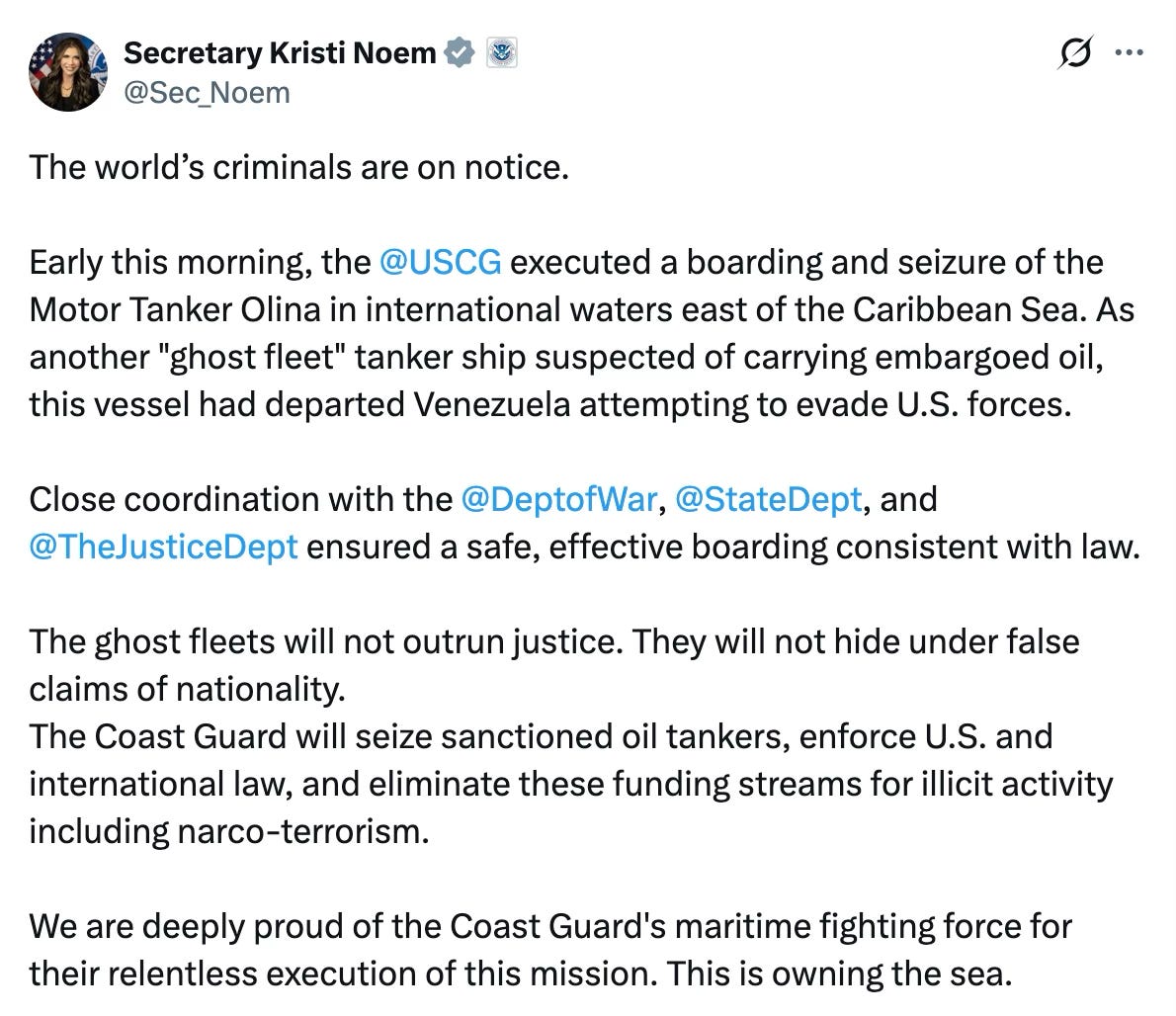
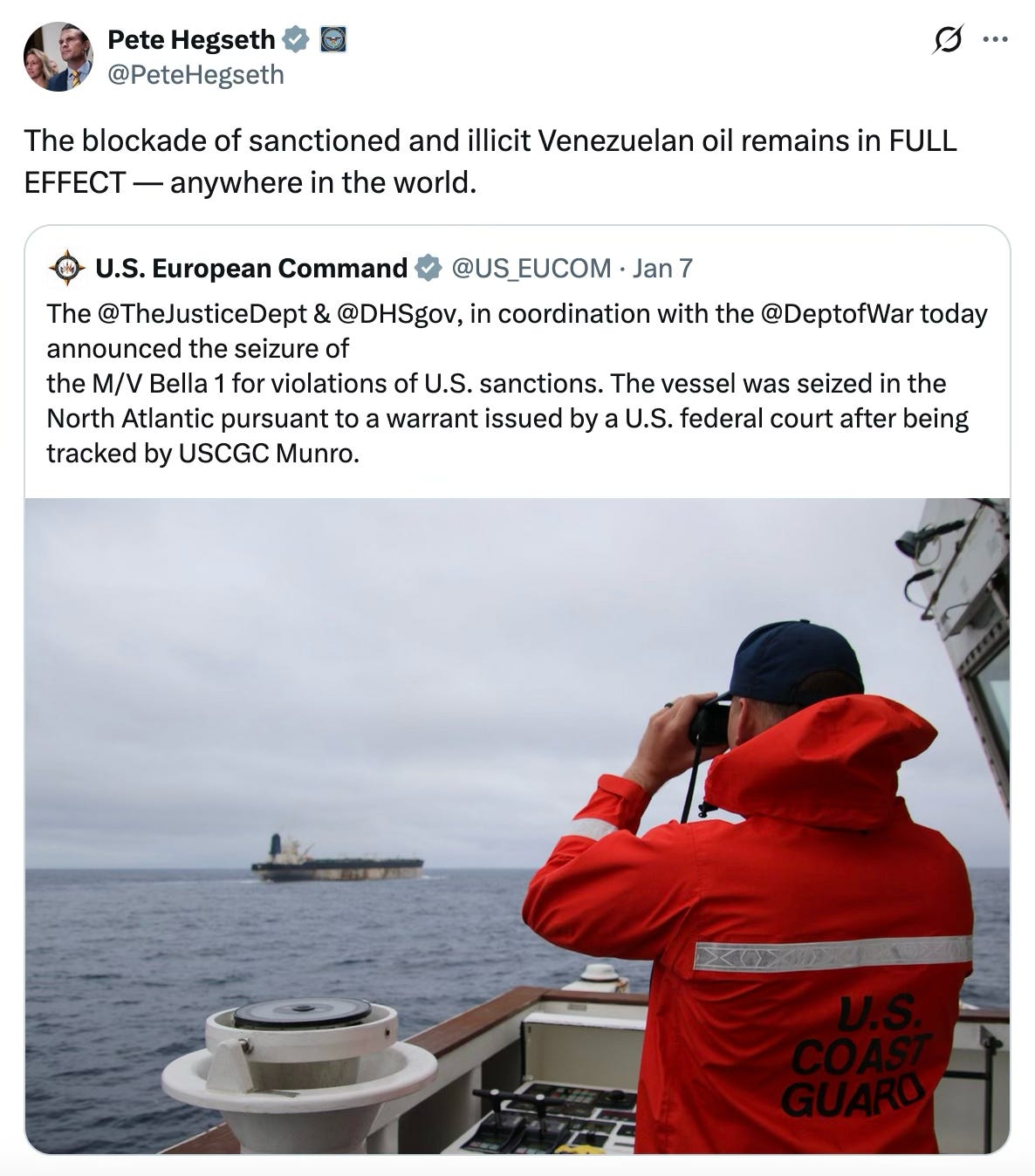
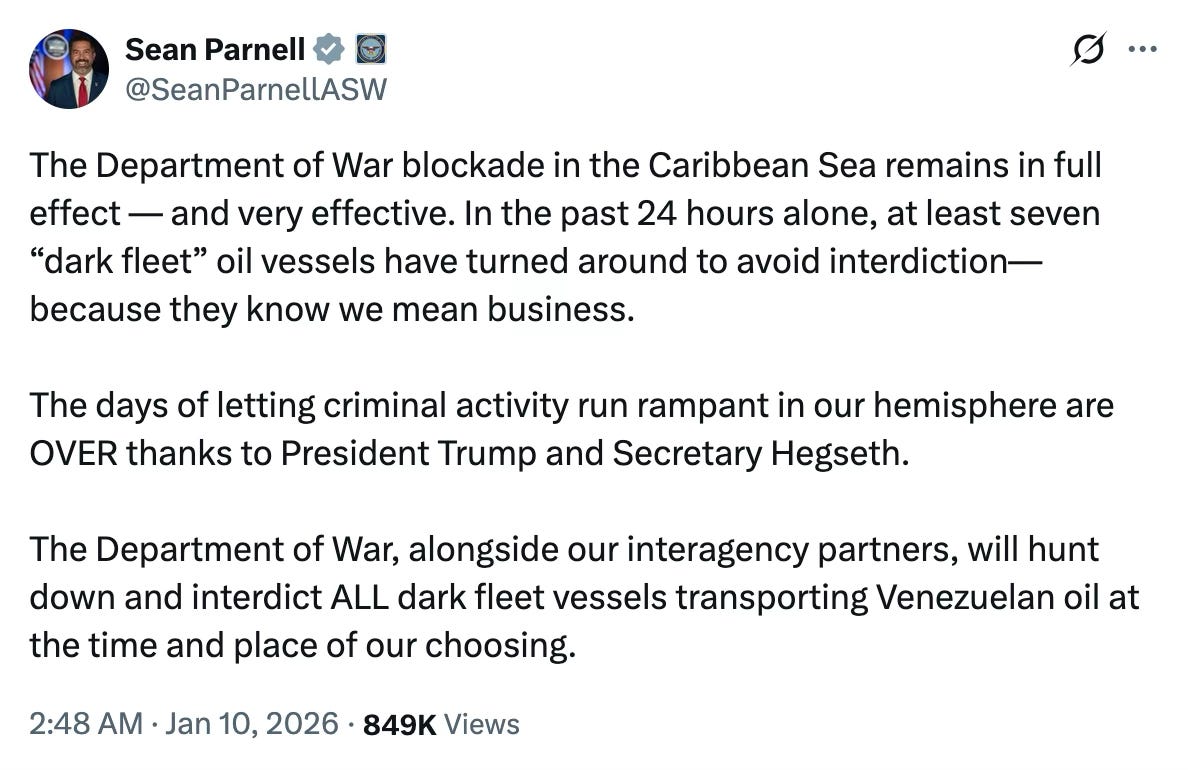
The final thing I want to consider is that years of media narratives playing fast and loose with terms like ‘dark’ and ‘shadow’ fleet - with little critical or detailed regard for where they sit between legality and extraterritorial projections of imperial power - has made it much easier for the Trump administration to slot themselves right into this discourse as they ramp up their ‘sanctions enforcement’ by seizing vessels and cargo. In late 2025, when the Trump administration began seizing vessels, even Lloyd’s and the Atlantic Council cautiously expressed concern about the lacking legal basis of such actions. “Sanctions alone”, Stephanie Connor writes, “do not authorize the seizure or confiscation of property”, and while under UNCLOS (United Nations Convention on Law of the Sea) Article 110(1)(d), a warship or government vessel can board a vessel suspected of being stateless on the high seas, after which they can then apply their own jurisdiction, the US is famously not a signatory to UNCLOS. On X, Pete Hegseth extended the reach of the ‘blockade’ of sanctioned ‘illicit’ Venezuelan oil to “anywhere in the world”, while Kristi Noem celebrated the US seizure of a “ghost fleet” tanker as akin to “owning the sea”. Sean Parnell, a state official at the Department of War, tweeted that the Department of War “will hunt down and interdict ALL dark fleet vessels transporting Venezuelan oil at the time and place of our choosing”. Trump himself seemed most excited by the prospect that the US would get to keep the oil in the seized tankers.
On March 12th, the US filed an order to permit the immediate sale of the vessel Skipper which it seized off the coast of Venezuela in December 2025, alongside the oil it was carrying. Maritime Executive reports that since the seizure, the US has spent $47 million on repair, maintenance, and storage costs associated with the vessel and its cargo, and while the vessel is worth about one fifth of that, the oil cargo is valued at around $120 million. The US expects this could rise by a further $5 million over the next two months, in addition to oil storage costs which are $450,000 per month. The longer they hold the vessel then, the smaller the profit margin from the seizure, though the exploding oil prices following the closure of the Strait of Hormuz might alter the speculative calculus at work here. The label of piracy to name this situation has been rejected by international law scholars as inadequate because pirates are private actors and the US is a state actor. But, if the Trump regime is best understood precisely as a fusion of the two, where Trump seeks to turn the presidency, as Melinda Cooper has argued, into a “founder-controlled family firm”, where any and all available arms of the state can be instrumentalised and weaponised for private gain, then whatever public-private binary sustains the definition of piracy in international law quickly begins to collapse.
The FT has argued that re-flagging vessels to Russia constitutes a form of legal protection for the ‘shadow’ fleet as this prevents them from being boarded on grounds of statelessness. However, an even more recent piece from Lloyd’s List argues that the Russia flag switch is “losing appeal” for shadow fleet operators because the assumption is now that the US will just seize Russian-flagged ships if they want anyway (which is basically what is being spelled out in the tweets above). Charlie Brown from UANI, who is consulted once again in this Lloyd’s List article, says the following: “In the immediate aftermath of the Venezuela enforcement surge, moving into the Russian registry was likely seen as a way to complicate interdiction decisions and raise the political cost of action. But the US seizure of the Russian-flagged Marinera decisively broke that assumption, demonstrating that the US was prepared to act even after a vessel claimed to have adopted Russian registration.” Nowhere in this article is the legality of such a seizure examined, nor are euphemisms like “enforcement surge” or the US being “prepared to act” called into question as likely transgressions of international maritime law.
Journalists may very well believe that in highlighting the ‘dark’/‘shadow’ fleet they are bringing attention to ‘lawlessness’ at sea, but as I’ve tried to show here, simply adopting or regurgitating these terms without bothering to develop a proper account of the geopolitical and ideological assumptions they entail will leave even the most earnest believer in international law extremely ill-equipped for what is to come.
No posts
Comments
Nothing yet. Say the first thing.
Sign in to join the conversation.