
ENGINEERING

Small reasoning models have a nasty habit: on hard math and coding prompts, they emit a span, then repeat it over and over until the context window runs out. We call it the doom loop, and the usual fixes (repetition penalties, RL) are either band-aids or expensive. Antidoom is our open-source method that removes it at the source.
Surgical, not scorched-earth: the loop almost always starts on a single overtrained token (”Wait,” “So,” “Alternatively”). Antidoom retrains just that token and leaves the rest of the distribution intact.
Powered by FTPO (Final Token Preference Optimization): trains only the trailing token mid-generation, spreads probability across multiple coherent alternatives, and uses a KL-like loss in logit space to avoid disturbing the rest of the vocabulary.
The results speak for themselves:
Early LFM2.5-2.6B checkpoint: doom-loop rate fell from 10.2% → 1.4%
Qwen3.5-4B: fell from 22.9% → 1% under greedy sampling
Eval scores rose across the board in both cases — entirely from eliminating loops, not teaching the model anything new.
Fast and cheap: the whole pipeline runs in a few hours (about two hours to generate the training set on 8 H100s, one to two hours to train on a single H100).
If your small reasoning models loop on hard prompts, Antidoom recovers the accuracy those loops were costing you. Generation, detection, and the FTPO trainer are all open source.
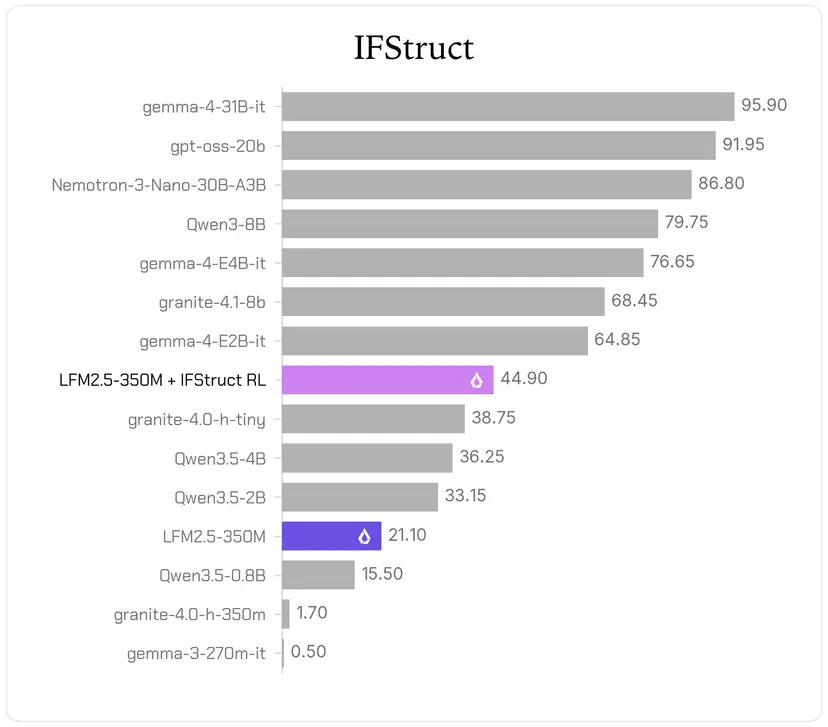
Constrained generation can guarantee valid JSON, and still hand you the wrong JSON. As our CTO Mathias Lechner puts it: no more “syntactically correct garbage.” A model can nail the syntax and still get a type wrong, invent a field, or pick an enum value that doesn’t exist. IFStruct is our new open-source benchmark for the thing that actually matters: output that satisfies the schema.
Tests requests the way real users write them: chat requests, bullet lists with explicit paths, raw JSON Schema, annotated JSON/YAML, and ASCII tables. Half are rewritten into natural prose.
Binary scoring: every field, type, enum, bound, and count has to be right, with no invented keys. Frontier models score near 100%.
The task is highly learnable: its generative design makes training data easy to produce, and the same yes/no check that scores the benchmark can serve as the RL reward signal.
Which is why a 350M model beats models 10x its size: LFM2.5-350M jumps from 21.10% → 44.90% after training, ahead of Qwen3.5-4B (36.25%) and granite-4.0-h-tiny (38.75%).
COMPANY NEWS
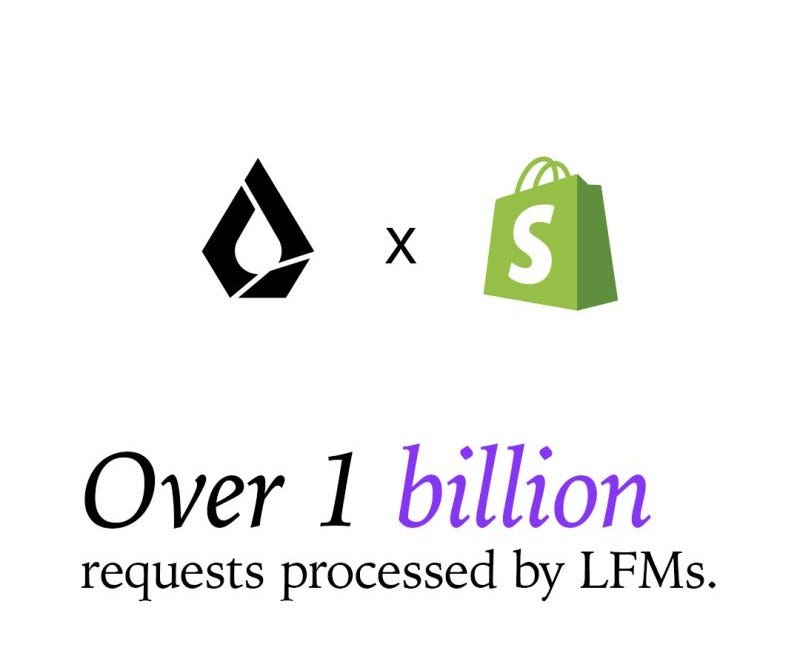
Liquid AI powers Shopify's search and recommendations with sub-20ms foundation models, now surpassing 1 billion requests processed after just six months!
WHAT IF
Liquid builds foundation models over amino acid tokens, enabling promptable protein design from sequence alone. In this discussion, CTO Mathias Lechner and ML scientist Kaeli Kaymak-Loveless dig into:
Designing proteins from sequence alone
Engineering an efficient plastic-degrading enzyme
How the same LFM could point toward new cancer therapeutics
Join our mailing list to get the latest on model releases, research, and deployments from Liquid AI.
Liquid Foundation Models are free to use for hobbyists and organizations with less than $10m in ARR. If you work in enterprise and have a use case for LFMs, feel free to contact us.
No posts
Comments
Nothing yet. Say the first thing.
Sign in to join the conversation.