
ENGINEERING
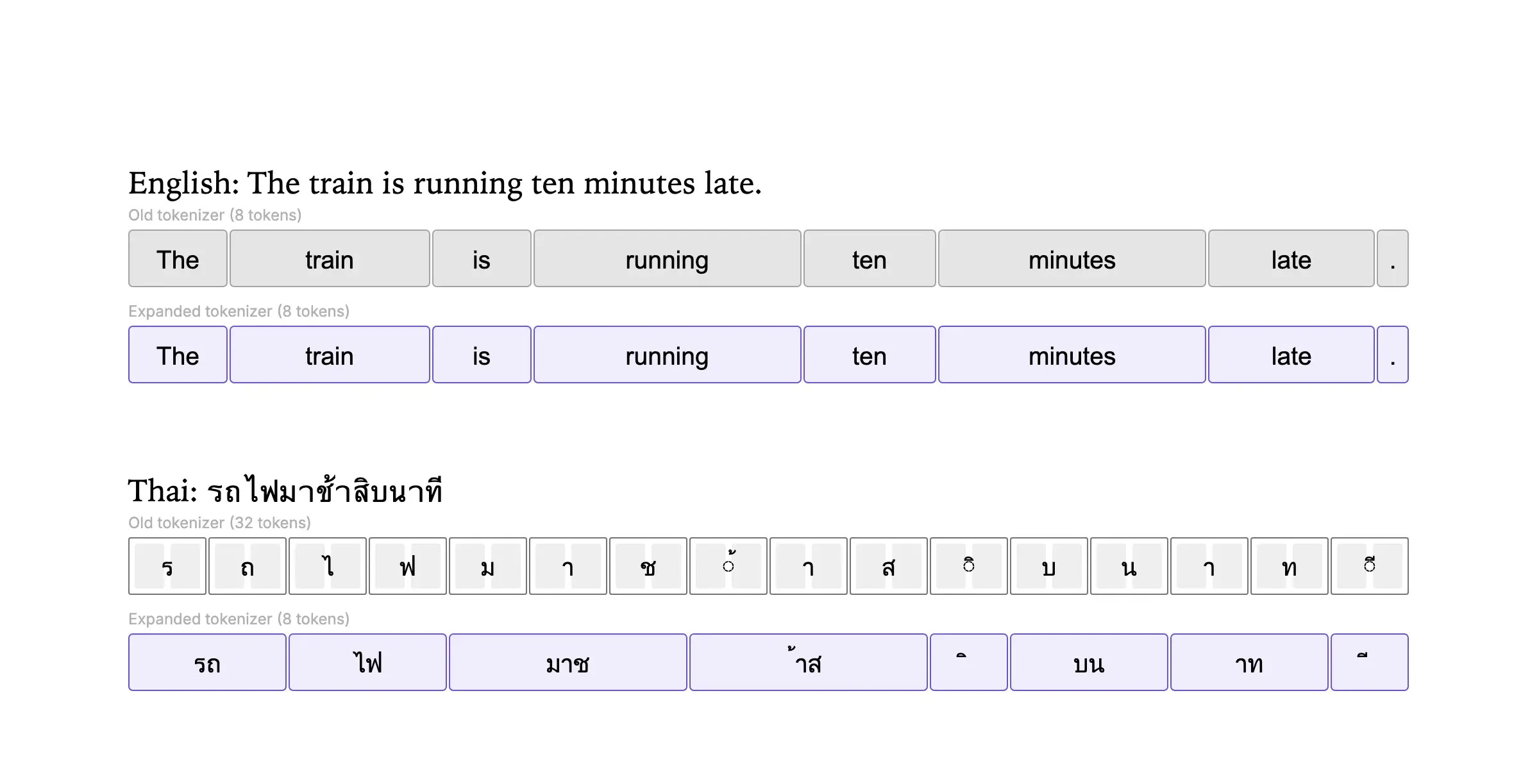
On-device, decoding is memory-bandwidth limited, and the LM-head reads the entire vocabulary at every step. Cloud models absorb a large vocabulary easily - the embedding and output matrices are a small fraction of their parameters - but edge models can’t, so they ship compact vocabularies and live with fragmentation outside their priority languages. LFM2’s original 65K tokenizer left almost no budget for Hindi, Vietnamese, or Thai. Here’s how we doubled it to 128K on a checkpoint we’d already trained:
Extend, don’t replace: we froze the original BPE merges and built new tokens on top, so most of the original 65K carried over unchanged and every new token decomposes exactly into old ones.
Initialization comes for free: new embeddings start as the mean of their sub-tokens. Nothing random, no cross-tokenizer alignment problem to solve.
Two-stage adaptation, because training everything at once degraded what already worked:
Stage 1: new embeddings alone, 600B tokens
Stage 2: the full model, 400B tokens
The results:
Thai needs 4.0× fewer tokens, Vietnamese 2.6×, Hindi 2.4×
That’s roughly 2.2–3.7× faster decoding on-device for these languages
Quality on previously-supported languages holds steady, so there’s no tradeoff
If you own your tokenizer and can continue its original merges, this recovers the latency that fragmentation was costing your under-served languages without throwing away the pre-training you already paid for. LFM2.5-8B-A1B and the expanded tokenizer are both live on Hugging Face with open weights, and the full method, benchmarks.
COMPANY NEWS
Liquid Foundation Models (LFMs) have officially crossed 40 million downloads from the community - a milestone we couldn’t have hit without you.
As proud contributors to open source and firm believers in open-weight AI and American AI leadership, we’re just getting started. The next generation of lightweight, powerful LFMs is coming, and we’re accelerating their open-weight release to the world.
Let’s go. We can’t wait to see what you build.
WHAT IF

ShieldFlow is Liquid’s on-device privacy layer for AI, redacting sensitive data locally before it ever reaches a cloud agent. Felipe Benavides traces what it caught during an ordinary vibe coding session:
77 sensitive entities flagged in session traffic: names, usernames, emails, device identifiers
None of it prompted. The source turned out to be forgotten files in a downloads folder
Redacted locally, so the frontier agent never saw any of it
Join our mailing list to get the latest on model releases, research, and deployments from Liquid AI.
Liquid Foundation Models are free to use for hobbyists and organizations with less than $10m in ARR. If you work in enterprise and have a use case for LFMs, feel free to contact us.
No posts
Comments
Nothing yet. Say the first thing.
Sign in to join the conversation.