
By way of introduction, there are many insightful contributions from academics, participants, Leavers, Remainers, pollsters and moi meme writing about the media

Why, sometimes I’ve believed as many as six impossible things before breakfast.” – The White Queen in Allce Through the Looking Glass by Lewis Carroll
Until I read Michael Gove’s defence of Brexit, written to mark the 10th anniversary of the referendum, my instincts were always to give him the benefit of the doubt. Unlike Boris Johnson, he is no charlatan. Nor is he an intellectual lightweight like Nigel Farage. Gove is a serious politician, the best Justice Secretary in memory. His position has been grindingly consistent; the elected UK parliament is sovereign, it answers to the people not to Brussels. The case for leaving the EU on constitutional grounds is therefore unanswerable.
Now, as one of my history professors once observed, sovereignty is not like virginity. There are economic and political constraints on a state’s freedom of action, not just legal. Perhaps sensing this ghost in the machine, Gove attempts to make the case for Brexit based on successive UK governments’ record in office since 2016. The result is a mishmash of evasions, half-truths and self-delusion which makes the White Queen’s words quoted above look tame by comparison.
Fiction: Gove begins with a conceit. He postulates that Sir Keir Starmer is a “born-again Brexiteer”. Thus Labour, liberated from the EU’s common trade policy, has cut tariffs on steel and foodstuffs to ease the cost-of-living crisis. To sugarcoat these achievements, Gove highlights the UK’s trade deals with India and the US, the world’s two largest democracies.
Fact: Nice try, Michael. But the EU has also struck a comprehensive free trade deal with India. It is due to be signed at the end of the year. As for the US, despite then Lord Mandelson’s best efforts as UK ambassador in Washington, there is only a skeleton, sector-specific agreement called the US-UK Economic Prosperity Deal. A free trade deal with the US would invariably require the UK opening its market to US agriculture and pharmaceuticals, never mind the on-going dispute over the Digital Services Tax affecting Big Tech companies like Apple, Google, Meta and X. Oh, and it would also require approval by Congress - no freebie there, either.
Fiction: Gove argues that the UK’s tech sector has established a lead over its continental rivals because it operates outside the EU’s Digital Services act. This has allowed the Labour government to establish an AI Institute for Security (originally named the Institute for Safety under Rishi Sunak). None of this would have been possible under EU membership, he claims.
Fact: Long before Brexit, the UK has been a go-to destination for technology investors (see Google’s shining new headquarters in King’s Cross, Amazon’s presence, and a burgeoning start-up scene around Silicon Roundabout in London). But I see no reason why a British government would have been prevented by EU law from creating its own AI institute. ps There is no EU constitution, as Gove suggests, only an amalgam of EU treaties going back to the 1957 treaty of Rome. To borrow a French phrase: If it quacks like a canard, Michael, it must be a canard.
I am more sympathetic to Gove’s argument that the City of London has thrived despite dire warnings that Brexit would spell terminal decline for the UK’s financial services sector. Despite President Macron’s charm offensive, the American investment banks have not decamped to Paris. Nor to Frankfurt which remains as stodgy as ever. Milan has proved attractive, but mainly to tax avoiding “non doms”. Dublin has pulled in some asset management business: step forward, Somerset Capital Management, co-founded by arch Brexiteer Jacob Rees-Mogg, which said without a hint of embarrassment in 2018 that it needed to move to Ireland to access the single European market.
I won’t rest my case there.
As Gove himself admits, UK immigration policy has been a shambles since Brexit. Despite taking back control of UK borders and shutting down immigration from the EU, especially central and eastern Europe, successive governments, notably Boris Johnson’s, presided over a flood of immigrants from elsewhere. Some 4.2m arrived between 2021-2025, a historic figure. Ukrainians and Hong Kong Chinese refugees but also thousands of boat people and South Asians (with dependents) filling jobs in the social care sector.
Then there is the trade friction which has accompanied the UK’s exit from the single market. Gove mentions the hardships endured by the food sector caused by extra red tape; but he could also point to heavy industry such as the chemicals sector or indeed small and medium sized companies who relied on trading with our nearest neighbours and have now been forced to look to more distant markets overseas. Many have simply given up. As for the winners, these are few and far between, as an excellent FT investigation foundas an excellent FT investigation found
Gove argues that UK growth surpasses the major European economies (though he notes in passing that some of the best performers such as Greece, Ireland, Portugal and Spain suffered the hardest as a result of austerity imposed during the euro sovereign debt crisis 15 years ago). But by universal consent UK growth has been anaemic over the past decade, not just because of the Covid and Ukraine crises but also because of a lamentable productivity record since the global financial crisis which has nothing to do with Brexit or being a member of the EU.
The result has been a loss in economic output of around 6 per cent of GDP, according to a recent analysis by respected economists at Stanford University. The consequent loss of between £40bn to £90bn in tax revenues would have easily plugged the hole in the UK defence budget which provoked the resignation of two senior ministers last week and continues to alarm Britain’s top brass.
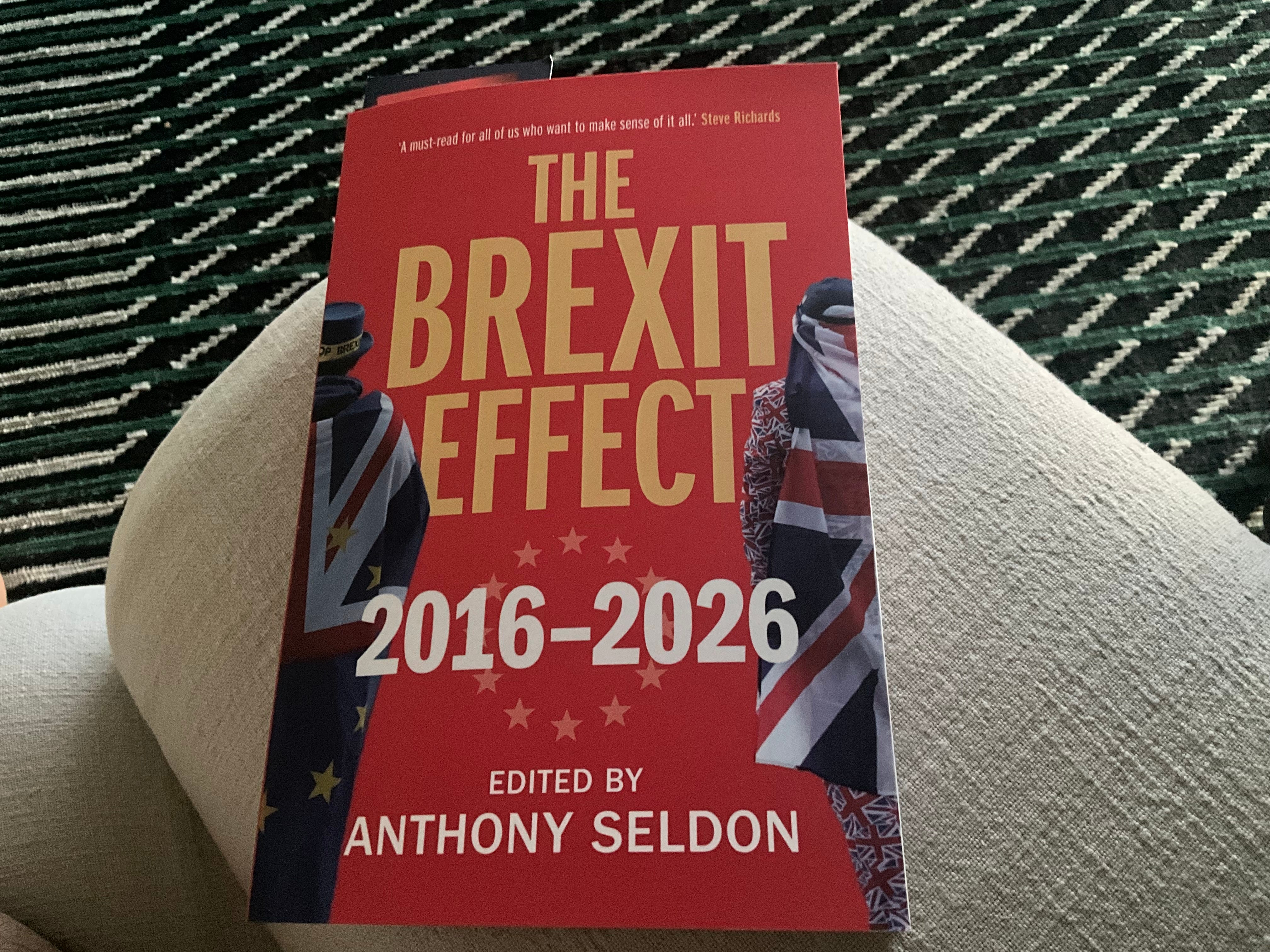
For a better understanding of the “Brexit effect”, I would advise buying a copy of a new book by the same name which will be published next week to coincide with the 10th anniversary of that fateful referendum in June 2016. The anthology contains 36 chapters written by academics, former civil servants and political participants in the Brexit drama. (Health warning: Yours truly has contributed an account of the media’s role based on my own experience at the FT as well as interviews with several current and serving editors).
Several points are worth considering in this fascinating book which is edited by Anthony Seldon, the Whitehall historian and distinguished headmaster.
The Remain campaign was a plodding operation based on practical arguments with no emotional appeal. By contrast, Leave was a guerrilla campaign, brilliantly if cynically led by Dominic Cummings. Kate Fall, who served as deputy chief of staff to David Cameron, is refreshingly honest about the former prime minister’s political mistakes, even if she is supportive of his decision to have a high-risk plebiscite held in the interest of settling the European question once and for all by the British people. “Having won the (2015) election, we misread the mood of the nation or Zeitgeist”, she admits.
The British establishment continue to fall victim to stereotypes of the European Union. It is not a superstate. Federalism is less fact, more aspiration. The EU remains a hybrid: a combination of supranationalism and intergovernmental co-operation which goes back to the 1992 Maastricht treaty. As for sovereignty, look no further than the Gaullist French on national exceptionalism or indeed the Germans who continue to block efforts to create a federal budget with common borrowing.
British governments misread European politics. I remember George Osborne, then chancellor, assuring me over a coffee in Davos that Germany was the key to the renegotiation on Britain’s membership ahead of the EU referendum. Wrong!. Chancellor Merkel blocked Cameron’s (reasonable) request for an emergency brake on EU immigration, judging that it would infringe freedom of movement in the single market. She was myopic, but then again she viewed the Conservative party as equally unreliable. Indeed, she viewed the Tories as “wreckers” after their decision to leave the centre-right European People’s Party (EPP) and sit with the ultra-right nationalists in the European parliament.
Anthony Seldon has done a service by inviting contributions from prominent Leavers such as Douglas Carswell and Professor Robert Tombs. Like Gove, these are principled advocates of a cause, too often denigrated as swivel-eyed loons. On the other hand, some of the other political contributors veer into self-parody, treating the whole Brexit exercise as a student game. For more on this, read Simon Kuper’s book Chums.
There are valuable contributions from the point of the view of the Civil service, written by former cabinet secretary Simon Case and former deputy cabinet secretary Helen MacNamara and Lord Simon McDonald, former head of the Foreign Office. Brexit tested civil service impartiality, but it also challenged Whitehall (and Parliament’s) ability to deliver on the voters’ verdict. Cameron’s insistence that no preparation be done in case of Leave was partly to blame.
Here is Helen McNamara on the events post June 2016 which resemble “an epic poem”, in her phrasing.
“Voters who thought that Westminster was detached, self-serving and disconnected from reality were served up with two years of an impenetrable and bad-tempered row played out within 500 yards of a central London street as both the government and Parliament went through multiple conniptions.”
At one level, the conniptions continue to plague the country. The Labour government led by Sir Keir Starmer has failed to deliver meaningful change. Other European body politics (France, Germany, the Netherlands etc) are struggling too, but Labour has been feeble and timid. So we now face the prospect of yet another change at the top: the seventh prime minister in a decade. By this measure, Italy looks a model of stability.
So where does this leave us?
My old FT colleague Martin Wolf has argued persuasively that the answer does not lie in fast-tracking re-entry into the EU. Gove claims the terms would be Carthaginian. He may well right, assuming - and it is a very large assumption - that the EU even wants us back.
The obvious course is a reset of relations, but above all a focus on our own homework, as the Germans say. Brexit was not the source of our present discontents, nor is it the solution.
It’s down to us.
On that, I agree with Michael Gove.
ends
No posts
Comments
Nothing yet. Say the first thing.
Sign in to join the conversation.