
Wellness cults.
I did not click play on a podcast about wellness cults expecting I’d be able to extrapolate insight from it for founders.
I only started listening to this episode of Armchair Expert for one unrelated-to-cults reason: I knew Ellen Huet.

We met ten years ago at Bloomberg’s San Francisco office. She told me about her beat. I told her about YC-backed startups.
Now, she’s the author behind a new book Empire of Orgasm: Sex, Power, and the Downfall of a Wellness Cult—and she recently went on Armchair Expert to talk about it. Here’s the line of questioning I want to share with you:
Dax: How much responsibility should news and media take for promoting these terrible ideas, [like the wellness cult OneTaste]?
Ellen: As a journalist, I feel a lot of compassion for other journalists who are just trying to find a story, find something interesting to say, do a reasonable job, file it, and move on. There’s so much to write about orgasmic meditation that’s interesting to begin with. What is it? How does it work? Where did it come from? Wait, what happens in it again? It took me six or seven months to report that first story about these cult allegations. It takes time and resources. If that’s not available to you as a journalist, you might just write the story that’s like: Here’s this interesting thing.
That line: Here’s this interesting thing.
How does your startup become the interesting thing? (Without creating something that eventually gets the FBI involved.)
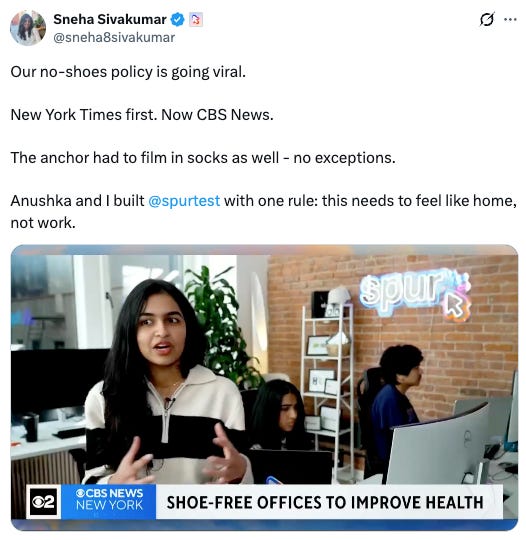
Why does the startup Spur get covered by CBS News for a no-shoes policy?
Why does one hacker house land in The New York Times and not another?
These stories answer a deeper question: What are we learning about ourselves right now?
When OneTaste was first widely covered in 2010, we were entering into the fourth wave of feminism. A startup framed around women’s sexual empowerment reflected something larger unfolding culturally.
Spur was covered this week amid mass layoffs, hiring freezes, and rapid advances in AI leading workers to feel burned out and anxious about job security. A startup promising “feeling at home” reads as countercultural in this moment.
And FoundHer House and all the startups featured alongside it in The New York Times? That’s what I’m going to break down for you.
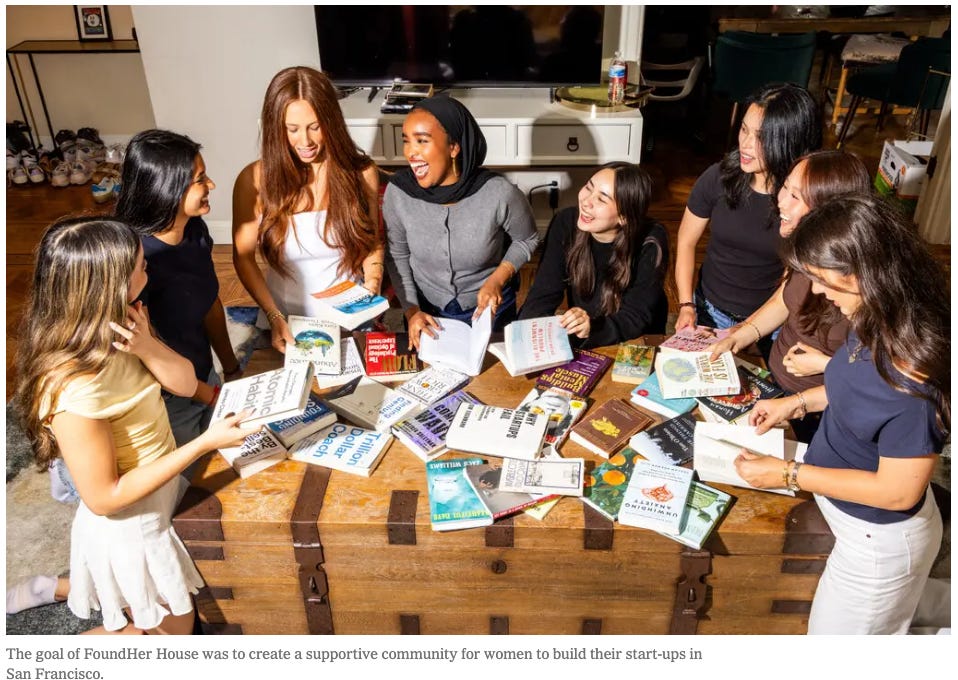
The FoundHer House is a supportive community in San Francisco for eight women building startups. And while a women-only hacker house is still rare, it’s not, on its own, shocking enough to warrant coverage in The New York Times.
What does make it coverage-worthy is what the house reflects about Silicon Valley right now.
1. Doom loop to boom loop.
I lived in the Bay Area for most of the pandemic. My last day in Y Combinator’s San Francisco office was March 11, 2020. It wasn’t until March 15, 2023 that I would reunite with my coworkers back in the city.
This experience was not atypical for tech workers, and San Francisco suffered for it. There were high office vacancies, crimes, and shrinking tax bases.
The doom loop.
Then, slowly, we saw signs of reinvigoration with the AI boom and return-to-office mandates. (Hayes Valley was even deemed Cerebral Valley, and investors everywhere began comparing generative AI to the invention of the iPhone.)
The boom loop.
The FoundHer House is another anecdote in this shift—a signal that San Francisco is once again attracting young builders. As The New York Times put it:
As Silicon Valley has been gripped by a frenzy over artificial intelligence, attracting technologists and young people who want to work on this new wave, emerging A.I. start-ups and hacker houses have been dominated by men, according to investors and funding data.
That last clause—“dominated by men”—leads directly to the second cultural shift this story surfaces.
2. The anti-DEI political climate.
I’m going to oversimplify this, but the signal is undeniable, even without the full political context.
But three signals are hard to ignore.
Tech companies like Meta, Google, and Amazon have reduced DEI programs and rolled back previous representation goals.
Prominent figures in tech and business appear in the Epstein files.
And videos are going viral that center on using technology to deceive women.
Against this backdrop, the FoundHer House reads as countercultural. Again, from The New York Times:
Of 3,212 venture capital deals with A.I. start-ups this year through mid-August, fewer than 20 percent were with companies that had at least one female founder, according to data from PitchBook, which tracks the industry.
So what are we learning about ourselves—or about Silicon Valley—right now?
San Francisco is back as an innovation hub, and women are still not equally represented within it.
That’s New York Times worthy. Here are the additional details that helped the story land:
News hooks: The first all-women hacker house—designed to help women build successful startups—and the first demo day for an all-women hacker house. “Firsts” are newsworthy milestones.
Founder background: All eight founders were between the ages of 18 and 21. This reflects a larger trend: founders getting younger, and more are dropping out of college to pursue startups.
Partnerships: Name recognition matters, and FoundHer House had institutional validation. The article notes that “FoundHer House became a hot spot for dinners and panel discussions sponsored by venture capital firms such as Andreessen Horowitz and Bain Capital Ventures. Recently, the venture firm Kleiner Perkins sent a hibachi chef to cook dinner on the back patio.”
Investors: The piece includes exact dollar amounts and names: Expenses were defrayed with a $500 donation from Precursor Ventures, $1,000 from angel investor Alice Leung, and $10,000 from Brad Feld of Foundry Group and Techstars.
Access: The reporter, Natallie Rocha, had access. She went to the hacker house and listened in on a brainstorm about demo day; she attended demo day, where she could report on the event having standing-room only; she interviewed the hacker house residents, as well as investors who attended demo day. Natallie could immerse herself in the story and bring valuable color to the reader.
To really understand Silicon Valley, you have to immerse yourself in Silicon Valley.
You have to attend the tech parties. Meet the founders. Argue your way into underground robot fights.
Natallie Rocha, a new tech reporter for The New York Times covering startups, VC, and the AI innovation scene, immerses herself in Silicon Valley.
And she did, in fact, find her way into an underground robot fight.

I first met Natallie when she reached out about an event on founder-led marketing I hosted, the To Do List Summit. She had recently moved from San Diego, and was looking for ways to connect with founders in the community.
She attended—all day—and was one of the last people to leave. Every time I’d glance over, she was talking to a new founder.
The reporters who immerse themselves not just in tech companies, but in tech culture, are the reporters I want to work with. They don’t just report the news—they understand its impact at a deeper level.
I imagine Natallie met Anantika Mannby and Miki Safronov-Yamamoto, the founders of FoundHer House, at a tech event. All three clearly know how to network.
Natallie fought her way into robot fight club.
Anantika and Miki, meanwhile, built enough momentum around their hacker house to attract a stack of applications—and eventually the attention of top venture firms willing to support the community.
Conferences and parties can often feel like distractions. But stories like this are a reminder that genuine, in-person connections still matter. Sometimes, the story really does start at a party.
Here’s what a pitch to Natallie might have looked like:
Hi Natallie,
Great meeting you last night. I wanted to follow up on a potential story idea we discussed.
Amid the AI boom, the return of young builders to the city, and a broader pullback from DEI across tech, FoundHer House the first women-only hacker house, is reflective of what Silicon Valley looks like right now.
A few details that might make this worth a closer look:
This is the first all-women hacker house we know of, and we’re hosting our first demo day next month.
All eight founders are between 18 and 21—part of a growing trend of younger founders opting out of traditional paths like college.
The house has become a gathering spot for the ecosystem, with dinners and panels sponsored by firms like a16z, Bain Capital Ventures, and Kleiner Perkins.
We’d love to invite you over—both to see the house and to sit in on a brainstorm ahead of demo day, and of course to attend demo day.
We think the story isn’t just about us, but about what this next phase of Silicon Valley looks like.
So what’s next? What are we learning about ourselves right now?
What does your startup reveal about the moment we’re in?
The next wave of “interesting” startup stories will likely reflect the unresolved tensions shaping Silicon Valley in this moment.
Silicon Valley didn’t suddenly become conservative; it stopped needing its workers.1
At the same time, there’s a growing urgency around preserving democratic values and rights in the U.S.—and a widening gap between how much influence tech leaders have and how rarely they choose to use it.2
That tension is already surfacing. Hundreds of tech workers are urging their CEOs to publicly condemn ICE and push back against federal enforcement.3
The next New York Times story about startups may say less about the products being built—and more about how Silicon Valley is negotiating power, responsibility, and influence.
No posts
Comments
Nothing yet. Say the first thing.
Sign in to join the conversation.