
The dating world scares me these days, and I’m not even part of it.
From the outside, it seems utterly exhausting and a mind fuck of trying to decipher whether someone’s intentions are genuine.
I worked with someone who shared with me that they were in the middle of a personal challenge: they were going on 100 dates in 100 days. They showed me their spreadsheet tracking details of every date and their personal rating of those dates.
I wasn’t left feeling like they were desperately trying to find love. I was left feeling like they were conducting an experiment.
And it’s anecdotes like this, and many more shared by friends, that make me unsurprised that 78% of Gen Z reports dating app burnout.1
I actually meet with Gen Zers—startup founders, specifically—on a weekly basis. Not to discuss challenges in their love lives but challenges communicating about their startup.
So, it’s through this post, dearest gentle founder2 and the generation I speak most often to, that I hope to help you in two ways:
(If you’re single): Find love, as a high achiever, without turning it into an experiment.
(And whether you’re single or not): Avoid common mistakes made by founders to ensure your story lands in outlets like The Wall Street Journal.
Date Drop is a new matchmaking platform only available to students at ten colleges, including Stanford, Princeton, MIT, and Penn. The company was founded by Henry Weng and his algorithmic approach to matchmaking has captivated campuses with its hyper-optimized solution to love.
The startup, which raised $2.1 million in funding, was covered by The Wall Street Journal days before Valentine’s Day.
On the surface, this is a story about the modern-day version of the romantic compatibility paper quizzes that were all the rage back in the 1990s and early 2000s.
The tests were often administered through schools and asked a flurry of questions about your interests and personality. The results would reveal who was most and least compatible with you.
Stories like this—ones that capture how history repeats itself—do well with readers. They create nostalgia for older generations and capture cultural relevance for the current one.
But dig deeper, and it’s a story about history repeating itself in more ways than one.
Facebook started at Harvard, then expanded school by school. First to the Ivy Leagues, then elite universities more broadly, before eventually opening to everyone.
When a startup’s story resembles one that has already defined a generation, our brains pattern-match. We subconsciously place it on the same trajectory, expecting it to be the next generational company.
Reporters and creators: they want to be early to cover the next generational company, and they want to write about interesting, culturally relevant things.
That’s how you turn a product launch into a story.
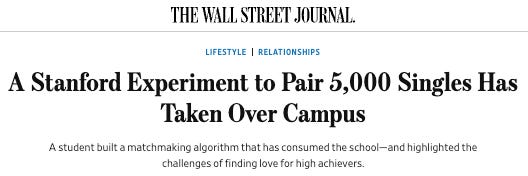
To a reporter, a pitch about your new product often feels like you’re asking them to write an ad.
Product launches matter to your customers, not the readers of The Wall Street Journal. (Although, if you’re pitching a trade publication, you might find a reporter is interested in your product launch.)
I’ve sat in office hours with founders who tell me they pitched 40 beat reporters on their upcoming product launch and vision to overtake powerful incumbents. They had a few reporters reply, asking to see the announcement blog post—but in the end, their efforts resulted in zero coverage.
Here’s why. Founders, you need to:
Pitch an exclusive
Tie your story to something trending or cultural relevant
Back your vision with facts: data, access to customers, virality
Find the exact reporter whose coverage is a fit for your story
Bonus: Your story resembles one that has already defined a generation
Now to map this back to Date Drop’s story in The Wall Street Journal.
On February 10, Date Drop’s story was captured in one publication.
(Since then, they’ve landed coverage in Business Insider and TechCrunch.)
I highly suspect they offered the reporter, Jasmine Li, the exclusive on their launch, including exclusive access to data on the adoption of the product, interviews with the founder and users, and their funding.
When you offer a reporter an exclusive, you’re promising your news to them, only. You can not reach out to other reporters with your news until after the reporter with the exclusive publishes.
Exclusives increase your chances of a reporter agreeing to write about your news, as you’re giving them time to interview people involved in the story, research the industry, go on-site, and try the product—and ultimately, write the most compelling story for their readers.
Exclusives also mean they don’t have to compete for readership with other publications. This is attractive to reporters who want to find the next interesting thing and be the first to write about it.
Exclusives also make it easier for a reporter to get a ‘yes’ from their editor, who might need to sign off on coverage.
On the surface this is a story about a dating app going viral. But the reporter said yes to covering it—a startup, as a reminder, that just raised $2.1 million—because it sits at the intersection of several cultural tensions:
The lingering effects of the pandemic. The pandemic was defined by social disconnection, and 65% of Gen Z compared to just 22% of Boomers say that had to relearn social skills after the pandemic restrictions lifted.3
Dating app fatigue among Gen Z. Remember, 78% of Gen Z reports dating app burnout.
The pressure in the U.S. to marry and have babies—more babies, please. Whether explicit or subconscious, this context matters. At a time when public discourse includes calls for more babies and a president referred to himself as the “fertilization president,” the dating lives of Gen Z are culturally relevant.4
The author captures this relevance through quotes.
The growth, fans say, reflects a reality about many college kids: They’re intimidated by real-life courtship and overwhelmed by the endless scroll of dating apps.
“People just struggle with striking conversations in general—let alone romantic interactions.”
Princeton freshman Pierre Du Plessis said Date Drop has been useful on a campus where asking someone out is unusual.
Ideally, your story connects to at least one—but ideally multiple—cultural tensions or macro themes.
Reporters don’t say yes to a story based on vision alone. They say yes to facts.
Are you actually relevant? Are you solving a meaningful problem for a defined demographic? Are you introducing something that measurably changes behavior?
Share your vision all you want, but without evidence of traction, it won’t result in coverage of your product launch.
I like Data Drop’s vision: The quality of your relationships is the single best predictor of the quality of your life. College, they argue, is your best shot at finding them.
But note that vision doesn’t show up in the story. Facts do, and here’s what they shared with the reporter:
More than 5,000 Stanford students have used Date Drop at a school with about 7,500 undergraduates.
Date Drop raised $2.1 million in venture-capital funding.
One match was paired with a 99.7% compatibility score.
Multiple users were interviewed, with six quotes included in the final story.
Interestingly, the reporter, Jasmine Li, primarily covers politics. Recent headlines include “University of Minnesota Students Protest Federal Agents in Minneapolis” and “Texas Gov. Greg Abbott: White House Should ‘Recalibrate’ Immigration Enforcement Strategy.”
But she excels at identifying cultural and power tensions. Even in her political coverage, her stories often focus on generational shifts, institutional stress, and cultural friction.
The Date Drop piece may feel like an outlier, but it isn’t random. It’s a cultural trend story—lighter in tone, but meaningful—with a strong social signal.
Since Date Drop, she’s also covered “For College Applicants, Pressure to Make Summers Count Has Gotten Even Worse,” suggesting continued interest in institutional strain and the underlying forces shaping young people’s lives.
What does this mean for you?
Don’t pitch product updates, funding announcements, or generic founder backstories.
Do pitch behavioral shifts, generational tension, and cultural anxiety.
Date Drop was created Henry Weng, a computer science student at Stanford who coded the product in about three weeks.
Thefacebook was created by Mark Zuckerberg, a computer science (and psychology) student at Harvard University who coded the product in about two weeks.
Date Drop started at Stanford and has since rolled out to ten other top colleges, including Columbia, Princeton, and MIT.
Thefacebook started at Harvard and rolled out first to Stanford, Columbia, and Yale.
Today, Meta is worth over $1 trillion.
Maybe in 20 years, Date Drop will be worth the same. When a startup mirrors the early narrative of a generational company, a reporter may see not just a launch but the possibility of being early to covering the next one.

As always, I’ll take a stab at what I imagine Henry’s first pitch to Jasmine looked like:
Hi Jasmine,
I’ve been following your coverage, and one consistent thread is your focus on cultural friction and generational tension. I’m reaching out with a story that sits squarely in that lane.
At Stanford, more than 5,000 of 7,500 undergraduates are using Date Drop, a matchmaking algorithm built by a fellow student, to choose their romantic matches—a signal of Gen Z’s dating app burnout and post-pandemic social discomfort.
Layered onto that is broader cultural pressure around relationships and family formation, making the dating lives of Gen Z particularly resonant right now.
Students gather every Tuesday night to see who they’ve been matched with, and the product has begun expanding to Ivy League schools and other top campuses.
We can offer exclusive access to adoption data, interviews with students, and details on the $2.1M raise.
Would you be open to a quick conversation?
If you want coverage in The Wall Street Journal, don’t ask a reporter to write about your launch. Give them a lens into something bigger happening in the world, and let your company be the proof point.
And if you’re looking for more comms education, study Date Drop’s rollout. Before landing national coverage, they showed up in campus publications like The Stanford Daily, Yale Daily News, and The Daily Northwestern. They understand the importance of local press coverage.
https://www.forbes.com/health/dating/dating-app-fatigue/
Please get this reference. But if you don’t, it’s Bridgerton.
https://theharrispoll.com/briefs/covid-19-5-years-later/
https://www.politico.com/news/2025/09/07/trump-the-fertilization-president-has-yet-to-deliver-the-babies-conservatives-want-00547981
No posts
Comments
Nothing yet. Say the first thing.
Sign in to join the conversation.