
By the time alarm bells started ringing among some of the staff at Fisheries and Oceans Canada (DFO) about a satellite tagged leatherback sea turtle named Dina, the beleaguered 1,000- pound reptile had been trying to exit the increasingly frigid Gulf of St. Lawrence—to return to her Caribbean nesting ground—for ten weeks.
The Northwest Atlantic subpopulation of leatherback sea turtles—listed as endangered in 1981, and legally listed under Canada’s Species at Risk Act (SARA) in 2003—is at a critical juncture, with the population disappearing much faster than it can reproduce. For reasons we’ll get into later, Dina was known to be a “valuable nester,” which prompted a sense of urgency in the DFO’s Species at Risk Program (SARP).
Emails obtained through an Access to Information Request (ATIP) by Nova Scotia fisherman, Darren Porter, reveal that on November 27, 2024, Clair Evers, a biologist with SARP, convened a Microsoft Teams meeting to discuss the “possible outcome scenarios” for the turtle, and how the various DFO sectors “would coordinate and mobilize in each.”1
On that day, seven DFO staff, including Mike James, the head of DFO’s sea turtle unit, considered Dina’s predicament and noted that the tracking data gathered from her tag up to that point indicated she had attempted to exit the Gulf at St. Georges Bay nine times, but her passage to the Atlantic Ocean and her route back to the beaches of Trinidad was being blocked by the Canso Causeway.
In order to successfully exit the Gulf, leatherbacks must follow the coast of Cape Breton Island and “round its northern tip,” according to the emails. Dina tried to do this several times. According to the satellite data emitted from her tag, she made multiple attempts northward around Cape Breton—her typical migratory route to the Caribbean—but the ambient ocean temperature, also logged by her tag, showed it was getting progressively colder. For instance, by late November—around the time the Teams meeting was convened—Dina’s tag was regularly logging water temperatures in the range of 3-6°C, and according to the emails, her behaviour “was becoming increasingly frantic.”
In a “summary of events relating to the case of Dina,” written by James in January 2025 at the request of the Maritime SARP, while leatherback sea turtles “have some remarkable adaptations that enable them to maintain elevated body temperatures for extended periods in cold waters,” such as an oily layer of connective tissue under their shell, ”they are nonetheless ‘cold-blooded’ like all reptiles.” Unlike mammals and birds that generate their own heat, Dina’s body temperature would fluctuate with her surroundings.
“As time passed, surface waters cooled faster in the Gulf north of Dina, potentially acting as a thermal deterrent to her exit from the Gulf.”
James writes that the cold waters further north combined with Dina having “a strong instinct to migrate south [which] intensified with each passing day,” led her, repeatedly, towards the southernmost part of the Gulf and the Canso Causeway—a subject we’ll return to later in this series.
But first, Dina.
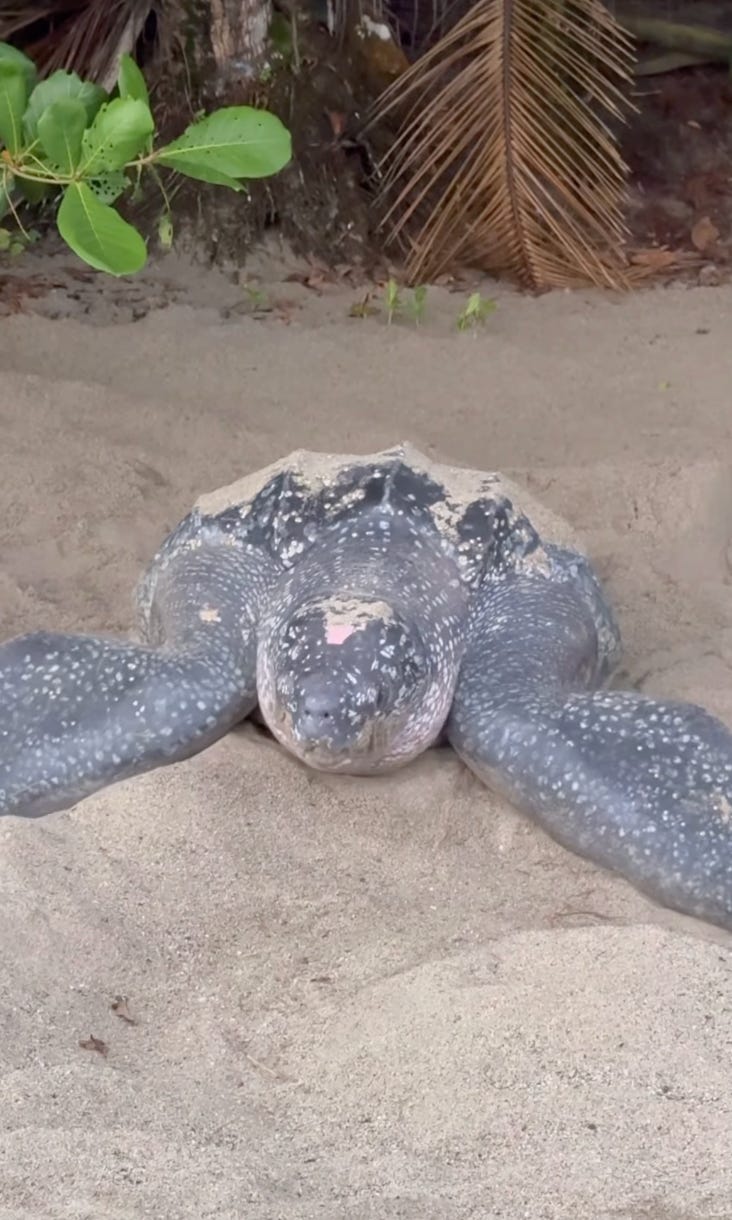
This female leatherback sea turtle is nesting on Grande Riviere beach on Trinidad’s north coast. Dina’s microchip also traced her back to this same beach where she was first recorded nesting in 2010. (Photo: Jared Ranahan/ Instagram)
On August 19, 2024, just a few weeks before Dina was set to begin her fall migration, James and his team at the sea turtle unit captured her while they were conducting field operations near the entrance to the Gulf of St. Lawrence just off Cape Breton Island. Upon examination— according to James’ summary of the events—they discovered she had a Passive Integrated Transponder (PIT)—a small, rice-sized microchip injected under her skin for permanent identification.
Using a specialized scanner, the unique code on the tag traced the turtle back to a “leatherback nesting beach science program in Trinidad, where she was first recorded nesting at Grande Riviere Beach in 2010, a 1.2 km beach on the country’s north coast, considered one of the top nesting sites for leatherbacks between March and August.
According to James’ summary, the nesting beach program, which reports to the government of Trinidad, has been continuously operating at that beach for three decades and “is one of the longest-running programs of its kind in the Northwest Atlantic.” The DFO sea turtle unit has been collaborating with them since 2012.
The ATIP emails also reveal that in terms of the Northwest Atlantic leatherback sub-population, Dina was valuable. For one, she was extraordinarily large. Her curved carapace length (CCL) or body length was just under 5’4” (164.4 cm)—making her one of the largest female leatherbacks ever “sampled” by the sea turtle unit. They also estimated that she was at least 30 years old, based on the fact that she had already been nesting for a minimum of 14 years (when she was initially PIT tagged), and leatherbacks reach maturity at about 15 years of age. Thirty was still relatively young for leatherbacks, known for their long-life spans, sometimes exceeding a century.
In his summary, James noted that “female leatherbacks become increasingly fecund with age.” In other words, Dina likely laid a lot of eggs during nesting season, and given that only 1 in a thousand eggs ever makes it to becoming an adult turtle, size and age take on a lot of importance, especially when the species is on the brink of extinction.
After the sea turtle unit discovered the PIT tag and the turtle’s history, and, while they had her on their specialized platform, they decided to affix a satellite-linked tag to her back, as well as a “very high frequency” (VHF) tag.2 These would allow them to track her movements and behaviour, and, according to James, gain some crucial knowledge about the “highly endangered population.” In particular, they were hoping to locate the species’ critical habitat—a key piece of information for SARA Recovery Plans and Action Plans—another subject we’ll return to.
The sea turtle unit then named her Dina.
On September 12th—just three weeks after Dina was tagged—the satellite-derived location data indicated a “behavioural shift consistent with southward migration, as has been previously observed among other leatherbacks tracked by DFO sea turtle unit.”
All is well, they must have thought.
But Dina’s ancient, hard-wired instinct would soon become her undoing, and instead of recording a glorious southward journey unimpeded through the Atlantic to her familiar dark sand beach, the tags would record her desperate attempt to get out of the Gulf of St. Lawrence.
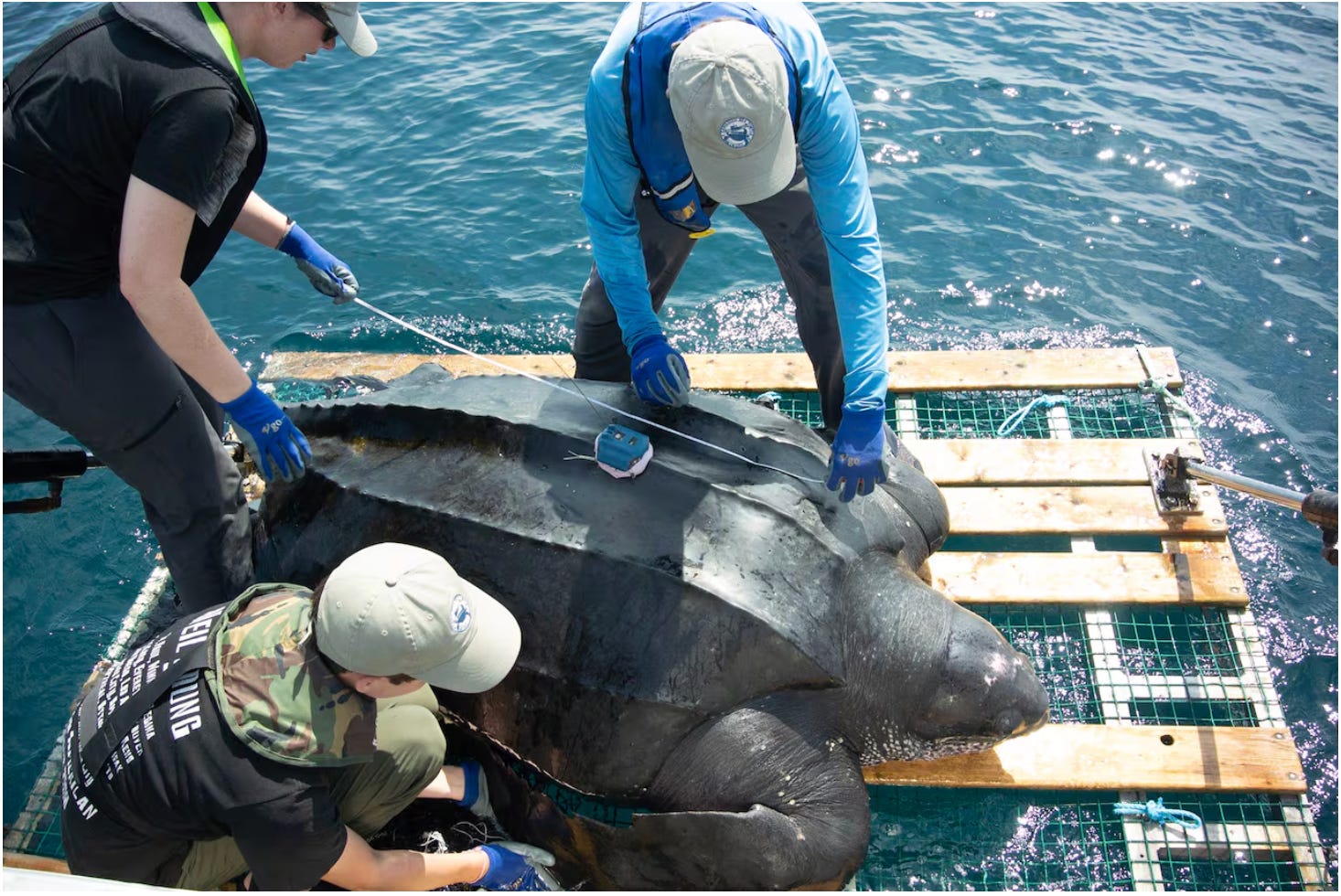
Female leatherback sea turtle named Isabel being satellite tagged off Nova Scotia in July 2019. DFO/Canadian Sea Turtle Network (Source)
A feast of jellyfish is what brings leatherback sea turtles, like Dina, to Canada’s east coast waters to feed in the summer. It’s an important part of the species’ life cycle—but it wasn’t that long ago that scientists thought leatherbacks seen here were just lost or blown off course.
But through the pioneering work of Mike James and (his partner) Kathleen Martin, executive director of the Halifax-based Canadian Sea Turtle Network, it has been definitively established that leatherbacks come here regularly to feed.
In an interview, Martin tells me that James’ graduate work at Acadia University involved going to fishing villages in Nova Scotia and putting up signs asking, “have you seen this turtle,” with a number to call.
“Martin says James’ graduate work was “building on” the earlier work of Tom Herman and Sherman Bleakney, both professors at Acadia University at the time. Herman was James’ thesis supervisor, and had used a similar approach using posters to locate Nova Scotia’s endangered Blanding’s turtle, the subject of much of Herman’s research. Meanwhile, Bleakney was thought to be the first person to suggest that the leatherback sea turtles’ appearance in Canadian waters was part of its annual migration, and that they fed almost exclusively on jellyfish.3
James’ posters led him to the Cape Breton fishing village of Neils Harbour, where he was receiving calls from fishermen who were seeing leatherbacks around their nets and traps. He received 200 sightings in one season, according to a documentary that was made about his research.4 Lion’s mane and moon jellies, abundant in the area, were attracting the turtles to the area. The waters off eastern Cape Breton Island, including Sydney Bight (and Neils Harbour) have been identified as one of the primary areas of important habitat for the species.
“From the beginning it’s always been a community-based project,” says Martin. “It really is such a beautiful story. The fact that commercial fishermen were the ones that helped change our understanding of leatherbacks in Canadian waters, by being asked and being included in the process—the knowledge that they have and their understanding of what goes on in the ocean and their ability to do great record keeping and data collection. That’s an amazing Canadian success story.”
Martin explains that some leatherbacks return to the same beach in Trinidad every nesting season, but others might go a little further down the coast, but still lay their eggs in the same region.
“When they’re doing the genetics work, they find that all the turtles on the beach are related… you’ve got these collections of matrilineal DNA, because you hatch on the beach, and then you come back to that same beach where your sisters are as well, where your mother is.”
I ask Martin about how dire the situation is for the species.
“They’re declining at a rate of almost 8% a year,” she says.
“The greatest threat to the sea turtles everywhere in the world is entanglement and drowning in fishing gear.”
The air-breathing reptiles can hold their breath for roughly 20 minutes, but they can only swim forward, so once they’re caught in a net or fishing line, they’re not able to back themselves out of it. If the gear is heavy, it can hold them underwater and they’ll drown.
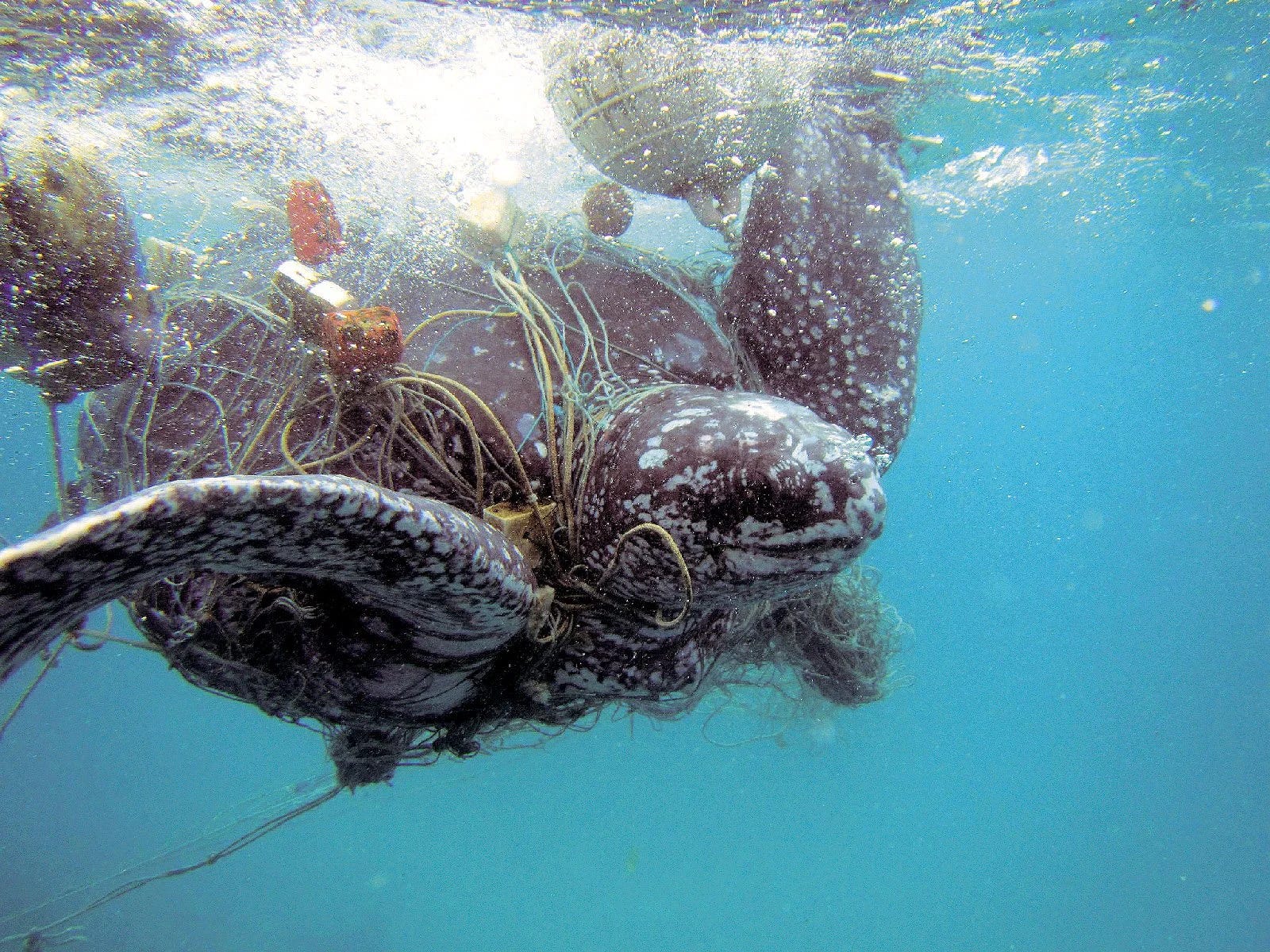
Severely entangled leatherback sea turtle in Grenada. In fisheries lingo this is referred to a “bycatch,” or the unwanted fish and other marine creatures caught during commercial fishing for a different species. Source
A few days before the Microsoft Teams meeting was being convened to look at possible scenarios with Dina, another leatherback sea turtle was found dead on a beach near Pointe-Sapin, New Brunswick, on the Northumberland Strait in the Gulf of St. Lawrence. The DFO Alert went out on November 23rd, and the sea turtle unit asked the local Conservation and Protection (C&P) detachment to retrieve the turtle and take it to the Atlantic Veterinary College for necropsy, but “high winds and high surf” made it “impossible.” It was noted there was no entanglement observed on the animal. When the officers did eventually arrive, they couldn’t locate the turtle and ended the search effort.
When it came time for the Teams meeting, there seemed to be a sense among the attendees that saving Dina presented a formidable challenge, but one definitely worth taking on.
Recall, by this point the tracking showed that Dina had tried to exit the Gulf nine times, each time blocked by the Canso Causeway. The ambient ocean temperature was getting progressively colder and her behaviour “was becoming increasingly frantic.” It was the first time the sea turtle unit had observed a tagged leatherback in the Gulf so late in the season. Dina’s “lowest thermal tolerance” was unknown.
In the ATIP notes, Dina was described as “not dying, just not in a feeding mode.” She was “behaviourally switched,” it says.
The brainstorming session considered three scenarios and how the DFO could respond in each. Dina could strand on a beach alive. She could strand on a beach dead, or the DFO could intervene to get her out of the Gulf “while she is still swimming.”
According to the meeting notes, it would be possible to recover Dina if she strands alive on a beach, but there was a “limited window” of opportunity. Given her size and weight there would need to be trucks, and a covered trailer to keep her warm. Wind chill was a big issue. According to James, leatherbacks often become hypothermic and then strand. It could take several hours or days before they actually die, he says, “even though they can appear to be dead they often have a heartbeat.”
During the meeting someone mentioned “Stewie,” a leatherback that stranded in the summer of 2021 on a sandbar near the mouth of the Stewiacke River. That turtle was airlifted with the help of a helicopter to a waiting truck and trailer, and then returned to the ocean.
But Dina’s rescue seemed to have more moving parts.
To recover Dina from a beach they would likely need a back hoe and a piece of plywood, which would cause the “least amount of trauma to the animal.” Tarps would also be required, to deal with the wind chill issue.
The idea was that she could be lifted into a trailer and if they were anywhere close to the causeway, lift her back into the ocean on the other side. That way there was a chance she would sense the open, and slightly warmer, water and clear passage south. But success would depend, at least in part, on what remained of her energy reserves to swim the distance. While a female leatherback will feed during her migration south—a journey that could be as along as 12,000 km—the bulk of her energy comes from the months of foraging in Canadian waters, dining voraciously on protein-rich jellyfish, as much as 800 pounds a day.
How much of her energy stores had she already used up trying to get out of the Gulf?
No one knew.
But there was also no way of knowing where Dina would strand alive, if she did, and then having to execute the recovery effort quickly would also present a challenge. By my reading of the Teams discussion, those present at the meeting seemed confident the logistics could be worked out. The question was, would they get to her in time, and would the relocation to the Atlantic side of the causeway be enough to ensure her survival?
The other possibility was that Dina would strand dead. In that case, there was a lot less to worry about: It would involve “more dragging,” and be “less time sensitive.”
But there was another scenario—the possibility of intervening “to get [Dina] out of the Gulf while she is still swimming.”
They could tow the turtle in the water behind a boat, deploy a boat to assess her condition, or they could herd the turtle out of the Gulf with boats.
The Teams meeting discussion notes are relatively brief, and from what I can tell, that option didn’t look promising.
There were problems that made the “probability of capture and rescue from water very low,” including that Dina’s surfacing behaviour was “erratic and below what we would expect in summer.” When DFO captured and tagged Dina in August, 2024 the weather was not only much better, but she was actively foraging for jellyfish, and spending much more time near the surface, and therefore visible to the researchers.
But near the end of November, her tracking data showed she was only at the surface 10% of the day, which would make her “difficult to locate even with the satellite tag.”
“We are not publicly advertising this ongoing situation as we don’t want to imply an expectation that we can rescue her,” the notes read.
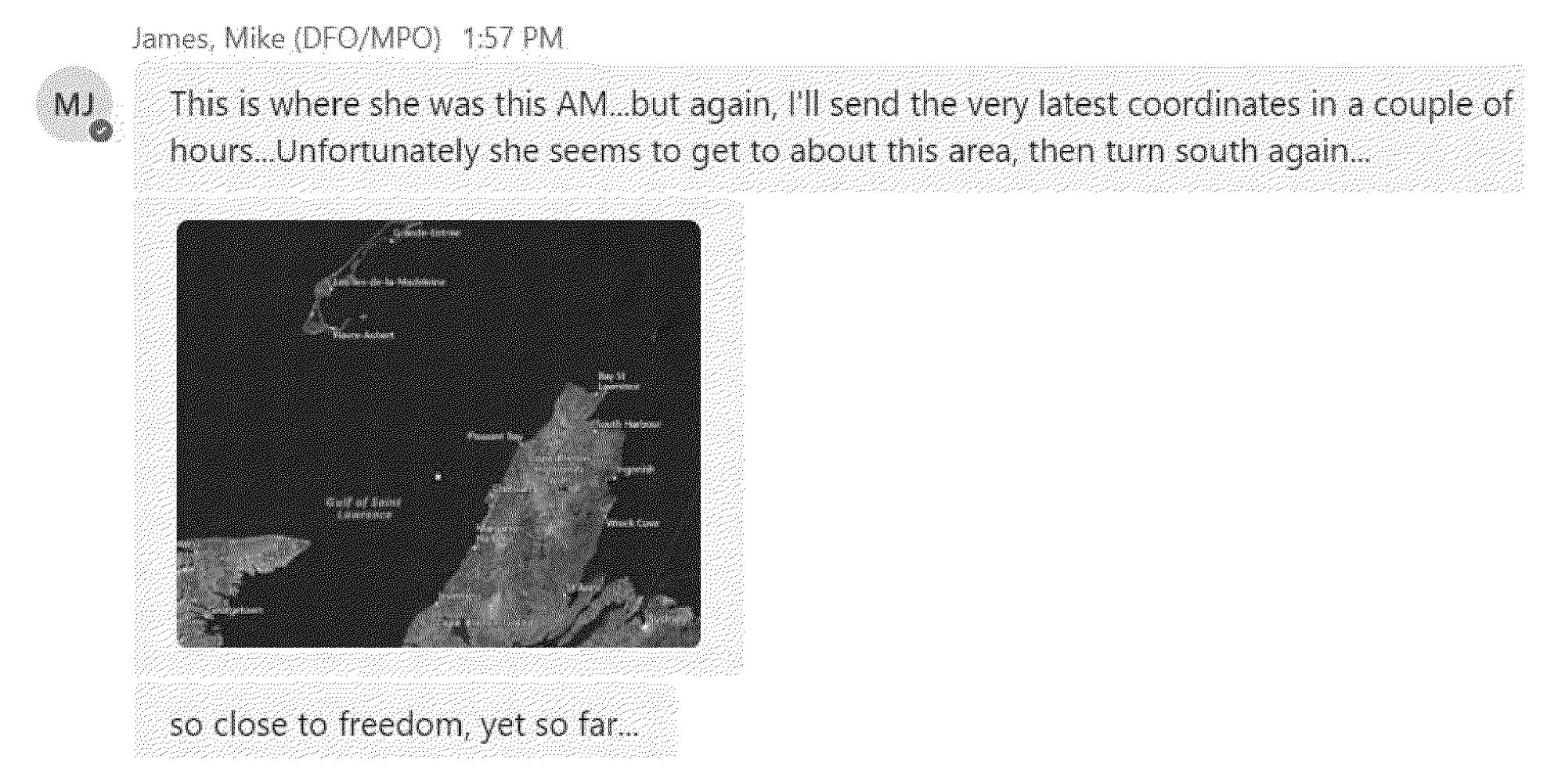
A map pinpointing Dina’s location picked up by her satellite tag. The map, posted by James, was circulated via email to his colleagues on December 2, 2024.
A day after the TEAMS meeting, another update. Dina is “persisting” in the Gulf and she is “actively swimming tens of kilometres each day and is transitioning between Nova Scotia, New Brunswick and PEI waters.”
By November 29th Dina was 20 km north of Tracadie Bay, PEI, and moving west.
On December 2nd, James posted a map pinpointing Dina’s location in the Gulf, just south of Pleasant Bay. He writes, “unfortunately she seems to get to about this area, then turns south again… so close to freedom, yet so far.” The map is circulated to his colleagues via email.
As previously mentioned, while an at-sea intervention seemed practically ruled out at the Teams meeting, it must have garnered more support as Dina’s plight worsened. In his “summary of events relating to the case of Dina,” James seems to suggest that the discussion began with the Teams meeting, and was an “evolving” one, and that at some point it took into consideration the advice of Lara Cusack, a veterinarian and associate professor at the Atlantic Veterinary College at the University of PEI. It’s unclear from the ATIP what Cusack said about Dina’s welfare prior to December 11th – the date when an at-sea intervention and live capture was planned – but it clearly seemed to influence it.
In his summary, James writes, “the evolving discussion, informed by Dr. Cusack’s advice, focused on potential options for recovering Dina at sea and relocating her to the opposite side of the Canso Causeway, where she would have a significantly enhanced probability of survival.”
The plan, outlined in the ATIP release, under the heading of “Rationale for late-season leatherback sea turtle response in Gulf of St. Lawrence,” reads as follows:
“If sea conditions allow, and her location is along the southwest coast of Cape Breton, St. Georges Bay, or northern Nova Scotia, a vessel could be deployed to attempt to locate, board and move Dina to the Atlantic side of Nova Scotia where she will be released to continue her southward migration.”
So, on December 10th, three vessels, two shore teams with trucks and trailers, one helicopter, and many support people were ready to attempt an at-sea recovery and relocation of Dina.
James recounts that on that day the sea turtle unit sought permission from DFO’s Maritime Science Management to participate in a potential recovery operation.
“The request was approved… Dr. Cusack was also notified, as she planned to coordinate animal care procedures during turtle transport. C&P scheduled their team and helicopter and DFO Sea Turtle Unit assembled its equipment.”
But in the early evening of December 10th, something changed.
Someone decided to “let nature take its course.”
[Stay tuned for Part 2 of this series]
Thanks for reading The Quaking Swamp Journal! This post is public so feel free to share it.
Satellite tags transmit data to satellites and are ideal for long-distance migration tracking, as well as for remote, hard to access areas. They are expensive – and cost depends on what the tag can do. VHF tags (Very High Frequency) are cheaper and are useful for local real-time monitoring in a specific study area by researchers using receivers. In other words, satellite tags are used to find the general area and VHF is used to locate the specific animal. You can find more detailed information about these tags here.
Information about Bleakney from “A Tribute to Dr. J. Sherman Bleakney (1928-2019),” by Graham R. Daborn, from the Acadia Centre for Estuarine Research. From Proceedings of the Nova Scotian Institute of Science (2021) Volume 51, Part 2, pp. 257-270.
No posts
Comments
Nothing yet. Say the first thing.
Sign in to join the conversation.