
Begin with the absurdity of it. In February 2022, Ukraine scuttled its own flagship at Mykolaiv rather than let it fall into Russian hands. From that moment, by every conventional measure, Ukraine had no navy. Russia possessed the Black Sea Fleet — a force with three centuries of history, a fortress home port at Sevastopol, and total command, on paper, of every wave from Odesa to the Kerch Strait.
Four years later, that fleet has been driven from Sevastopol to hiding places in Novorossiysk and beyond. And this week, Ukrainian drone crews spent four consecutive nights hunting Russian merchant shipping in the Sea of Azov — a body of water so enclosed, so thoroughly ringed by Russian-held coastline, that Moscow’s military planners classified it as an internal lake. Between the night of 6 July and the morning of 9 July, Ukraine’s Unmanned Systems Forces struck thirty-five vessels: roughly twenty-seven tankers, six dry cargo ships, a ferry, and a tugboat, with a Security Service naval drone adding a further tanker in the Black Sea for good measure.
The campaign built with the rhythm of a drumbeat: two tankers on the first night, ten vessels on the second, nine on the third, fourteen on the fourth. Several ships were struck, then struck again. Satellite imagery afterwards showed burning hulls being dragged into the occupied port of Kerch, and — more telling still — a general exodus of Russian tonnage fleeing the Azov entirely.
Analysts working from radar satellite imagery estimate that Ukraine hit more than a quarter of all vessels present in the Sea of Azov during those four days. Think about that figure. No blockading squadron in the age of sail, no U-boat wolfpack in the Atlantic, ever achieved a destruction rate of one ship in four across an entire theatre in ninety-six hours.
And Ukraine did it without a navy.
Here is where my professional life becomes relevant, because the casual reader sees footage of a burning tanker and wonders whether it will be patched up and returned to service. Allow me to disabuse you.
The published strike footage reveals a deliberate, almost surgical doctrine. The first drone targets the deckhouse — the bridge, the accommodation block, the nerve centre of the vessel. This blinds and immobilises the ship. The second drone strikes the deck above the cargo tanks, seeking ignition. This is not random violence; it is the methodical conversion of an asset into a liability.
In marine insurance, we have a concept called constructive total loss — a vessel is written off not when it sinks, but when the cost of repair exceeds its insured value. A riverine tanker with a gutted bridge, destroyed navigation and communication equipment, and fire damage across its cargo deck is, for all commercial purposes, dead. It will never be economical to repair.
But here is the deeper cut, and the one almost no commentator has grasped.
These vessels are shadow fleet tonnage — sanctioned ships, including the Panama-flagged Galiaskar Kamal, operating precisely because they exist outside the legitimate maritime order. That means they carry no cover from the International Group P&I clubs. No Lloyd’s war risk policy. No reputable classification society standing behind their seaworthiness. When a legitimate merchant vessel is damaged, an entire architecture of insurance, salvage, and finance mobilises to restore it. When a shadow fleet tanker burns, nothing mobilises. The owner — usually a shell company three jurisdictions deep — absorbs the loss in full.
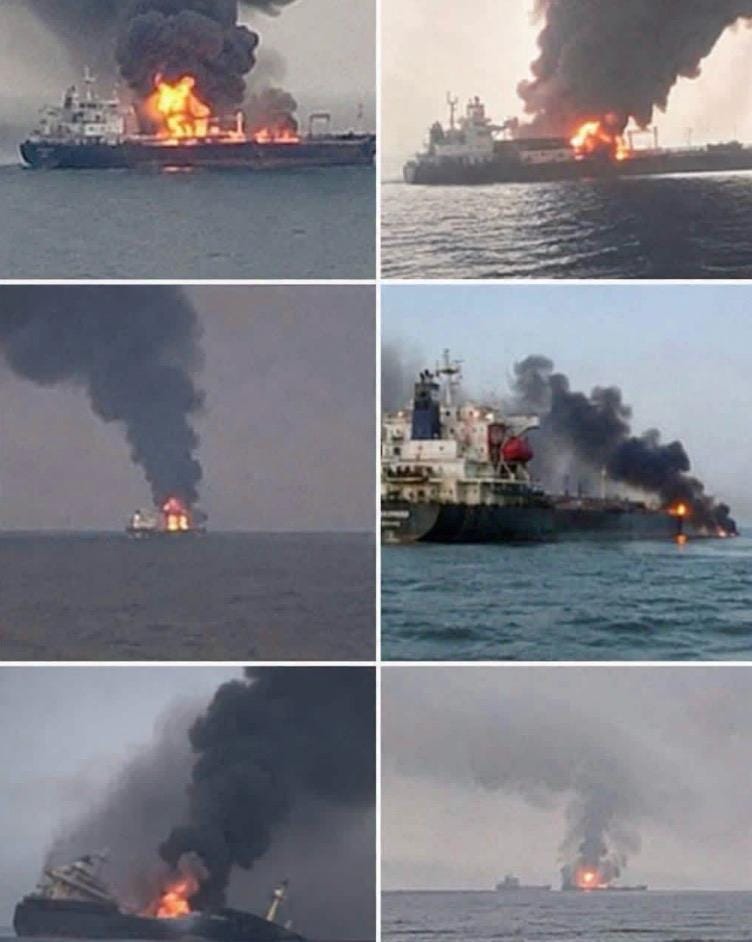
Russia built the shadow fleet to escape the Western insurance system. Ukraine has now demonstrated the price of that escape: every hull is uninsured, unrecoverable, and irreplaceable. And Russia’s domestic ship repair capacity, already saturated, cannot begin to absorb thirty-five damaged vessels. These are not ships awaiting repair. They are scrap metal awaiting acknowledgment.
There is a further scarcity problem. The Azov trade runs on shallow-draught riverine tankers — specialised vessels built for the Don river system and the shallow northern sea. You cannot substitute an ocean-going Aframax. This class of tonnage is small, aging, and no longer built in numbers. Ukraine is not merely sinking ships; it is exhausting a finite and effectively non-renewable class of assets.
The naval theorists of the last century divided maritime power into two ideas. Mahan preached sea control — command of the waves through battle fleets. Corbett, the subtler Englishman, argued that for most purposes sea denial suffices: you need not rule the sea, only prevent your enemy from using it.
For a hundred years, sea denial was the doctrine of the weak, and it required expensive instruments — submarines, mines, shore batteries. What Ukraine has proven, first with the surface drones that humiliated the Black Sea Fleet and now with long-range aerial drones hunting merchant shipping, is that sea denial has become almost free. The Deep Strike Centre coordinating this campaign was established only in December 2025. Within seven months it has rendered an entire sea unusable to the power that claims it as internal waters.
Consider the second-order effects already visible. Russian tactical aviation over the Azov has reportedly collapsed after Ukraine destroyed an A-50 radar aircraft and damaged an Il-22. The queues of vessels that once waited at anchor for inspection before transiting the Kerch Strait have vanished — the Russians have either abandoned inspections or the ships have abandoned the route. An anonymous Russian general has reportedly admitted that after the General Staff disbanded the Crimean Defence Group in 2024, Russia simply lacks the means to defend these waters.
A navy that cannot protect a lake it surrounds on three sides is not a navy. It is a museum with sailors.
Do not mistake this for maritime theatre. The Azov campaign is the closing movement of a strategy I have written about before: the systematic severing of Crimea from Russia.
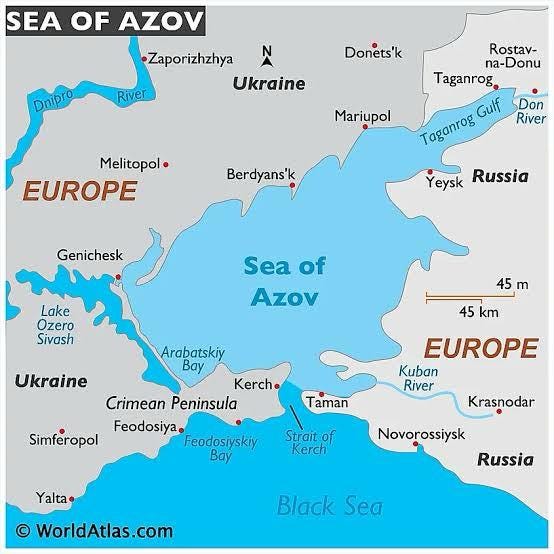
The sequence has been remorseless. Strikes on the Kerch Bridge made road and rail logistics precarious. The intermediate-range campaign against depots, railheads, and fuel infrastructure in the occupied territories degraded the land routes. Moscow’s answer was to shift supply to the sea — small tankers shuttling gasoline and diesel across the Azov to a peninsula already enduring fuel rationing and rolling blackouts. Putin personally blessed this maritime resupply operation.
Ukraine watched Russia commit to the sea route, waited, and then destroyed the sea route in four nights.
This is the anaconda method — not the dramatic decisive battle, but the patient closure of every artery until the limb dies. Crimea, the trophy of 2014, the jewel Putin annexed to found his historical legitimacy, is becoming a besieged island that Russia can neither supply nor defend.
Even Putin, a man constitutionally incapable of admitting weakness, conceded publicly in June that Russia faces a fuel shortage.
Readers of this Substack know the framework I have been developing: legitimacy — the recognised right to rule — is the true currency of international order, and it is earned through performance, not proclamation.
Sovereignty over waters is a claim of protection. When a state declares a sea “internal,” it asserts that vessels within it enjoy the state’s shield. For four nights running, Russia’s shield was shown to be fiction. Ships flying the Russian flag, in Russian-claimed waters, within sight of the Russian coast, burned one after another while the Russian state watched. The military bloggers who form the Kremlin’s own nationalist chorus have erupted in fury — because they understand, instinctively, what has been demonstrated.
This is the same lesson the Houthis taught in the Red Sea and Iran codified in the Strait of Hormuz: in the twenty-first century, the power to make a sea unusable has migrated downward — from great-power navies to any actor with drones, patience, and targeting discipline. The maritime order that rested on a handful of blue-water fleets is dissolving before our eyes. What replaces it is a world where seas belong to whoever can govern the risk upon them. Iran governs the Hormuz risk through authority and insurance. Ukraine governs the Azov risk through fire.
Russia governs nothing.
Watch three things. First, the insurance and chartering markets: if the shadow fleet cannot safely serve even the Azov, Russia’s sanction-evasion architecture — the financial lung of this war — begins to suffocate from within.
Second, the Kerch Strait itself: with inspections abandoned and traffic panicking, the strait is now both bottleneck and killing ground, and Ukraine has shown it can strike ships queued on either side. Third, Crimea’s civilian economy through the summer: fuel rationing in July, in the peninsula’s tourist season, is politically radioactive for a regime whose entire Crimean narrative is triumph.
The war of attrition I have chronicled for months — the refinery strikes, the collapse of Russian logistics, the economic strangulation — has now been extended to the water. Russia entered this war with the world’s third-largest navy and history’s largest sanctions-evasion fleet. It is ending it unable to move a gasoline barge across a lake.
How do you defeat a navy without one? You stop fighting navies, and start extinguishing the idea that your enemy controls the sea. Ukraine has understood this. The admirals of the world’s great fleets should be losing sleep — because if Russia’s maritime pretensions can be burned down by drone crews in ninety-six hours, so, one day, can anyone’s.
Lim Tean is an international shipping lawyer of over three decades’ standing. He writes on geopolitics at The Great Game.
No posts
Comments
Nothing yet. Say the first thing.
Sign in to join the conversation.