

In May 1945 Newburgh, New York was supposed to start a ten-year study on fluoride and its long-term effects on the dental health of its population. But for whatever reason, when the project got delayed by a month, the city didn’t bother telling anyone.
So it came as a bit of a surprise when people from in and around the area started calling in complaining about stomach problems, headaches, and a wide assortment of completely bullshit symptoms, weeks before a single drop of fluoride had ever been added to the water supply.
Nothing was in the water. The water was exactly the same water it had been the month before, and the month before that.
What changed was what people believed about it.
Hold that thought.
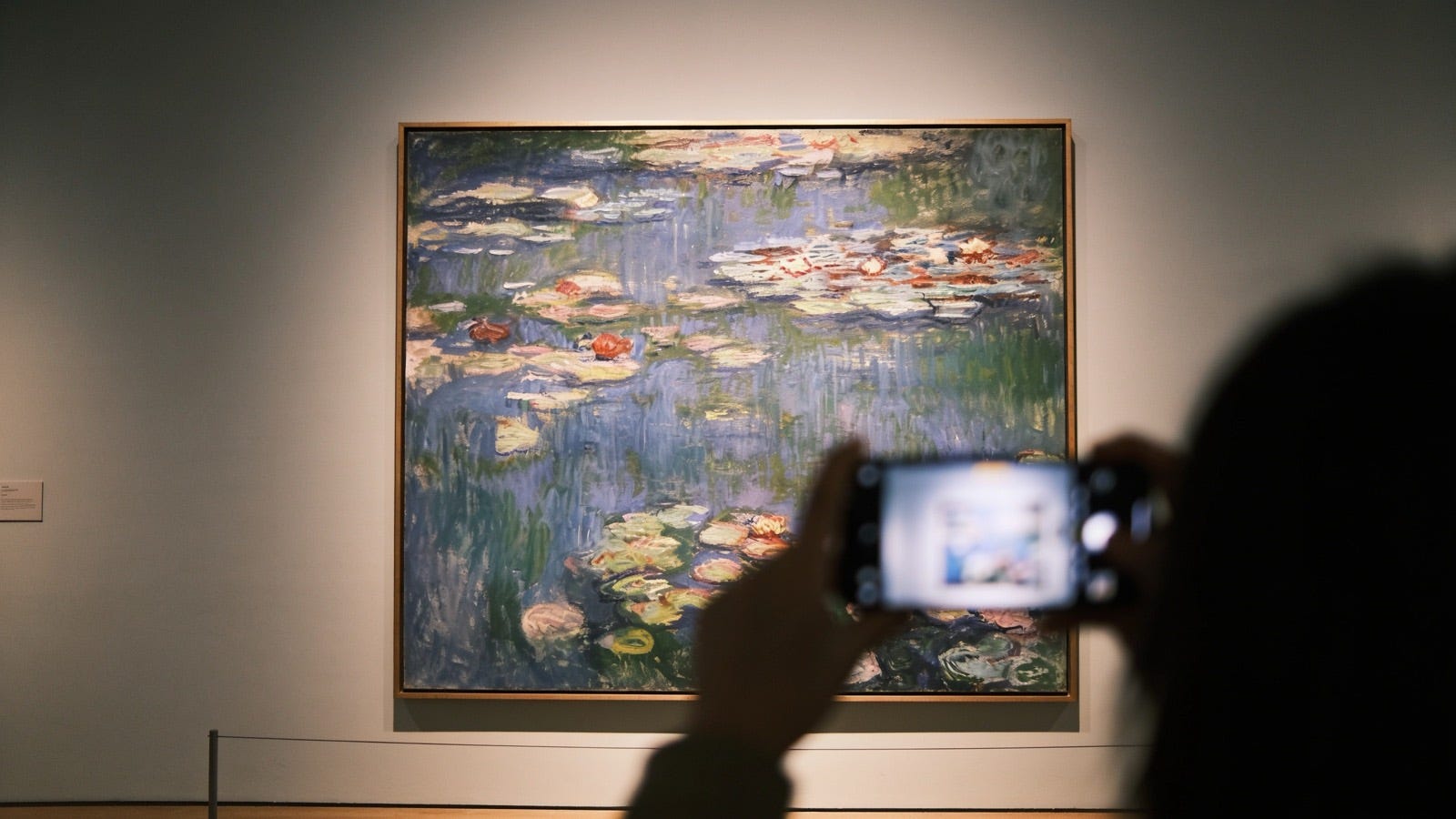
A few months ago on X, someone posted a painting, told people it was AI generated, and asked for their opinions. The response was overwhelmingly negative. It was called “soulless.” “Pure trash.” “AI slop.” The general sentiment, loudly proclaimed by the masses, was that AI was inferior in every conceivable way.
For the record, it was a real Monet.
Not one of the people frothing at the mouth over AI slop learned a single goddamn lesson.
Same mechanism as Newburgh. Nothing was in the water. The canvas didn’t change, the brushwork didn’t change, the thing hanging in the museum for a century didn’t change. Someone said a word next to it, and hundreds of people’s aesthetic judgment collapsed on command.
Study after study shows the same result: when someone is told something was made by AI, they rate it lower whether or not it actually was. Images, video, writing, all of it. The prejudice is irrational and it is largely uncontrollable. It is becoming a trope among the stupidest people in our society, and it is spreading, because it is cheap and it feels like discernment.
Which is why it is a bit more than concerning that Substack just released a “should I be prejudiced toward this writer or not” button.
On July 21, Chris Best announced Substack’s partnership with Pangram — an AI detector now sitting under posts, notes, replies, and comments over 100 words. He called the problem “Claudefishing.” He was very clear about what the actual harm is:
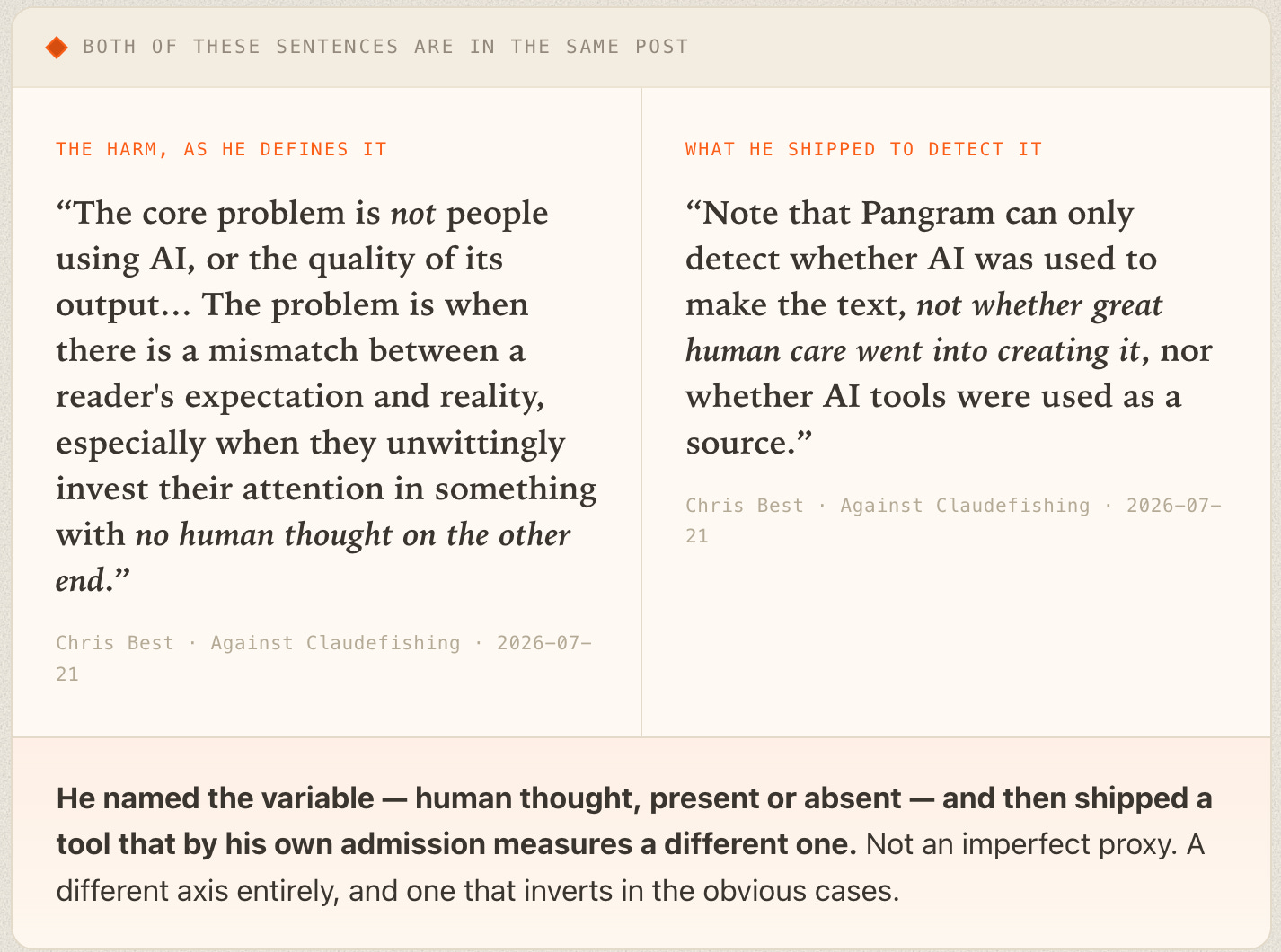
Think about what that means in practice. A piece a celebrity ghostwriter produced start to finish, with zero thought from the name on the byline, scans perfectly clean. A piece somebody agonized over for a week — their argument, their evidence, their conclusions, their voice — run through a model to tighten the structure, gets marked.
The tool doesn’t just fail at his stated goal. It reverses on the exact cases his own definition cares most about. He wrote the diagnosis and the disclaimer in the same essay, four screens apart, and shipped it anyway.
Read his own framing again: the problem is “a mismatch between a reader’s expectation and reality.” Expectation. Not quality — he says outright that quality isn’t the issue, that not everything made with AI is slop and not all slop is made with AI. He has correctly identified that this is a problem about what readers are told.
Then he built a machine whose only function is to tell readers something. Before they read a word.
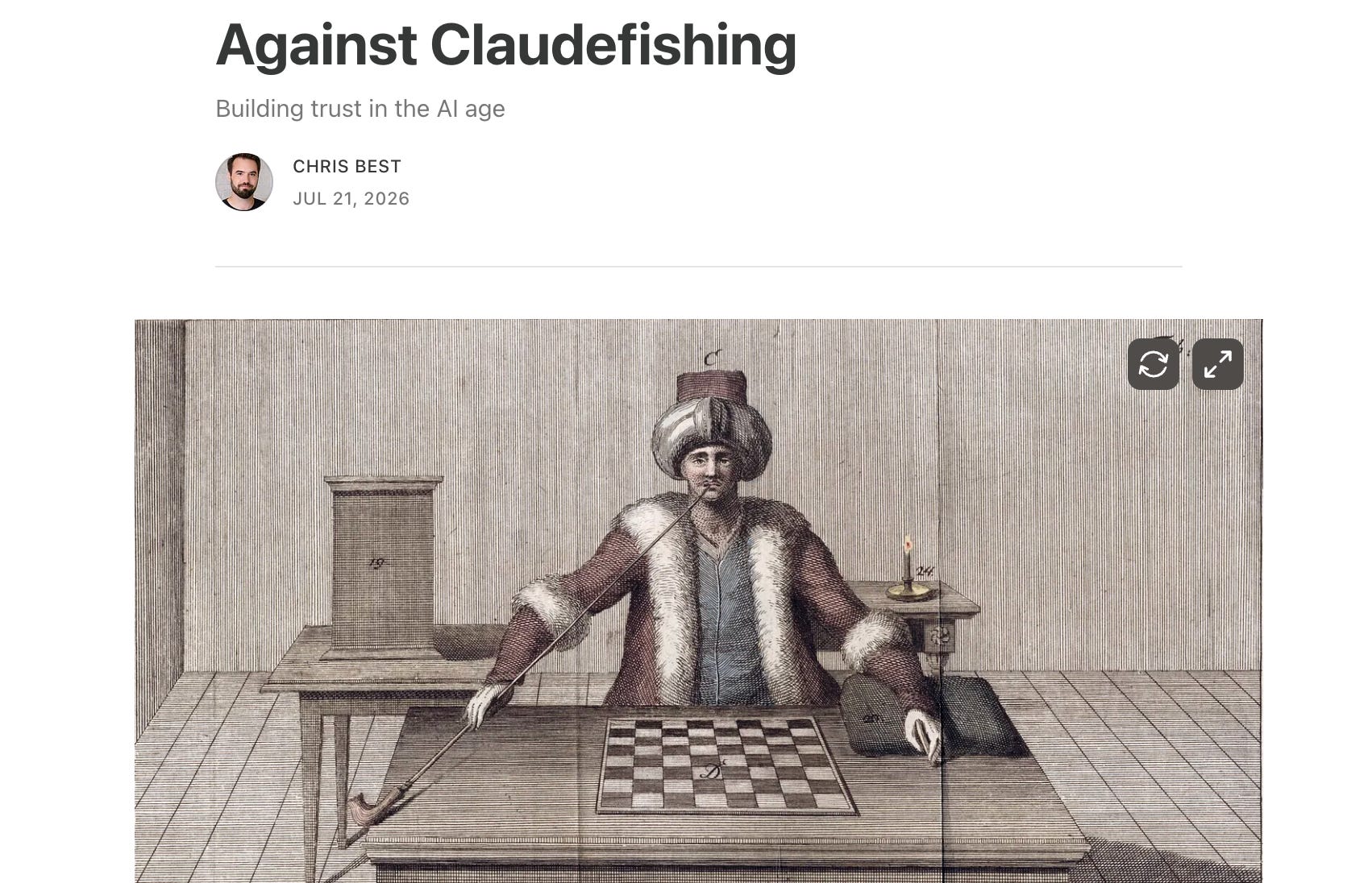
The header image on Best’s post is Joseph Racknitz’s 1789 engraving of the Mechanical Turk.
Racknitz’s engravings exist for exactly one reason: to show the human being hidden inside the machine. They are diagrams of the con. That’s the whole point of them.
So to illustrate an essay about machines passing as human, he chose a picture of a human passing as a machine. And the Turk’s real lesson — the one that actually survives 250 years — is that audiences were fooled because they wanted to believe the box was thinking. The expectation did the deceiving. Not the object.
That’s Newburgh. That’s the Monet. It’s on his own masthead.
“You should have a choice in the matter”
Best closes the feature section with this: “Either way, you should have a choice in the matter.”
Read who “you” is. It’s the reader. Every single time. The reader chooses to scan. The reader chooses what to trust. The reader gets preferences, reply rules, recommendation controls.
The writer gets scanned. No consent, no opt-out, no notification. Anyone can run it on anything you publish over 100 words, and the framing that this “will show an analysis only to those who request it” is presented as restraint — it isn’t. It means the scan is available on every piece of writing on the platform, permanently, on demand, and you will never know who ran it or what they decided about you.
And the remedy he offers, if the machine is wrong about you? You may “report and remove any scans on your own work that you believe are mistaken.”
You get to appeal. That is a presumption of guilt with a customer service form attached. The mark goes on first and the burden of proof lands on the accused, which is precisely backwards from every publishing norm that has ever existed and exactly how every stigma system in history has been administered.
Catfishing requires an impostor. It requires somebody actively pretending to be someone they are not, for gain. Best’s own definition needs intent — a “mismatch,” a con. The Freddie deBoer quote he leans on needs it even more explicitly: “Fooling me in that process is just a con.”
Fine. Except the scanner detects no intent, requires no accusation, and runs on everyone by default. You do not screen an entire population for catfishing. The word is doing moral work the tool cannot back up — it imports the guilt of fraud and sprays it across every writer on the platform, including the overwhelming majority who deceived nobody about anything.
The scan runs downward only
From the same essay: “We use AI all the time at Substack to write software, do research, and build product features like clipping, translations, and more.”
Good. Nobody should care. But notice who carries the label and who doesn’t. Substack’s product isn’t scanned. Substack’s announcements aren’t scanned. Substack’s own blog post about the sanctity of human authorship arrives with no disclosure of its own provenance, no “How I make this” statement, and no scan result printed underneath it.
So here are the questions, and they are not rhetorical:
01 How do we know you wrote this post yourself, or if you paid somebody to write it for you, or someone from your team wrote it for you, or if it went through any kind of editorial process?
02 Is Substack going to require everyone to reveal their process of publishing content?
03 Is it going to go after ghostwriting?
04 Is it going to reveal what operating system you’re using and how often you use spell check?
05 Is it going to require personal notes and research methodology to be disclosed?
How far is Substack willing to go to verify the purity of every single word published on their platform was written by a “real” writer? (and how are they defining a real writer to begin with?) Because they have picked exactly one tool out of the entire history of writing assistance and made it the one that gets a public mark, and they have not offered a single principled reason why that tool and not the others.
There isn’t one. That’s why it isn’t in the post.
Editors. Researchers. Ghostwriters. Copy editors. Fact-checkers. Sensitivity readers. Translators. The people doing the majority of the writing in professional publications are unseen, and their names never make it to the bylines. This isn’t some bizarre scandal that AI exposed. It’s how publishing has worked for as long as publishing has existed. For a platform so hell-bent on preserving pure writing, that history should matter a whole hell of a lot.
I’m not going to be disclosing my process. Not because I’m hiding something, but because it’s my business. The work is the thing I’m handing you. How it got made is mine. That has been the deal between writers and readers for centuries and Substack does not get to renegotiate it with a button.
Let me be straight about the thing I’m not going to pretend: Pangram works. It’s good. I spent time trying to beat it and I couldn’t. Anyone telling you AI detection is still the coin-flip garbage it was three years ago is hiding the truth, and I’m not building an argument on a lie that a benchmark can knock over next week.
It doesn’t matter. Even if it were perfect, it would still be wrong to ship it like this — and it is worth noticing that the accuracy claim is the only place Best cites anything, with an unlinked “independent research suggests,” in a post demanding that everyone else document their sources.
The commons problem he describes is also real. Industrial content farms flooding feeds with generated garbage is a genuine thing that genuinely degrades a platform. Nobody is defending that.
That’s a spam problem, and spam detection has never required branding individual writers by name. Content farms will defeat a public detector first, they’re motivated, automated, adversarial, and iterating daily against a known target. The people who will actually carry the mark are real writers with real names and real audiences who used a tool to think more clearly, to get their ideas out of their heads and in front of an audience.
He conflated an industrial abuse problem with an individual authorship verdict, and built the thing that fails at the first and succeeds at the second.
Underneath all of this is the truly ridiculous assumption that struggle is what makes art legitimate. Anything that comes easy(er) counts less, is worth less.
Effort does not equal quality. Ironically it’s usually the other way around — the better you get at something, the less effort it takes. We don’t dock a surgeon for operating efficiently. Can you imagine telling a cinematographer their shot is worth less because they knew where to put the camera without agonizing for hours? Nobody has ever asked a novelist how many drafts it took before deciding whether the book was good (ok, to be fair, you don’t have to ask a novelist that question, they won’t shut up about it.)
And I’ve watched this exact movie before. I’ve been in film production for over twenty years. For twenty years I watched big studios use CGI, digital doubles, video walls, and green screen to build entirely artificial worlds, dumping hundreds of millions of dollars into every film they produce, and those same studios now condemn AI as cheating.
Because how dare the poors get their hands on something that lets them express themselves without spending millions of dollars.
This is the whole thing. Everything above is evidence; this is the argument.
Stigma is always bad. Because stigma does not attach to behavior, it attaches to people, and once it’s attached it does not come off, and it does not distribute itself according to merit. It lands on whoever is least able to fight it.
Every stigma machine in history has arrived with the same paperwork: we are protecting something precious, the honest have nothing to fear, you may appeal if we’ve made a mistake. Purity tests are the oldest technology we have. Religion has been running this exact play for millennia. They establish an invisible standard of inner authenticity, appoint someone to judge it, and let the community do the rest. It has never once produced more virtue.
What it does produce is people quietly deciding they’re not welcome. That’s what I’ve spent years arguing about ADHD, and it’s the same shape here: the diagnosis doesn’t hurt people nearly as much as the label does. The kid who’s told he’s lazy stops raising his hand. The writer who gets flagged stops publishing. Neither of them was ever the problem.
It takes zero effort and zero thought to click that button. The person who clicks it walks away feeling intellectually superior to someone who spent days wrestling an idea into a shape they desperately wanted to share.
And that’s the last inversion, the one that should have stopped this feature in review. The very thing this tool accuses people of; outsourcing your thinking… is exactly what the tool does. It’s a device specifically designed to replace the work of reading with a number. It violates the standard it pretends to enforce in more ways than AI-assisted writing ever can or will.
Great line. Got 6,700 likes. It’s also two different mistakes stacked on top of each other, and the second one is the one that should keep him up at night.
First: it demonstrated Chris has literally ZERO clue how AI works. Ask Claude for an opinion and you do not get some alien non-human perspective beamed in from outside. You get your own framing, elaborated, in better sentences. It reflects you. It is very good at telling you what you already think with more confidence than you had. The homogenized machine-mind flooding the commons is not the failure mode — the failure mode is a mirror, and if you don’t know that, you don’t understand the tool you have just installed as a gatekeeper.
Second, and worse: he did ask. Not about prose quality. About the only question that actually matters: is this person worth reading. He put a model’s verdict underneath every writer on his platform, ahead of their first sentence, and called it protecting writers.
You said if you wanted Claude’s opinion you’d ask Claude. Then you put a button under my work that asks a machine whether I’m worth reading, and shows the answer to everyone before they get to my first sentence.
He writes, in the same essay, that “human perspective is the essential ingredient of culture.” Then he handed the job of deciding which perspectives count as human to a classifier.
Admit you were wrong and remove this unethical and hypocritical “feature” from Substack. Not because the technology doesn’t work but because you defined the harm as an absence of human thought, shipped a tool that cannot detect human thought, aimed it exclusively at the people whose rent depends on you, exempted yourself, and handed every reader on your platform a one-click permission slip to dismiss a writer they haven’t read.
I’m not going to defend my process, and I’m not going to apologize for using these tools. That’s not a dodge. It’s the position: you are not entitled to my process, and the demand itself is fucking absurd.
What I am going to keep doing is helping people get good at this. Everything I’ve ever done has pointed the same direction, level the playing field, and put resources, education, and tools in the hands of people who were never going to be handed them otherwise. I did it in filmmaking, where the gear and the gatekeeping kept out anyone without a trust fund. I’ve done it with ADHD, where the stigma does far more damage than the wiring ever did. I do it here.
These tools are the single biggest leveling event for expression in my lifetime. They let people who could never afford an editor sound like they have one. They let people whose brains don’t organize themselves into paragraphs get an idea out of their head and into the world intact. That is an enormous good, and a scarlet letter under every post is designed — functionally, whatever the intent — to make the people who need it most afraid to use it.
I’m not going to stop. And you should stop pretending a button that manufactures prejudice is a service to writers.
No posts
Comments
Nothing yet. Say the first thing.
Sign in to join the conversation.