
On Caroline’s birthday a couple years ago, we went out dancing. Twice in my life, I have been in the mood to go out dancing.
The first time was at The Brotherhood in Olympia, one New Year’s Eve. We’d left my parents’ house and decided to hit it up on a whim, on our way home. It was the year I’d been unable to taste for 10 weeks, and I hadn’t had a drink since Halloween, on a self-imposed allergen elimination regimen. We were 29 or 301. We drank Stella, they served it in the special goblets, I’m sure that was the only time we drank Stella at The Brotherhood. DJ Dead Air played “West End Girls” by Pet Shop Boys, and “Girls & Boys” by Blur, and “Wannabe” by Spice Girls. We danced so hard, I remember kicking up my heels, spinning, dancing with strangers.
This was the second time, at the lesbian bar in Spokane. I was ready to tear up the dance floor. The DJ was playing Top 40, nothing special. A European man propositioned Kaden. They were both wearing the exact same shoes, white Pumas with a black stripe. A little goth girl complimented my dancing, after she slammed into a half-wall and grimaced in pain, she’d just had her nipples pierced. Our friends were like, dang, you guys. On my way out, I told a young queer who I’d been watching that I liked their look (very rumpled orphan boy). Kaden and Emily were running through the lawn sprinklers at the train station across the street. The young person followed me! Outside, they smoked a joint with Alex. I had to say I was 41, probably the oldest person in the place, and, to be transparent, I was with Kaden.
They asked me what my special interests were.
I was so tickled! No one has ever asked me what my special interests are, before or since. Granted, I don’t have hyperfocused special interests, it’s just not how I roll. But I have a few abiding interests. Third wave queer punk feminism and its precursors. Lineages of music, especially of the Pacific Northwest, leading to so-called “grunge.” And, the one I answered with:
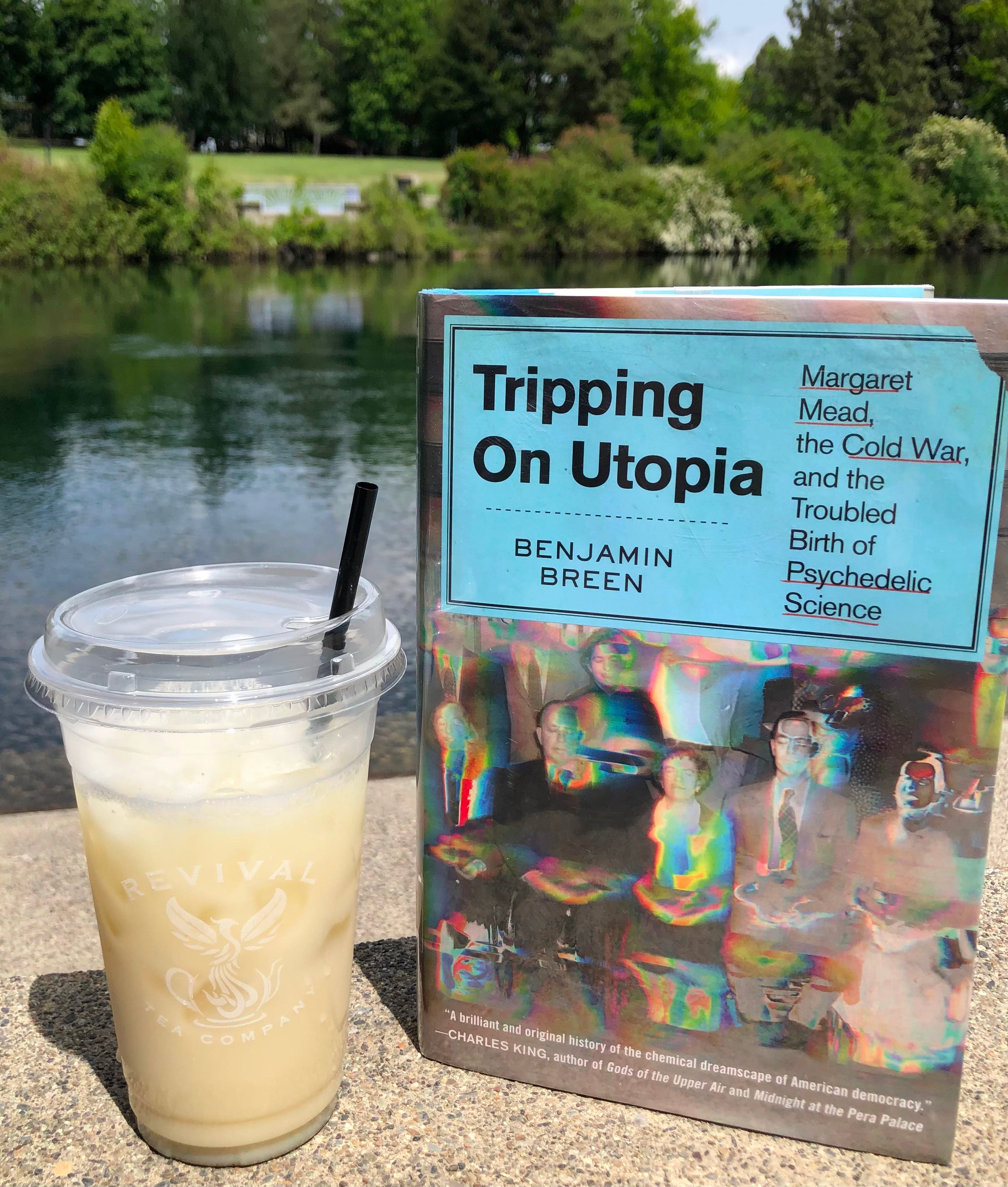
I’d just finished reading Tripping on Utopia: Margaret Mead, the Cold War, and the Troubled Birth of Psychedelic Science by Benjamin Breen, a historian of science and medicine. A must-read for anyone who shares my abiding interest, this intricately woven narrative brings together a whole generation of players—academics, scientists, artists, and government agents, with primary focus on Margaret Mead and her third husband, Gregory Bateson. The section about John Lilly’s experiments with dolphin communication was a fucked up highlight2.
I started reading about psychedelics when I was 18. Someone gave me a Barnes and Noble gift card, maybe for my high school graduation, and I got the classic Acid Dreams: The CIA, LSD, and the Sixties Rebellion. Where did I hear about this? Did I just pick it up and go, wow? Albert Hoffman in his laboratory and on his bicycle, Timothy Leary in his corner office at Harvard, Ken Kesey, an orderly at a Veteran’s hospital and unwitting volunteer in the MK Ultra experiments. Spiked drinks at government sponsored parties. These stories have been with me so long, they have become comfortable places I can go in my mind.
I used to listen to the podcast Church of Chill. If you know me, you know ‘I don’t listen to podcasts,’ but I loved listening to Sean and Cass get high and talk about drugs and Juggalos and sex and family histories. I listened throughout the first year+ of the pandemic, every 45-minute walk to and from work after I stopped riding the bus. I trailed off when they got into cryptocurrency. But I have indelible memories of their talks. I often recall Cass monologuing on the value of the Dark Carnival aspect of a “bad trip,” and how it allowed her to understand what Juggalos were celebrating.
Ranking #4 of my all-time favorite books is Chris Rush’s memoir The Light Years, his story of falling in with his sister’s cohort of Christian drug dealers as a gay kid in the late 60s, selling acid at New England boarding schools, hitchhiking across the southwest, and becoming a mountain hermit, back when you could send acid through the mail. Ranking #2 is Lynda Barry’s Cruddy, the whole story unspooling from a stash of supposed mescaline that is, in fact, “that mental-house shit…that psycho shit you guys stole from the nuthouse, right?” (The preferred term, says the supply guy, is pharmaceutical shit.)
That TC Boyle novel about Leary sucked. It was like, “Hi guys, what if the story of LSD in American counterculture was—get this—a novel?” I had high hopes, and instead it was the first book that made me question the very construct/concept of a novel.
At the time I am writing this post, I’m reading True Hallucinations by Terence McKenna. I thought I knew a lot about McKenna, from my psychedelic reading, in particular Tao Lin’s Trip: Psychedelics, Alienation, and Change. But somehow I didn’t clock that his account of seeking the psychedelic sacred in the Amazon as a young person was a book you could just, uh, pick up and read. I came across True Hallucinations on the New Arrivals table at The Montague Bookmill. “What’s that?” Kaden asked. I mumbled about “The OG psychedelics guy, South America, in the like, 1950s…” I could tell the clerk was listening to how I was describing the book, and I soon realized I had the dates very wrong. McKenna went to the Amazon in 1971, at the age of 24. It was Burroughs who was there, seeking ayahuasca, in the 1950s.
True Hallucinations, written in the early 1990s looking back twenty years, is a tantalizing narrative, lucid, precise, technical. It has me thinking about the plot vs. character argument, genre vs. literary fiction. Although this is non-fiction, memoir, it’s really all plot, missing the intimacies of developing relationships (“I deliberately do not say much about any of us,” he writes, and stays true to that), and there isn’t much in the way of why McKenna or his party, which includes his younger brother Dennis, are seeking what they are seeking. It is clearly more than drugs.
They connected early European alchemical studies to shamanistic practices in the global south. Roughly 1/3 of the way through the text, McKenna writes, “There, persistent rumors circulate of a magical material, generated out of one’s body by master shamans, that allows one to cure, work magic, and obtain information unavailable by any normal means…Our task was to create a credible model of how such a phenomenon could operate without leaving the known or suspected laws of physics and chemistry far behind.”
How did they come into the preliminary information, the alchemy texts, the rumors of Amazonian shamanism? I want the whole personal history! There is an earlier book co-written by the brothers McKenna, and a more recent memoir by Dennis McKenna. The latter describes the same incidents as True Hallucinations, and seems to offer the missing context3. But like I said, I don’t really hyperfocus, so it might be years before I get to these additional volumes.
Something I LOVE about True Hallucinations is how each chapter is subtitled “In which…” Such as:
In which Dennis begins to outline his approach to the Alchemical Opus and a psychofluid that may or may not be translinguistic matter is debated.
I love that structure so much, it was used in one of my favorite childhood books, Harris and Me by Gary Paulson, and in another book from adolescence, but all I remember of that one is the subheading, “In which my sister’s eyes roll back in her head.” Of course I remember that one.
To my occasional regret, I, personally, am not a psychonaut. Between 2001 and 2006 I tripped on mushrooms maybe a half-dozen times, at non-heroic doses, and twice took ecstasy that was mostly speed. For years, I felt mournful that LSD and DMT never crossed my path. Reading Sheila Heti’s recent essay in Granta, Good Medicine, on psychedelic therapeutics, made me only vaguely envious that I’m not someone who gets offered such experiences. But consider my reading list over the past 25 years. All history, how psychedelics shaped counterculture that bled into mainstream culture, the way the story is told and re-told, how different people in different places and different cultural and socioeconomic conditions experienced various hallucinogenic substances. The Merry Pranksters showing up at Millbrook, west coast hippies vs. east coast academics. Ram Dass dosing a holy man in North India who never gets high. Roky Erickson, institutionalized and receiving electroconvulsive therapy in a Texas state hospital, at the very same time the brothers McKenna were trekking and tripping through the Amazonian jungles, themselves expressing schizophrenic-like states.
I’m like. Maybe I’m a fan of drugs more than a user! My primary interest is in the writing, the literature—and, as with my other abiding interests, the music. I care so much about the history of psychedelic music. Back in the day, some boys were smoking weed with us at our house, and I was playing The Psychedelic Sounds of the Thirteenth Floor Elevators on LP. One of the boys asked me to turn it off, it was giving him bad vibes. But I only like music with bad vibes4, so here’s a playlist of favorites, old tracks only, which I’ve been collecting since around 2004: Psychedelic Sounds for Creepy People. Some are more shambling garage rock than psychedelic freak out—it’s a continuum. Turn on and tune in to the good old days of garage and psych reissues via Olympia’s Rainy Day Records and Portland’s Jackpot Records.
The first week I worked at UMass, in November, I had a mammogram revealing a spot. Couple days earlier, I low-key saw a UFO. My cousin A. was in her last days of life. In December, when I went in for additional imaging, I was reading Jung’s Flying Saucers in the waiting room.
Roughly six months later, it’s now my last week of working in the office at UMass, before I move across the country and work remotely. In the mammography waiting room, for another imaging follow-up, I finish reading True Hallucinations, which draws heavily on Jung’s examination of flying saucers. The day before, my cousin J., A.’s sister’s husband, passed. The two of them had been outliving their cancer diagnoses for years.
There is an eerie tidiness to the symmetry.
(My calcifications are in fact getting smaller, and nothing to be concerned about yet).
The whole thing has me feeling pretty woo-woo. Jupiter enters Leo, my rising sign, the same day we leave Massachusetts for Washington. When Jupiter was in Leo in 2002-2003, I was 19, 20, and my life changed immensely. Jupiter was also in Leo 2014-2015, when I began allowing myself to write fiction, as an adult. I can’t believe all that was packed into each of those years, summer to summer. Post mushroom trip(s?) in spring 2003, I felt the residual peace and rightness McKenna describes experiencing at La Chorrera. I have always associated it with practicing Progoff’s depth-psychology journaling method in Marilyn Frasca’s Drawing a Life program at Evergreen, and learning to express myself through drawing. I knew something was happening, my life becoming knowable to me, everything falling into place. During this time, Kaden and I fell in love—we first said I love you and shared a bed 48 hours before Jupiter transited my ascendant. Until reading True Hallucinations, it had never occurred to me that my peaceful magnetism could’ve been related to my mushroom usage. And Jupiter transiting my first house, calm, full of hope and confidence.
I’m only putting this down for my own reference, so that I don’t rewrite my own history. If it was the year I couldn’t taste for 10 weeks, it was 2013, but I know we went to the New Year’s Eve set with the same DJ, playing mostly the same songs, the next year. In 2014, we were in Albuquerque, so this timeline cannot be correct. But for the purposes of this vignette: it was the year I couldn’t taste for 10 weeks.
From a Goodreads review: “Dennis's story is at times slowed down by an overabundance of personal detail,” which is EXACTLY WHAT I WANT, so.
Comments
Nothing yet. Say the first thing.
Sign in to join the conversation.