
I was interviewed last week by a National Science Foundation (NSF) funded Ph.D. researcher who was surveying people in the lighting industry and the Department of Energy about the status of healthy circadian lighting. What she found was outright dismissal of any need for circadian lighting - they were telling her “it just wasn’t relevant to modern lighting”!
Remarkably, she was completely unaware, from her prior interviews, that over 20,000 scientific papers have been published on the impact of light on circadian clocks and health. and that 248 of the world’s leading scientists on this subject had reach consensus that blue-rich light in the evening and at night is harmful, and blue-rich LEDs (in other words most conventional LEDs today) should carry warning labels1.
It is clear we need to take a lesson from Madison Avenue and get better at punching home the message that the wrong light at the wrong time is bad for your health. We need to teach not just the scientific facts. but also appeal to the emotions.
a
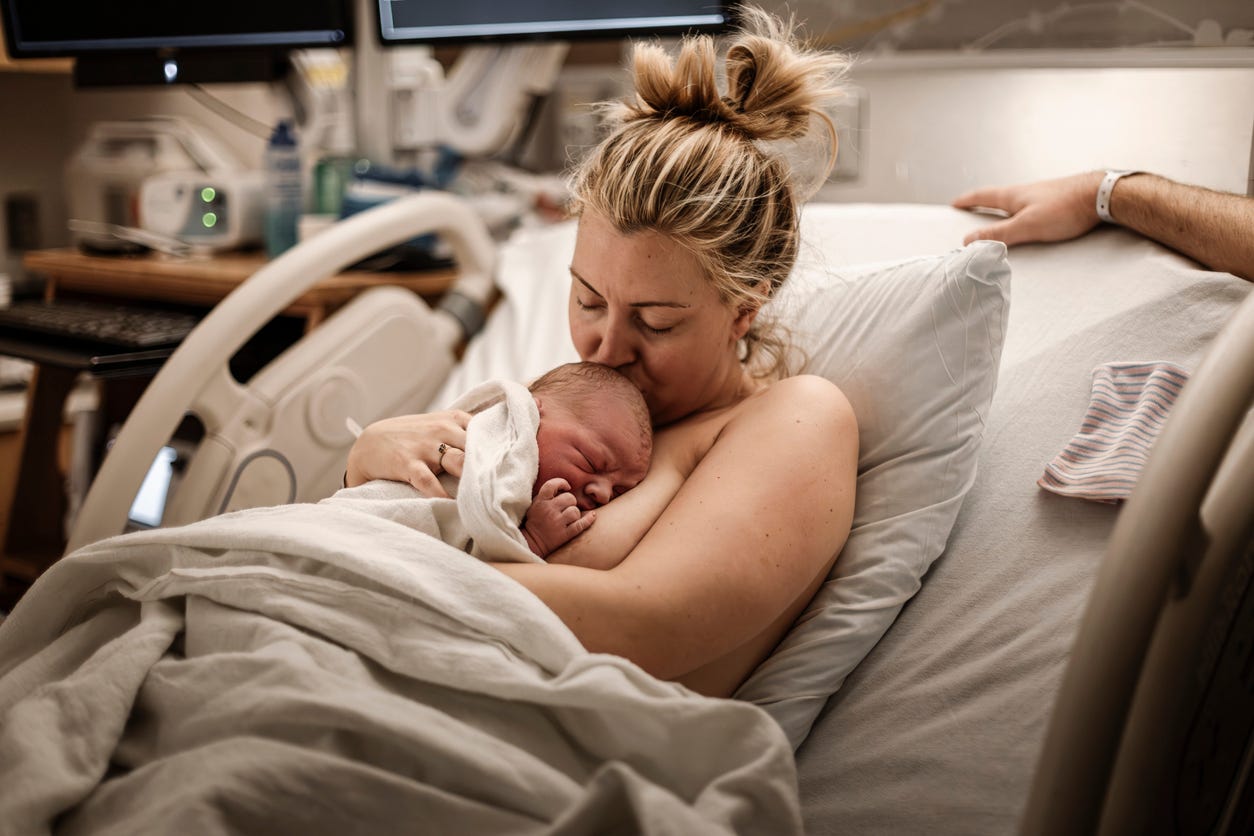
Throughout human history pregnant mothers have spent their evenings free from the blue wavelengths of light. Pre-electric lighting from wood fires and candles was virtually free of blue. And more recently, under incandescent light bulbs, the blue content of the light they saw before going to bed only rose slightly.
Nowadays expectant mothers are besieged in the evenings with the insidious effects of LED light with 10 - 20% sky-blue content (440-495 nm), and this has many bad outcomes for the mother -- and the baby.
One of the most direct and fast-acting effects of the blue wavelengths in white LED light during the evening and night hours is to cause disruption of our circadian clocks.2 One important consequence is our cells immediately become resistant to insulin, and glucose metabolism is disrupted3. Both blood glucose and insulin levels spike to abnormal heights indicating a pre-diabetic state even in a healthy person. This is a different mechanism from the normal circadian rhythm in glucose metabolism which is driven by how much insulin the beta cells of the pancreas produce.
Mothers can develop gestational diabetes during pregnancy, raising circulating blood glucose levels. The rate of gestational diabetes has been climbing steeply since 20164 5 when blue-rich LEDs became widely introduced and the exposure of pregnant mothers to blue light in the evenings progressively increased.
Now a new study by Balserak et al6 shows the causal pathway, and that this relationship between increasing levels of blue light in the evenings and the increase in maternal diabetes is not just a random association. Pregnant mothers wore devices that measured how much blue light exposure they had in the evening, and then subsequently their fasting glucose levels and the health and weight of their baby were measured.
It is well known that when a pregnant mother has high levels of blood glucose, the baby gets much more glucose passing through the placenta, but the mother’s insulin molecules that could have counteracted the increase glucose load are too big to pass through the placenta to the baby. Hence the baby’s own insulin production by its immature pancreas has to respond, and convert the excess glucose into fat, and thereby abnormally increase the baby’s birthweight.
The consequence is a condition called Macrosomia where a baby is significantly larger than normal. This may cause much more difficult and harmful deliveries, and greater risks after birth, including hypoglycemia when the baby’s extra maternal glucose supply is suddenly shut off.
The Balserak study showed that the mothers with the greatest evening blue light exposure during pregnancy had the highest fasting blood glucose levels, and the heaviest babies.
So when people in the lighting industry and the Department of Energy casually dismiss the need for circadian lighting, with rich blue light in the morning and blue-free light in the evening, they are being totally cavalier.
The health of newborn babies and their mothers are at stake.
And there are many more negative health impacts of blue rich light at night for people of all ages, as my book THE LIGHT DOCTOR explains in depth
Blue-free lights for evening use are now available, so you can solve this problem today.
The quickest way to understand the importance of healthy lighting and outdoor daylight exposure for everybody, and the value of nocturnal darkness is to read my book THE LIGHT DOCTOR.
Get Your copy of THE LIGHT DOCTOR

and get The Ultimate Circadian Bedroom Lighting Package as a free gift of healthy light and restful sleep with each new Annual Paid Subscription to THE LIGHT DOCTOR newsletter.
Upgrade to Annual Paid Subscriber
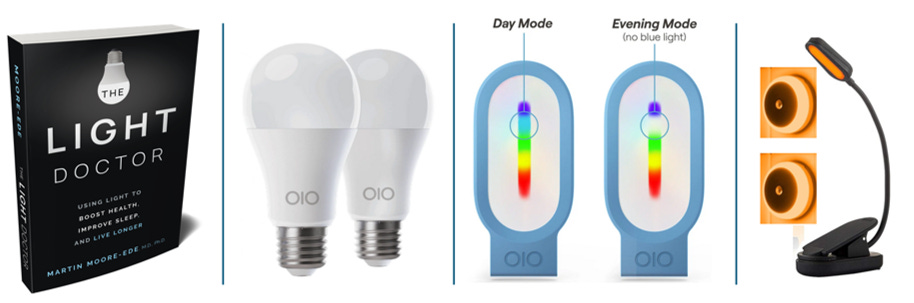
Here are the benefits you unlock with each new Paid Annual Subscription to THE LIGHT DOCTOR newsletter beginning today:
Ultimate Circadian Bedroom Lighting Package mailed to your home (for USA residents only*), including:
Latest edition of THE LIGHT DOCTOR book.
Blue-free book reading light - so you can read the book in the evening without any blue light exposure
Two A-19 automatic OIO circadian light bulbs which automatically cycle between blue-rich days, blue free evening lights and red night lights – so that your lighting is always healthy
OIO loop which enables you check any light fixture or bulb to see if it is providing healthy light appropriate for the time of day or night.
Hallway and bathroom blue-free night lights which automatically switch on when it is dark - so you safely walk to the bathroom without switching on the lights
Unlimited year-long access to all THE LIGHT DOCTOR newsletters, podcasts and premium resource materials.
Catalog of evidence-based healthy lighting products from reliable vendors.
The Ultimate Circadian Bedroom Lighting Package is the ideal gift for family and friends (or yourself) so you can bless them with healthy light and restful sleep,
Give yourself and your loved ones the gift of healthy bedroom lighting with each new Annual Paid Subscription to THE LIGHT DOCTOR newsletter
If you are already a paid monthly subscriber and wish to take advantage of this offer please go to the subscribe page and upgrade your subscription to an Annual Paid Subscriber.
Upgrade to Annual Paid Subscriber
PLEASE NOTE: *The Ultimate Circadian Bedroom Lighting Package can only be shipped to USA residents because of electrical compatibility and current tariff fees. Residents of other countries who sign up for an Annual Paid Subscription to THE LIGHT DOCTOR newsletter will be shipped a signed copy of the latest edition of THE LIGHT DOCTOR.
We regret this offer is not available to monthly paid or complimentary subscribers - but you are welcome to upgrade to a Paid Annual Subscription If you are already an Annual Paid Subscriber we will continue to honor your current lower annual subscription price when you automatically renew, but you will not receive the incentive package for new subscribers.
Moore-Ede, M., Blask, D. E., Cain, S. W., Heitmann, A., & Nelson, R. J. (2023). Lights should support circadian rhythms: evidence-based scientific consensus. Frontiers in Photonics, 4, 1272934.
Mason, I. C., Qian, J., Adler, G. K., & Scheer, F. A. (2020). Impact of circadian disruption on glucose metabolism: implications for type 2 diabetes. Diabetologia, 63(3), 462-472.
Morris, C. J., Yang, J. N., Garcia, J. I., Myers, S., Bozzi, I., Wang, W., ... & Scheer, F. A. (2015). Endogenous circadian system and circadian misalignment impact glucose tolerance via separate mechanisms in humans. Proceedings of the National Academy of Sciences, 112(17), E2225-E2234.
Gregory EC, Ely DM. (2022) Trends and Characteristics in Gestational Diabetes: United States, 2016-2020. Natl Vital Stat Rep. 71(3):1-15.
Lam, E. L., Walker, J. M., Wang, M. C., Venkatesh, K. K., Khan, S. S., & Shah, N. S. (2026). Gestational diabetes in the US from 2016 to 2024. JAMA Internal Medicine, 186(2), 269-271.
Balserak, B.I, Hermann, R., Hernandez, T. L., Buhimschi, C., & Park, C. (2022). Evening blue‐light exposure, maternal glucose, and infant birthweight. Annals of the New York Academy of Sciences, 1515(1), 276-284.
No posts
Comments
Nothing yet. Say the first thing.
Sign in to join the conversation.