
In 2014 the lighting industry launched a massive uncontrolled and undocumented experiment on six billion1 of the world’s population by introducing blue-pump white LED lights. These lights produce cheap white light but have a narrow artificial spectrum that doesn’t provide the key light wavelengths and correct day and night dosages essential for health. The only people who didn’t participate in this massive experiment were those who lived in the non-electrified regions of the world.
Unlike the introduction of most other innovations with broad impacts on public health, such as vaccines and pharmaceuticals, there was no IRB (Institutional Review Board) to independently examine the health and safety risks. And there was no informed consent obtained from any of the study participants.

Furthermore, no data collection was planned or undertaken by the lighting industry to evaluate the health impact of blue pump LEDs. Instead, there has been dismissal or outspoken opposition by the lighting industry when anyone raises concerns about the serious health problems caused by illuminating our evenings with these blue pump LED lights.
In most trials of a new technology with widespread medical impacts, you can choose whether you want to participate, and serve as a subject in the experiment. However, the choice of whether or not to participate in this experiment was blocked by new Federal regulations which banned the other previously available lighting alternatives such as incandescent and halogen lights, and by state by state bans on fluorescent lighting.
And there are plans by 2028 to increase the dosage and adverse effects of this experiment by progressively tightening lumens per watt regulations which restrict other lighting alternatives, and to amplify the potential harm of these artificial spectrum blue-pump LEDs.
Just like ignorance of the law is no defense, ignorance of the published peer-reviewed science is not a valid excuse. Let’s take a look at what was well known and accepted by the scientific community by 2014.
Light at night disrupts circadian rhythms and causes multiple adverse health effects
The risk of obesity, diabetes and certain cancers is significantly increased by light at night
Blue light is much more potent than other wavelengths at suppressing melatonin at night and disrupting circadian clocks
The blue-rich light at night → melatonin suppression → increased cancer growth pathway had been defined and explains the causal mechanisms.
The warning signs were already there in 2014. It was a known fact that broad introduction of blue-rich LEDs was likely to cause major adverse health impacts. And yet the lighting industry went full steam ahead.
Ten years into this massive uncontrolled experiment, with broad denial from the lighting industry that there is any health problem with blue-pump LED lights, the scientists who have published the most peer-reviewed scientific studies on light and circadian health came together to set the scientific record straight.
These 248 scientists from all over the world reached consensus on 25 statements2
1. Robust circadian rhythms are important for maintaining good health.
Circadian rhythms are most robust when they are tightly synchronized to the natural day-night cycle, and the circadian clocks throughout the body are tightly synchronized with each other. Circadian rhythms under these conditions typically show the greatest amplitude (widest swing between daily maximum and minimum levels). When circadian rhythms are robust, sleep during the night is most restorative, mood, alertness and cognitive performance during the day are enhanced, and the immune system’s capability to ward off disease is strongest.
2. Disrupting circadian rhythms can cause ill-health.
There is a broad scientific consensus that disrupting the human circadian clock system precipitates a wide range of medical disorders. Circadian disruption can have many different types of significant adverse health effects in children, young adults and in the elderly. These include obesity, diabetes, heart disease and breast cancer.
3. Regular daily exposure to daylight enhances circadian entrainment and strengthens circadian rhythms.
Getting outside at a regular time each day, especially in the mornings, and being exposed to natural daylight, is well established as an effective way to keep our circadian rhythms firmly synchronized. In the absence of regular exposure to daylight, our circadian rhythms can become dissociated and flattened and ill-health and susceptibility to disease can result. Regular exposure to daylight strengthens our circadian rhythms and tightens their entrainment by the natural cycle of day and night.
4. Regular daily exposure to daylight can enhance sleep at night.
The average person spends over 90% of their time indoors under twilight levels of lighting. The lack of a strong contrast in light exposure between day and night is a major contributor to the sleep problems that are so common today. Regular daily exposure to outdoor sunlight, or even cloudy overcast daylight, helps deepen and extend our uninterrupted nocturnal sleep.
5. Increasing indoor light intensity during daytime can enhance circadian entrainment and strengthen circadian rhythms.
Since we tend to live indoors in twilight levels of light, our circadian rhythms can become dampened and lose their tight associations with natural day and night. Increasing the brightness of indoor light during daytime hours, especially if it is rich in blue wavelengths, helps to compensate by synchronizing our circadian rhythms to the natural day-night cycle – a process called entrainment. At the same time the entrained circadian rhythms show an increased amplitude – a greater contrast between peak and trough of the daily rhythm.
6. Increasing indoor light intensity during daytime can improve daytime alertness and reduce sleepiness.
Natural light from offices with windows, and bright electric light indoors, especially when it has significant blue content, has an alerting effect, and reduces sleepiness. This combats the natural tendency to drowsiness when we live under twilight conditions.
7. Increasing indoor light intensity at night increases the disruption of circadian rhythms.
Our eyes and brain are highly sensitive to light during the nighttime hours (from sunset to sunrise), and the disruptive effects on our circadian rhythms get more pronounced the brighter the light intensity. This effect is exacerbated by lights with high blue content such as LEDs or fluorescent lights.
8. Increasing indoor light intensity at night increases the suppression of nocturnal melatonin production.
Melatonin is the pineal hormone that plays an important role in signaling the darkness of night to all the cells of the body and their internal circadian clocks. When people live outdoors in the natural world, melatonin rises at sunset and falls at dawn. But when we use electric lights, we suppress the melatonin signal and may shift it. Our internal circadian clocks interpret electric light at night as a shift in the timing of day and night. The brighter the electric light at night the more suppressed and shifted is the melatonin rhythm.
9. Repetitive and prolonged exposure to light at night bright enough to cause circadian disruption increases the risk of breast cancer in women.
The first reports were published in 2000 showing a significantly increased risk of breast cancer in women exposed to light on the night shift. Since then, several national and international scientific bodies have reviewed the considerable accumulated evidence from hundreds of human epidemiological and animal model studies. After reviewing all the evidence, the WHO International Agency for Research on Cancer, and the National Toxicology Program of US National Institutes of Health have linked light exposure at night to circadian disruption and to the significant increase in the rate of new breast cancer cases.
10. Repetitive and prolonged exposure to light at night bright enough to cause circadian disruption increases the risk of obesity and diabetes.
A substantial body of evidence has accumulated in recent years showing up to twice the risk of obesity and diabetes in people who are exposed to light at night, either by leaving the lights on in the bedroom at night, or by working on night shifts. These effects can start developing even after only one night of light exposure.
11. Repetitive and prolonged exposure to light at night bright enough to cause circadian disruption increases the risk of sleep disorders.
Light at night has three key effects on sleep. First it alerts and stimulates our brain which makes it harder to fall asleep or stay asleep. Second it shifts our circadian clocks so the timing of when we can easily fall asleep is shifted. Third it disrupts our circadian clocks and the architecture of the various sleep stages such as REM and non-REM sleep, so that sleep is disrupted and not as fully restorative.
12. The sensitivity peak of the ipRGC melanopic receptors in the human retina is approximately 480nm in the blue part of the visible spectrum.
A major breakthrough in circadian science was the discovery of the intrinsically photosensitive retinal ganglion cell (ipRGC) receptors in the eye that detect the blue wavelengths in light. The peak sensitivity of these ipRGC receptors is to sky-blue light at about 480 nm.
13. The most potent wavelengths for circadian entrainment are 460-495 nm blue light near to the sensitivity peak of the ipRGC melanopic receptors.
While the ipRGC receptors have their peak sensitivity at about 480 nm, they can sense a broader range of blue light photons. Blue light is most potent in synchronizing human circadian clocks to the environmental day-night cycle, a process called “entrainment”, in the 460-495 nm range near the 480 nm peak sensitivity.
Blue-enriched (460-495nm) light in the evening (during the three hours before bedtime) …
disrupts nocturnal sleep more than blue-depleted light at the same intensity
phase delays the circadian system more than blue-depleted light at the same intensity.
disrupts circadian rhythms more than blue-depleted light at the same intensity.
When you are exposed to light containing potent 460-495 nm blue wavelengths in the evening after sunset, it shifts and disrupts your circadian rhythms and impairs your sleep at night. We are sensitive to an even broader range of 440-495nm blue during overnight hours. The solution is to use blue-depleted light at night – i.e. light without those disruptive blue wavelengths – rather than conventional LED lights which are rich in blue. This greatly reduces the risk of shifting our circadian clocks, and disrupting our sleep.
17. Exposure to 460-495nm blue light at night suppresses melatonin production.
Because we are so sensitive to blue light at night, a broad range of blue wavelengths can suppress pineal melatonin production. The strongest suppression occurs with blue light wavelengths between 460 and 495 nm. These blue wavelengths interfere with the signaling of natural darkness by melatonin and undermine the important protective effects of melatonin at night, such as suppressing cancer cells in the body.
18. Exposure to 460-495nm blue light at night disrupts circadian rhythms.
These same 460 - 495 nm blue wavelengths during the nighttime hours have the largest effect in disrupting circadian rhythms. These blue wavelengths are 20 times more potent than full spectrum white light which contains all the wavelengths of the visible light spectrum. Exposure to even a small amount of blue light at night is highly disruptive to circadian rhythms.
Practical Applications
The 248 scientific experts were then asked about the practical implications of the well-established science of circadian-light interactions and reached a consensus on the following statements:
19. Light used in the evening (during the three hours before bedtime) should have as little blue content as practically possible.
We become increasingly sensitive to the blue content in our electric lights as the evening progresses. Thus, it is important to replace your lights in the places you spend your evenings, such as the family room, bathroom and bedroom, with lights that have very little or no blue content.
20. The risk of circadian disruption during the three hours before bedtime can be reduced either by 1) dimming indoor lighting which may compromise the ability to perform visual work tasks, or 2) reducing the blue content of indoor lighting maintained at the intensity required for visual tasks.
There are two ways of addressing the problem with blue-rich light during the evening hours. Since what matters is the total number of blue photons that you are exposed to per second, you can dim your existing conventional lights significantly to reduce the total amount of light to which you are exposed. The problem is that this may make it hard to read, or difficult for your children to do their homework. Alternatively, you can replace your current lights with low blue content lights so you can maintain visual illumination at your preferred levels.
21. The blue content of light entering the eyes is much more important in determining circadian health outcomes than the correlated color temperature (CCT) of the light source.
Changing the color of lights, measured as correlated color temperature or “CCT”, has been touted by the lighting industry as a way to reduce blue content. Unfortunately, this is a highly misleading marketing strategy which does very little to address the problem. At the key 460 - 495 sky-blue wavelengths high CCT and low CCT electric lights can have very little difference in blue content, as they are all based on blue-pump LEDs. It is far more important to know the blue content of the lights that you are using than their CCT or color appearance.
22. Increasing the energy efficiency of lights is desirable, but not if it increases the risks of causing circadian disruption and serious illness.
Since the widespread introduction of LED lights in 2013, the lighting industry has been focused on promoting and improving the energy efficiency of LEDs. It has been the key selling proposition which has enabled blue-enriched LEDs to dominate the lighting market. While maximizing energy efficiency is, of course, desirable, failing to address the adverse health impact of lumens/watt efficient blue-enriched LEDs is a much more significant problem. These blue-rich LEDs can increase your exposure to blue light at night, and accelerate the electric circadian havoc and ill-health caused by electric light.
23. LED lights with high 460 - 495nm blue content should carry the warning label “maybe harmful if used at night”
There was strong consensus among the 248 leading scientists researching the impact of light on circadian rhythms, that the evidence is now clear than blue-enriched LED lights with high 460 - 495 nm blue light content should carry a hazard warning label related to their use at night. This is justified by the increased risk of obesity, diabetes, heart disease and several types of cancer that are associated with exposure to excessive blue wavelengths at night.
24. There is now sufficient evidence to support the widespread introduction of circadian lighting that adjusts light intensity and blue content across day and night to maintain robust circadian entrainment and health.
There was also strong consensus that the lighting industry needs to transition to circadian lighting where the brightness of light and its blue content are varied by time of day. During the daytime hours indoor lights should be rich in sky-blue wavelengths, and during the nighttime hours from sunset to sunrise these sky-blue wavelengths should be removed.
25. There is significant variation in individual sensitivity to light, therefore circadian lighting should be optimized where possible using personalized solutions.
Some people are much more sensitive to the blue content of light than others, and it is important to adjust the blue content in electric lighting to make allowance for these more sensitive people. Furthermore, the orientation of our circadian clocks in relation to day and night may differ somewhat between individuals. Some of us are early rising “larks” and then fall asleep earlier in the evening. Others are genetically more sensitive to blue rich light in the evening and their sleep patterns may be delayed. These differences between people are reduced by regular exposure to natural outdoor light during the day.
The fastest way this changes is for enough people to know what their lights are doing and to start asking for better. The 248 of us can lay out the evidence. We cannot create the demand. Only you can do that, one informed choice at a time.
The lighting industry has known about this for years. Regulators have been slow to act. But you do not have to wait for either of them to change the light in your own home.
You can also join the movement to alter the regulations to enable more healthier light alternatives. Visit: https://circadianlight.org/campaign/background-on-the-healthy-lighting-campaign/
The quickest way to understand the importance of healthy lighting and outdoor daylight exposure for everybody, and the value of nocturnal darkness is to read my book THE LIGHT DOCTOR.
Get Your copy of THE LIGHT DOCTOR

and get The Ultimate Circadian Bedroom Lighting Package as a free gift of healthy light and restful sleep with each new Annual Paid Subscription to THE LIGHT DOCTOR newsletter.
Upgrade to Annual Paid Subscriber
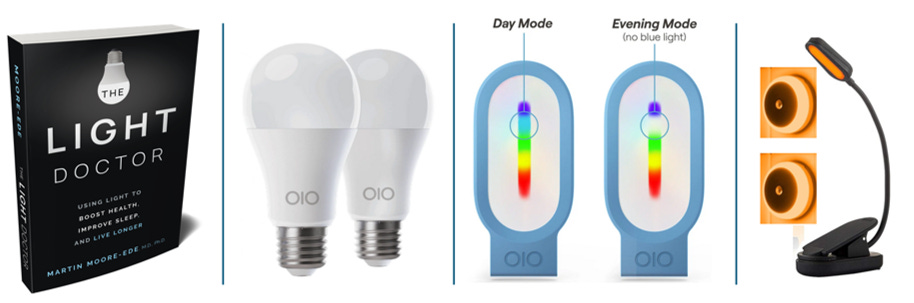
Here are the benefits you unlock with each new Paid Annual Subscription to THE LIGHT DOCTOR newsletter beginning today:
Ultimate Circadian Bedroom Lighting Package mailed to your home (for USA residents only*), including:
Latest edition of THE LIGHT DOCTOR book.
Blue-free book reading light - so you can read the book in the evening without any blue light exposure
Two A-19 automatic OIO circadian light bulbs which automatically cycle between blue-rich days, blue free evening lights and red night lights – so that your lighting is always healthy
OIO loop which enables you check any light fixture or bulb to see if it is providing healthy light appropriate for the time of day or night.
Hallway and bathroom blue-free night lights which automatically switch on when it is dark - so you safely walk to the bathroom without switching on the lights
Unlimited year-long access to all THE LIGHT DOCTOR newsletters, podcasts and premium resource materials.
Catalog of evidence-based healthy lighting products from reliable vendors.
The Ultimate Circadian Bedroom Lighting Package is the ideal gift for family and friends (or yourself) so you can bless them with healthy light and restful sleep,
Give yourself and your loved ones the gift of healthy bedroom lighting with each new Annual Paid Subscription to THE LIGHT DOCTOR newsletter
If you are already a paid monthly subscriber and wish to take advantage of this offer please go to the subscribe page and upgrade your subscription to an Annual Paid Subscriber.
Upgrade to Annual Paid Subscriber
PLEASE NOTE: *The Ultimate Circadian Bedroom Lighting Package can only be shipped to USA residents because of electrical compatibility and current tariff fees. Residents of other countries who sign up for an Annual Paid Subscription to THE LIGHT DOCTOR newsletter will be shipped a signed copy of the latest edition of THE LIGHT DOCTOR.
We regret this offer is not available to monthly paid or complimentary subscribers - but you are welcome to upgrade to a Paid Annual Subscription If you are already an Annual Paid Subscriber we will continue to honor your current lower annual subscription price when you automatically renew, but you will not receive the incentive package for new subscribers.
The global population was 7.2 billion in 2014, of whom 1.2 billion lived in non-electrified regions of the world. https://www.prb.org/wp-content/uploads/2015/11/2014-world-population-data-sheet_eng.pdf
Moore-Ede, M., Blask, D. E., Cain, S. W., Heitmann, A., & Nelson, R. J. (2023). Lights should support circadian rhythms: evidence-based scientific consensus. Frontiers in Photonics, 4, 1272934.
No posts
Comments
Nothing yet. Say the first thing.
Sign in to join the conversation.