
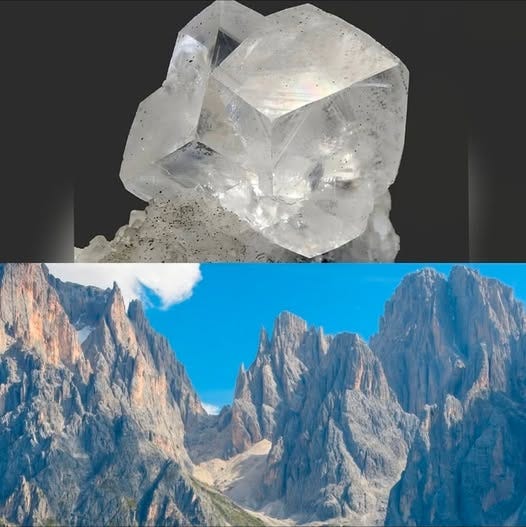
Recently, geologists studying dolomite formations in northern Italy once again faced the century old puzzle known as the “Dolomite Problem.” These towering peaks called the Dolomites are made almost entirely of a mineral that stubbornly refuses to form under the calm, slow conditions that evolution based geology requires. Dolomite, a calcium magnesium carbonate, looks much like limestone, but its chemistry tells a very different story.
For over 200 years, scientists have tried to reproduce dolomite formation in laboratories and natural settings. Yet dolomite does not form easily in today’s oceans or shallow seas. It requires extreme heat, high pressure, and concentrated chemical reactions, conditions that simply do not exist in normal marine environments. Despite endless experiments, no one has found a slow, steady process that could account for the immense dolomite layers covering vast areas of the earth. The very existence of these rocks defies the long age story of gradual deposition.
The Dolomite Mountains themselves testify to rapid, catastrophic transformation. Their clean boundaries, upright fossil layers, and vast extent reveal a violent, water driven formation. During the year long Flood described in Genesis, massive amounts of hot, mineral rich water would have surged through layers of sediment, rapidly converting limestone into dolomite. The energy, heat, and pressure from global upheaval provided the exact conditions needed to accomplish what slow natural processes never could. The Dolomites rise as a monument in stone declaring not eons of quiet change, but the sudden power of God’s judgment and the truth of His Word.
https://creation.com/en/articles/dolomite-problem
Comments
Nothing yet. Say the first thing.
Sign in to join the conversation.