
Around two and a half years ago I reached the tipping point of my health. Not a full-blown crisis but enough of a problem to realise that I was going in the wrong direction.
The moment when it finally clicked came during a call with a nutritional doctor. I remember their final words clearly: “Liam, you’re doing everything right but you’re just probably missing this one single supplement.” And I thought: “There’s something very wrong here. If I’m doing everything right except one supplement, why is my health getting worse, not better?”
Plenty of health experts had told me before that I was just “missing one thing”, but none of what they suggested had made much of an impact. Not really. Why would this, I asked myself, be any different? How many supplements do I have to take to finally get healthy?
The truth is, I thought I was already doing everything right. No alcohol. No cigarettes. No processed foods. No meat. No sugar or gluten. But my health issues were getting worse and new ones were appearing. I finally decided that there had to be something fundamentally wrong with my approach. So I took it all back to basics and asked myself: Is there such a thing as a diet where I don’t need supplements at all - something more natural - and, if so, what does it look like?
Living on a boat, the health of nature used to puzzle me: the birds don’t seem to have any health problems, yet they’re not taking a stack of supplements or managing their diet like I am. They just eat the food that is right for them and avoid the ones that aren’t and they naturally seem to know what those are. What do they know that I don’t? What am I missing here?
So after some research I changed my diet completely to one that seemed to be (on the evidence) what nature had designed for humans over hundreds of thousands of years, and which had appeared to have worked pretty well throughout that time.
And here’s the strange thing: literally within weeks all of my health problems just went away. They didn’t just improve. They simply disappeared. No fuss, no struggle, no complicated methods. It was as if nature already knew how to take care of me. It seemed to know what to do and what I needed to be healthy.
And it didn’t appear to be a fluke. My partner joined me on the diet - and got the same results. Long term health issues - that no previous diet, supplement or practice had helped - all largely healed.
What I discovered is that before we decided to make life complicated, for reasons I’ll discuss below, humans had quite a simple diet and lived fairly straightforward lives. And although they faced major problems - particularly infections and accidents for which they had no cures and which shortened the average lifespan - the evidence suggests that in many ways humans were physically healthier. They were generally taller, had stronger bones, better teeth, larger brains, and far lower rates of the chronic diseases that are common today, such as cancers, diabetes, heart disease and mental illness.
And another thing I noticed as well in my research is that humans were generally mentally healthier. There is little evidence of the chronic anxiety, stress and psychological struggle that are so common today. So it got me to wondering whether there was something different about their “mental diet” as well. Just as nature evolved humans to consume foods that helped them to survive the most efficiently with the least amount of problems, perhaps humans were using their brains differently as well. The evidence suggests they did.
And it all made me think: Just as I had been feeding my body the wrong food - leading to health problems - perhaps I had been feeding my brain the wrong kind of information. And maybe those were causing other problems as well. In other words, perhaps I had the wrong mental diet.
It turns out there are two types of mental “food”.
One helps us stay healthy.
The other creates problems.
Here’s a way to understand it. Take a moment to look at what is going on in your life right now. You’ll notice there are two things that are actually happening - two “levels of existence” if you like or two ways you are “digesting information”. The first is what is actually happening in your physical environment: what’s going on around you, what you feel, what you see, what you smell, what you touch. It’s the information provided by your five senses. The other type of input you are digesting is imagined scenarios, stories you are creating in your mind through your thoughts.
So here you are sitting reading this, your eyes following the words, your body resting in a chair, the sounds around you, your physical environment.
But you’re also imagining things like, “What does this mean? What could it mean? How can this help me?”
“I’ve got this problem I need to deal with. I’ve got something I need to do. I need to make sure I’m prepared for it. I had an argument with my spouse yesterday, and I wish it hadn’t happened. I would have said something different in hindsight.”
It’s information you are using to describe what you think your life means. But it’s not actually your direct experience of life.
So these are essentially two types of input:
Reality coming through your senses.
Words, stories and imagined scenarios in your head.
But here’s what I’ve come to understand: the brain seems to work best when it is dealing with the former rather than the latter. Humans evolved, just as the rest of nature did, to respond to what’s actually happening in the most appropriate and effective way. And this makes sense doesn’t it? Respond when there is evidence of a lion, rather than spending every day reacting to lions that exist only in your imagination.
But when we started to anticipate the lion, when we began creating stories such as “there are no lions here but they might come one day”, we suddenly gave the brain situations to deal with that weren’t actually there. What could happen, what should have happened, and what we want to happen - the brain is suddenly living in a world it was never designed for. A world of endless dangers which can never be dealt with because they’re simply not real. And the brain was built to deal with the real. It was not built to live continuously in the imaginary.
We are feeding the brain food that it can’t digest.
And just as with physical food, the result is problems.
This is exactly what I experienced those years ago when I lost everything and became homeless. It was that crisis, that tipping point, that made me realise that whatever I was doing was fundamentally not working. The mental food I was feeding my brain was only making things worse. So I threw away all the mental supplements and reduced everything to just one question: What should I do right now?
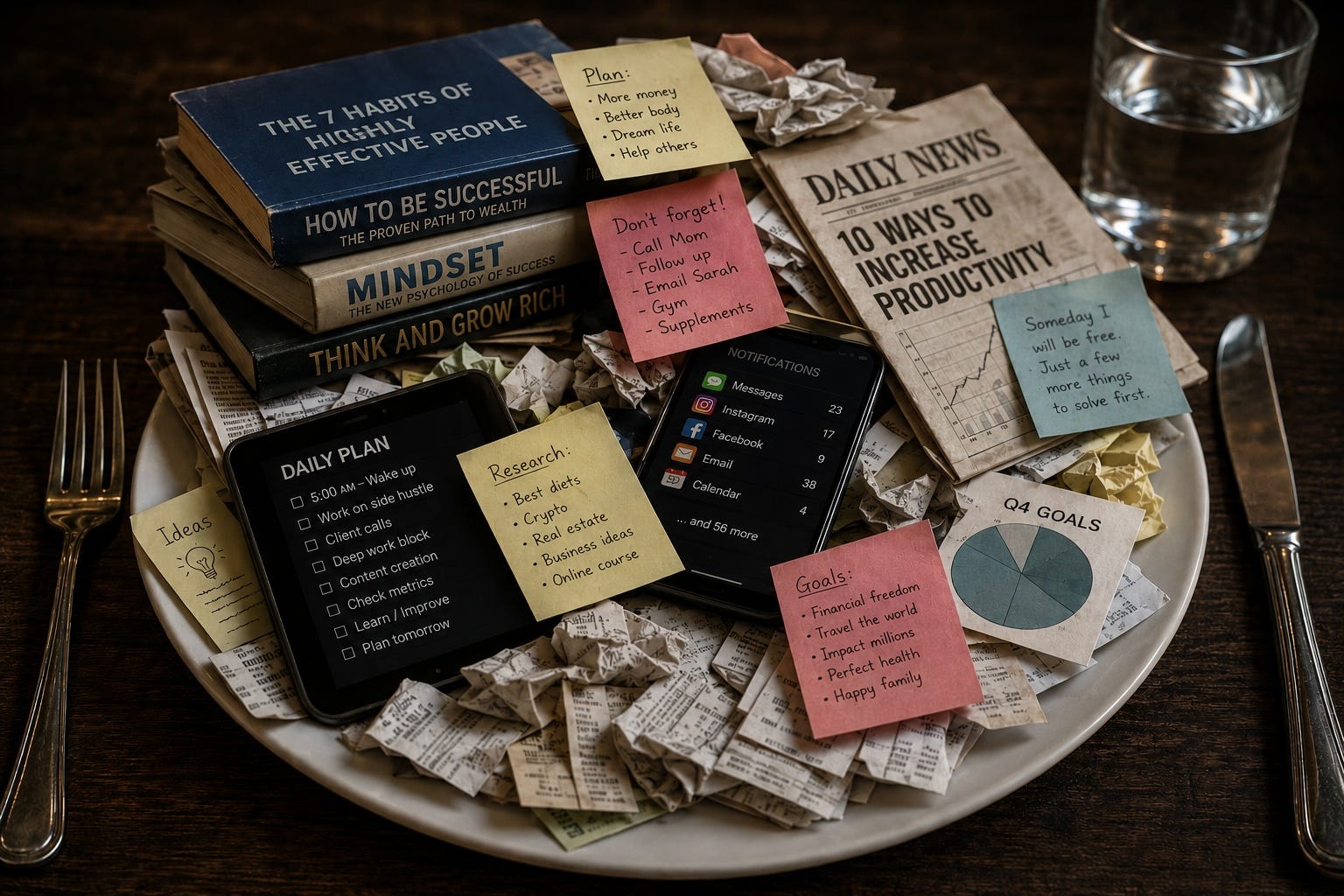
Perhaps you’re living with a lot of “mental supplements” as well. Perhaps you’re carrying around a bag of things like I did such as:
affirmations
positive thinking
techniques for changing your beliefs
reading more
gathering more information
trying to find better explanations for things
analysing, discussing and thinking through your problems.
But ultimately there comes a point we all need to acknowledge: none of these things are really solving our problems. We may understand our problems better. We may even feel better about them. But if we're honest, many of the things we've spent years working on are still there. We still have the same fears, the same frustrations, the same struggles. We've become better at managing them, perhaps, but not at making them disappear.
The “experts” tell us that these supplements work, that we’re on the right track, we’re doing all the right things. Just keep going and one day we’ll see results. And everyone else we know is using the same supplements - and getting the same lack of real results that convince us that this is just how life is.
We might see some small improvements, but most of why we feel better is because we think we’re going in the right direction, not because we’re making any real progress. If we’re honest, we see that we still have the problems, the same stresses and struggles. Nothing has changed. We justify it to ourselves by saying, “This is normal. It’s just life.” Or, as with my health issues: “This is what happens when you get older. It’s the same for everyone.”
But once you see the difference between the two types of food you are feeding your brain and understand which one it was primarily designed to digest, you can see that just like most health problems, life problems are a symptom rather than the cause. And that’s when you can start to make real changes and get real results.
Try this. Next time you’re in a discussion or a conversation with your partner or your spouse, see the difference between what is actually happening and what you think is happening. What is actually happening is that you are seeing their lips move and their facial expressions change. You’re hearing sounds come out of their mouth. You’re hearing your own voice and feeling the movements and reactions in your body. That is reality.
But what do you imagine is happening during this conversation? What mental stories are you creating around the event? They might be:
What do they mean?
How are they feeling?
How can I get them to see my point of view?
Why are they talking like this?
What does this conversation mean for the future of our relationship?
Let go of the temptation to react to the stories in your head and just stay with the present moment, with what is actually happening physically. Just observe. Don’t do anything or try to get involved. Just observe what is happening physically, and what your body actually does in response without you thinking anything. Stay with the real, not the imaginary.
Of course this is difficult in the beginning because you’re changing the way you have lived for a lifetime. But try it a few times and you’ll start to see - and do - things rather differently.
When I changed my physical diet, my body quickly showed me what it had been needing all along. It was as if it was saying: “Finally you’ve stopped interfering and are allowing me to do the job I was designed to do.”
I found exactly the same thing with my mental diet.
Nature already knows how to thrive, physically and mentally.
The question is whether we’re feeding it what it was designed to work with.
If this idea resonates with you, and you’d like to experience what happens when you stop feeding your brain information it was never designed to live on, I created a short guide called the Instinct Reset.
It’s a simple introduction to the principles behind what you’ve just read and a practical way to experience them for yourself.
You can learn more here
Comments
Nothing yet. Say the first thing.
Sign in to join the conversation.