
Lexi Ventures is a VC firm with a unique focus on genetic engineering at seed stage.
Lexi Ventures is hosting a pizza party during Deep Tech Week SF on Thursday, June 25. It carries the same easygoing spirit as our JPM party in January, with founders, investors, and friends of the fund. Join us here.
Kopra Bio, a UCSF spinout in Lexi Fund I, announced $9.1M in seed funding this month, alongside a study published in Nature Communications. The company engineers a replicating retrovirus that infects dividing glioblastoma cells and makes them produce an IL-15 superagonist, an immune signal that recruits and activates the T cells and NK cells that kill tumors. In effect, the tumor becomes a local factory for its own destruction. In glioblastoma mouse models, this produced tumor-specific immunity and durable remission, and the vector stays silent outside the immunosuppressed tumor, which spares healthy tissue.

Glioblastoma is among the deadliest cancers, with few options and short survival, so a durable response is a high bar that Kopra is clearing in the lab. The company now plans IND-enabling work and a Phase 1/2a trial in recurrent glioblastoma. Lexi invested at the seed stage in October 2024, alongside Y Combinator and Andreessen Horowitz and is now followed by Singularity Capital, Paul Graham, and others. Backing this science years before the headline is the work our fund is built to do.
This spring, two acquisitions put a price on the exact science Lexi backs. Eli Lilly agreed to buy Kelonia for $3.25B up front and up to $7B with milestones, for an in vivo CAR-T built on engineered viral delivery. UCB agreed to buy Neurona for $650M up front and up to $1.15B, for a stem cell therapy. Both are core genetic engineering modalities, and both are seed-stage ideas that grew into multibillion-dollar exits.

Lexi Fund I already owns this category. Kopra Bio delivers a therapeutic gene with an engineered virus (see above), ParcelBio is developing in vivo CAR-T through engineered mRNA, KiraGen Bio builds off-the-shelf CAR-T by multiplex gene editing, and TippingPoint targets pediatric brain cancer. Lexi is the rare seed fund with a high concentration in genetic engineering. That focus is why we see and own these modalities at the earliest stage, while generalist funds treat the field as a side bet.
Cell therapy comes in two forms, and the difference drives cost, speed, and how many patients can be treated. Ex vivo therapy removes a patient’s cells, engineers them in a specialized facility, then returns them. It works, it is safe, and the first approved CAR-T cancer therapies use this route, but it is slow, expensive, and made one patient at a time. That bespoke manufacturing is the main reason these cures can cost hundreds of thousands of dollars per dose.
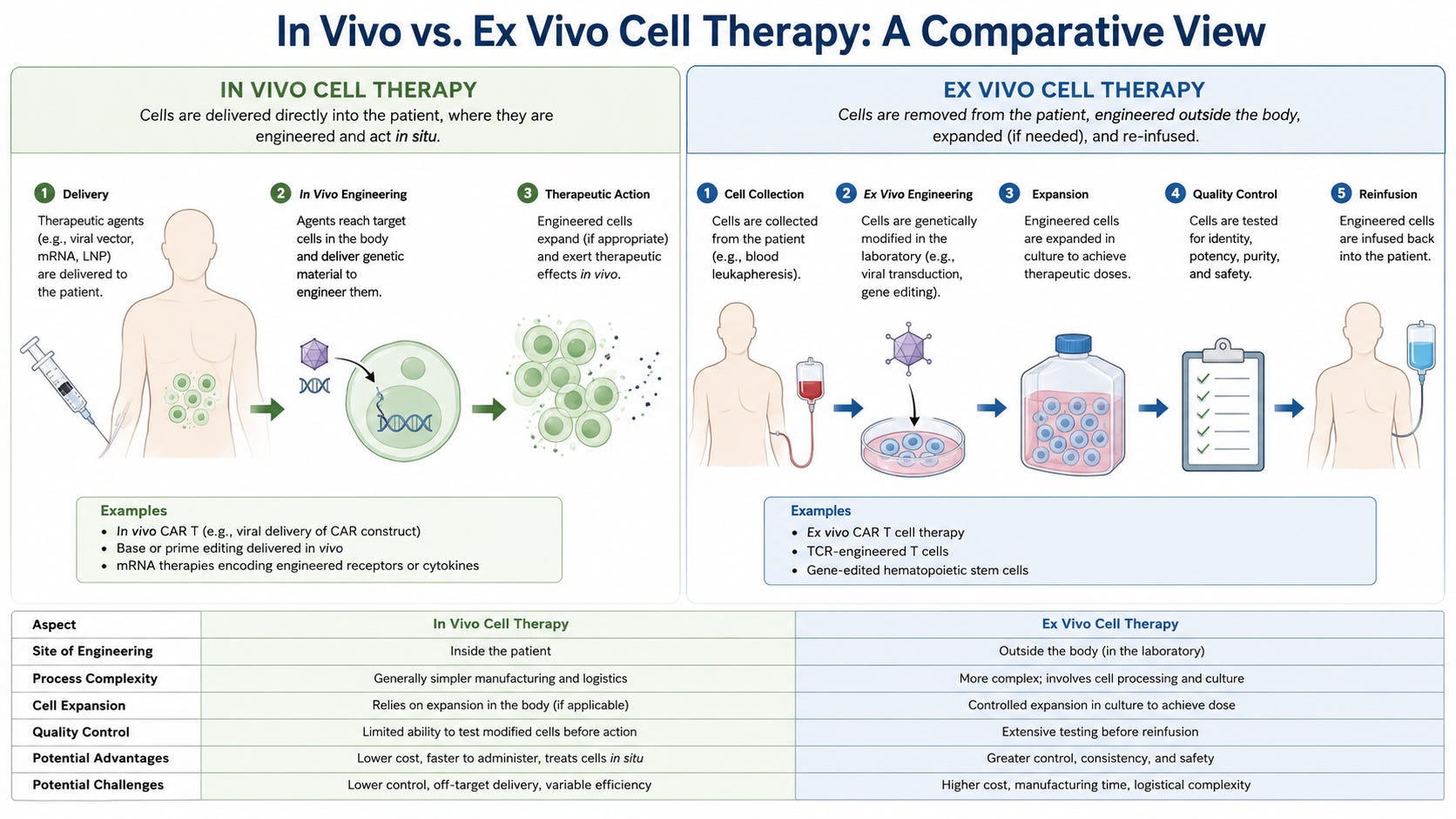
In vivo therapy engineers the cells inside the body with a targeted delivery vehicle, so there is no per-patient manufacturing. It promises off-the-shelf treatment at a fraction of the cost, which is why pharma is paying billions to acquire it. Lexi holds both approaches: ParcelBio pursues in vivo CAR-T with engineered mRNA, and KiraGen builds off-the-shelf cells that any matched patient can receive. The next wave of this field moves treatment out of the factory and into the patient.
On June 9, Anthropic released Claude Fable 5, its most capable model, and walled off only a short list of subjects. It restricts two domains, biology and cybersecurity, the areas where a powerful model could do real-world harm. When the leading AI lab decides where to hold its best model back, it is telling you which capabilities it considers most powerful, and biotech sits at the top of that list.

We believe that signal maps straight to commercial value. A token of AI compute spent designing a protein, a drug, or a living cell is worth far more than a token spent writing newsletters :) or sorting email, because of the capabilities of the output. Capital is following that logic: Isomorphic Labs raised $2.1B, Lila Sciences is building what it calls scientific superintelligence, and NewLimit raised $435M for cellular reprogramming. Lexi invests where AI meets biology at the seed stage, the highest-value frontier of computing.
At Lexi Ventures, we often explain our thesis that genetic engineering will reshape the world. You do not have to take our word for it. Several people with a serious view of the future share the conviction. Jensen Huang, the CEO of Nvidia, says that for the first time in human history “biology has the opportunity to be engineering, not science”.
Patrick Collison, the cofounder of Stripe and an avid bio-philanthropist, describes how new tools to read, model, and write biology at the level of a single cell could let us finally cure complex diseases (video, chapter 10, 41:56).
And China’s latest five-year plan names biotechnology, along with AI and rare earths, a strategic priority under Xi Jinping (analysis).
A few favorites for anyone who wants to go deeper on the science behind the thesis.
Siddhartha Mukherjee, The Gene: a sweeping history of heredity, from Mendel’s peas to gene editing, and the personal and ethical stakes along the way.
David Goodsell, The Machinery of Life: a beautifully illustrated, to-scale tour of the molecular machines working inside every cell.
Walter Isaacson, The Code Breaker: the story of Jennifer Doudna, CRISPR, and the academic race to learn how to edit the code of life.
Matt Ridley, Genome: one gene from each of our 23 chromosomes, used to tell the story of what makes us human.
Jamie Metzl, Hacking Darwin: a look at how genetic engineering will reshape human evolution, and the choices it forces on us.
Thank you for your interest and support.

Comments
Nothing yet. Say the first thing.
Sign in to join the conversation.