
Lexi Ventures is a VC firm with a unique focus on genetic engineering at seed stage.
By Marcus Li, Investor, Lexi Ventures
Psychedelics have shifted from forbidden to increasingly mainstream, echoing marijuana’s path after California became the first state to legalize medical use in 1996. The biggest signal of that shift is Eli Lilly’s cash acquisition of AtaiBeckley, announced July 16, at about $2.8B up front, plus a contingent value right worth up to $1.0B more. AtaiBeckley’s lead asset BPL-003, an intranasal form of 5-MeO-DMT for treatment-resistant depression, holds Breakthrough Therapy designation and has initiated Phase 3 activities.

It’s not just one deal, it’s a trend. Johnson & Johnson’s ketamine-based Spravato has been approved since 2019 for treatment-resistant depression, since 2020 for major depressive disorder with acute suicidal ideation, and since January 2025 as a monotherapy. AbbVie paid up to $1.2B for Gilgamesh Pharmaceuticals’ bretisilocin, a short-acting 5-HT2A agonist now in combined Phase II/III trials for major depressive disorder. Otsuka closed its $1.23B acquisition of Transcend Therapeutics in June, buying TSND-201, a non-hallucinogenic neuroplastogen that entered the Phase 3 EMPOWER-1 trial in PTSD after strong Phase 2 results and an FDA national priority voucher.
The furthest along is Definium Therapeutics, which was MindMed until it renamed in January. Its DT-120, lysergide in a 100 µg orally disintegrating tablet, hit its primary endpoint in the Phase 3 Emerge study in June: an 8.1-point placebo-adjusted MADRS improvement at week 6, holding at 7.3 points at week 12, from a single dose. Two more Phase 3 trials in generalized anxiety disorder are running. The company raised $700M on the result.
Four of the largest pharmaceutical companies in the world have now bought into a class of molecules that was a criminal liability twenty years ago. Stigma is not a permanent property of a molecule. It is a temporary property of the evidence.
Lexi is announcing a new AI tool for matching startup companies to investors within and adjacent to genetic engineering. That includes applications in health, consumer, ag, industrials, and software.
We intend to have as broad coverage as YC’s network around genetic engineering tech. As a fuzzy matcher on rich data, our results are more relevant than label-based searching on NFX Signal.
We are often surprised at the non-obvious common ground this tool finds between investors and founders. We are happy to run it for any biotech startup. Just reach out to Jonah.
On June 30, Anthropic released Claude Science, an AI workbench for researchers, in beta on macOS and Linux. A coordinating agent runs more than 60 skills pre-configured for genomics, single-cell, proteomics, structural biology, and more across numerous data sources without researchers navigating each schema, and model calls. It runs on-prem, so proprietary data stays put. A reviewer agent flags numbers it cannot trace.
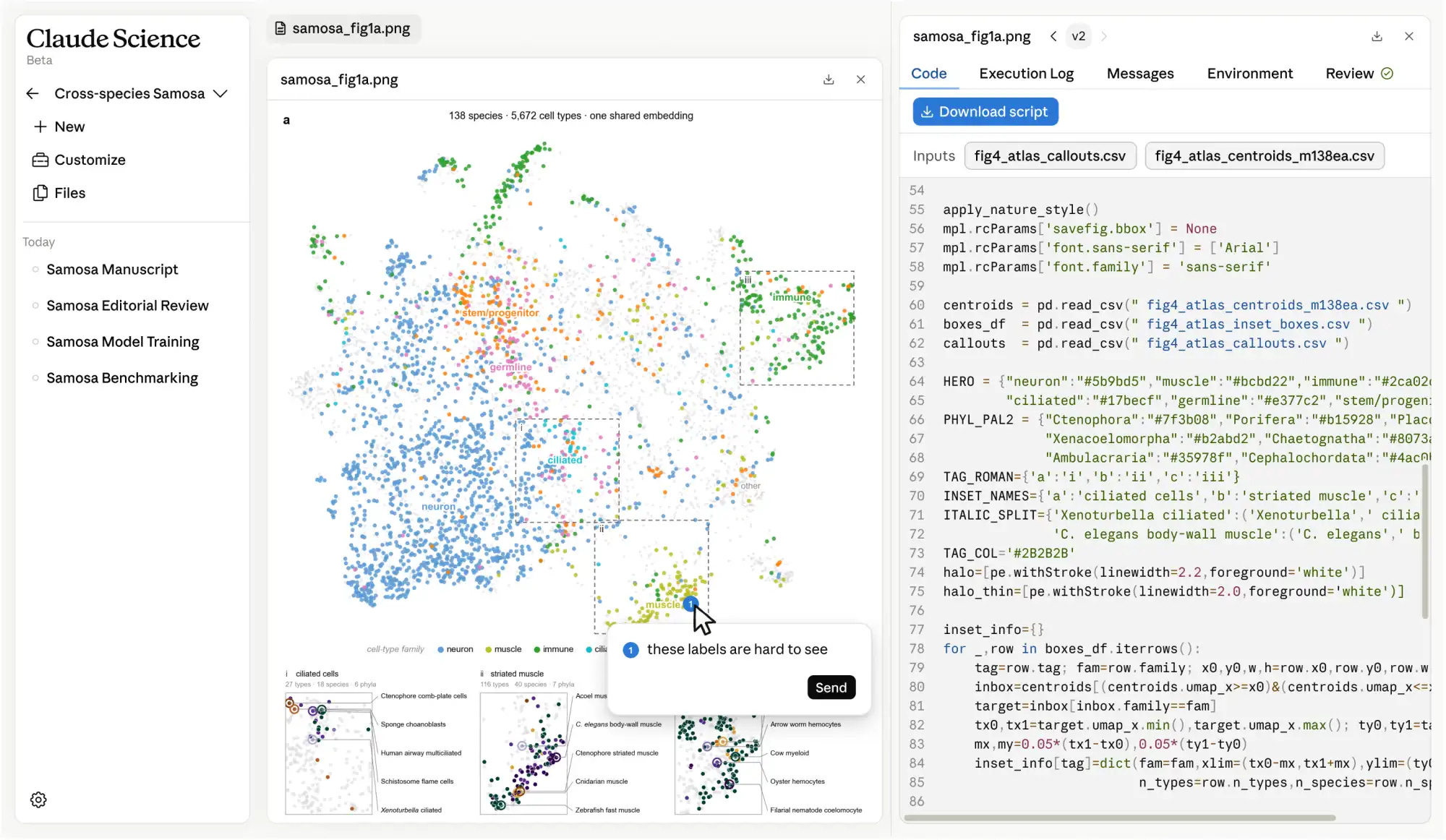
An epidemiologist at the UCSF Brain Tumor Center reports running germline workups on glioma in roughly one-tenth the previous time, then independently validated the output. Our portfolio company Kopra Bio is going after glioblastoma, the most aggressive glioma.
As seed investors, we care because the constraint on a formation-stage company is rarely coming up with ideas. It is that ideas are practically worthless without a computational biologist, a data engineer, and a cluster before the first real experiment. That team costs more than a pre-seed round. Claude Science moves that work within reach of two founders and a laptop. Cheaper experiments mean more shots and more companies worth funding at the stage where we invest.
On July 1 the FDA extended Casgevy, the Vertex and CRISPR Therapeutics gene-editing therapy, to sickle cell patients aged two and older. The prior floor was twelve, set at the 2023 authorization. Sickle cell damages organs cumulatively from infancy, so editing at two rather than twelve turns the therapy from damage control into prevention. An agency willing to edit the genome of a toddler has decided the safety record is good enough to weigh against a lifetime of disease.
The review took 53 days. That was the eighth product cleared under the FDA’s Commissioner’s National Priority Voucher pilot, which compresses a 10 to 12 month review into roughly one to two months. A sponsor files the manufacturing section and draft labeling 60 days early, a multidisciplinary team pre-reads it, then meets for a single day and reviews the whole application at once rather than in sequence. Vouchers go to products addressing a US health crisis, an unmet need, or domestic manufacturing capacity.
For an early-stage company, ten months of review is ten months of burn and one more financing round. Compressing it shortens the path to an exit and cuts the capital needed to reach it. Transcend held a voucher for TSND-201 when Otsuka paid $1.23B for the company. We now ask founders whether their indication plausibly qualifies.
Taxa Technologies is a Lexi Fund I company, and the funnest one to explain at a dinner party. Taxa engineers the microbes that already live on your skin.
Body odor is not produced by you. It is produced by bacteria metabolizing your sweat. Conventional deodorant either masks the smell or kills the bacteria, and the population grows back within hours. Taxa instead rewrites the skin microbiome at subspecies resolution, so a single application of a probiotic cream reseeds the community with strains that do not generate odor. One application lasts a week or more. The pipeline extends to engineered strains that absorb UV and repel mosquitoes.
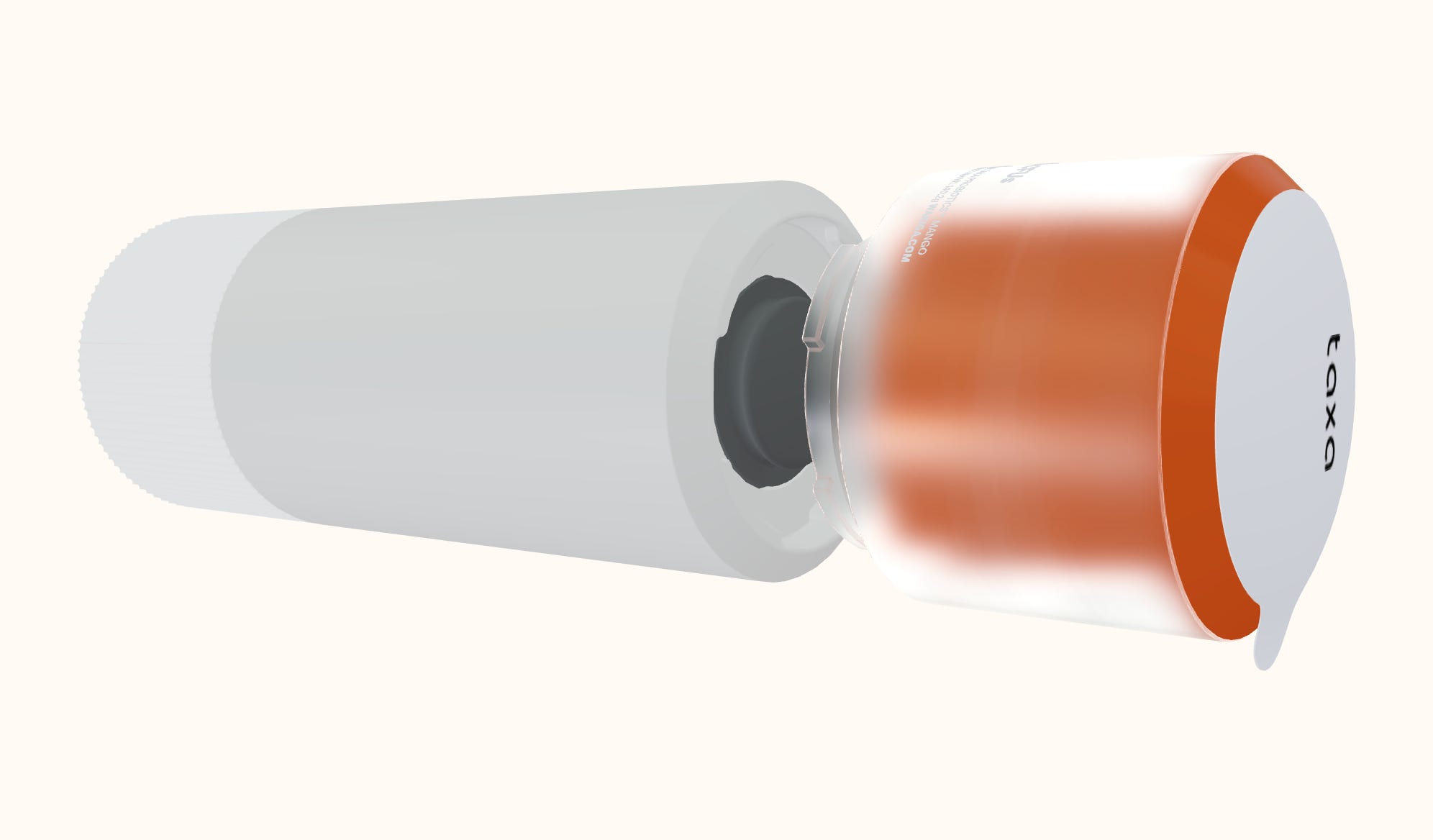
Taxa was founded in 2023 by Xavier Segel and Yuichi Fukunaga, with Jacob Baker as CSO. Taxa is a reminder that genetic engineering is not only medicine. The same tools that edit a gene to cure sickle cell can edit a gene to change what’s in your armpit. That market is larger than most investors assume.
Join the waitlist for the US roll-out of Swap!
The first half of 2026 was strong for biotech venture capital and uneven underneath. Across the firms BioPharma Dive tracks, at least 68 companies raised more than $9.1B from January through June, the highest first-half sum since 2022. About 76% of those dollars went into rounds of $100M or more, and roughly two-thirds went to companies that already had a candidate in human testing. Acquisitions ran at the best pace in at least seven years.
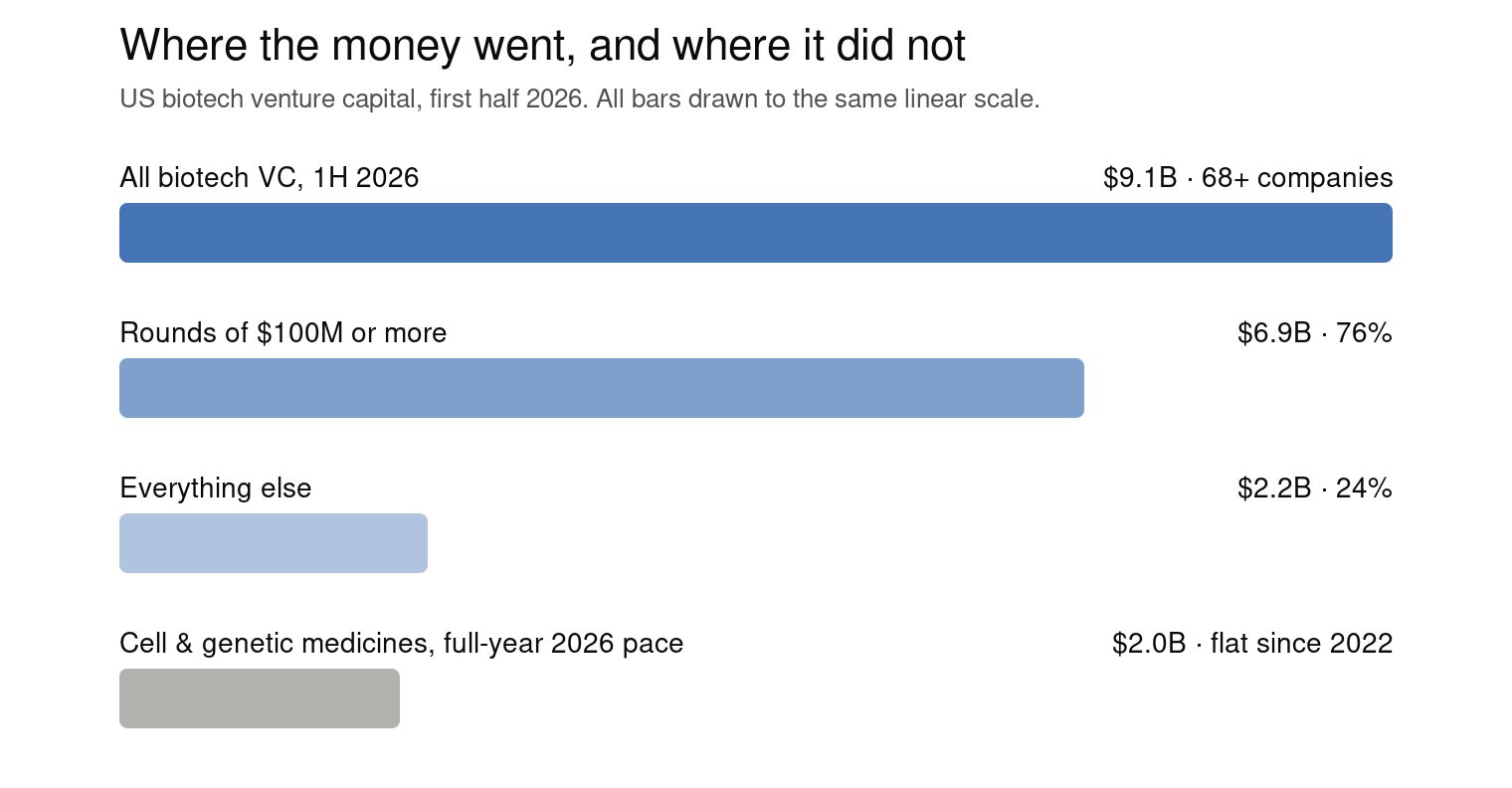
Underneath that, seed rounds and first-time founders drew less than they did five years ago, and cellular and genetic medicines are on pace for about $2B for the full year, flat since 2022. Capital is buying de-risked assets.
We read this as a pricing dislocation rather than a verdict on the technology. Quality still gets funded at the formation stage. Two of our companies proved it this year: Kopra Bio closed $9.1M with Andreessen Horowitz on the cap table, and ParcelBio launched with $13M led by Breyer Capital. Both are genetic-engineering companies in exactly the modalities the aggregate data says are lagging. The money is not absent. It is concentrated, and it reaches the strongest science first. Our job is to be there before it arrives.
Thank you for your interest and support.

Comments
Nothing yet. Say the first thing.
Sign in to join the conversation.