
For about a year, I lived on the other side of the curtain.
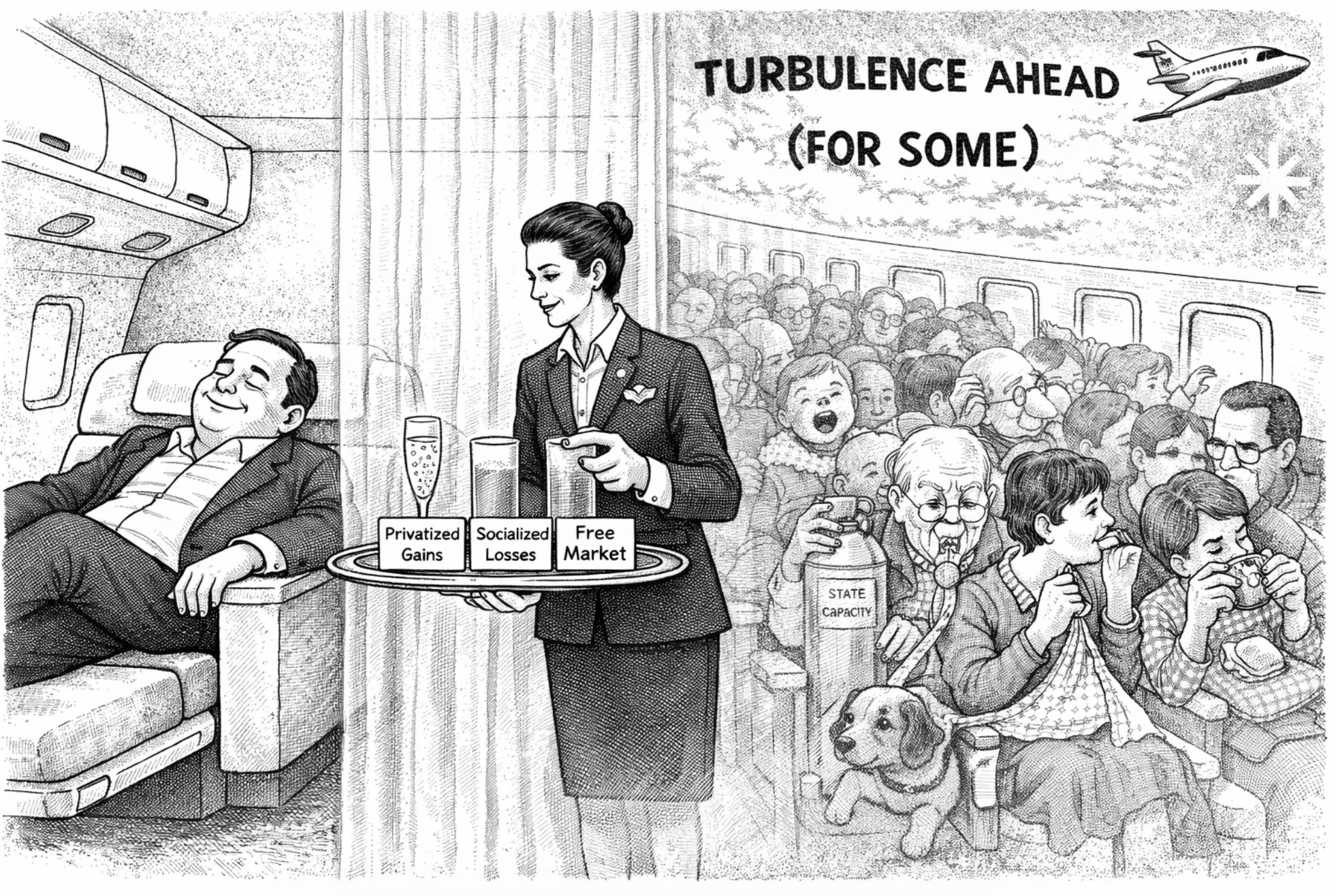
I was United Global Services. Not because I earned it. My mother had flown constantly for work, and a quirk in the policy allowed her to pass the status to me. It came all at once: pre-boarding, upgrades, real silverware, the phone line where a human answered immediately and problems dissolved before they could compound. And the curtain, that thin partition between cabins that is less a physical barrier than a signal. This is where the experience changes. This is where a different set of rules applies.
At first, it felt like a gift. Then it stopped feeling like one.
What changed was not the seat. It was my sense of what was normal. Within weeks, the silence of first class had become my baseline. The extra room, the unrushed pace, the feeling that the system was oriented toward me. None of it registered as luxury anymore. It registered as how things worked, as if the system had simply caught up to something that had always been true about me.
Then it went away. I went back to coach.
Nothing about the airline had changed. The routes, the planes, the people, all the same. But from the other side of the curtain, the experience was entirely different. More waiting. More uncertainty. Less margin for error. And something else: I was suddenly aware of a whole texture of shared life I had simply stopped perceiving. The negotiations over armrests. The overhead bin diplomacy. The small comedies of inconvenience that people navigate together when they are all, unmistakably, in the same situation.
Trevor Noah once said, “there is no comedy in first class” (I can’t find the exact video with the quote and maybe I’m mis-attributing, but the memory is pretty clear). There is comedy in coach because coach requires the recognition that none of us are fully in control and all of us are in this together. First class is specifically designed to make you forget that. When the friction disappears, so does the connection that friction produces. Privilege has a way of turning into identity. And identity, if you are not careful, turns into ideology.
But the metaphor needs updating. Because the wealthiest Americans, all 989 of them by the latest Forbes count, a record high, their fortunes swollen by post-election tax cuts, are increasingly not in first class at all. They have left the plane entirely. They have their own.
The few times I have flown private, it was fan-freaking-tastic and I was grateful for my hosts. I will not pretend otherwise. But what I remember most is not the comfort. It is how completely the rest of the traveling world disappeared. Not just the inconvenience of it, but the people, the noise, the shared negotiation of getting somewhere. All of it, gone. And with it, any visceral reminder that other people were also trying to get somewhere, under much harder conditions.
This is the material reality behind a great deal of our current political discourse. The top 1% of Americans now holds nearly 32% of national wealth, a decade-high record. The bottom 50% holds 2.5%. The people making the loudest arguments about markets, taxation, and government efficiency are, in significant numbers, people who have not experienced a commercial airport, let alone a public benefits office or an emergency room waiting room, in years. They are not arguing from behind the curtain. They are arguing from a different airport altogether.
The view from a private terminal is not just more comfortable than the view from coach. It is structurally different. It does not merely obscure the experience of the back of the plane. It makes that experience nearly impossible to imagine accurately, because the imagination, like every other faculty, is shaped by what it regularly encounters. When your environment is curated and frictionless, friction starts to seem like a personal failing in other people. The system appears to work because it works for you. That stops feeling like a perspective and starts feeling like a fact.
Somewhere along the way, the scaffolding disappeared from view. The public infrastructure, the internet seeded by DARPA, GPS developed by the Defense Department, the basic research that undergirds modern AI and pharmaceuticals and semiconductors, funded substantially by federal grants before private capital ever arrived, all of it receded. What remained was the success. Success became identity. Identity became principle. And principle became the justification for insisting that everyone else simply needs to make better choices.
The clearest sign that you are watching position masquerade as principle is selective logic, the kind that shifts quietly whenever the stakes change for the person making the argument.
Consider what the country’s most prominent tech and business leaders are actually doing, as opposed to what they claim to believe.
They are hawkish on China. They invoke national security with urgency and describe AI as the defining geopolitical technology of the century. And then some of the loudest voices on that threat continue to support technology exports and market access arrangements that serve their own bottom line in that same market. Warning that China is a strategic rival while supporting sales of advanced enabling technologies into that market is not a national security doctrine. It is a business preference with a patriotic accent.
The same inversion appears on markets and government. These leaders are vocal about free markets and the burden of state interference, except when the government is funding the research their products depend on, enforcing the intellectual property protections that defend their competitive position, or providing the Pentagon contracts that anchor their revenue. Government is the problem, except when it is the customer, the funder, or the enforcer on their behalf.
On taxation, the argument is that wealth concentration reflects superior capital allocation, that money in the hands of successful individuals produces better outcomes than money collected by the state. What this erases is that the postwar expansion of American prosperity was built on high top marginal tax rates combined with large-scale public investment in education, infrastructure, and basic research. The relationship between public investment and private wealth creation was not adversarial. It was compounding. They built their fortunes on the same public systems everyone else depends on and now argue that sustaining those systems is someone else’s obligation.
They call it principle. It is usually just position with better branding.
But intellectual honesty requires the argument to turn here. Because there is a second version of the same error, less discussed and no less consequential.
There are people who look at the private jets, the 32% wealth share, the gutted public institutions, and conclude that the answer is clear: raise taxes, fund programs, the rest follows. This is not wrong as far as it goes. It does not go far enough.
The Biden administration committed more than a trillion dollars to rebuilding American infrastructure. The funding was real. The intentions were serious. The results were incomplete in ways that mattered. The administration pledged 500,000 electric vehicle charging stations by 2026. Fewer than 10,000 were built by 2025. Not because the money was stolen. Because the permitting systems were broken, the state approval processes stretched across years, the contracting mechanisms could not move at the speed the moment required. The money arrived. The chargers did not.
California passed Proposition 30, raising significant new revenue for education. Two years later, roughly 60% had reached classrooms. The rest was caught in district bureaucracy, outdated payroll systems, and compliance requirements written for a different era.
Jennifer Pahlka has been one of the clearest voices in making this pattern legible: government failure is usually not ideological failure. It is operational failure. The policy can be right. The funding can be right. The law can be right. And the outcome can still fail because the software is broken, the hiring process is frozen, the procurement rules run to 775 pages, and the money gets stuck long before it reaches anyone. Good intentions plus revenue does not equal results. Revenue plus capacity might. {NOTE - you can get involved in Pahlka’s work on this via her new organization, The Recoding America Fund. You can also follow her work on her Substack Eating Policy and her book, Recoding America, which Ezra Klein talked with her about on his podcast episode entitled: The Book I Wish Every Policymaker Would Read}.
State capacity means the government’s actual ability to do what it says it will do, not in intention but in execution. Collecting revenue. Moving money through systems that function. Hiring and retaining competent people. Delivering services to the people who need them. Enforcing rules fairly. Without it, even the best-designed laws fail in practice. This is why a wealth tax, whatever its merits in theory, is also a question of execution. If the administrative machinery cannot convert the revenue into results, the failure becomes ammunition for the people who wanted to dismantle public institutions in the first place.
The billionaire on his private jet who says government fundamentally cannot work is wrong about the cause and convenient about the conclusion. The progressive who says tax the rich and assumes the rest follows is right about the problem and incomplete about the solution. Neither position reckons honestly with what it actually takes to convert public revenue into public results. That work is unglamorous, technically demanding, and invisible to almost everyone arguing loudest about it.
We are not sharing the same experience of this country. But we are breathing the same air. We are depending on the same highways and broadband cables and electrical grids and public health systems, whether we experience them directly or not. Moving to a private terminal does not dissolve that dependence. It only makes it invisible.
That invisibility is the problem. Not the wealth itself. Not even the jets. The problem is what happens when the people with the most power over how this country is organized lose the ability to perceive what the organization costs, and who pays, and what breaks when the maintenance stops. When your world is silent and frictionless, friction starts to look like a personal failing in other people. The system appears to work because it works for you, and that stops feeling like a perspective and starts feeling like evidence.
First class is not a moral category. It is a position produced by a system. The same is true of a private plane, of a $140 million net worth, of being among the 989 Americans whose collective wealth now shapes the political conditions everyone else lives inside. The confusion of position with proof, and the politics built on top of that confusion, is what makes the current moment so difficult to navigate honestly.
A wealth tax is, among other things, a way of making visible what has become invisible to the people at the front: that the system which lifted them there has obligations to everyone still depending on it. Not punishment. Maintenance. The same way an airline has to maintain the whole aircraft, not just the cabin that generates the most revenue.
Global Services was phenomenal. The few times I have flown private, it was dreamy.
I am not going to build a political argument on the pretense that I did not enjoy those things. But I also keep coming back to what gets lost in that kind of silence. The shared complaints. The arm rest negotiations. The small, absurd comedy of strangers deciding, without discussion, to tolerate each other across a long flight. None of that exists in first class. None of it exists on a private plane.
There is no comedy in either. And in a life that was always short and is growing shorter, I find I want the laughs more than the legroom. Not as an aesthetic preference, but because the laughs come from the recognition that we are all in this together, that none of us are fully in control, and that the only sane response to that fact is to find it a little funny and try to make the shared experience more bearable for everyone on board.
That is the project. Not which cabin you sit in. Whether the plane lands well for everyone on it.
Thanks for sharing with others
Comments
Nothing yet. Say the first thing.
Sign in to join the conversation.