
In Chinese astrology, 2025 was the Year of the Snake, associated with shedding what no longer serves you, turning inward, and clearing ground. That felt right at the time, so I leaned into it. Then 2026 arrived as the Year of the Fire Horse, a rare sixty-year cycle associated with momentum and bold action. The phrase ma dao cheng gong captures its spirit: success arrives with the horse.
I had plans for the Fire Horse.
The Fire Horse had other plans for me.
Something began shifting in my health during 2025. At first it was subtle. Small irritations I folded into the rhythms of work and life and tried not to make too much of. When the new year arrived, the pace changed.
On February 19th the left side of my face froze. I was diagnosed with Bell’s palsy. The paralysis was severe and sudden. What accompanied it was worse: an excruciating, constant pain in my head, ear, and jaw that has not let up since. Twenty-three days now. Heavy medication does not touch it.
Tests followed and are still ongoing. I am not going to name everything here, not because I am being coy, but because the list is not the point and the picture is still developing. What matters is that things that once felt stable - my energy, my nervous system, my ability to rely on my own body - have begun behaving unpredictably slowly and then all at once.
The Bell’s palsy will, hopefully, pass.
The other things might not.
When my neurologist finally named what she was seeing this week, she chose her words carefully.
Life altering, she said, but not life limiting.
Those were difficult words to absorb. Not because I believed I was immune to illness, but because the pattern had unfolded in such a way that I had not fully registered what it was becoming. Something here. Something there. A symptom that could be explained away. Another that seemed manageable in isolation.
Until the pieces began to line up and it became clear this was not a series of unrelated problems but maybe different clusters of things signaling multiple systems degenerating (ugh! that word!) at once. Or not. We just do not know.
We’re in the long and roller coastery middle of something. At the very least, a new structure of life taking shape.
Success arrives with the horse? I suppose that depends on how you define success. Right now, that is not how this feels.
This piece is not a request for help or ask for pity. I can work, I can move around, I am generally fully functional (albeit with an eye patch, a funky face, some gnarly pain, less talking than I normally do and no driving; the latter two things are great for everyone).
Rather, it is an apology, a reflection, and a question about what we have built together.
Just before our first daughter was born, my husband had an acute health crisis. Thankfully the immediate crisis passed, but it became a chronic condition he now lives with.
He is someone who shares what he is going through. He talks things through out loud. He lets people see what is actually happening inside his life. It is one of the qualities that makes him such a generous friend and partner.
I am not built quite the same way. I tend to process privately and keep things contained. Over the years I have become better at sharing, largely because of him, but my instinct is still to hold things closer.
When he was navigating his health challenges, he was open about what he was experiencing. He talked about it with friends, family, and colleagues. One of his best friends and I even joked that maybe he could dial it down a little. At one point I said something to the effect that people do not necessarily want to hear the details of someone else’s health problems.
At the time it felt like practical social advice.
Looking back, I can see that it revealed something else.
It revealed the limits of my imagination.
Right now the balance of our household has shifted dramatically. We have always shared the responsibilities of raising our children and managing our home while both navigating careers. But at the moment I am able to work and be present with my family while contributing very little to the daily logistics that keep everything running.
He has taken those responsibilities on without hesitation. Driving the kids, cooking meals, helping with homework, managing sports practices and games, and handling the steady stream of small tasks that keep a household moving.
He has done it with a steadiness and selflessness, always checking on me and asking what more he can do, that still leaves me in awe.
My friends and family have shown up the same way. My work colleagues have been remarkable.
The phrase support system suddenly feels too small for what it means when people quietly rearrange things to show up for you.
I see all of you.
Thank you is nowhere near enough, but it is what I have.
Which brings me to the apology.
What I understand now, and did not understand when my husband was going through it, is how difficult chronic illness, and especially chronic pain, is to imagine if you have never lived inside it. Not because people lack compassion, but because the experience itself resists explanation.
Most of us know how to respond to an acute crisis. There is a diagnosis, an accident, a visible emergency. Those stories have an arc. Something happens, people mobilize, and eventually there is resolution. We show up, we fix what we can, and when the crisis passes we feel we have done our part.
The long middle does not work that way.
It is the stretch where nothing resolves. Symptoms fluctuate. Some days are manageable. Others are less so. The timeline is unclear and the person living it often cannot tell you what they need. Not because they are withholding, but because they no longer quite know who they are. The self they knew how to take care of has shifted. The new one is still coming into focus. They are adjusting to a normal that has not yet arrived, and there is no clear ask to answer, no resolution in sight, no moment where the helper gets to feel the satisfaction of the problem solved.
We carry, or at least I did, a quiet assumption that people will generally be healthy, that setbacks are temporary, that with enough will and effort individuals can restore normalcy. My instinct has always been to fix things. If there is a problem, you solve it. But some disruptions cannot be fixed. They must instead be absorbed, navigated, and lived alongside.
As I’ve been trying to understand this, I think this tendency is where something deeper begins to show itself.
The difficulty we have imagining life inside chronic illness is not only personal. It reflects a broader pattern in how we design systems in the United States around health and well-being. Those systems were largely built by people trying to solve specific problems, not by people living inside the conditions those systems are meant to support.
I have good health insurance. I have the time and resources to pursue answers. Even so, assembling coherent care has been one of the most exhausting and at one point genuinely dangerous experiences of my adult life. An early doctor gave me a possible diagnosis that was life-threatening and was also totally and irresponsibly wrong. No one was holding the full picture besides me. I was doing that myself, in pain, with a lot of AI assistance.
Eventually I built my own team with the help of friends: specialists for individual systems and a primary doctor (who does not take insurance) willing to look at me as a whole person rather than a presenting complaint.
If navigating the system is this complicated for someone with resources, it is really and truly almost impossible for people without them.
American healthcare is very good at treating events. It is far less capable of sustaining people.
It was built over time as a patchwork of insurance structures, specialized medicine, and targeted programs. Each piece works well on its own terms. But the whole person rarely sits at the center.
The underlying assumption is that illness is a discrete problem requiring a discrete fix. Find the broken part. Treat it. Bill for it. The whole person is nobody’s business model.
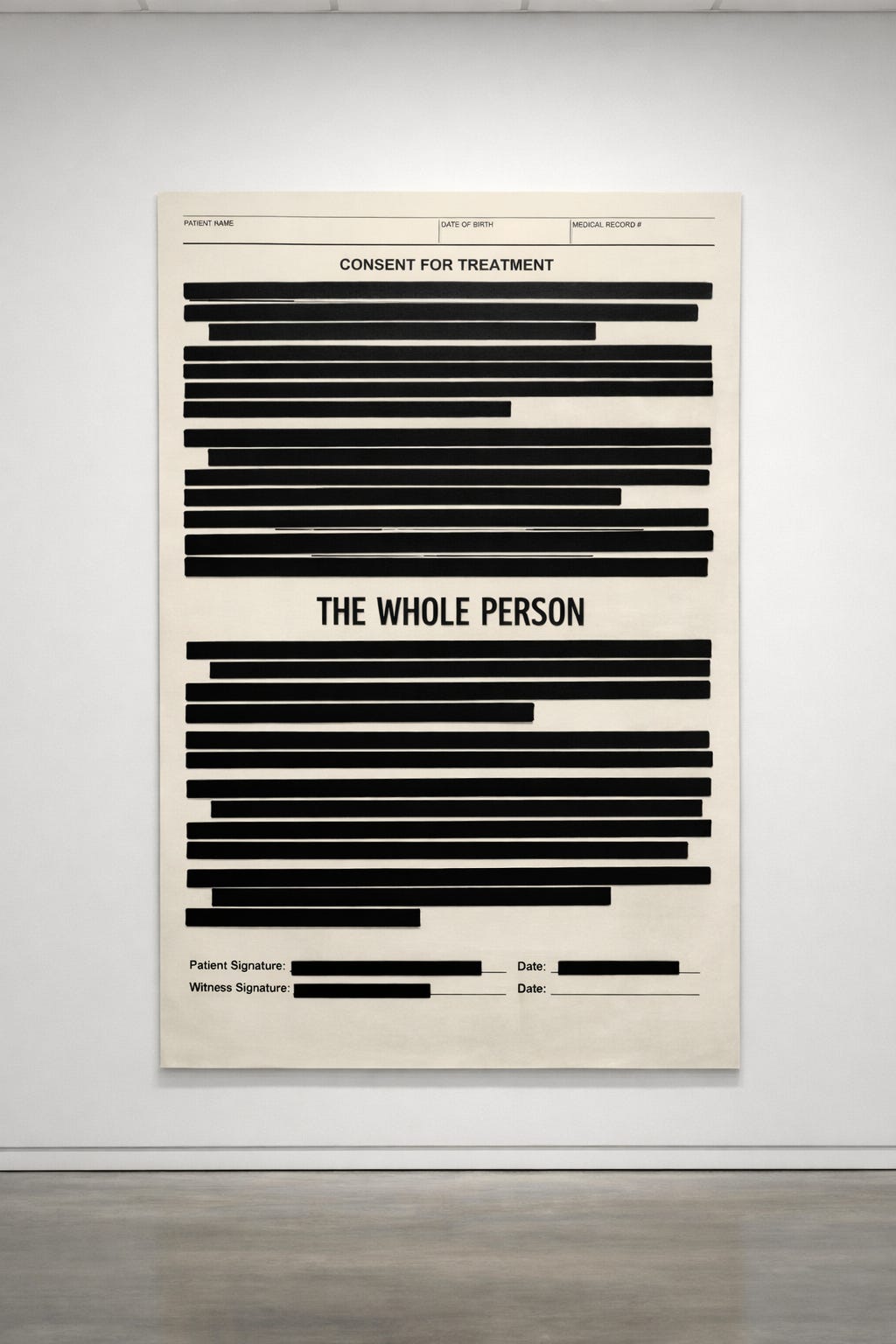
This maze of fragmented, reactive healthcare is not unique to healthcare. It reflects how we have organized American society, and about what we have quietly decided people are worth. Especially in the current Administration.
Consider the current push to give Americans investment accounts from birth, sometimes framed as a way to modernize Social Security. The instinct is not without merit. Ownership matters. In an economy increasingly shaped by technology and artificial intelligence, more Americans should share in the growth that technology creates.
But assets are not capability. And an account is not a life.
True security comes from the constellation of supports that allow people to build and sustain something real. Education that develops genuine skills. Healthcare that treats the whole person. Work that provides not just income but dignity, purpose, and community. Mental health treated as seriously as physical health.
When the proposal for investment accounts arrives alongside cuts to Medicaid, defunded public schools, stripped worker protections, and disappearing workforce development programs, it stops looking like investment in people. It starts looking like the same pattern we have seen everywhere else: address one visible symptom, declare the problem solved, and let the whole person continue to disappear from the picture.
This is what we do. We design systems to fix isolated glitches at the lowest possible cost rather than asking the harder question: what do people actually need in order to live well over time?
The Commonwealth Fund has documented for years that the United States spends more on healthcare than any comparable nation while achieving worse outcomes on nearly every population health measure. Our education results tell the same story. These are not isolated failures. They are the predictable consequence of a society that has never seriously organized itself around the flourishing of everyone in it.
What would it look like if we did?
Not as charity. As architecture.
The countries that come closest to that answer did not get there through sentiment. They built systems whose primary measure is whether people are genuinely equipped to live full and healthy lives. Primary care that holds the whole person over time. Mental and physical health integrated rather than siloed. Education and workforce development that produce real capability alongside income. Financial systems with ladders, floors, nets, and trampoline bounce backs strong enough to prevent the kind of cascading crisis that makes everything else impossible to address.
Most of this has been demonstrated to reduce emergency costs, improve productivity, and lower long-term spending. The barrier is not knowledge. The barrier is that we have not decided, as a society, that everyone’s flourishing is a goal worth organizing around.
We have chosen instead to treat suffering as a personal matter, design systems to process problems rather than prevent them, and trust the market to sort out the rest.
The cruelty I directed at my husband was small and came from ignorance, and I am so deeply sorry for it. The cruelty embedded in systems that greet suffering — in health, in financial circumstance, in any of the ways a life can come undone through no fault of its own — as individual failure rather than collective design flaw is larger, slower, and far harder to see when you are not inside it.
But they share the same root. An inability or unwillingness to recognize that someone else’s suffering is reason enough to respond, whether or not we will ever experience it ourselves.
*******************************************************
I am still in the middle of this. The answers are still coming in. I do not yet know what I am adjusting to.
What I know is that being here, inside the long middle, has given me a clarity about what we owe each other that I’m not sure I would have arrived at any other way.
The Fire Horse is a year for bold action. I am not moving at the speed I planned. But I am paying attention in ways I was not before. And I am starting to believe that is not a consolation prize.
It might be the whole point.
I hope you are reading this in health and wellness. But, if not, I send you love.
Comments
Nothing yet. Say the first thing.
Sign in to join the conversation.