
The word cannibal first appears in English in 1541. It came from the Spanish caníbal, derived from the name the Arawak peoples of northern South America and the Caribbean gave themselves, cariba, meaning 'brave' (this was also where the name Caribbean came from). Courageous they may have been, but Spanish explorers were more interested in the lurid accounts of the Carib castrating, fattening and consuming their enemies.
Many of these tales were either greatly exaggerated or made up entirely, but they were politically useful. After Spain’s Queen Isabella decreed that cannibals could be sold as slaves, Spanish imperial forces were incentivised to identify indigenous peoples as que comen carne humana (eaters of human meat), regardless of their true dining habits. (In this it has been compared to how some regimes label opponents terrorist to legitimise repression.)
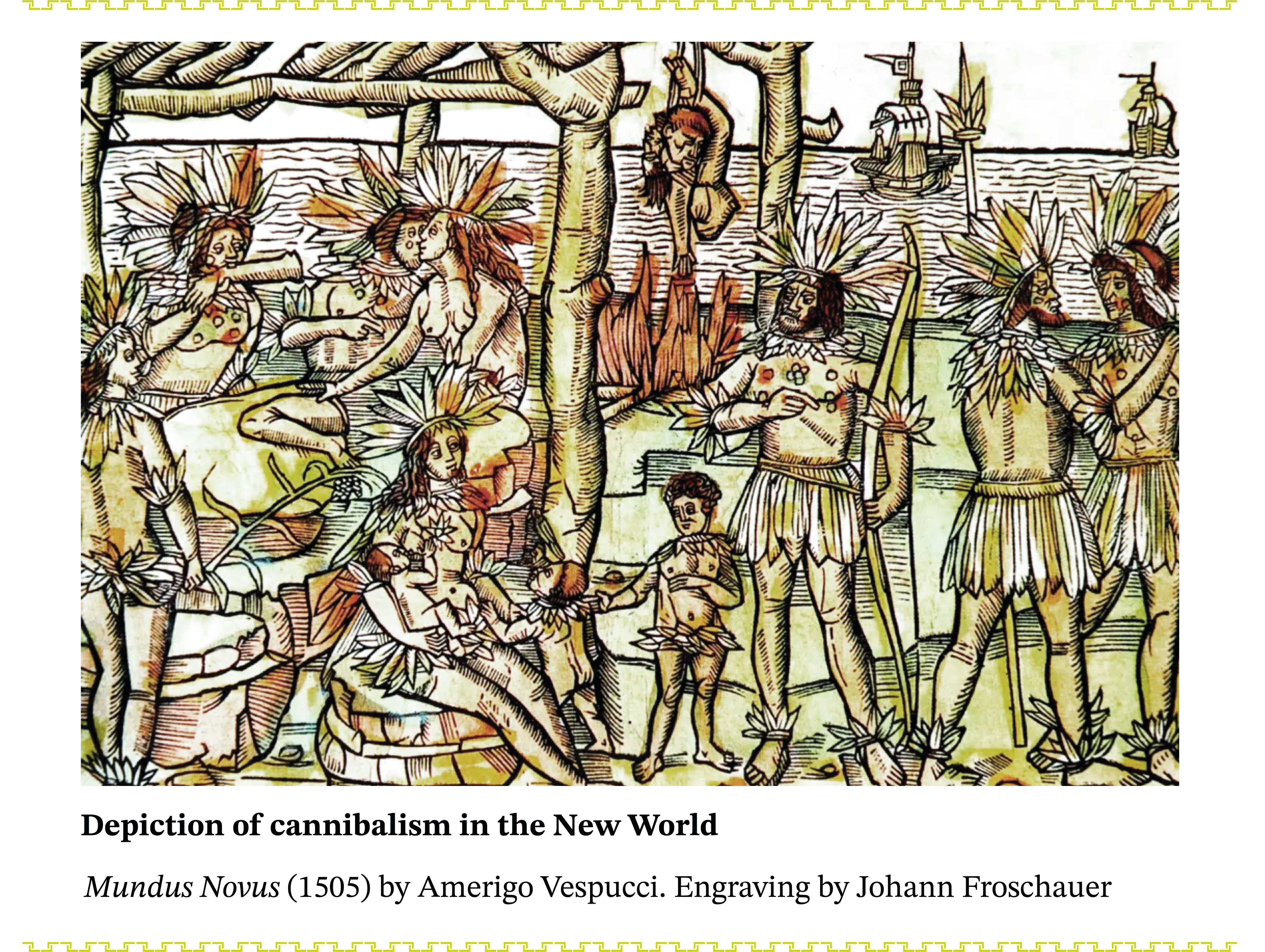
Despite the cooked-up stories, however, there were man-eaters in the New World - and in China, New Zealand, the Congo, New Guinea, Fiji (known to Europeans in the 17th century as the Cannibal Isles), Samoa and more. But the Why’s, How’s and Who’s of cannibal customs varied depending on whose table you were served at.
Anthropologists distinguish between endocannibalism, where people within the community are eaten, often within the context of grieving (so-called funerary cannibalism), and exocannibailism, where the meat is from killed or captured enemies outside the community (war cannibalism). They also differentiate between cannibalism for nourishment – survival and culinary cannibalism – and more ritualistic forms, sometimes referred to by an older word for cannibalism, anthropophagy, from Ancient Greek anthropo- (human) +phagus (eating).
Recognising these distinctions, Christian Siefkes, author of Edible People: The Historical Consumption of Slaves and Foreigners and the Cannibalistic Trade in Human Flesh (2022), argues we shouldn’t talk of a singular cannibalism but many cannibalisms. Siefkes identified thirteen types to chew on, including: infanticidal cannibalism, corpse food, foreigner poaching, slave eating, sacrificial cannibalism, medicinal cannibalism, famine cannibalism and antisocial cannibalism. In other words, there are lots of reasons to eat someone.
Where the English language struggles is what to call these human ingredients. Man-meat (1962) is all the Oxford English Dictionary has to offer, while human flesh is the term most commonly found in historical accounts, but neither suggest any gastronomic appreciation. Those doing the eating described things differently. Long pig (Vuaka balavu) was the Fijian name, along with long turtle (Vonu balavu) and trussed frog (Botu-walai), which was a man baked whole. In parts of China, two-legged mutton was the appetising euphemism, alongside thinking meat or craved meat (translations vary). While in the Congo it was the flesh that speaks (‘la viande qui parle’). The Maori tradition of kai tangata (people-eating) has long been forgotten, but when it was practiced involved a man-sized stone oven, the umu tangata, designed for the purpose. In the Aztec civilisation, human meat and maize were the same word – tonacayo, meaning ‘our flesh’ – reflecting the link between the human body and the food that sustained it. Uniting the two, literally, was the Nahuatl dish tlacatlaolli - ‘man corn’ - described as a ‘sacred meal of sacrificed human meat cooked with corn’. Recipes don't survive, but I imagine it was like a meaty succotash.

The Spanish weren’t the first explorers to find cannibals in faraway lands. The Greek historian Herodotus wrote about the Issedones and Padaens who practiced funerary cannibalism; and later, in the first century CE, the Roman general Strabo told of the ‘savage man-eaters’ in Ireland, just beyond the Imperial domain, where they devoured their fathers and had sexual intercourse with their mothers and sisters. Incidentally, the assocation of cannibalism with incest has long been a preoccupation of foreign observers, but that's another story.
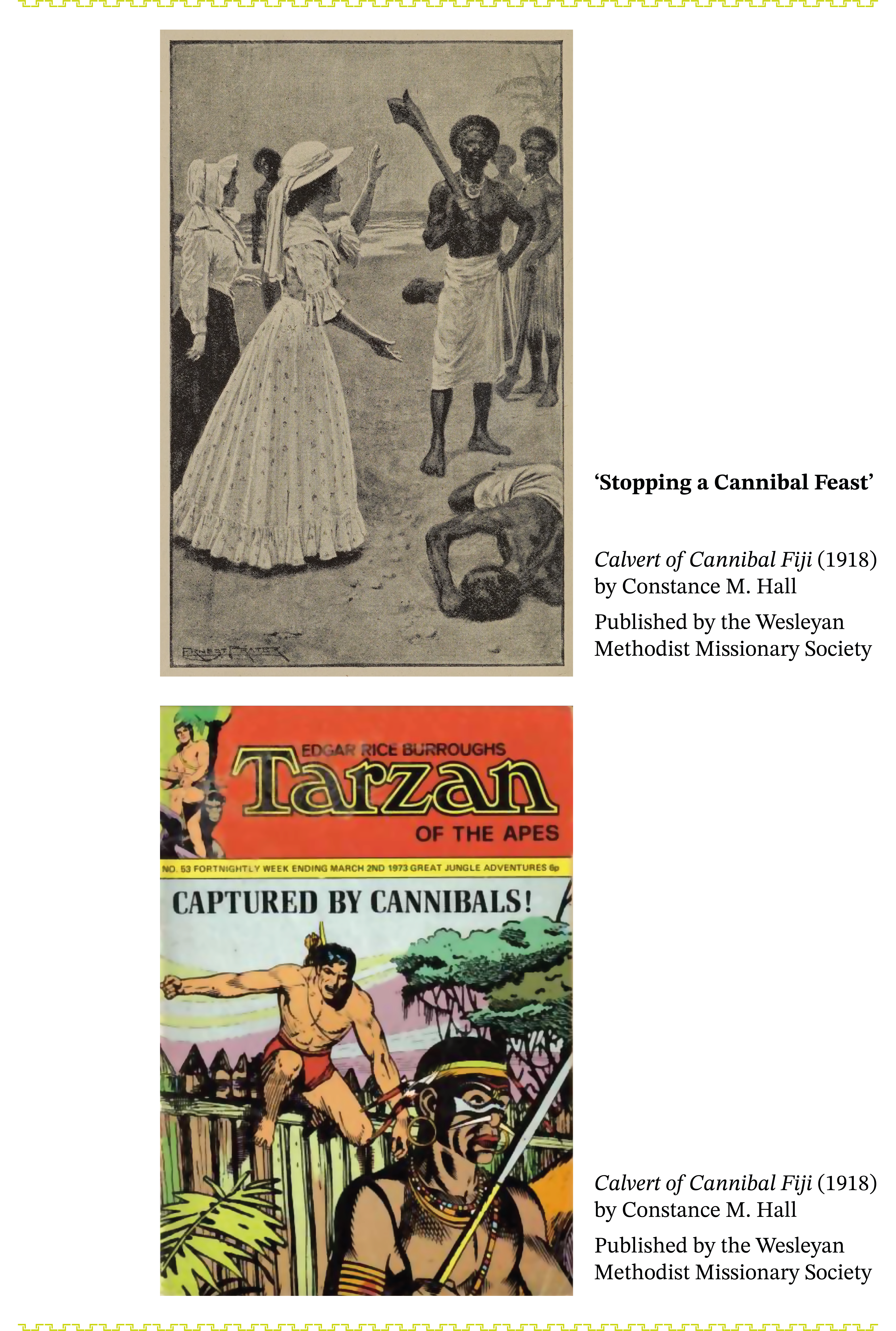
The fascination with savagery at the frontiers of ‘civilisation’ was a potent theme for Europe’s colonial powers too, where the cannibal was the ultimate Other; bloodthirsty, dangerous and animalistic. Outlandish stories of frenzied cannibal feasts proved the moral superiority, necessity even, of colonialism, and fed racist tropes that still echo today. To Victorian England, Africa was a cannibal continent whose savagery could only be saved by Christian missionaries and British soldiers. The same themes pervade accounts of indigenous peoples in New Zealand, Australia, the Americas and Polynesia. In all these places, the Cannibal - both real and imagined – was an important feature of the colonial narrative.
Given its taboo status, it might be surprising that cannibalism isn’t a named offence in many countries (although would-be cannibals should avoid Idaho, the only US state to have an anti-cannibalism statute on the books). Instead, laws around murder, assault and the storage of human remains make cannibalism effectively criminal, although there are a few interesting get-arounds, like auto-cannibalism and consensual cannibalism.
As the term suggests, auto-cannibalism involves consuming parts of yourself. It sounds unlikely, but it happens. After a motorbike crash in 2018, a Reddit user known only as IncrediblyShinyShart had his foot amputated. Requesting the limb be returned afterwards, he had the meat cooked as fajita tacos to share with friends. Yes, they knew what they were eating, and no, it didn’t taste like pork. “It was almost like venison”, he said, with a “very pronounced beefy flavour”. But maybe that’s just foot. (You can read about IncrediblyShinyShart's meal here, and find more accounts of auto-cannibalism in this Wikipedia list.)
Eating one’s own placenta after childbirth, so-called placentophagy, is arguably another form of legal cannibalism, with plenty of recipes available online. And so long as it’s consensual, drinking human blood - haematophagy - is kosher too, although not kosher kosher (see Leviticus 7:26).
Blood-drinking animals are sanguiniverous, but blood-drinking people prefer to call themselves medical sanguinarians, or vampires. In the darkest corners of goth subculture, real vampires actually exist, fed by willing blood donors, sometimes known as black swans. But is it cannibalism if there’s no flesh involved? They'd say not, but it’s certainly cannibalish.
Another loophole, albeit an unenviable one, lies in certain instances of survival cannibalism. It's rare today, but in centuries past, survival cannibalism was an acknowledged feature of maritime lore, with one historian describing it with the masterful euphemism the custom of the sea. Speaking of euphemisms, the survivors of the 1972 Andes plane crash sought to justify their survival cannibalism to the media in what became known as the communion defence, arguing that they were inspired by Christ’s Last Supper to eat the bodies of deceased passengers. Years later, survivor Carlos Páez Rodríguez was rather more honest, saying: “We were hungry, we were cold and we needed to live.”

Drawing our linguistic tour of cannibalism to a close, it would be remiss not to mention Jonathan Swift’s celebrated satirical essay, A Modest Proposal (1792), in which he suggests that the children of the poor would make a delicious and nutritious alternative to traditional farmed meats, providing desperate families with a source of income, and wealthy landlords with a bountiful table.
As Swift explained, ‘a young healthy child well nursed is at a year old a most delicious, nourishing, and wholesome food, whether stewed, roasted, baked, or boiled; and I make no doubt that it will equally serve in a fricassee or a ragout.’ He even provided some recipe instructions, although they’re pretty basic. The same couldn't be said about The Cannibal Cookbook (2019), a collection of ‘human meat recipes from around the world’ compiled by convicted murderer Nico Claux. This ghastly book (please don’t look for it!) reflects a more contemporary interest in cannibals; not the savage Others from faraway lands, but the epicurean serial killers who enjoy their prey with fava beans and a nice chianti.
No posts
Comments
Nothing yet. Say the first thing.
Sign in to join the conversation.