
Gm Fintech Architects —
Today we are diving into the following topics:
Summary: We examine why financial narratives like ICOs, NFTs, and AI agents can attract billions before the underlying economy actually arrives. Bankr and Virtuals illustrate the problem: both generated substantial fees during their respective agent-token booms, then saw activity collapse by more than 90% as attention moved elsewhere. We propose five tests for separating a temporary financial “meta” from durable technology: external revenue, miracle count, chokepoints, boring prices, and clock speed. The key distinction is whether value depends on continued attention and speculation or survives through real customers, cash flows, infrastructure, and distribution.
Topics: Stripe, Coinbase, Robinhood, Tempo, Virtuals, Bankr, Revolut, Epsilon Theory, Perscient, Kalshi, Polymarket, Generative Ventures, OpenAI, Goldman Sachs, Ticketmaster, Uniswap, Sushiswap, Binance, Gartner
Thanks as always for your time and attention,
Lex
To support this writing and access our full archive of newsletters, analyses, and guides to building in the Fintech & DeFi industries, see subscription options below.
Generative Ventures | AI Research | Robot Money | Linkedin & Twitter | Sponsors
🚀 Lex is actively meeting teams building machine-native financial companies. If that’s you, reach out here.
🤖 AI & Robotics Industry Encyclopedia: In this 100+ page report, we collate all the meaningful companies across public quities, private equity, and digital assets related to the machine economy. 👉Learn more here
🦄 In partnership with InterPrivate, we just launched a $200MM SPAC looking for targets in fintech, digital assets, and AI infrastructure. If you are a late-stage founder or have an idea to discuss, reply directly to this email.
The problem with being early is you don’t really know how early you are. Or to what really.
Sometimes being early means you get the glory and success of everyone that follows. You are the great conqueror, having discovered the secret path.

Sometimes it means you have brought your party to the desert, and it is there, without water and food, that they will starve and die.
I’ve been trying to grapple with the contradiction in the current market environment in all sorts of ways. One of these is to generate charts and research documents, and point out the difference between infrastructure and application cycles. That’s the logical side trying to find an anchor to a mechanism that makes sense.
But here’s the other way. How is it possible that Stripe and Coinbase, and maybe Robinhood, are spending billions of dollars on the agent economy and yet the ground is barren and there is barely any economic activity? Tempo appears to be ramping up a bit, but we do not know whether this is AI-related or just general nominal payment volume transfer.
These are the big incumbents!
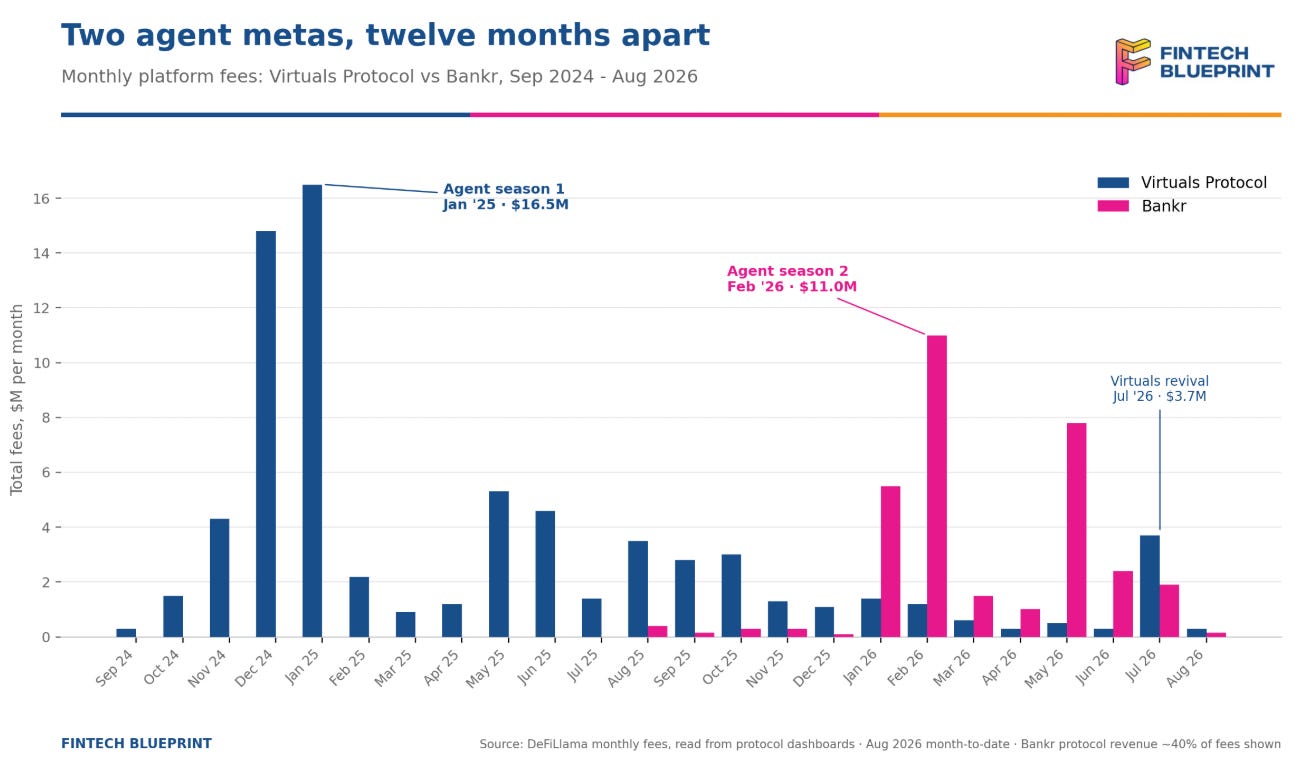
And what of the early pioneers? Take Virtuals and Bankr, two onchain projects and ecosystems that have flown a tall banner around DeFi, onchain capital markets, AI agents, and generally what I would classify as machine economy.
If we look at revenues, there is a clear problem.
The business model of these projects is primary token issuance, and then ongoing trading volume provision — taking a share of the market making fees. That means the projects win when financial events happen, not when the underlying thesis (i.e., machine economy) of the funded companies gains traction in the real world.
Comparable volatility can be seen in the attention markets — Google search indexes of people searching these niche names. In fact, we can go deeper and try to get a feel for some larger financial fashions that have been covered in detail in our newsletter.
Consider — ICOs, NFTs, and LLMs. All three-letter-gifts from the Fintech Gods to a research analyst, and unique in meaning to their time.
Initial Coin Offerings were meant to replace IPOs and equity crowdfunding with tokens, and bring retail forward to capital market participation. They were later rebranded as token generation events, Initial Exchange Offerings, and arguably fair-launch memecoins.
NFTs are non-fungible tokens, which is just a way to put digital rights management on digital objects like images, music, video, and software constructs. They became bundled together with ideas of the metaverse and a new economic paradigm echoing the creator economy and social media.
LLMs are an intermediate title for large language models, as opposed to image, video, or other foundational models. Their title evolved from neural networks, generative AI, and is now being replaced by “AI agents”.
We can also compare those searches against another custom and unique word, “Revolut”. Unlike a thematic label, Revolut is a name of a neobank that functions like a perpetual motion engine through cashflow, and is therefore able to reinforce a brand through products and services rather than attention and information markets.
What can you notice?
Fashions spike and fade.
And this is true for most such labels. It does not imply that the underlying theme is wrong or that there is no substantive progress. Rather, it implies that the label has a quality that both enhances and obscures reality. My discussion here is quite a direct lift from Epsilon Theory, which tracks memetics and narratives as a series of quantitative objects commercialized through Perscient.
That neatly maps into the financialization of all markets, and the collapse of the younger generations into gambling through Kalshi, Polymarket, Coinbase, and Robinhood across the world.
It is not enough to say (1) there are fashions, (2) there are some truths, and (3) the speculative fashions power the adoption of the truths. I want to understand this better so we fail less, so that we do not fall for the trick of the story, or if we do, so that we sell it before the story expires.
Why does Revolut persist while the Metaverse dies?
Comments
Nothing yet. Say the first thing.
Sign in to join the conversation.