
(Paying Subscribers, you will find a rare Stuff Smith 8-minute radio broadcast at the bottom, featuring wild violin and Jonah Jones’s flamboyant trumpet.)
[Anthony Barnett is a poet, editor of the literary and arts print journal Snow lit rev, and a jazz historian specializing in violinists who has published books and articles and uncovered and released many previously unknown recordings, all available here. He has shared exclusive material with us before. Here are more unknown jazz violin recordings, this time from Paul Whiteman’s radio show.
Paul Whiteman (1890-1967) is a controversial figure in jazz history. He is not the main topic of this essay, but I must note that while he was a hugely popular bandleader among white and even many Black audiences, he was also disparaged by “hardcore” Black and white jazz fans and musicians for presenting a type of “light jazz.” And when his management promoted him as the “King of Jazz,” he readily accepted the title, seemingly oblivious to the affront that this offered to the many Black artists on whose shoulders he stood. On the other hand, by premiering the longer works of composers such as George Gershwin and Ferde Grofé, Whiteman encouraged a melding of jazz with classical music that is increasingly important to this day. He was invited to perform with his all-white orchestra for Black audiences at the Savoy Ballroom in Harlem and at a Black college. And on occasion he presented Black performers, notably Stuff Smith, and works by Black composers. So—”it’s complicated,” as they say. I’ll let Anthony continue:]
Stuff Smith and Paul Whiteman, by Anthony Barnett
The exciting violinist Stuff Smith (1909-1967) had a long history with Paul Whiteman. He was first a guest on Whiteman’s New York radio show on February 23, 1936. Whiteman introduced Smith as “The New King of Swing,” and the music that Stuff played was released years later on rare LPs and CDs. (These tracks, featuring wild violin and Jonah Jones’s flamboyant trumpet, are below for Paying Subscribers.) This is believed to be Smith’s first New York broadcast after opening at the Onyx Club on February 3 and making his first Vocalion recordings on February 11 (excluding a no-longer-extant January try-out) .
A few months later, Smith appeared on the same concert as Whiteman’s Swing Wing, a small group of Whiteman band members, at the famous New York’s First Swing Music Concert at the Imperial Theatre, May 24, 1936. Although not recorded (a purported Artie Shaw “swing strings” performance turned out to be a studio recreation), photos are extant. Smith’s group, along with Louis Armstrong’s, and solo pianist Meade Lux Lewis, were the only black performers among some seventeen or so bands. The Swing Wing included Frankie Trumbauer and the Teagardens—Jack and his trumpeter brother Charlie. (The Three T’s, as they were known, had performed Smith’s “I’se a-Muggin’”on a March 1936 Whiteman program that has been issued.) A Joe Venuti outfit was advertised but did not show—it would have made an interesting contrast with Stuff’s music. Publicity credits the concert as sponsored by Joe Helbock’s Onyx Club. Smith, in a 1960s radio interview (I believe in Sweden but I cannot for the moment lay hands on it), recalled that it was also sponsored by Whiteman. There is no publicity to support this claim, but Whiteman contributed an essay to the program book, and it is certainly possible that he did also contribute financially.
The New York magazine Collier’s issue of September 10, 1938 invited Paul Whiteman to select his notional dream orchestra “The All-America Swing Band.” In a previous essay, Lewis showed that the Black press criticized his list for omitting major Black artists. Whiteman also devoted several paragraphs to violinists: He included a four-man “All Fiddling Fools” string section, comprising Joe Venuti (“Joe isn’t the father of the swing violin; he’s the grandfather of it”), Al Duffy (“He’s almost as crazy but not quite as funny as Joe”), Black virtuoso Eddie South (“There’s no style of music he can’t read and play”), and Matty Malneck (“He is a man who ranks with the best”). Smith was not there—to be fair, it’s hard to imagine him sitting still in a string section! Yet the following year, Whiteman, in association with votes cast by “hundreds” of radio editors, had ousted Duffy, and Smith was indeed there. The presence of seven Black musicians in the 1939 list was noteworthy enough to be remarked on in the national white press, as well as in Black newspapers such as the Pittsburgh Courier, who called them “sepia” musicians on November 25, 1939:

Further, on February 21, 1939, the Chicago Federation of Musicians produced the “Biggest Dance Ever” featuring numerous bands, mostly white ones including those led by Bob Crosby and Tommy Dorsey, but also Fletcher Henderson’s and an act listed as “Stuff Smith - Paul Whiteman.” This indicates a strong association between the two musicians.
Surely there are more such instances, but let’s move on now to today’s discovery: Smith was known to have been a guest on Whiteman’s show on WABC radio, New York, March 25, 1954, at 9 pm. The program was pressed on a 12’‘ transcription LP for radio stations, AFRS F36303 Paul Whiteman Varieties, no. 6. I have not found a copy, and there is not one in the Whiteman archives at Williams College. The late Bozy White owned a tape dub, which was borrowed and never returned. Who has it? However, a recording of Smith’s two numbers, made off the radio at Nola Recording Studios, has recently surfaced. As the labels show, Smith played “How High the Moon” and “Body and Soul”:
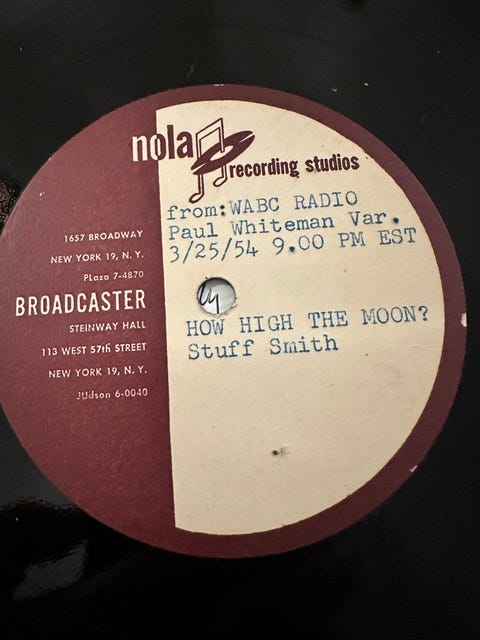
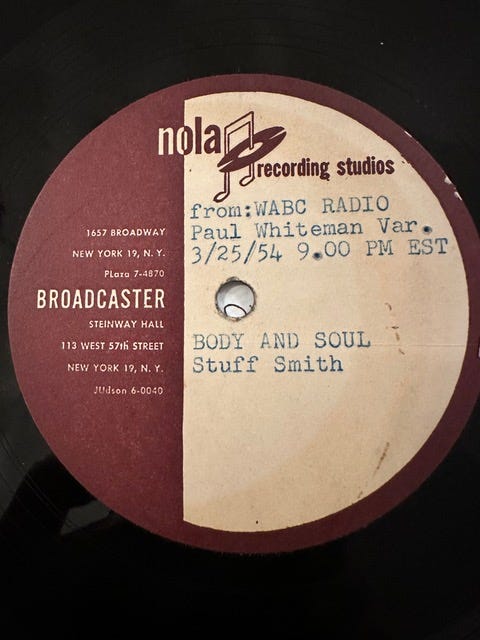
Who are Smith’s accompanying musicians? Almost certainly members of the ABC orchestra. This would likely be Buddy Weed on piano, Bobby Mortell on rhythm guitar, and Morey Feld on drums. The bassist is less certain—possibly Ted Kosoftis? Here is “How High The Moon.” There was some opening conversation, but the start of side 1 was damaged to the extent that it could not be played—we must await the finding of the original AFRS disc for that. Also, the first few seconds of the music had some skips and repeats, which Lewis has edited to the point where it’s as listenable as it can be. And all the rest of the music is there. The full orchestra comes in only for the last note:
0:00
-1:50
Between numbers, Smith and Whiteman engage in very familiar, pally conversation, which delights the audience.
[Lew notes: Whiteman calls Stuff “old boy,” which is not derogatory, but is rather a kind of “British-ism.” But later he says “Is that right, boy?,” which would not be acceptable today. As I’ve shown, calling musicians “boys” was standard among Black and white musicians until the 1960s. Still, it’s uncomfortable to hear Whiteman use it here in this way. Back to Anthony:]
Smith tells a story that he repeated differently elsewhere, about being taken by his father when very young to hear Venuti (whether in a small group or with, for example, Jean Goldkette’s orchestra we do not know). Smith also talks about Venuti playing the song “Back in Your Own Back Yard” with Whiteman. This song was written, in part by Al Jolson, in 1927 and recorded by Whiteman in 1928 without Venuti, who joined in 1929. So this is too late to have been a formative influence on Stuff, who was born in 1909 and didn’t visit New York until 1928 (two uncomfortable weeks with Jelly Roll Morton at the instigation of trumpet player Edwin Swayze, Smith’s mentor in the Aunt Jemima Revue and with the Alphonso Trent band). There is a somewhat similar confusion about when Smith first heard Louis Armstrong: Smith says here “I heard Louis play ‘Savoy Blues.’” He often spoke about that and “West End Blues” as formative influences. But again, these were recorded in 1927 and 1928, too late for that to be true. So surely there is some poetic license in Smith’s earliest recollections, and in the credit that he wished to give to his idol Armstrong.
To bring on “Body and Soul,” Smith tells Whiteman, “I’ll take the soul and you lay the body on me”—that gets a good laugh. But musically, Stuff means business:
0:00
-3:22
On thing is certain—Whiteman, who himself was trained on violin and viola, held Smith in a certain affection.
My grateful thanks to Harry Arends who provided the label scans and Michael Feinstein, who now owns the disc, for the transfers.
[Thank you Anthony!
All the best,
Lewis ]
(Paying Subscribers, you will find a rare 8-minute radio broadcast below, featuring wild violin and Jonah Jones’s flamboyant trumpet.)
Comments
Nothing yet. Say the first thing.
Sign in to join the conversation.