
This is a short excerpt from an essay I was commissioned to write on poetry and grief for Poetry Ireland Review, issue 144, which was published this time last year. Thanks to all at PIR and editor Jessica Traynor. To read the full essay buy a copy of PIR here.
Whether concerned with grief or not, some of my most cherished poems manage to combine an appeal to the head as much as to the heart. With this in mind I really must mention my favourite Christmas poem. In ‘Merry Christmas from Hegel’, Anne Carson finds herself alone, utterly alone, at Christmas:
It was the year my brother died, I lived up north and had few friends or they all went away. Christmas Day I was sitting in my armchair, reading something about Hegel.
She is confused by the point Hegel is trying to make but attempts to paraphrase it. Frustrated by critiques of his bad prose, Hegel claims that conventional grammar gets in the way of his philosophical process of ‘speculation’:
*
‘Speculation being the proper business of philosophy. Speculation being the effort to grasp reality in its interactive entirety. The function of a sentence like ‘Reason is Spirit’ was not to assert a fact (he said) but to lay Reason side by side with Spirit and allow their meanings to tenderly mingle in speculation. I was overjoyed by this notion of a philosophic space where words drift in gentle mutual redefinition of one another but, at the same time, wretchedly lonely with all my family dead and here it was Christmas Day, so I put on big boots and coat and went out to do some snow standing’.
*
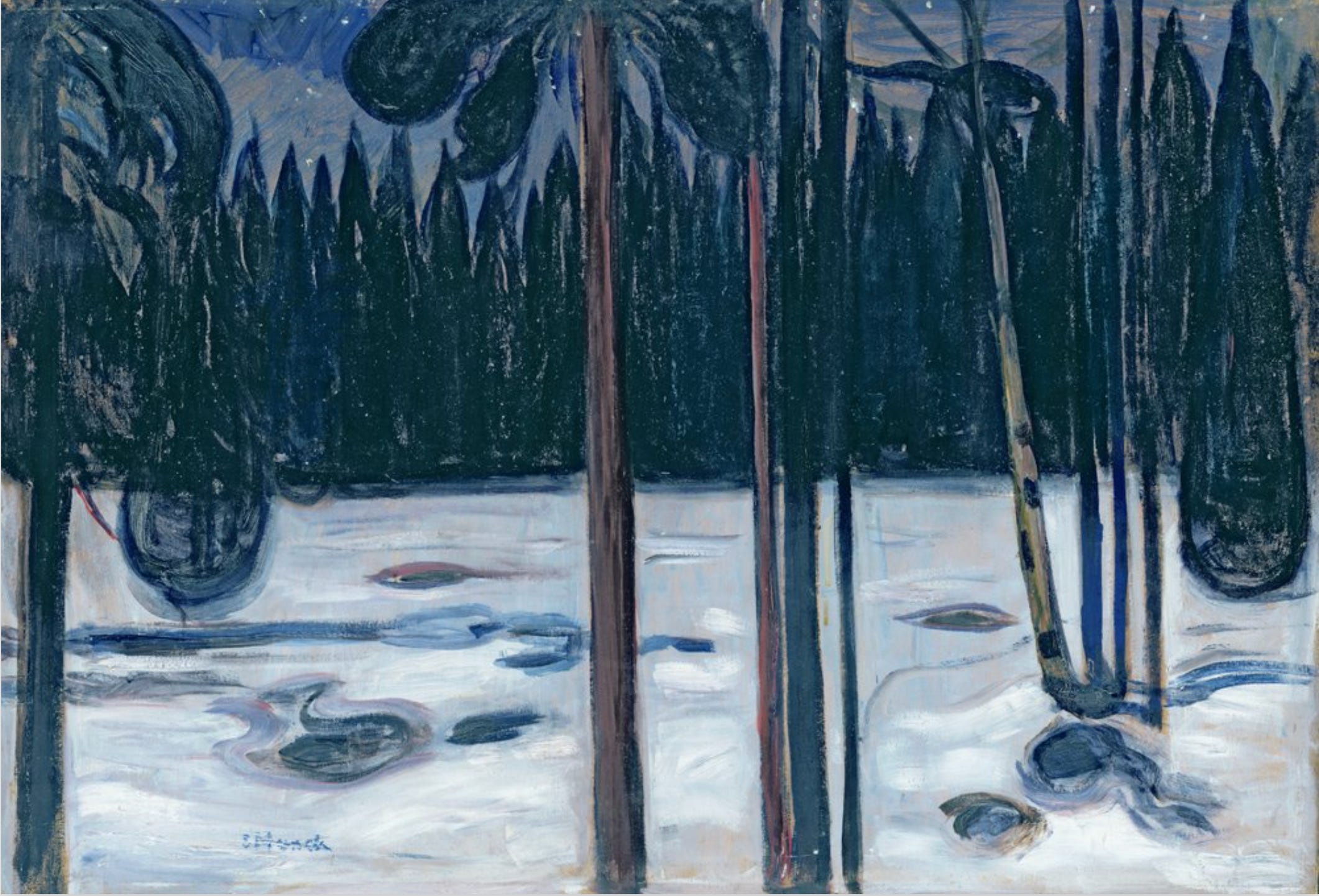
The idea of heading out into the woods to stand alone with all one’s family dead may sound dreadfully sad, but it allows the speaker to find some kind of comfort, warmth, and light out there among the firs, ‘the teachers of this, all around.’ The sound of traffic fades and a fullness of concentration is given to audible ‘Inner sounds’: ‘cracks, sighs, caresses, twigs, birdbreath, toenails of squirrel.’ Though the surface of the body is freezing, the inner core remains hot and it is there that a ...
*
‘ravishing peace flows in, so ravishing I am unembarrassed to use the word ravishing, and it is not a peace of separation from the senses but the washing-through peace of looking, listening, feeling, at the very core of snow, at the very core of the care of snow’.
*
Though none of this seems to have anything to do with Hegel, she admits that reading his work is what ultimately led her to this pristine convening with the beauty of her surroundings. In grappling with relatively difficult philosophical ideas from a notoriously hard to read philosopher, the poem, written entirely in prose, feels erudite at times. But there is also humour in the speaker’s admission of being mostly stumped by Hegel’s writing, and a tragic sense of loneliness in the reality of how, now that her brother has died, she finds herself alone in the cold. Nevertheless, the poem charts a way out of the despair to a hot and ravishing epiphany in the snowy depths of a freezing winter.
If Carson’s is my favourite Christmas poem, John Kelly’s ‘Winter’s Blessing’ is my favourite for the liminal no-man’s land of the post-Christmas period. (I read this at my uncle’s funeral, a few days after Christmas last year). It is short enough to be quoted in full:
Unexpected birdsong
in the brief sun
of Sundays after Christmas
when you drink too much
and most miss the dead.
*
When you bow your head
to the soloing thrush,
lit like an old friend’s soul
in the bones of a silver birch.
*
Happy Christmas. As always, Let the Dead available here.
Thanks for reading Let the Dead! This post is public so feel free to share it.

No posts
Comments
Nothing yet. Say the first thing.
Sign in to join the conversation.