
Pilot Nick - 4mn read
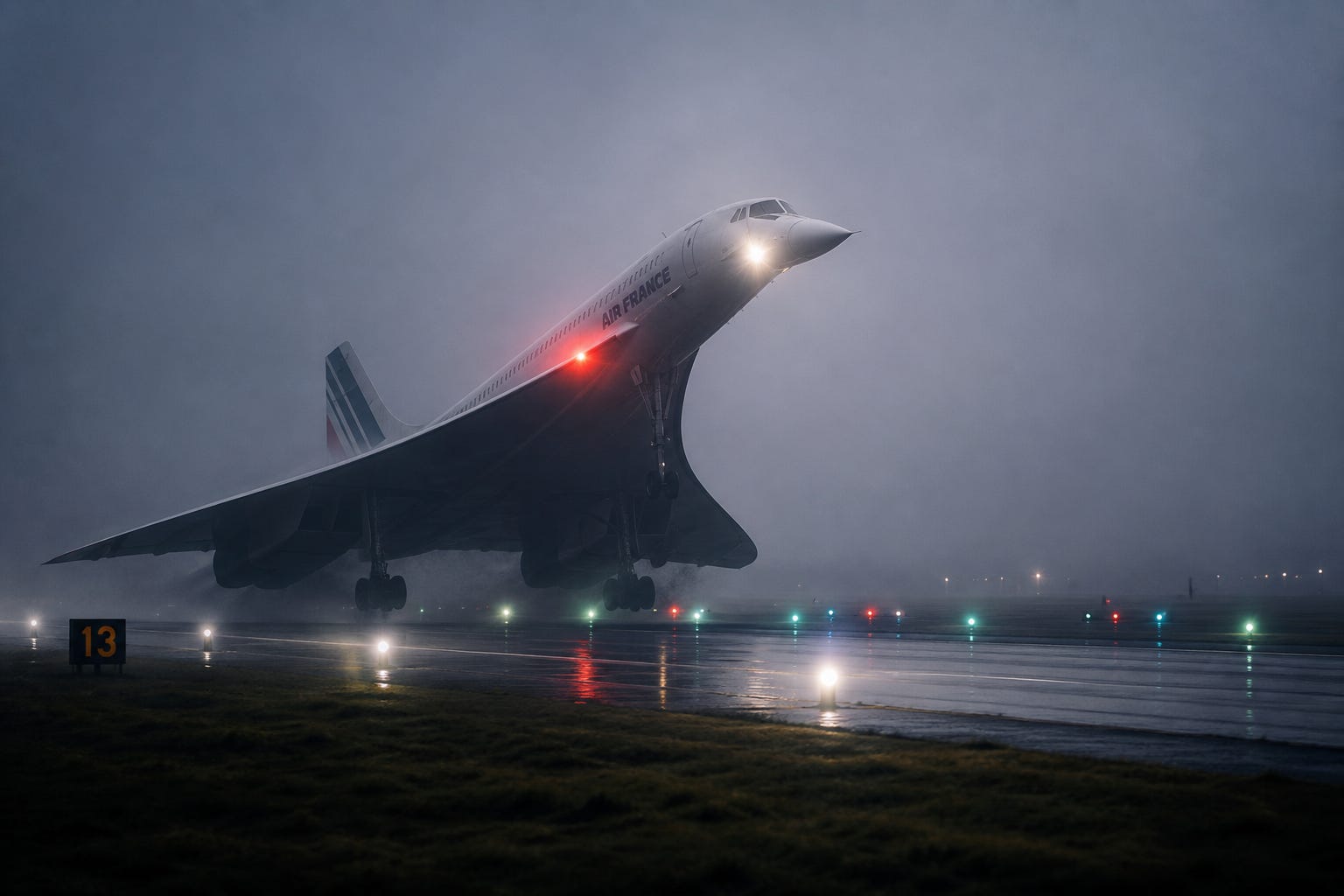
Concorde cruised at Mach 2, above 50,000 feet, where the air was too thin to breathe and the aircraft’s skin could heat to 127°C.
You would think an aeroplane like that belonged in clear skies, miles above the weather.
Then you open the Air France Concorde Operating Manual and find something rather unexpected:
Category 3. Decision height: 10 feet. Minimum use height: zero. Runway visual range: 150 metres.
In other words, the fastest passenger aircraft ever built was also certified to land itself in fog so thick that the pilots might not see the runway until they were almost on it.
And it did it with technology designed in the 1960s.
Concorde wasn’t France’s first CAT III aircraft.
On 9 January 1969, an Air Inter Caravelle arrived at Orly from Lyon with 56 passengers on board. The airport was covered in fog. Captain Larribière let the aircraft fly the approach and landing automatically.
It became the first automatic landing in commercial service under Category 3 conditions in French civil aviation.
The approval had come two months earlier, after years of testing. Trials had been running since 1962, and a Caravelle had already made a zero-visibility automatic landing at Toulouse in March 1963.
Exactly who deserves to be called “first” is still debated. The Caravelle, Hawker Siddeley Trident and Smiths Industries prototypes all have a claim, depending on whether you mean the first experimental autoland, the first certification or the first one carrying passengers.
But one thing is clear: France was at the very front of the race to make airliners land automatically in dense fog.
And that experience mattered when Concorde came along.
Sud Aviation, which developed the Caravelle, became part of Aérospatiale, which assembled Concorde at Toulouse. There wasn’t much direct technical inheritance between the two systems. Concorde’s electronics, sensors, monitoring and servos were completely different.
What carried over was something harder to put on a wiring diagram: experience.
The engineers already knew an automatic landing could be made reliable enough for airline service and they knew what it took to convince the certification authorities.
By the 1970s, autoland itself was no longer unique. The Boeing 747 received CAT III certification in 1971. The Trident followed with CAT IIIa in 1972 and CAT IIIb in 1975.
But neither of them landed like Concorde.
Concorde approached at around 14 degrees angle of attack, nose drooped, on a delta wing with no flaps or slats.
That 14-degree attitude wasn’t for show. Concorde had no conventional high-lift devices. On approach, the delta wing had to generate the lift itself, helped by the powerful vortices forming over the wing.
The result was a very nose-high approach.
Even with the famous droop nose lowered, the view ahead was restricted. The aircraft was fast, draggy, and operating with less energy margin than a conventional airliner.
On a 747, the flaps generate enormous amounts of lift while allowing the aircraft to fly at a relatively modest angle of attack.
Concorde didn’t have that luxury.
If speed began to decay or thrust came back too quickly, things could deteriorate rapidly.
And then there was the landing gear.
The main gear sat a long way aft under the delta wing. Changes in aircraft weight and centre of gravity altered the geometry at touchdown, which made programming the automatic flare particularly difficult.
The system somehow had to take this fast, nose-high, flapless delta and place its main wheels precisely onto the runway.
In fog.
Automatically.
Every time.
Even its certification was unusual.
Concorde was approved under TSS Standard 1-2 — Transport SuperSonique, a regulatory framework written specifically for the aircraft.
The numbers in the Air France manual are remarkable:
Decision height: 10 ft
Minimum use height: 0 ft
Runway visual range: 150 m
Maximum headwind: 25 kt
Maximum tailwind: 10 kt
Maximum crosswind: 15 kt
For US operations, the crosswind limit was reduced to 10 kt.
And all of this was being achieved with analogue technology.
Two autopilots and two very important green lights
Concorde had two autopilots: AP1 and AP2.
For a full CAT III automatic landing, they could work together in LAND mode. In front of the pilots, two landing situation indicators showed exactly what capability remained.
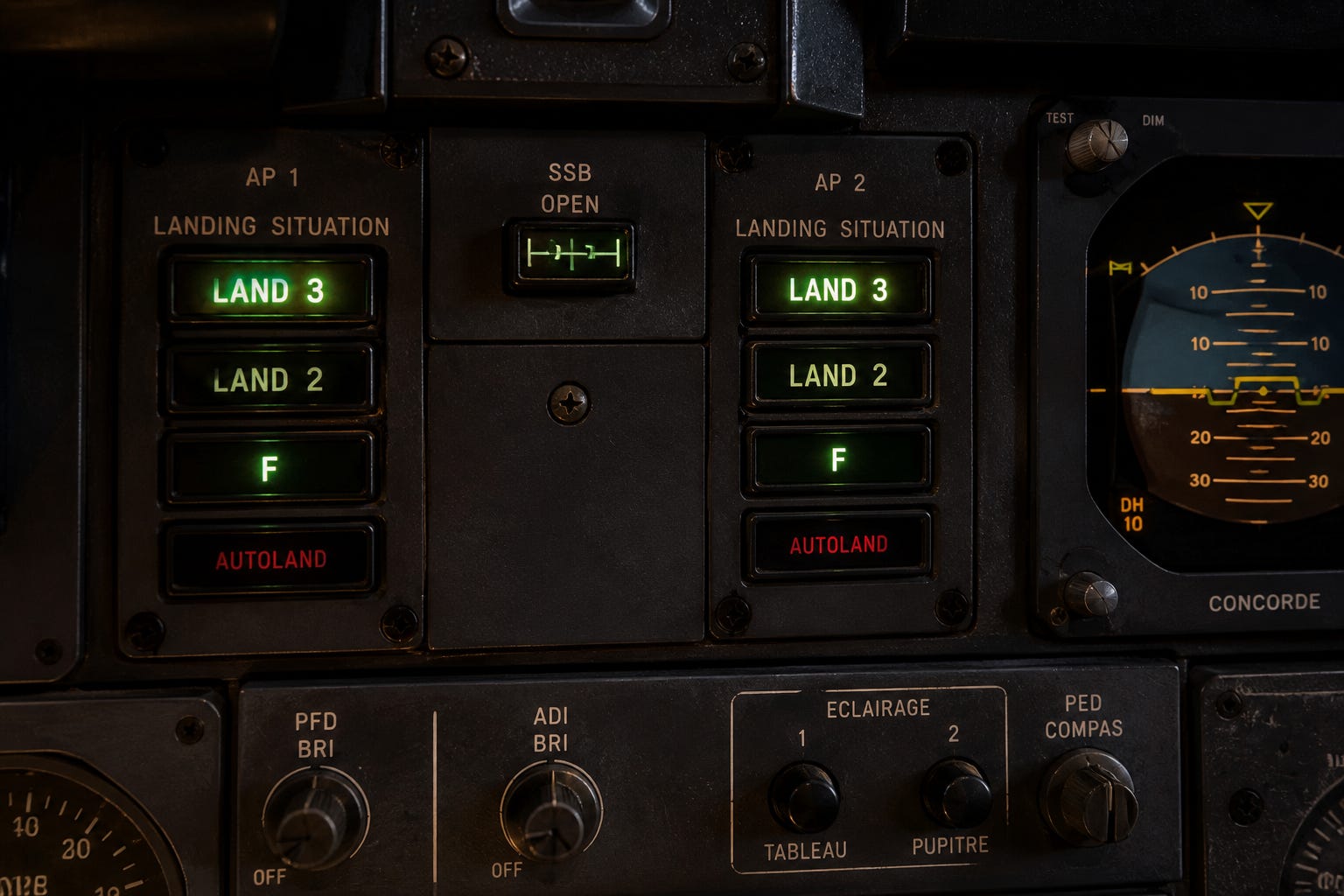
A green LAND 2 light meant at least one autopilot was operating correctly in LAND mode.
That was enough to perform an automatic landing, but the system was fail-passive. There was no longer another complete channel waiting to take over.
LAND 3 was the one you really wanted.
It meant both autopilots were engaged, both autothrottles were operating correctly in IAS ACQ mode, and the split system bus separating the two autopilot channels was open.
Now the system was fail-operational.
If one autopilot failed on short final, the other could take over and continue the automatic landing.
And the crew didn’t simply trust that redundancy was there.
Before every CAT III approach, they tested it.
The captain disconnected AP1. LAND 3 disappeared and LAND 2 illuminated. The crew checked that AP2 was still flying the aircraft correctly.
Then AP1 went back on.
LAND 3 returned.
Only then had the system proved that it could lose an autopilot and keep flying.
Below: what happened during the final 700 feet right down to the strange alarm that told the crew the landing had worked.
Comments
Nothing yet. Say the first thing.
Sign in to join the conversation.