
Sports fans of a certain vintage will recall LeBron James’s 2010 live television broadcast, The Decision, when he announced that he would be leaving the Cleveland Cavaliers to “take his talents to South Beach” and join the Miami Heat. It was the biggest story in sports for most of July that year, and I vividly remember watching a panel of commentators discuss it on ESPN. One of them passionately defended James’s choice, saying, as he slapped the desk in front of him, “At the end of the day, LeBron did what he felt was best for him. And you can’t criticize him for that!”

One reason I remember this so clearly is that I used to share this anecdote on the first or second day of my ethics classes, to illustrate the value of thinking clearly and well about morality. Contra the good fellow on ESPN, you most certainly can criticize someone for doing what’s best for themselves. We do so all the time, and we call it “morality.” I taught my ethics course dozens of times from 2010 to 2018, so I’ve told the story dozens of times. But there’s another reason I remember The Decision so vividly, and I confess that I’m a little embarrassed to admit it publicly.
LeBron James hurt my feelings.
My hometown of Hudson, Ohio, is roughly equidistant from Cleveland (where the Cavs play) and Akron (where LeBron was born and raised). I am a lifelong and therefore longsuffering Cleveland sports fan. The teams I root for have suffered a litany of massively disappointing losses in big games. And the region itself, for as long as I can remember, has been the butt of insulting jokes and the object of unwarranted disdain. The upshot of all this is that northeast Ohioans, even more so than most sports fans or most people who love the places they come from, tend to be personally invested in our teams’ successes and failures, and sensitive to anything that could be construed as criticism or praise of the place we call home.
We really thought—I certainly thought—that LeBron was one of us, in the fullest sense of the phrase. He grew up here, and by an astounding stroke of good luck, was eligible for the NBA Draft the same year the Cavs held the first overall pick. He’d cut his teeth as a professional athlete playing for his hometown team and made public promises about bringing a championship to Cleveland. It seemed like there was no way he’d leave. But then… he did, and a lot of us felt not merely disappointed, but betrayed. LeBron wasn’t merely a great athlete whom we’d had the good fortune to have on our team; he was our guy, the guy who’d been on the cover of Sports Illustrated wearing his jersey from St. Vincent-St. Mary High School; he was Just A Kid From Akron and all that. And he left. It was hard not to take it personally, even for some of us who like to think of ourselves as mature adults who understand that sports aren’t really terribly important in the grand scheme of things.
Circling back to that talking head on ESPN, who insisted that LeBron did what was best for LeBron and therefore could not reasonably be criticized, my reaction in the moment was, “What are you talking about? Of course you can criticize someone for doing what was best for himself! One’s own self-interest is not the only factor relevant to what one should do. There are actually quite a lot of other things to consider! You should consider whether you’d made promises to the people of northeast Ohio. You should consider the value of loyalty. Dagnabit, LeBron, you should consider my feelings!”
Now, I say all this with my tongue pretty firmly planted in my cheek. LeBron certainly had the right to go to Miami, and even if one wants to make the case that he did not do the morally best thing when he left for Miami, he can hardly be accused of committing an egregiously evil action. What’s more, as you most likely know, LeBron eventually returned to Cleveland and delivered on his promise to win a title.1 Any criticism I make of Mr. James is and always will be tempered by my gratitude to him for that.
But Jiminy Cricket. He’s done it again. Given the opportunity to return home and end his career with the team that drafted him—a team, let us note, that made it all the way to the Eastern Conference Finals in 2026 and which really would have had a shot at the title next season with LeBron back on the roster—he decided to sign instead with the Philadelphia 76ers, who are admittedly really good but who feature a star player who can’t stay healthy and who, more importantly, do not play in the city where LeBron is from and where he started his career and which would have given him an opportunity for an unbelievably heartwarming storybook ending, not to mention the undying affection of every Cleveland sports fan from now until the end of time.
So why did he do it?
Well, the answer seems pretty clear. LeBron wants to be known as the greatest basketball player of all time. The 76ers haven’t won a title since 1983, and if LeBron does for them what he did for the Cavs in 2016, on top of winning titles with the Heat (2012, 2013) and Lakers (2020), the claim that he really is, as we say these days, the GOAT will be strengthened. Whether it would be true or not, I leave to others to decide. But clearly, being seen as The Greatest is what motivates him, not loyalty to or love for the North Coast nor a desire to bookend his career with warm and fuzzy stories about his hometown nor my feelings nor anything else that might have brought him home. Alas.
On the same day LeBron announced that he’d be signing with Philadelphia, I saw the following eye-catching headline in The Athletic:
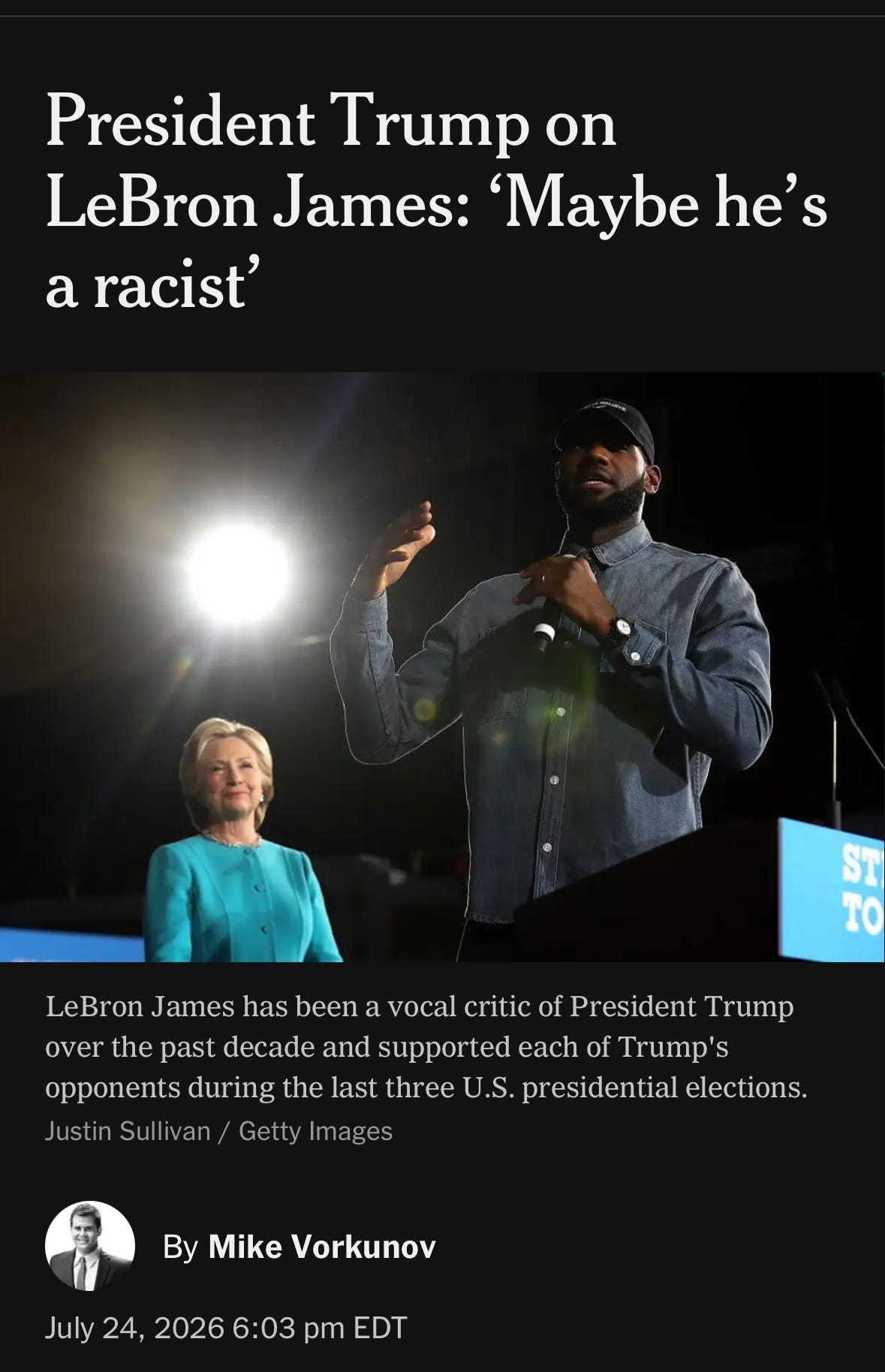
“Maybe he’s a racist,” the sitting president of the United States said of a professional basketball player. If you would be able to refrain from following that link, dear reader, well, your clickbait resistance is clearly stronger than mine.
Reading the article, I was mildly disappointed to learn that our Commander-in-Chief was not trying to explain why LeBron James is now a Philadelphia 76er instead of a Cleveland Cavalier. (You have to admit: that would have been super interesting hypothesis to explore.) He was instead discussing the massively important question of why LeBron, unlike Michael Jordan, had supported Trump’s opponent in each of the last three presidential elections. Whether racism is, or is not, the best explanation of this fact is another matter I will leave to others to decide.
What struck me, as I was thinking about all this, was the fact that Donald Trump and LeBron James are kindred spirits, at least in one respect. Trump, too, wants to be known as The Greatest. Anyone who has followed American politics over the last decade, whether an admirer or a critic of the president, will surely agree with this assessment. He has publicly ruminated on the merits of being added to Mount Rushmore, favorably compared himself to George Washington and Abraham Lincoln, added a picture of himself to a custom edition of the U.S. passport, made his proposed White House ballroom a prominent focus of his second term, put his name on the Kennedy Center, et cetera, et cetera, et cetera. By all appearances, both men are motivated to an enormous degree by concern for their own fame.
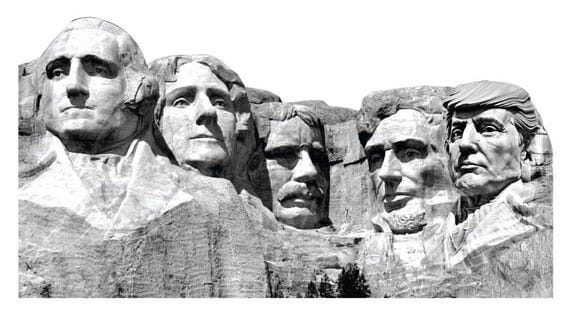
In saying that, I don’t think I’m being unkind. I certainly hope I’m not. These are men who have chosen to live their lives in the public eye, and I’m making an inference about what they value based on their public actions and words. If you think this is not a plausible interpretation, well, let me know in the comments and give me reason to reconsider. I’m open to being persuaded I’ve got these guys wrong, though I don’t think I do. From where I’m standing, it sure looks like there is very little, if not nothing, that motivates Donald Trump and LeBron James more than being thought of as Truly Great. The rest appears to be just details.
I don’t know if I would have been struck by this similarity between the two of it hadn’t been for a third figure presently prominent in our cultural conversation: the Ancient Greek hero Odysseus, as portrayed by Matt Damon in Christopher Nolan’s retelling of The Odyssey. I saw the movie the day after LeBron announced his decision to go to Philadelphia, and I thought it was fantastic. I am among those who were very skeptical going in, due to talk of the film being yet another Hollywood exercise in heavy-handed propaganda for all the things that fall under the label “woke.” To say I was pleasantly surprised would be an understatement.
One of the things I loved most about Nolan’s adaptation of Homer’s epic poem was the degree to which he Christianized Odysseus and his adventures. (This paragraph contains minor spoilers about the film, so if you haven’t seen it yet, you might want to skip ahead.) Whether Nolan would agree with this description is an open question; apparently he is not a religious believer himself, and I won’t pretend that themes of self-sacrifice and love for family are the unique province of Christians. But my goodness. In Nolan’s version of the story, unlike Homer’s, marital love is a key driver of the plot. Odysseus is an essentially faithful husband2 and Penelope is a loving wife. Kingdoms and political power and even the longing for home—all of which lie right at the heart of Homer’s Odysseus—are less important in this story than the union between husband and wife. An even more important change is that Nolan’s plot hinges on Odysseus’s remorse over the sacking of Troy. Unlike the Greek original, Nolan’s Odysseus is wracked with guilt. He and his men have “broken the law of Zeus,” and the film implies that atonement must be made. Odysseus is exhorted to surrender, to give himself up to the gods, at which point he undergoes a metaphorical baptism, washing up on the shore with arms extended as though crucified and finally arising with the appearance of lashes across his back. He suffers greatly in his effort to defeat Penelope’s suitors, and has mercy on those who humble themselves and acknowledge him as king. (In Homer’s version of the story, Odysseus kills them all and emerges unscathed.) In a final act of humility, he willingly abdicates his throne, installing his son as king and choosing, for the sake of peace in Ithaca, to go into exile with Penelope.

So what’s the big deal? Well, if you know anything at all about the values celebrated in Ancient Greece, you probably know that the Homeric heroes were centrally motivated by desire for their own glory. Certainly this is true of Odysseus in the traditional version of The Odyssey. But in Nolan’s telling of the story, Odysseus is a different kind of hero. He looks a lot more like a Christian: contrite for his sins and willing to suffer and sacrifice for the good of others.
It’s interesting to consider LeBron James, Donald Trump, and Matt Damon’s Odysseus through the lens—or perhaps as mirrors—of American culture in the Year of Our Lord Two Thousand and Twenty-Six. I submit that the Odysseus presently appearing on the big screen is the kind of person we aspire to be. Or at least, he’s the kind of person we used to aspire to be. He’s certainly the kind of person we ought to aspire to be (more or less, and with various caveats). Odysseus is the hero we need. LeBron James and Donald Trump are, if I may be so bold, the heroes we deserve. They are pagan heroes, Greeks recast for the twenty-first century, seeking their own glory in a recognizably American register. They are the natural products of a culture that exhorts us, over and over, and in myriad ways, to “be true to yourself.”
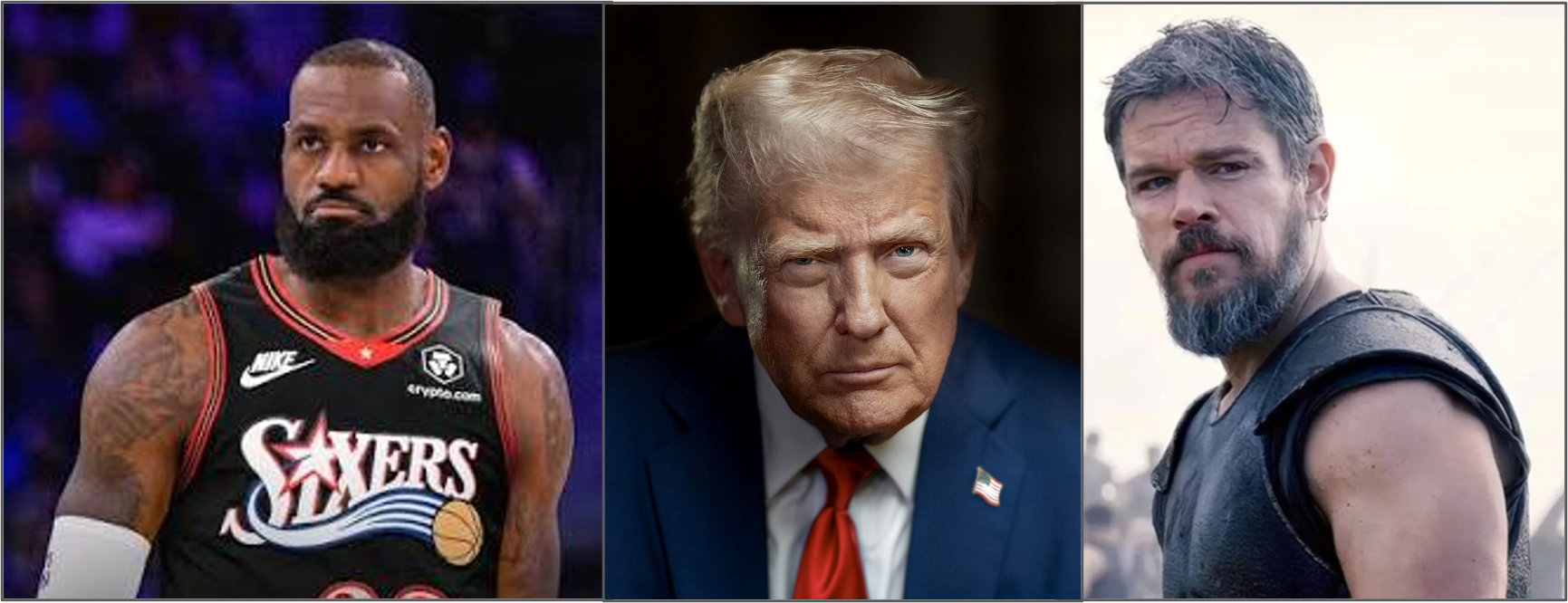
It has been suggested that the guiding philosophy of our time can aptly be described as expressive individualism: the idea that the greatest good, the very meaning of life, is to live in accordance with one’s authentic desires. If you truly want something, then it is good for you to have it. If something is an obstacle to your perceived happiness, then it is bad and should be eliminated or removed. Unfettered consumerism and accumulation of wealth, sexual fulfillment free of any duties or obligations toward others, the pursuit of fame and power above all else: any of these, and a million other things besides, are justified on the aforementioned grounds that “I’m doing what’s best for me, and no one can criticize me for that.”
The thing is, however, that we can criticize people—the wise among us will first and foremost criticize ourselves—for doing what’s best for them.3 All of us know this. Figures like Odysseus just remind us of it. There really are such things as duty and honor. Doing that which is right can be costly. It is not always good for us to get what we want. Our hearts can lie. Humility is a virtue. Sacrificing our own needs and desires for the sake of others is sometimes required. The worthiness of a life is found neither in others’ esteem nor in the achievement of one’s goals, but in the degree to which it is oriented toward that which is good. The kind of man or woman you are—the character you exemplify—is far more important than how much money you have or how many people know your name.
I wish LeBron would have come back to Cleveland. I wish President Trump would talk and act like a man who cares more about justice and mercy than about the number of buildings on which his name appears. But at the end of the day, these aren’t really my problems. To repurpose a phrase from Charles Dickens, “whether I shall turn out to be the hero of my own life” is a far more pressing matter for me to wrestle with, as it is for you in your life. So let me ask myself, and encourage you to do the same: What am I about? To what degree is my life oriented around my own success, my own comfort, my own pleasure, my own fame? And to what degree does it aim toward that which is truly good?
You made it all the way to the end! If you enjoyed this essay, I hope you’ll click the “like” button on Substack. Maybe you’ll even be so kind and so bold as to share it with a friend. And if you’re feeling especially generous, you can click the button below to…
I don’t know if you’ve heard, but the Warriors blew a 3-1 lead.
Nolan’s retelling omits his affair with Circe, and while the 2026 film strongly hints that Odysseus and Calypso were lovers, it equally strongly hints that he was with her only because she’d drugged him with lotus flowers.
One of the happy paradoxes that follows from the truth of Christianity is that it turns out that doing the right thing always is the best thing for each of us, objectively and ultimately speaking. But I won’t try to unpack or defend that claim here.
Comments
Nothing yet. Say the first thing.
Sign in to join the conversation.