
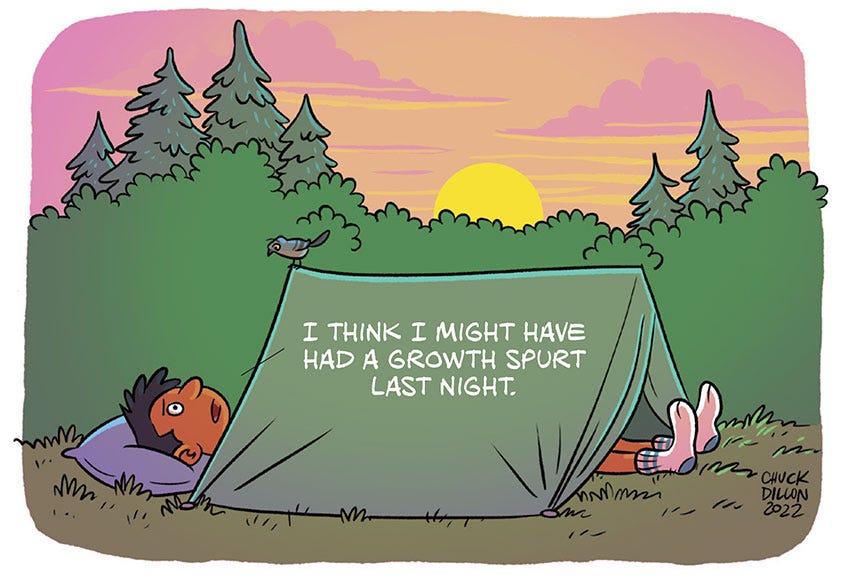
If you’ve seen a kid this summer who is suddenly, inexplicably, almost shockingly tall, you are not imagining things. Summer growth spurts can be dramatic, especially when they’re accompanied by the classic triad of sleeping until noon, eating everything that isn’t nailed down, and needing new shoes approximately every six weeks.
We’re not plants, though, so it’s not the sun that’s fueling this growth. It’s sleep. We cycle from light sleep to deep sleep to REM sleep throughout the night, and it’s the onset of deep sleep when our brains produce growth hormone (GH) in particularly intense bursts (science-y article here).
This explains why the kid who seems to be doing nothing all summer but snoozing is the most likely to be growing as well. When lazy days and long sleep-filled nights replace early school wake ups, late practices, and even later homework sessions, kids tend to get more sleep and produce more GH while they’re at it.
When a kid is growing... how tall are they going to be?
The moment a kid hits a growth spurt, the question almost every parent (and honestly, every kid) wants answered is: where does this end? Are we talking “please stop growing, we just bought new pants”? Are we talking “will need to duck in doorways”? Are we talking NBA?
We answered this question in what is now apparently our most controversial piece of content ever –– an Instagram reel about how to predict adult height. The video has almost 2.5 million views and hundreds of comments, with a lot of debate about the math.
We’ll be honest: we did not see this maelstrom of interest coming. We figured a video about growth potential and parental height averages would appeal to our little corner of the internet and maybe generate a few thoughtful comments.
What we got instead was hundreds of people in the comments doing math at each other. Aggressively. Some folks were convinced we had the formula wrong. Others were arguing about centimeters versus inches. A few people seemed to have completely missed the part where we explained that this is a range, not a prophecy — and that puberty timing, nutrition, and sleep (see above!) all play a role too.
Since the formula was clearly the flashpoint, here it is in plain sight. Pediatricians call this the mid-parental height formula. BIG point here: it lands with a target range, not a number written in stone. It won’t tell you exactly how tall your kid will be, but rather the range of how tall 95% of all kids will be if their parents are certain heights.
For BOYS: (Dad’s height + Mom’s height + 5 inches) ÷ 2 = target height (± 2 inches)
For GIRLS: (Dad’s height + Mom’s height − 5 inches) ÷ 2 = target height (± 2 inches)
Using centimeters? Add or subtract 13 cm instead of 5 inches.
That “± 2 inches” is doing a lot of work. It means a boy whose math puts him at 5’10” could land anywhere from 5’8” to 6’0” and be right on track. Puberty timing, nutrition, and yes, sleep, can all move that needle. The formula is a ballpark. Enjoy the ballpark.
We love that people care this much about a pediatric growth formulas. We love math! But we also gently suggest that if you are in the comments section of a parenting video getting into it with strangers about arithmetic, summer may be getting to you a little bit.
For access to all of our science-based content check out the Less Awkward Hub.
What if they’re NOT growing?
Not every kid will sprout up over the summer. Some of you are watching and waiting and quietly (or not so quietly), worrying because last year’s pants are still plenty long.
The anxiety around height — especially for boys — is well-documented and real. A large multi-country study from 2016 found that kids with short stature also had more internalizing problems (think: anxiety, withdrawal, depression) and lower quality of life than their average-height peers. A 2025 review found that kids with short stature face elevated rates of bullying, social isolation, and perceived stigma. This isn’t just kids being oversensitive –– it’s a documented experience.
And then there are the down-the-road stakes: research consistently shows that taller adults — particularly men — earn more, get promoted more, and are perceived as more authoritative. A widely cited analysis (mind you, it’s over 20 years old) found that someone who is 7 inches taller than average can expect to earn roughly $166,000 more over the course of a 30-year career (those are dollars from 2 decades ago). Kids who are paying attention to how the world works intuit this, even if they can’t cite the study.
So if your child is anxious about not growing, or if you are anxious about it on their behalf, it’s fair. This isn’t about vanity or superficiality –– it’s a pretty reasonable response to the world we live in.
That said, there’s a major counterpoint that deserves a lot of attention: there are lots of extremely happy and yes, highly successful, shorter people in the world. All of us can conjure a list of examples. But there’s data here too, like this 2023 study which showed that in otherwise healthy kids with short stature, quality of life and self-esteem were tied to social support and coping skills — not to actual height. The kids who were doing well weren’t the tallest ones. They were the ones who felt supported.
Where does this all land?
Growth is an emotional issue. Sometimes kids carry the baggage here, but oftentimes it’s the adults. Some suggestions if you’re worried or have questions:
Talk to your pediatrician if you have genuine concerns about growth velocity — not just about being shorter than friends, but about the rate of growth over time. That’s the number that actually matters medically.
Remind your kid — and yourself — that puberty timing varies enormously. The later their start, usually the later their growth spurt.
Don’t make height a running topic at home. Unless they bring up themselves, the kid who is already watching everyone else grow does not need the dinner table to be a weekly height update. Trust us, they are very aware.
And finally, maybe take a break from the comments section of the latest viral video on the topic?!

No posts
Comments
Nothing yet. Say the first thing.
Sign in to join the conversation.