
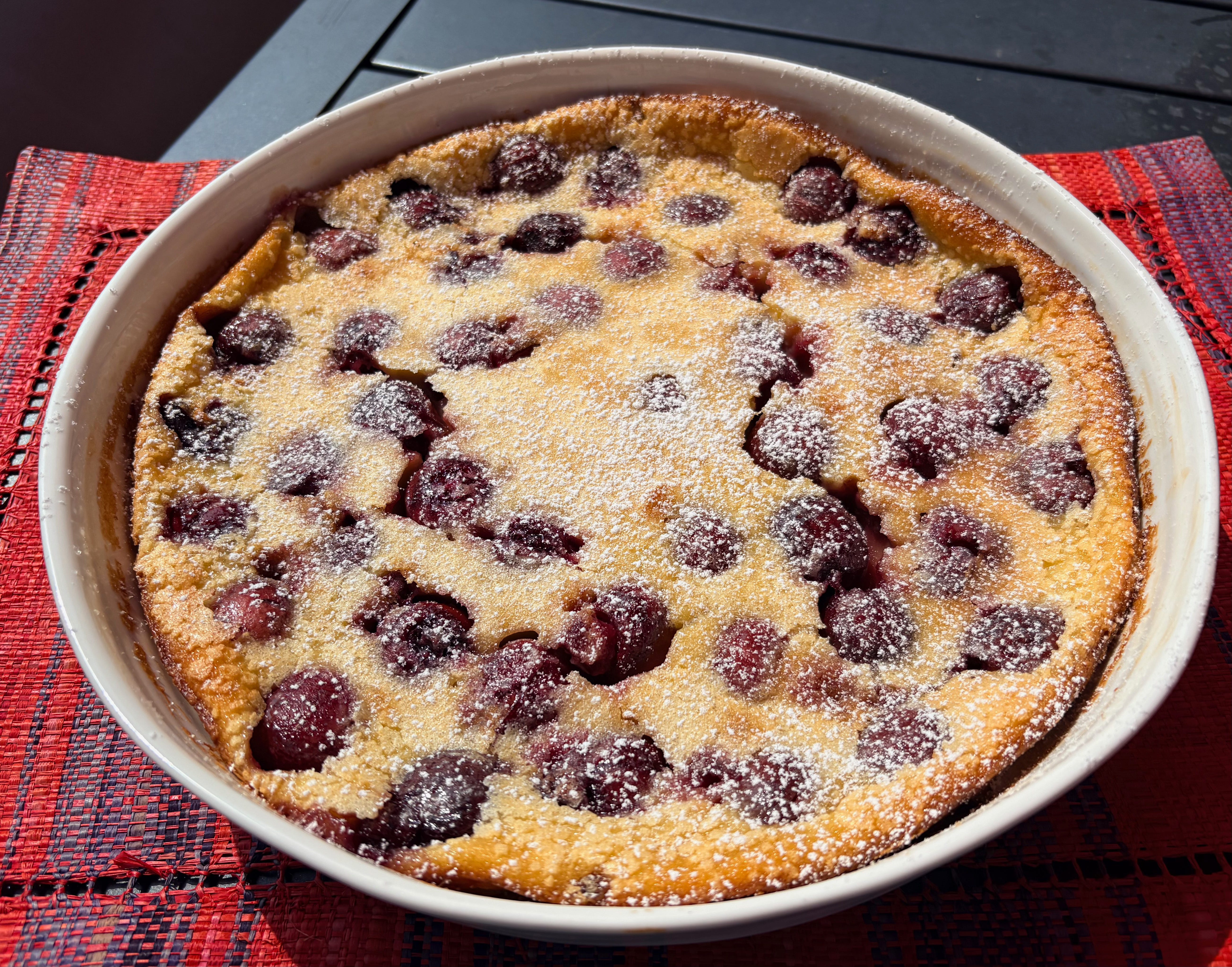
Clafoutis is a classic French dessert from the Limousin region: black cherries baked into a sweet, flan-like batter of eggs, sugar, flour, milk (sometimes cream), and a splash of vanilla, rum, or kirsch. As for the funny name, “clafoutis” is thought to come from the Occitan clafir, “to fill,” a nod to how the cherries get studded into the batter. Fun, right?
My first clafoutis experience, though, was not.
In the summer of 1989 I went to Lyon on stage to work at a beautiful patisserie/traiteur called La Minaudière. I learned a lot that summer, and not only about making éclairs and chocolate mousse cakes.
My plan was always to head to France on stage with one of my teachers from cooking school setting up the placement. His original intention had been to send me to the southwest of France to work for a famous pastry chef named Yves Thuriès, but that fell through at the last minute, so instead he found me a spot in Lyon. I was thrilled, yet there was a hitch: I would have to find my own lodgings. Time was short, and since there was no internet in those days, I booked two nights at a hotel near the train station and figured I would either stay there for the summer or find something less expensive.
The fact that I did all this on my own still boggles my mind. What did I expect to find? What if I didn’t find anything? But I was a pretty independent young woman, and I figured I would figure it out. And I knew France already, I thought, having spent a summer there at seventeen, at a ballet school in Cannes, where I and two American girls had quite a few crazy adventures.
(Anyway, this post is supposed to be about clafoutis, so I should probably focus.)
Once I arrived in Lyon, I arrived to the hotel I had booked, a two-star place called Le Phoenix, near the train station. Everyone but me knows that hotels around a train station tend to be sleazy, and this one was no different. I dragged my bag and my metal box of knives and spatulas up to my room and promptly passed out. When I woke up, I walked around the city and started doing some calculations about how I could afford to live in the sleazy hotel. It wasn’t looking feasible.
Somewhere along the way, either I or someone I met came up with the bright idea of going to the university and asking if they had rooms for students. So I did, and I found a room in Villeurbanne with a young woman named Michelle. We hit it off immediately, and Michelle turned out to be my conduit to life in Lyon, teaching me everything from how to eat radishes with butter to how to respond to a wolf whistle on the street.
On one of my few days off, Michelle asked me to come on a picnic in a local park with her family. I recall every detail of that day. Michelle was quite hip, but her parents were very old-school French. The day was extremely hot, close to 40ºC, and I recall sitting in the crisp brown grass while her mother opened plastic containers of small apéro nibblies to begin. I also recall that the main course was a crab salad made in honour of “La Canadienne.” As lovely as that was, the salad was heavy on crab, green peppers, and black olives, three ingredients I hated back then. The mayonnaise that bound it all together was already warm. I picked away at that salad for close to an hour before I managed to finish it, the entire family watching me all the while, unwilling to move on to the next course until I was done. Ugh!
After the cheese, Michelle’s mother pulled out dessert. Finally, I thought, something I would surely love. She held a cake wrapped in aluminum foil, which she carefully unwrapped. And that was the first clafoutis I ever saw. Sadly, it was swarming with ants. Michelle’s mom let out a little scream and quickly brushed them off, while I looked the other way, pretending not to see.
She handed me a thick wedge and I ate it, thinking, whoa, they forgot to stone the cherries, before almost choking on a pit. Traditionally, the cherries are left unpitted, as the pits are said to release a subtle almond-like flavour during baking, though most home cooks today pit them for convenience (and, baker’s trick, you can always add a few drops of almond extract to compensate).
This clafoutis was more cake-like than flan-like, lacking the texture usually associated with this baked custard. I ate it, but let’s just say that between the ants and the cherry pits, clafoutis was not something I pined for after that.
Years later, I encountered clafoutis here in Montreal, this time while working at the Pâtisserie de Gascogne. Baked in a sweet crust shell, the Gascogne clafoutis wasn’t at all like the clafoutis I had tasted in Lyon, especially as it was made with a mix of sour cherries, raspberries, and blueberries. The filling too was different, more flan than cake, a bit like a fruit quiche.
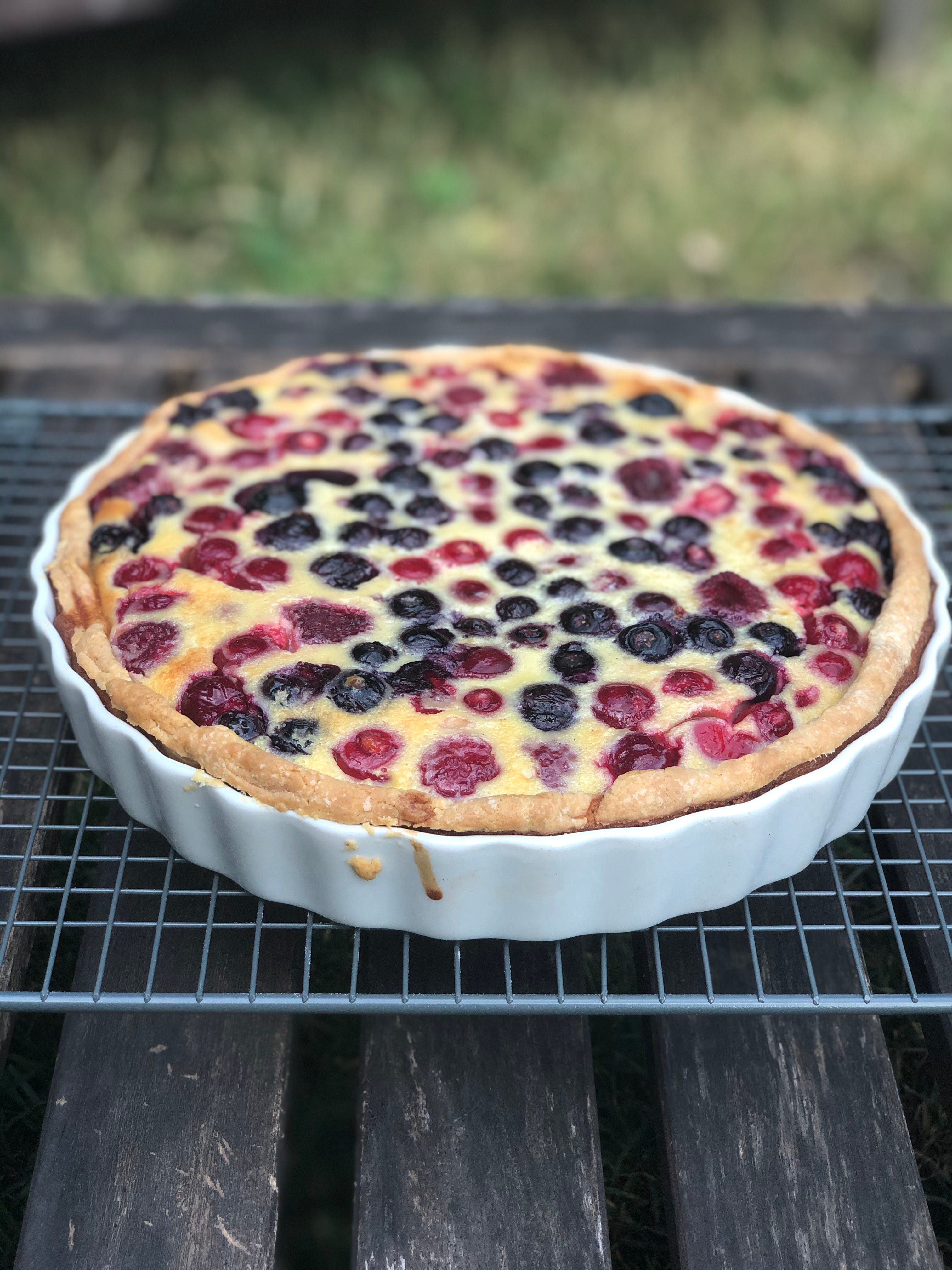
Purists insist that clafoutis refers specifically to the cherry version. When other fruits are used (plums, apples, pears, apricots, berries), the dish is technically called a “flaugnarde” (also from the Limousin/Périgord area), though in common usage, especially outside France, “clafoutis” is the term for fruit baked in custard batter.
The Gascogne clafoutis was terrific, so good that every day, when no one was looking, we would break one while unmoulding them and eat some for breakfast. It’s the clafoutis that made me fall in love with clafoutis. That recipe is in my latest cookbook, A Montreal Cook, and I love it. There’s also a crustless version.
Now, as Canadian cherry season is just past its peak, keep in mind that berries work extremely well in a clafoutis, especially blueberries and raspberries, or a mix of both. Strawberries and peaches are too juicy, but pears and plums are great, and I’d also try nectarines. Frozen cherries also work well, just be sure to defrost them on paper towels before using and blot off any excess moisture.
The recipe in my book is the one I truly adore, but I’ll admit it’s not for the beginner baker. It calls for a crust, and since the filling is liquid, your shell has to be sealed like a submarine or you’ll get leakage between the crust and the tart ring. It also needs to be blind-baked first, to dodge the dreaded soggy bottom. Worth it, but not a first-date recipe.
Here is an easier recipe so good I bet you’ll be making it all summer long. I added a bit of buttermilk for tang but regular milk or all-cream is fine.
As for the filling, cherries or other fruit, whatever... just avoid the ants.
Serves 8
Comments
Nothing yet. Say the first thing.
Sign in to join the conversation.