
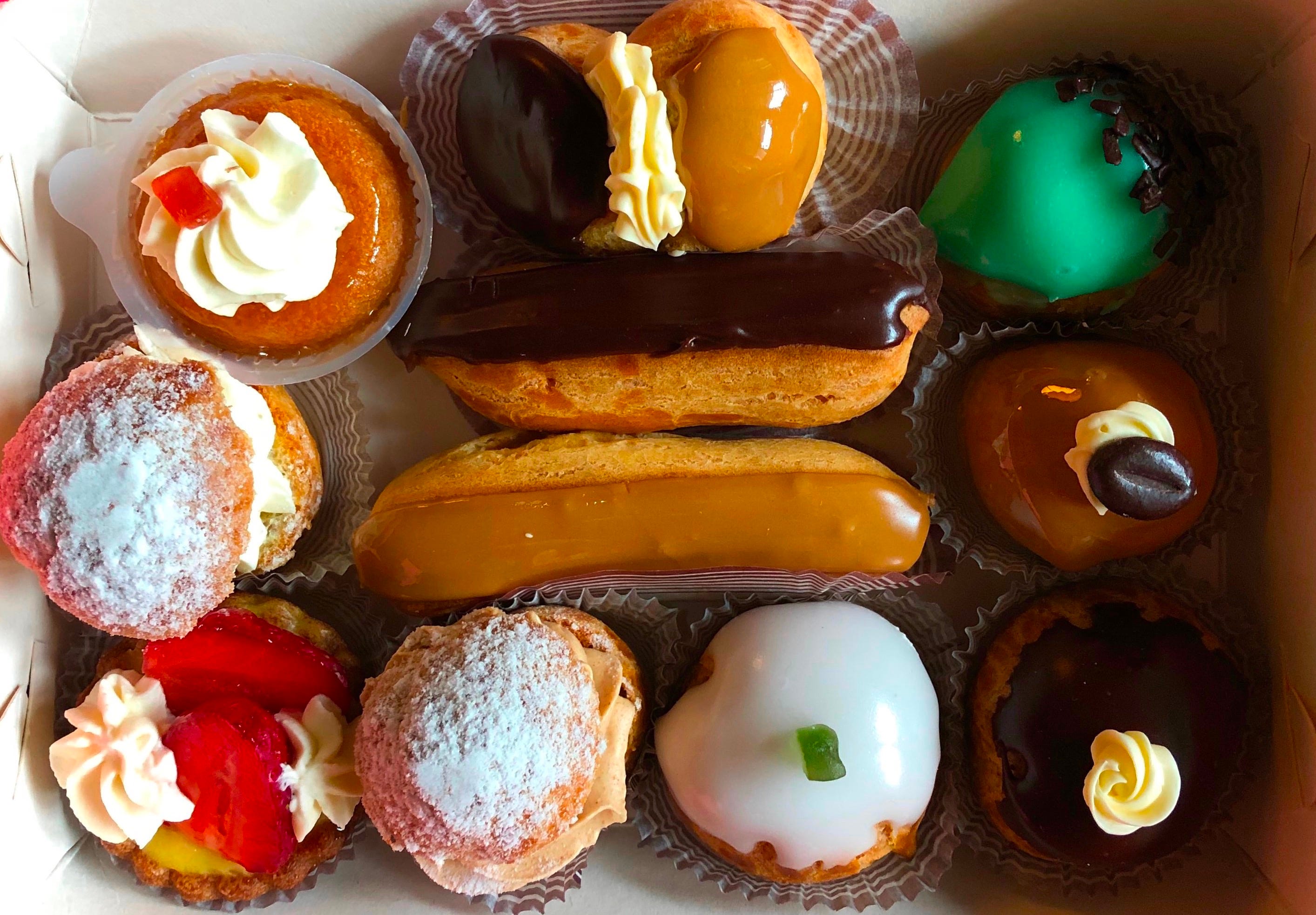
After a few weeks at La Minaudière, I started to settle in to the routine. First order of the day, prepare the fresh pastries for the shop. By fresh pastries, I mean the ones that only lasted a day, chief among them gigantic cream puffs that sold out as quickly as we made them. La Minaudière had an interesting array of pastries, some, like those mega cream puffs, were an invention of theirs and to this day I have never seen them anywhere else. Others, especially the pâte à choux-based pastries like the glands and the pomme de terre, were very old-school Lyonnais in style but completely new to me as well.
The gland was piped in a tear shape, filled with rum pastry cream and glazed with mint green fondant before being rolled in chocolate sprinkles. It’s not the most attractive of pastries and… a pastry shaped as a gland? Who the heck thought up that one? Not surprisingly, it’s one of those pastries that has fallen out of favour and I’m always surprised when it pops up in a display case in some old patisserie in obscure French villages.
The pomme de terre is another rare sight though more delicious than the gland. The base consisted of two oval sponge cakes filled with praline pastry cream. You then rolled out marzipan and wrapped each pastry in a thin layer of pâte d’amandes (marzipan) before dunking it in a vat of cocoa powder. The last step was to skewer the cocoa-dusted pastry a few times to make the eyes of the potato. It’s a nice little trompe-l’œil sweet and fun to make. Or so I thought. I put my heart into it and crafted a dozen. When I showed Thierry, he picked one up, weighed it in his hand, and ripped it open. “Not enough cream,” he said with the most annoyed tone imaginable, “start over.” I was crushed. An hour of work destroyed with one comment. My bad, I thought, unravelling them all before starting again.
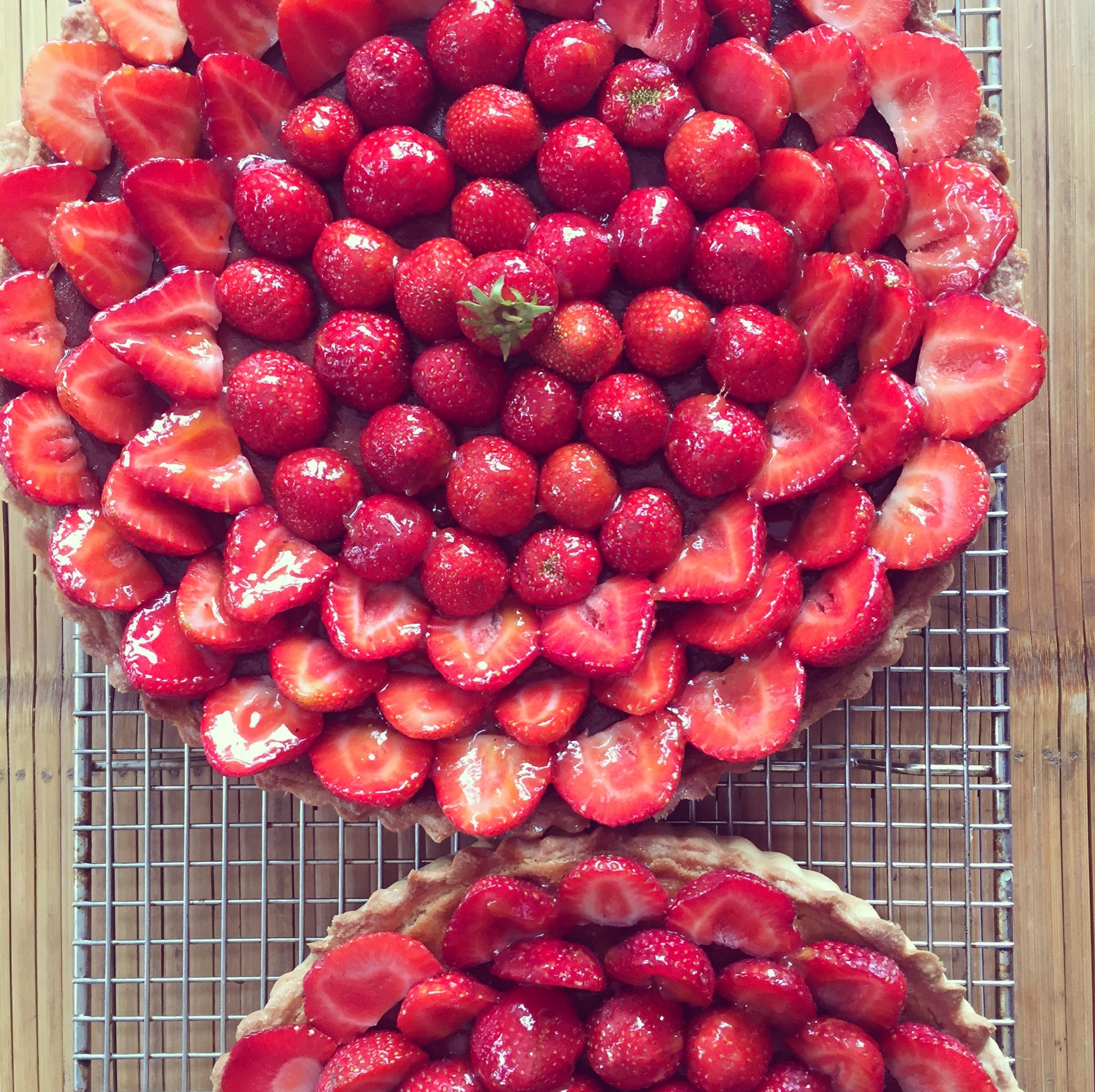
I so admired Thierry and worked hard every day to impress him, but it was beginning to dawn on me that my admiration for Mr. Rock-Star chef was in no way reciprocal. One morning I was asked to make “jardinières,” the name for fruit tarts. The fruit in Lyon was awesome (mara des bois strawberries, fraises des bois, plump raspberries, African pineapples, apricots, peaches, etc.), so I was inspired. I made three magnificent tarts, so beautiful, in fact, that everyone in the kitchen gathered around to admire them. Even the head of the tour, an older man who went by the nickname DD, came over and patted me on the shoulder. When Thierry walked by, DD said, “Chef, regardez ces belles tartes.” Thierry glanced over and said, “Get them in the fridge. They’ve been sitting out on the counter long enough.” Eesh…
Time and time again, the guy could not say one encouraging word about my work. If anything, I think he found me annoying. I recall one day when everyone was wishing him “bonne fête.” We all stood in line for the one-two kiss, and when it got to me, I said “joyeux anniversaire,” which set the whole staff into a fit of giggles. Thierry looked at me and, after a serious eye roll, said that it was his “fête,” the French name day, and not his birthday. I just couldn’t win.
It didn’t take long before my initial desperation to please began to fade away. In fact, I started to notice all that was NOT attractive about the guy. First, his teeth were a complete disaster. Second, like all the guys in the kitchen, he wore clogs, which I found hilarious. Back then, most of the men in pastry shops wore clogs, which amused me no end. Third, he was surly. Watching Mr. Shitty Mood stomping around the kitchen with his clogs, barking out orders before retreating to the ice cream room, was a low point of every morning. And I wasn’t the only one who felt that way. There was no love lost between Thierry and his staff. And there was no missing the frostiness between Thierry and the oven king, Gerard.
After an especially heated exchange with Gerard one morning, Thierry left for a meeting after lunch. The moment he walked out the back door, DD gave the all-clear to Gerard, who quickly bolted upstairs to the freezer. From below we could hear him rummaging around the walk-in, then opening a window, from which he hurled one of Thierry’s ice sculptures into the back alley behind the shop. As Gerard slowly descended the stairs and returned to his post, everyone cheered. “I couldn’t get to the butter so I had to move it,” he said nonchalantly, high-fiving his co-conspirators. From my vantage point I could see what was once a very nice horse, now shattered into several pieces, which conveniently melted long before Thierry’s return.
Gerard may not have been a World Champion, but in reality, he was the King of the Hill. Everyone deferred to him and no one worked as hard, or as well.
Gerard was in charge of all of the four secs, which is the fancy French word for cookies. Cookies may seem insignificant, but they’re actually big money makers in bakeries, as anyone who has picked up a box of them in a good pâtisserie is aware. French cookies are made several ways: sliced (like the “diamants”), rolled out (like a linzer cookie), poché using a “pochoir” or stencil (like a tulip cookie), or piped (like a cherry-topped sablé).
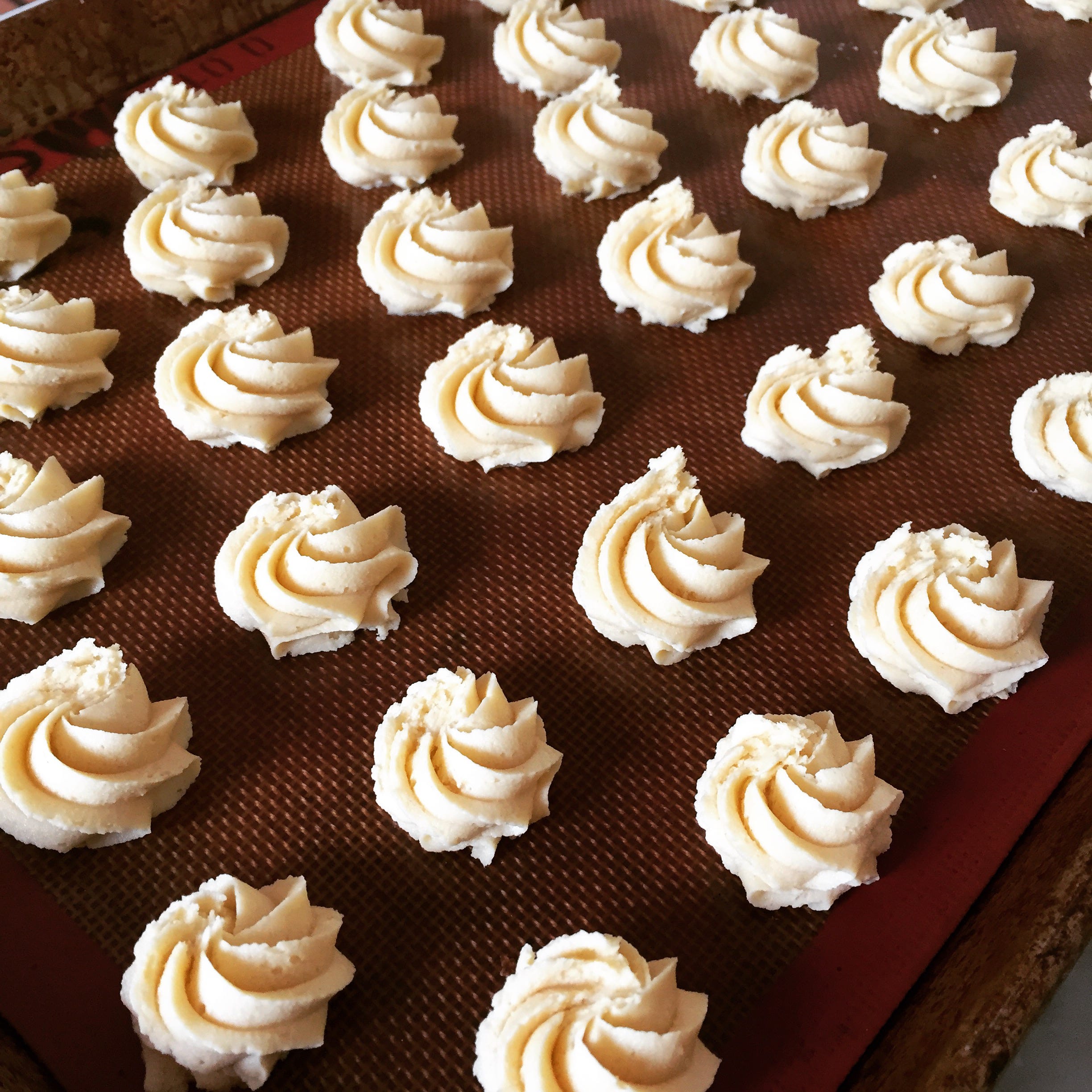
When Gerard piped cookies, he would stack up about 50 trays, make a huge batch of dough, and then for the next hour would pipe so quickly you could barely see his hands move. The best pastry chefs are not only fast, but precise, and Gerard was both. And all the while, he would turn around and be baking not only his cookies, but any other goods that came his way. The man was a machine, and I was completely in awe of his skills.
One morning, upon arrival at my usual time, 6 am, Richard came up to me and said, “Don’t talk to Gerard. All of the guys at the tour called in sick with a gastro and he has to do everyone’s job.” I looked over and saw Gerard at the laminoire (dough sheeter) rolling dough, making tortes, preparing trays of viennoiseries at twice the speed he usually worked. Head down, he got it all done, while still fulfilling his usual baking duties. By lunchtime, the guys at the tour began to trickle in, and everyone knew the miracle Gerard had just performed, even Thierry, fully aware Gerard had outdone himself that morning. Gerard was the most valuable employee in the enterprise and he knew it. We all knew it!
* * * * *
Staff lunch at La Minaudière was always taken seriously (this was Lyon after all, where food is a religion). Two tables were set up, white tablecloths were laid down, and bottles of good local wine were set on either side. The catering division loaded the table with salads, and we supplied the bread, savoury pastries, and desserts. At first I never touched the wine, but eventually I gave in, noticing that it would take the edge off while working on things that made me nervous, like the croquembouches we’d make for the afternoon deliveries, which required rolling out a hot caramel and almond mass similar to peanut brittle called nougatine, which I despised.
On one particular day, I lingered at the lunch table a little longer when the manager of the shop, a lovely guy by the name of Étienne, sat down. All of the staff had left save for me, Richard, and Thierry. I used to talk to Étienne about Montreal, but that day he had something else he urgently wanted to talk about: Gerard.
Upgrade to a paid subscription
While I played with last crumbs of my dessert, Étienne began to tell Thierry that Gerard had stolen his cheque book out of the staff lockers. When Thierry asked how he knew it was him, Étienne said that Gerard had used a cheque from his cheque book at a store a few doors down from the pâtisserie. Knowing Gerard and recognizing the name on the cheque, the store owner came and told Étienne what Gerard had just done. I was sad to hear it, but not surprised, having learned a lot about Gerard on his days off. I heard staff members saying they had spotted him in town sleeping on park benches at night. I heard he was from a very poor family and that Mr. Masson had more or less adopted him when he was 14 and brought him to work at La Minaudière, where he had worked in every department since. I knew he was friends with the prostitutes who lived upstairs, and he told me that sometimes he used their services. I knew a lot about Gerard.
Mr. Masson entered a few minutes later, and Thierry and Étienne told him about the cheque book, with Étienne insisting that he be fired. Mr. Masson’s answer was severe but not surprising: “Étienne,” he said, “Gerard is intouchable. I’d fire you before him. Gerard is the most valuable employee in this business and he’s like a son to me. Forget about the cheque book. It doesn’t matter.”
Over the years, I’ve heard of many circumstances where cooks kept their jobs even after being accused of all sorts of bad behaviour, like sexual harassment, stealing, psychological abuse, fighting, and so on. People are always outraged when these chefs aren’t fired, and rightly so. But whenever these cases came up, I thought of Gerard. He had a horrible temper and didn’t get along with Thierry, his boss, but the truth was, he was too valuable to let go.
I often wondered if he pulled that stunt on purpose, knowing full well he'd get caught but also confident that his talent and work ethic put him beyond the reach of the rules.
No posts
Comments
Nothing yet. Say the first thing.
Sign in to join the conversation.