
Published: 1 August 2026
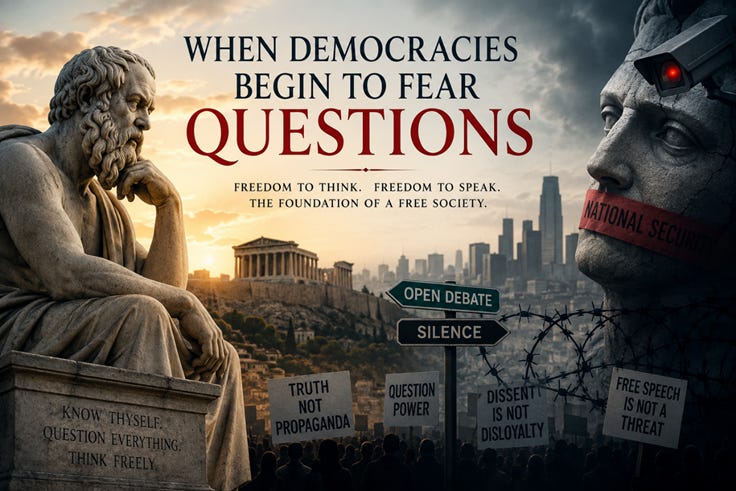
More than 2,500 years ago, Socrates introduced a revolutionary idea that would profoundly shape European civilisation.
Rather than telling people what to think, he asked them why they believed what they believed. Through careful questioning, he exposed contradictions, challenged assumptions and demonstrated a truth that remains as relevant today as it was in ancient Athens: authority alone is not evidence. Those in positions of power may possess influence and status, yet still be profoundly mistaken.
Socrates taught that ideas become stronger through scrutiny, not protection. Critical thinking was not an act of disloyalty; it was the highest expression of responsible citizenship.
Over the centuries, Europe was transformed by men and women who embraced that tradition. John Locke challenged the divine right of kings. Montesquieu argued that power must be divided to prevent tyranny. Voltaire defended freedom of expression and religious tolerance. The Enlightenment did not simply produce new political systems. It produced a new way of thinking—one in which questioning authority became not only acceptable but essential.
Modern Europe proudly traces many of its greatest achievements to that intellectual inheritance. Freedom of speech. Freedom of conscience. Freedom of the press. The rule of law. Democratic accountability.
Yet today many Europeans are beginning to wonder whether that tradition is quietly being reversed. Increasingly, the right to question appears conditional. You remain free—provided your questions remain within acceptable boundaries.
Across Europe, a series of developments has raised uncomfortable questions about the relationship between national security and freedom of expression.
In the United Kingdom, demonstrators protesting Israel’s conduct in Gaza have faced arrest under legislation connected to support for a proscribed organisation, prompting concerns among civil liberties advocates about the boundaries between protest, political expression and criminal liability.
In France, former RT France editor Xenia Fedorova has been ordered to leave the country after authorities concluded that her activities were incompatible with French national interests. She denies acting as an agent of the Russian state and disputes the allegations.
The European Union has imposed sanctions on retired Swiss intelligence officer and strategic analyst Jacques Baud, accusing him of supporting Russian information activities. His supporters argue that he is being punished not for espionage or criminal conduct, but for expressing controversial geopolitical views.
Reports have also emerged that German policymakers are examining constitutional mechanisms to prevent regional governments viewed as sympathetic to Moscow from obstructing NATO-related decisions during a security crisis, reopening debate about the balance between federal democracy and national security.
Each of these cases has its own legal context. Each deserves to be assessed on its own merits. But taken together they point towards a broader and more significant question.
Are democratic societies gradually redefining disagreement itself as a security problem?
There is no doubt that Europe faces genuine challenges. Russia conducts information campaigns. So does the USA. Foreign governments attempt to influence public opinion.
· Disinformation exists.
· Cyber operations are real.
Democratic governments have both the right and the responsibility to protect their societies against hostile interference. The question is not whether governments should act. The question is where legitimate defence ends and political control begins.
This distinction matters because democracies have traditionally drawn a clear line between hostile activity and unpopular opinion.
· A foreign intelligence operation is not the same as an independent journalist expressing a controversial view.
· An organised influence campaign is not the same as a retired military officer offering an alternative strategic assessment.
· Disagreeing with government policy—even on matters of war and peace—has never been evidence of disloyalty. Indeed, democratic societies have long regarded such disagreement as an essential safeguard against policy failure.
History offers countless examples. Governments have been wrong about wars.
· They have been wrong about economic policy.
· They have been wrong about intelligence assessments.
· They have been wrong about public health.
Progress has often depended upon those willing to ask uncomfortable questions before it became politically convenient to do so.
The irony is striking.
Europe’s intellectual greatness was built upon encouraging citizens to question accepted wisdom. Today, some critics fear that questioning official narratives increasingly risks being interpreted as assisting hostile foreign interests. If that perception grows, the consequences extend far beyond any single geopolitical dispute.
· Citizens begin to censor themselves.
· Academics become more cautious.
· Journalists hesitate before publishing unpopular opinions.
· Public debate narrows.
· Political conformity gradually replaces intellectual curiosity.
None of this requires authoritarian intent. Institutions naturally seek to protect themselves. Political leaders facing crises understandably prioritise stability. Security agencies naturally focus on identifying threats. The danger lies not in any single decision, but in the gradual expansion of what constitutes a threat.
A democracy that once distinguished between espionage and dissent may slowly begin treating inconvenient opinions as security risks simply because they challenge official policy.
That represents a profound shift in democratic culture. The most resilient democracies have never depended upon unanimity. They have depended upon confidence. Confidence that citizens are capable of evaluating competing arguments. Confidence that falsehood can be defeated through evidence rather than suppression. Confidence that open debate strengthens society rather than weakens it.
This brings us back to Socrates.
He understood that genuine knowledge emerges through questioning. A society that discourages questions does not become wiser. It merely becomes more certain of its own assumptions.
The central challenge facing Europe today is therefore not simply how to defend itself against external manipulation. It is how to do so without sacrificing the intellectual traditions that made European civilisation distinctive in the first place.
Every democracy must defend itself. No democracy should become so fearful that it begins to fear questions. For once governments decide which opinions are safe to express and which questions should no longer be asked, they risk abandoning the very principles they claim to defend.
The measure of a confident democracy is not its ability to silence dissent. It is its willingness to trust its citizens with competing ideas—and its confidence that truth can prevail without the protection of censorship.
Europe’s greatest legacy was never that it always possessed the right answers. It was that it taught the world the importance of continuing to ask the right questions.
Leon Vermeulen is an independent historian and commentator specialising in European memory, conflict, reconciliation and social cohesion.
No posts
Comments
Nothing yet. Say the first thing.
Sign in to join the conversation.