
Published: 4 August 2026
As Europe approaches what promises to be one of the most perilous winters in recent memory, a dangerous disconnect has formed between Brussels’ aggressive geopolitical maneuvering and the stark reality of continental energy security.
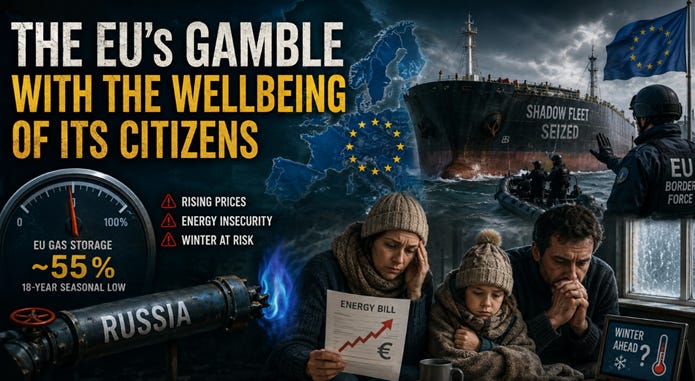
With gas storage facilities languishing at an 18-year seasonal low of roughly 55% to 57%, the European Union is playing a high-stakes game of chicken with Moscow and it is European citizens who are being used as chips.
The EU’s latest escalation, formalised under its 21st sanctions package, grants member states the unprecedented domestic power to seize Russian shadow-fleet tankers, board them under the guise of “statelessness,” and sell off the confiscated oil cargoes for their own national profits.
On paper, it is framed as a righteous crusade to choke off the Kremlin’s war chest and enforce maritime safety.
In reality, it is a legal and economic gamble that ignores Europe’s glaring vulnerabilities.
Brussels appears to be operating under the naive assumption that Russia will passively absorb these hostile acts without using the considerable economic leverage it still holds. Despite years of talk about “decoupling,” the EU remains tethered to Russian energy. Moscow still supplies vital pipeline gas through Ukraine and Turkey, alongside significant volumes of Liquefied Petroleum Gas (LPG) and oil products.
By systematically targeting and humiliating Russia’s maritime commerce, European leaders are actively provoking a response that could turn catastrophic when the temperature drops.
Should Moscow decide that the financial returns of these remaining routes no longer outweigh the strategic cost of being plundered at sea, a unilateral turn of the energy tap would plunge Europe into a structural crisis.
This provocation comes at the worst possible moment. The widening conflict in the Middle East has already severely disrupted Qatari LNG inflows, leaving Europe exposed in a brutal global bidding war against Asia.
Regulators have already been forced to roll back winter storage targets to an emergency 80% baseline, with some states quietly permitted to aim as low as 70%. The seasonal spread is broken; buying gas to store for winter is currently a loss-making venture for commercial utilities.
To cushion the looming blow, the EU has activated the Middle East Crisis Temporary State Aid Framework (METSAF), preparing emergency energy vouchers and tax breaks.
But state subsidies cannot create physical molecules of gas. If Russia responds to Europe’s maritime asset seizures by halting its remaining exports, wholesale prices are projected to double, skyrocketing past €100 per megawatt-hour.
European policymakers have backed themselves into a corner where geopolitical posturing takes precedence over basic civic safeguarding.
Punishing Russia’s economic interests has become an end in itself, pursued with a reckless disregard for the immediate consequences.
If the Kremlin decides to match Europe’s economic warfare in kind this winter, millions of European citizens may find out the hard way that righteous rhetoric is a poor substitute for a functioning heating system.
Leon Vermeulen is an independent historian and commentator specialising in European memory, conflict, reconciliation and social cohesion.
No posts
Comments
Nothing yet. Say the first thing.
Sign in to join the conversation.