
Germany of course has every right to rebuild its national confidence, and it does not need to live forever in 1945. What the AfD truly needs to prove is that a German revival does not have to come at the cost of weakening historical responsibility. Germany does not need to forget its past in order to believe in its future again. And this is precisely what Japan should make Germany wary of: historical revisionism and military normalization can move toward each other entirely within a democratic system, one seemingly reasonable exception after another, until step by step they lead a country back toward another immense catastrophe.
This essay is part of the series of State Governance and Capacity.
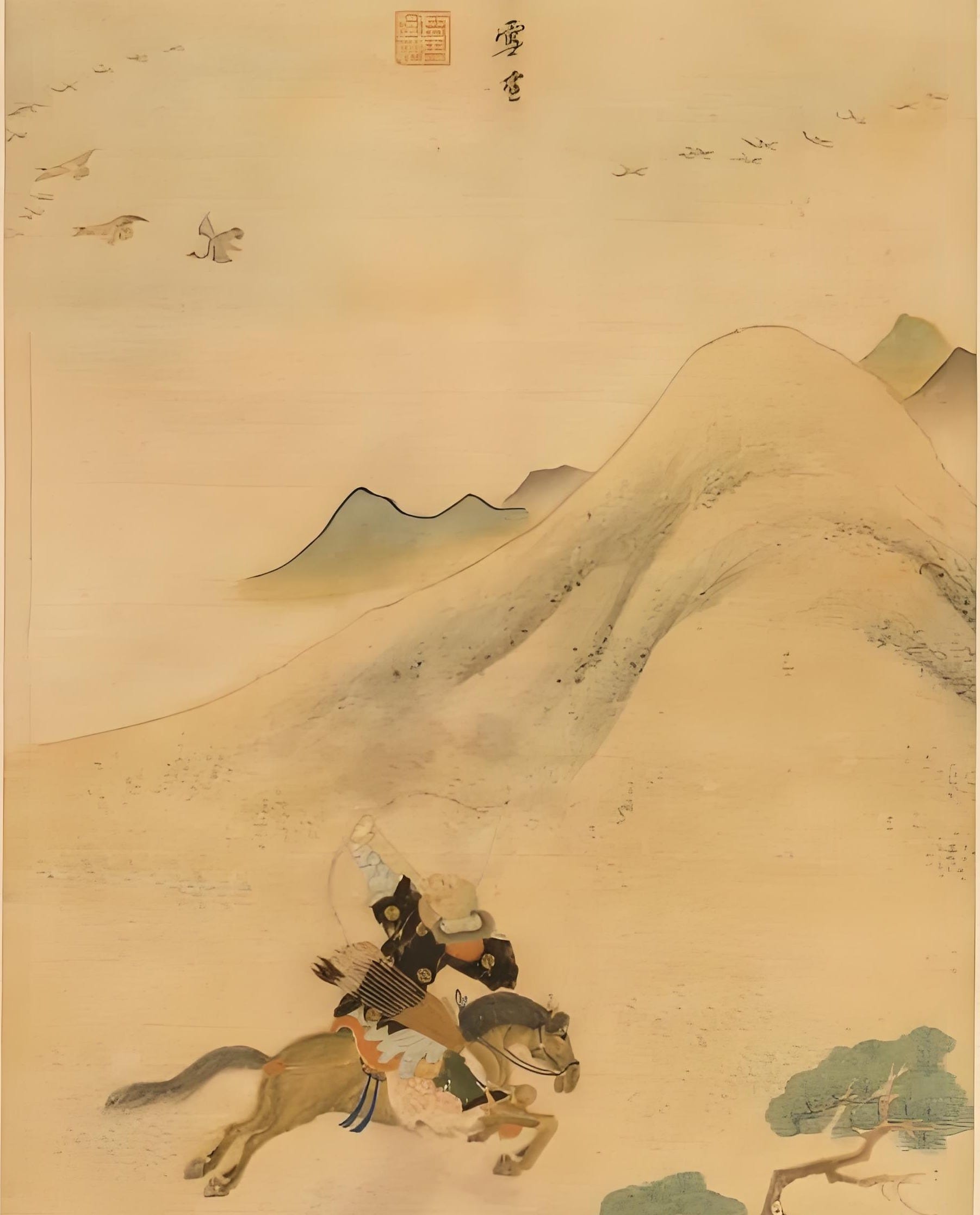
Hunting with a Falcon, 《猎鹰图轴》Kangxi period, Qing dynasty
A Gu embroidery, rather than a painting, depicting a mounted hunter in pursuit, with the imagery of eagle, horse and martial skill brought together in a single scene. The work also carries a subtle suggestion of state power, military tradition, and force held under restraint.
One moment in Elon Musk’s recent interview with The Economist’s editor-in-chief Zanny Minton Beddoes stayed with me. Musk said that the AfD was not really “far right” at all; it represented the normal positions of normal people. What was absurd, he argued, was that media outlets such as The Economist described secure borders, safe cities, sensible spending as part of the far-right fringe. Musk even insisted that this portion of the interview remain in the final version, calling the media’s description of the “far right” false, misleading and nonsense.
Seen from outside Germany, his question is hardly unreasonable. Why does demanding border control become “far right”? Why are support for nuclear power, opposition to gender politics, an emphasis on traditional families and even homework for students all placed under the same political label? Stranger still is Germany’s sensitivity toward history and national identity. Why is German identity so dangerous? Why does a German political party’s renewed emphasis on Bismarck, 1871 and national pride immediately touch the most sensitive nerve in German politics? The French can commemorate Napoleon. The British can commemorate Churchill. An American president is almost required to say publicly that America is the greatest country on earth. Why can Germans not simply say: Make Germany Great Again?
From the outside, this vigilance can sometimes look almost neurotic. Germany’s postwar political culture seems to have built an extraordinarily wide perimeter of alarm: nationalism easily evokes ethnic nationalism; national pride can slide toward historical revisionism; and any reassessment of German history quickly brings the discussion back to 1933–1945. The result is that political language regarded as perfectly normal elsewhere often arrives in Germany accompanied by a historical instruction manual. Musk sees exactly this.
Yet from an East Asian perspective, put Japan next to Germany and the picture changes.
Both countries were defeated in 1945. Both were occupied, disarmed and politically reconstructed; both later became democracies, American allies and major industrial economies. Eighty years later, Japan has still not restored a 1930s-style political system. There has been no military coup, no abolition of democratic elections and no restoration of empire. Yet Japan today has one of the world’s largest defense budgets, is deploying long-range counterstrike capabilities, expanding the legal scope within which the Self-Defense Forces may operate, rebuilding its defense industry, allowing the export of complete weapons systems including lethal equipment, and debating under what circumstances a Taiwan conflict could constitute a “survival-threatening situation” permitting the use of the Self-Defense Forces. It is also debating whether to loosen the Three Non-Nuclear Principles. The Sanae Takaichi government brought forward to fiscal 2025 a defense-spending target of roughly 2% of GDP that had originally been scheduled for several years later, while in 2026 it began rewriting the three national-security documents adopted only in 2022.
If one looks only at these final military policies, a simple explanation is readily available. China’s military power is rising. North Korea has nuclear weapons. Russia invaded Ukraine. The United States wants its allies to assume more responsibility. Japan therefore has every reason to strengthen its defenses. All of these explanations are real.
This is not really a China story. But my own reaction to these two cases made me curious. When Western readers see Japan increasing defense spending, acquiring Tomahawks and developing counterstrike capabilities, they tend to think first of the China threat, North Korea and alliance burden-sharing. As a Chinese, I see the same developments and almost immediately think of Nanjing, colonial rule, the comfort women, Yasukuni Shrine, and a debate over wartime responsibility that has never fully been settled.
And that made me think differently about Germany. When I heard Musk argue that many of the AfD’s positions were simply normal political views, while so many Germans and Europeans regarded the party with alarm, I realized that I could understand some of that alarm. Historical memory changes how otherwise ordinary political ideas are heard.
Put Japan next to Germany, and something becomes clearer: nationalism, historical memory and military power cannot always be understood separately.
In October 1978, Tokyo’s Yasukuni Shrine secretly enshrined fourteen Class-A war criminals.
Hideki Tojo was one of them.
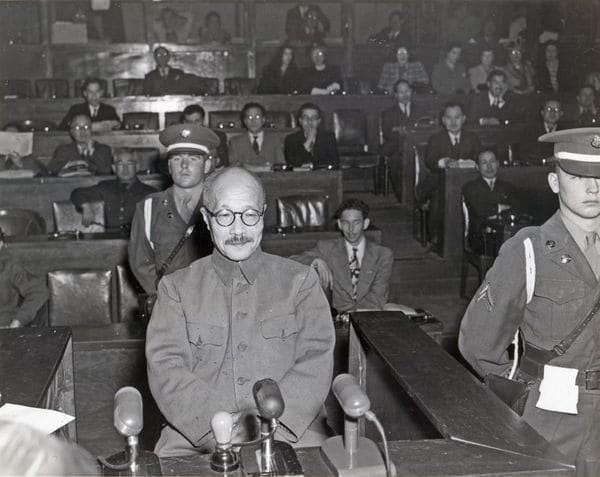
Hideki Tojo at the International Military Tribunal for the Far East.
The decision was not revealed by the Japanese media until 1979. Six years later, on August 15, 1985—the fortieth anniversary of Japan’s defeat—Prime Minister Yasuhiro Nakasone paid an official visit to Yasukuni. It was not the first time a Japanese prime minister had visited the shrine, but it was the first visit after the enshrinement of the Class-A war criminals that was explicitly made in an official capacity and on the anniversary of Japan’s surrender. China and South Korea quickly lodged strong protests. Nakasone never again visited in the same manner. Yasukuni gradually ceased to be merely a domestic Japanese site of war remembrance and became one of East Asia’s most sensitive political symbols.
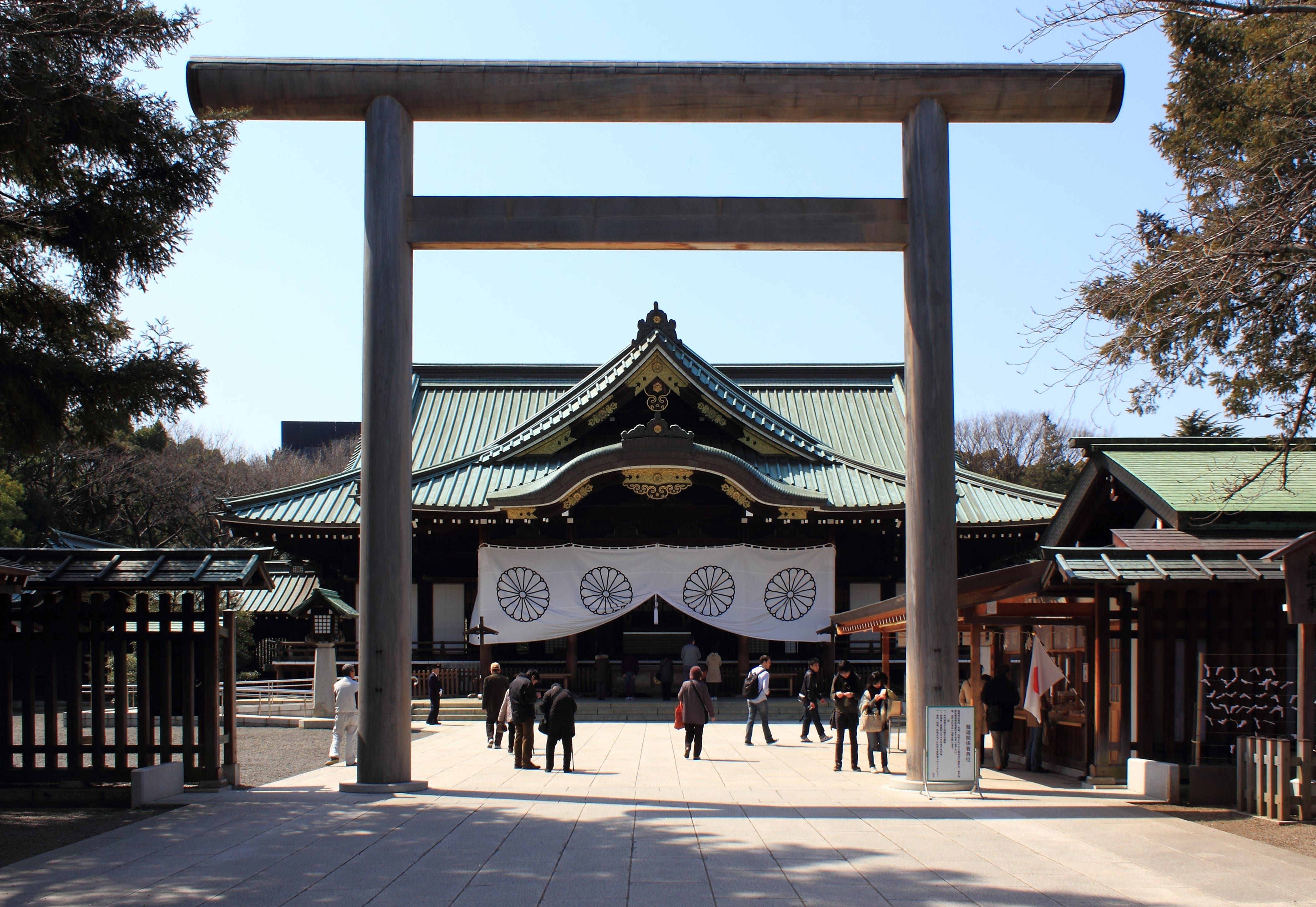
Yasukuni Shrine
Viewed purely from inside Japan, the reactions of China and South Korea to Yasukuni over the following decades can easily appear excessive. The Japanese right has always had a fairly intuitive explanation: Yasukuni enshrines roughly 2.5 million war dead; the fourteen Class-A war criminals are only a tiny fraction. When a prime minister visits the shrine, he is first and foremost mourning those who died for the country. Other countries have war memorials. Britain honors its soldiers. The American president lays wreaths at Arlington National Cemetery. Why should Japan be forbidden from remembering its own dead?
The problem is that after 1978, Yasukuni ceased to be simply a place for “the war dead.” Nagayoshi Matsudaira, the Yasukuni chief priest who pushed through the enshrinement of the Class-A war criminals, himself rejected the Tokyo Trials’ judgment of those wartime leaders. The fourteen included some of the highest-ranking political and military figures who launched and led the Pacific War. More revealingly, Emperor Hirohito never again visited Yasukuni after the Class-A war criminals were enshrined. In other words, Japan itself had long understood where that line lay.
China and South Korea therefore did not see an ordinary war memorial. China endured Japan’s full-scale invasion. The war from 1937 to 1945 left 20 million Chinese dead. Even today, parts of the Japanese right still deny or minimize the Nanjing Massacre, while the Japanese government continues to dispute its scale and death toll.
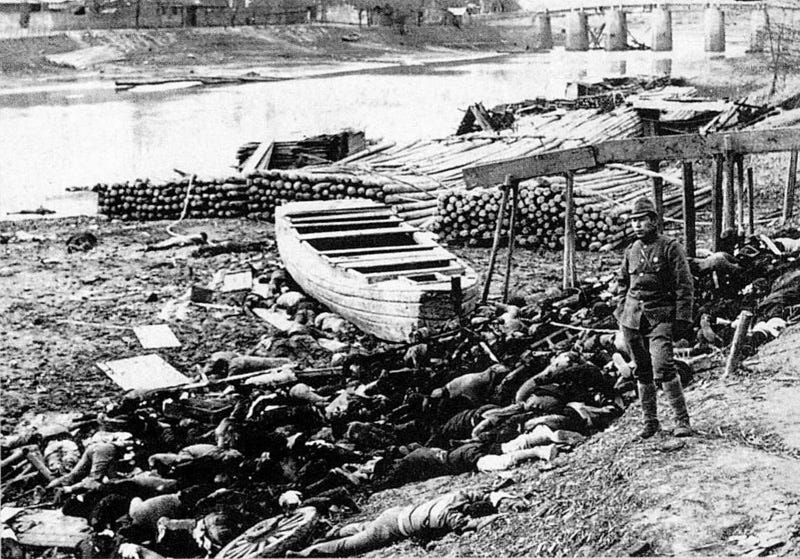
Bodies of victims along the Qinhuai River during the Nanjing Massacre, 1937–38.
The Korean Peninsula, meanwhile, endured thirty-five years of Japanese colonial rule: the suppression of the March First Movement in 1919 killed hundreds to thousands; toward the end of the war, nearly 800,000 Koreans were forcibly sent to Japan as laborers, and research estimates that more than 10% of Koreans forcibly mobilized across the Japanese Empire died or disappeared. At the same time, the “comfort women” system created by the Japanese military coerced, deceived or otherwise mobilized 200,000 women from Korea, China, the Philippines, Indonesia and elsewhere, with Korean women forming a major share—possibly as many as 100,000. They were sent to military brothels across China, Southeast Asia and the Pacific and subjected to prolonged systematic sexual exploitation and violence.
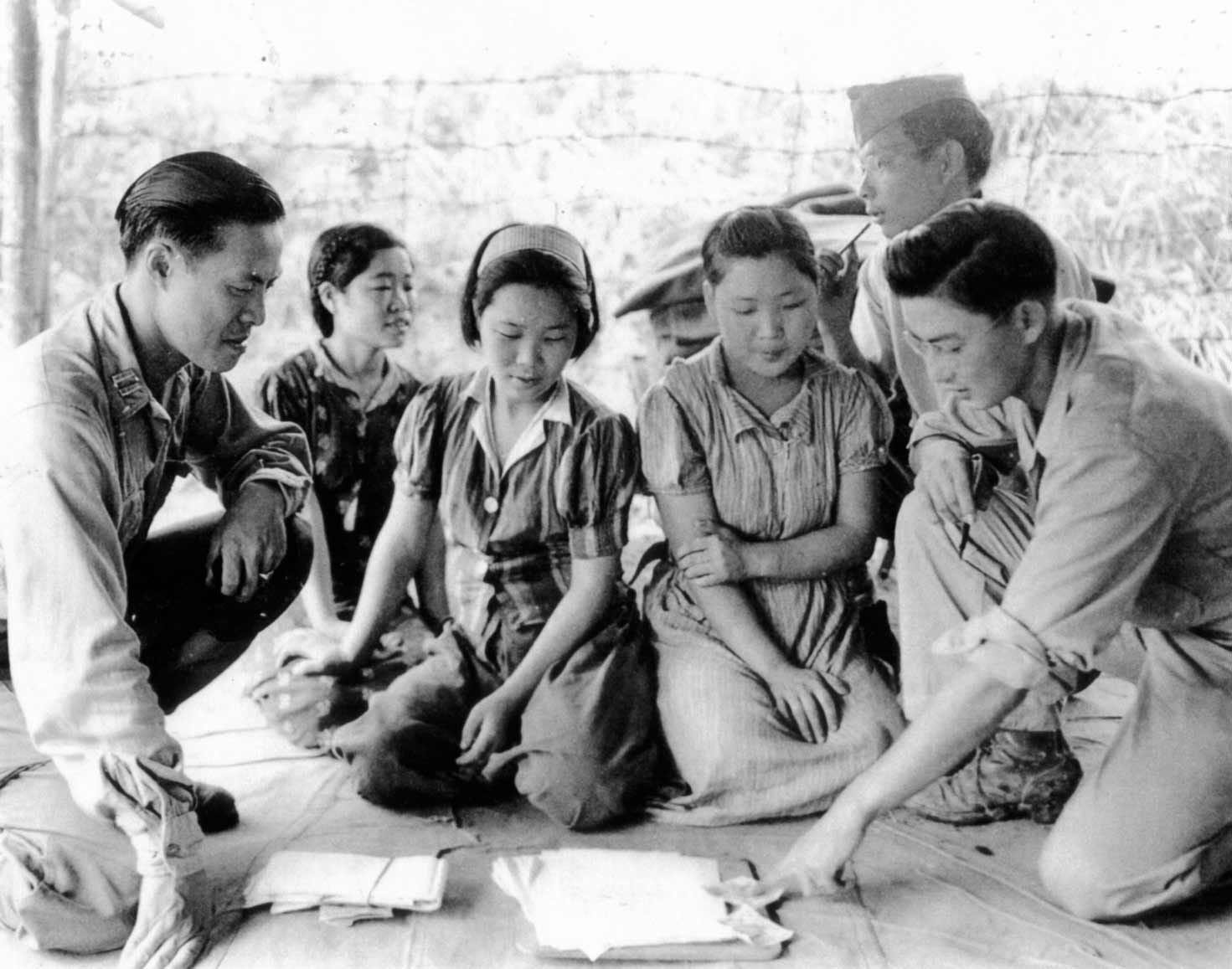
Three Korean “comfort women” captured in Burma and questioned by U.S. Army personnel, Myitkyina, August 14, 1944.
Japan occupied Southeast Asia for only three and a half years, yet the destruction was similarly enormous: Cambridge research estimates that roughly 4.4 million Southeast Asian civilians died prematurely, including about 3.4 million in the wartime famines of Vietnam and Java; the Philippines lost roughly one million civilians, while the Sook Ching massacre in Singapore killed around 50,000 ethnic Chinese. Japan itself had a population of roughly 70 million at the time, while the Asian peoples harmed by Japanese “colonial rule and aggression” amounted to the equivalent of 40% of Japan’s entire population. That does not include American or Soviet military casualties.
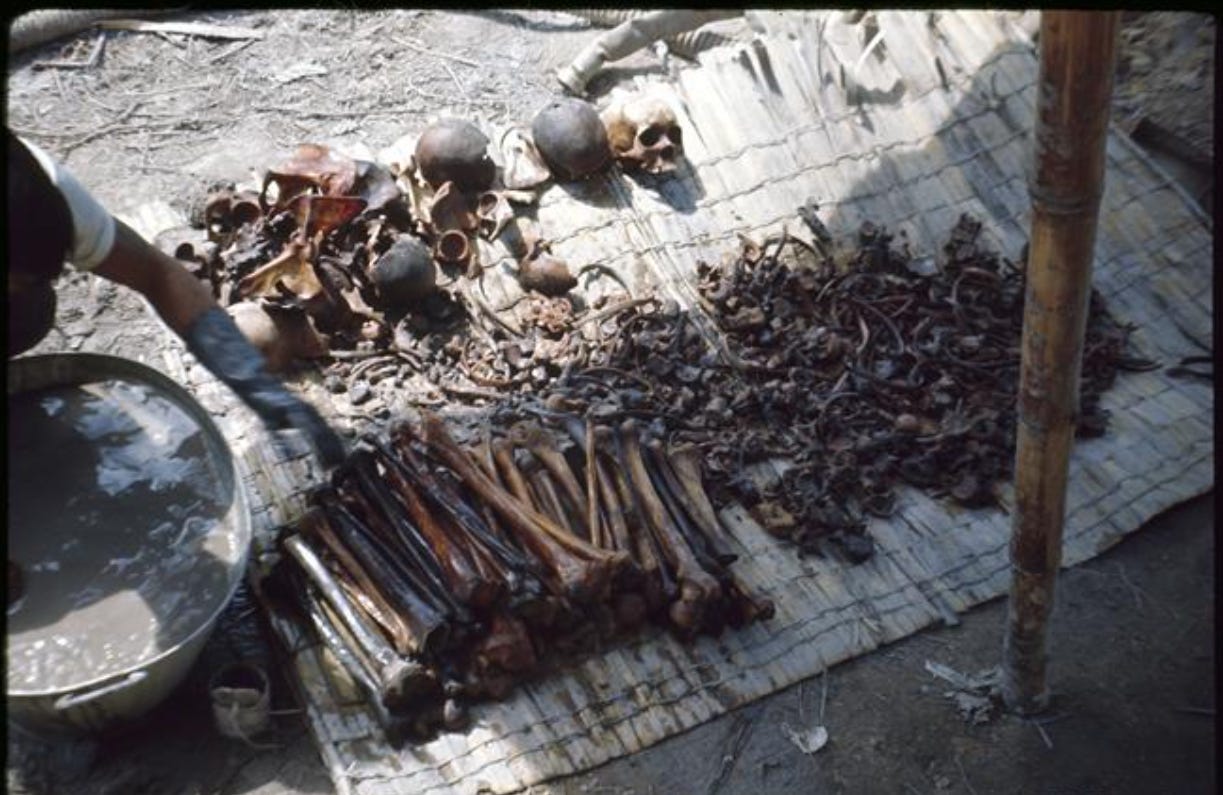
The remains of victims of the Sook Ching massacre exhumed from a mass grave in Singapore, c. 1966–67. Japanese forces carried out the Sook Ching purge after occupying Singapore in 1942, executing large numbers of Chinese civilians. Photo: James M. Punter / National Library Board, Singapore.
The 1995 Murayama Statement would later acknowledge, in the Japanese government’s own language, that Japan through its “colonial rule and aggression” caused “tremendous damage and suffering” to many countries, particularly the peoples of Asia. When a postwar Japanese prime minister enters a shrine that venerates ordinary war dead and wartime leaders such as Hideki Tojo alike as enshrined spirits, the argument in Asia has never been merely about whether Japan has the right to mourn its dead. It is about how Japan judges the men who launched those wars.
To understand why the Yasukuni issue has never disappeared, the timeline has to be pulled back further.
After Japan’s defeat in 1945, a genuine reckoning did take place. The military was dissolved. The International Military Tribunal for the Far East tried wartime leaders. Large numbers of figures associated with the old regime were purged from public office. The 1947 Constitution came into effect, and Article 9 renounced war as a means of settling international disputes. In this respect, the history was not as different from Germany’s as some later simplified narratives suggest.
The real divergence came after the reckoning had begun.
The Cold War rapidly changed Washington’s objectives in Asia. The Chinese Revolution, the Korean Peninsula and strategic pressure from the Soviet Union made the United States increasingly dependent on an economically stable, politically conservative and anti-communist Japan. A number of politicians closely connected to the wartime system were allowed to re-enter public life. The most symbolic case was Nobusuke Kishi. Kishi entered the Diet in 1942 under the Imperial Rule Assistance political system, was detained in 1945 as a suspected Class-A war criminal, and released in 1948. After the purge ended in 1952, he rebuilt his political base. In 1957, the man who only twelve years earlier had been imprisoned as a suspected Class-A war criminal became prime minister of Japan.
This did not mean that Japan in 1957 had again become a militarist state. Kishi became prime minister through competitive parliamentary politics, and the military did not regain control of the state. But it revealed a degree of political continuity rarely seen so starkly in Germany: a man who had entered Tojo’s wartime power structure could return, without ever standing trial, to the center of postwar conservatism and eventually lead the new democratic Japan.
Half a century later, one of the most important right-wing prime ministers in postwar Japanese history happened to be Kishi’s grandson—Shinzo Abe.
The family connection alone obviously cannot prove ideological continuity. But the choices Abe later made over Yasukuni gave it an unusually powerful historical resonance. On December 26, 2013, Abe visited Yasukuni as the sitting prime minister. Strong protests from China and South Korea were predictable. What was genuinely unusual was the American response: the U.S. Embassy publicly stated that Washington was “disappointed” that Japan’s leadership had taken an action that would “exacerbate tensions” with its neighbors. The American government rarely uses such language publicly against one of its most important Asian allies.
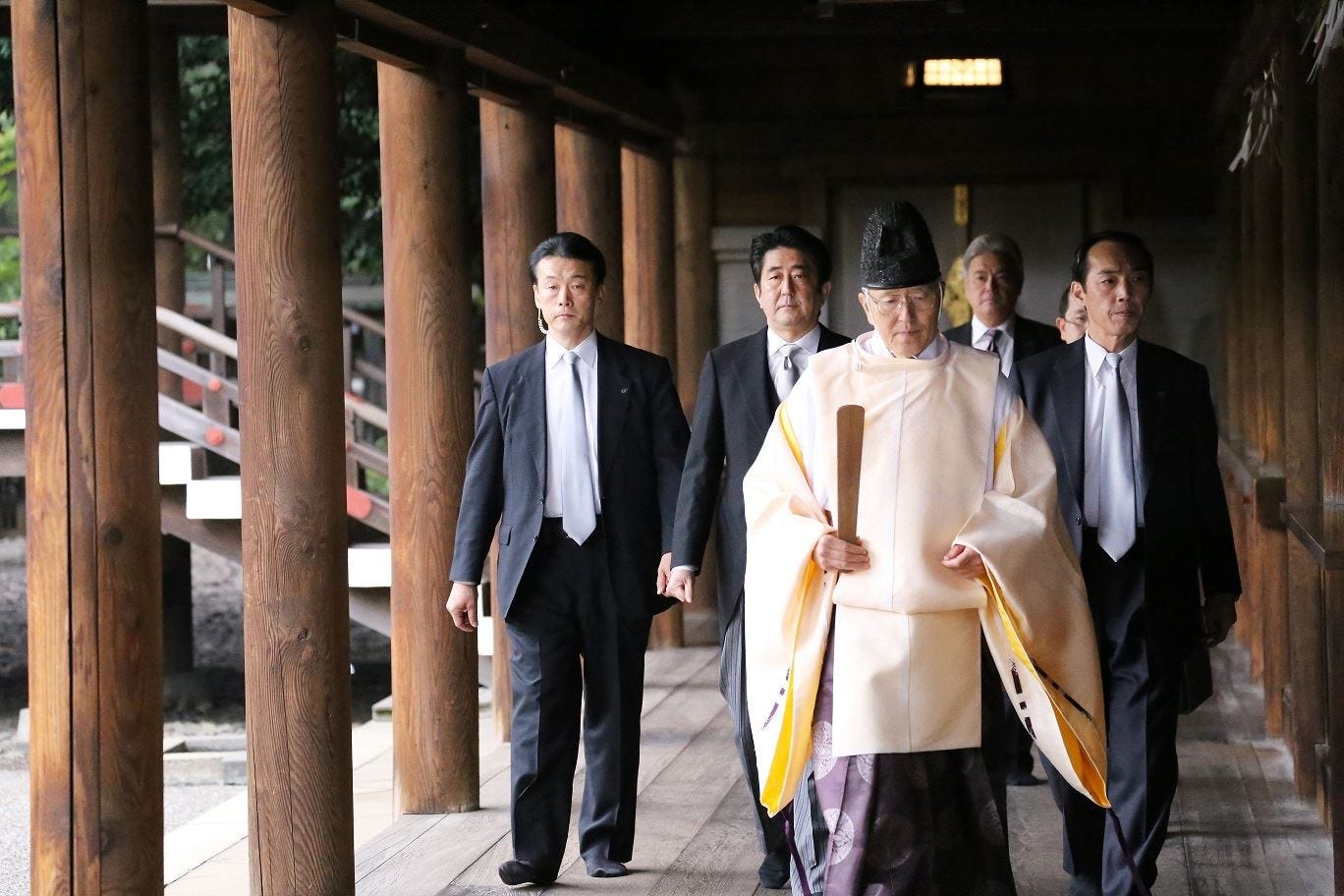
Shinzo Abe visits Yasukuni Shrine as prime minister, December 26, 2013
At the same time, Abe was pursuing another political project that appeared quite separate. In 2014, Japan replaced its strict arms-export restrictions with the Three Principles on Transfer of Defense Equipment and Technology; that same year, the Abe government reinterpreted Article 9 of the Constitution, opening the door to limited exercise of collective self-defense; and the 2015 security legislation converted that reinterpretation into an operational legal framework. Japan did not delete Article 9 from its pacifist constitution.
It began changing what Article 9 actually allowed Japan to do.
These two lines—historical nationalism and military normalization—did not move forward in lockstep at every stage. That is precisely why Japan’s transformation cannot be reduced to a right-wing government following a predetermined blueprint to “restore militarism.” The historical reality is much more complicated.
Turn the timeline back again to the 1980s, and another unfinished path becomes visible.
In 1982, Japan’s history-textbook controversy triggered a major international dispute for the first time. From then on, how school textbooks should describe Japan’s war in China, colonial rule, Nanjing, the comfort women and the expansion of the Japanese Empire became a recurring source of political conflict—between conservatives and liberals inside Japan, and between Japan and its Asian neighbors. The Japanese government eventually introduced the so-called “Neighboring Countries Clause” into textbook screening, requiring consideration of neighboring countries’ understanding when dealing with modern Asian history. History had entered the institutions of the state, but no settled national consensus had formed around what that history meant.
In 1993, Japan in fact took a very important step down another road. Chief Cabinet Secretary Yohei Kono released the findings of a government investigation acknowledging that comfort stations had been established at the request of the Japanese military; that the military had been directly or indirectly involved in their establishment, management and transfer; and that many women had been recruited against their will through deception, coercion and other means. The statement expressed “sincere apologies and remorse.”
Two years later, on the fiftieth anniversary of Japan’s defeat, Prime Minister Tomiichi Murayama issued an even more important statement. He explicitly said that Japan, “through its colonial rule and aggression,” had caused tremendous damage and suffering to the peoples of many countries, particularly those of Asia, and expressed “deep remorse” and a “heartfelt apology” on behalf of Japan. This was perhaps the closest postwar Japan ever came to a national-level historical reckoning.
If the Kono Statement and Murayama Statement had gradually hardened, like Germany’s recognition of responsibility for the Holocaust, into an almost irreversible cross-party and intergenerational national consensus, Japan’s subsequent politics of history might have looked entirely different.
The problem was that they became official positions of the Japanese government without becoming a non-negotiable moral boundary of Japanese conservative politics.
Japan never formally withdrew those apologies. Even the Abe government continued, at the legal and diplomatic level, to recognize the basic historical positions of previous governments. What never became settled was how much weight those apologies should carry within Japanese national identity. The Japanese right could simultaneously accept two propositions: Japan did wrong in the past; Japan has apologized enough. The comfort women could remain inside the government’s language of “apology and remorse” while politicians disputed the definition of coercion, the number of victims and the term “sex slaves.” The Tokyo Trial could remain formally intact while being described as victors’ justice. Japanese aggression could be acknowledged while equal emphasis was placed on the firebombing of Tokyo, Hiroshima, Nagasaki and the fact that ordinary Japanese soldiers and civilians were themselves victims of war. Yasukuni could continue to enshrine Class-A war criminals while prime-ministerial visits were explained simply as mourning the war dead.
The historical facts did not disappear.
What changed was the proportion among those facts.
Germany gradually turned 1933–1945 into a national rupture to which it must continually return. Japanese conservative politics preserved a different question: to what extent should 1945 continue to determine Japan today? Japan has democratized. Japan has developed peacefully for eighty years. Japan has become one of the world’s major economic and technological powers. So how long should the political and military restrictions accepted by a defeated country in 1945 continue?
Abe began answering that question in law.
Fumio Kishida turned it into actual military capability.
In December 2022, the Japanese government adopted a new National Security Strategy, National Defense Strategy and Defense Buildup Program, formally deciding to build counterstrike capability. The most familiar image of Japanese defense policy had previously been intercepting an enemy missile after launch; the new strategy began building the ability to attack military targets at greater range. Japan purchased Tomahawk cruise missiles, pushed ahead with the long-range Type-12 missile, hypersonic weapons and other stand-off weapons, while sharply expanding ammunition stockpiles, integrated air defense, space, cyber and joint-command capabilities.
Japan also possesses another capability that is rarely discussed openly: it is one of the clearest examples of a “threshold nuclear state” in the world. Japan holds roughly 44.4 tonnes of separated plutonium and possesses complete uranium-enrichment, nuclear-fuel-cycle and advanced industrial capabilities. Public estimates suggest that if Tokyo made the political decision, converting these civilian nuclear capabilities into an actual nuclear-weapons capability might take only months to a few years; one to two years falls within many of those estimates.
Of course, every one of these measures has a real-world rationale. China’s missile forces are much stronger than they were twenty years ago. North Korea possesses nuclear weapons and ballistic missiles. Russia had just launched its invasion of Ukraine. If Japan could only wait for a missile to leave the launcher before attempting to intercept it, under the conditions of modern warfare it might already be too late. And so “offensive capability” was legally and politically redefined as “counterstrike capability.”
But military technology does not recognize legal terminology.
A missile capable of flying more than 1,000 kilometers and striking targets deep inside another country does not lose the physical characteristics of a long-range strike weapon simply because Tokyo calls it a counterstrike capability.
Then came Sanae Takaichi.
Takaichi has long been regarded as one of Shinzo Abe’s most important political protégées and clearest heirs. Reuters has explicitly called her Abe’s protégé. Abe also backed her rise within the Liberal Democratic Party. What she inherited was not merely Abenomics-style economic policy, but an entire political vision: constitutional revision, stronger Japanese military capability, economic security, a harder line on China, and the idea that Japan should escape its exceptional postwar constraints and become a more “normal” great power again. After becoming prime minister in 2025, she consciously wrapped herself in political symbols associated with Abe to shape both her foreign-policy and domestic political identity.
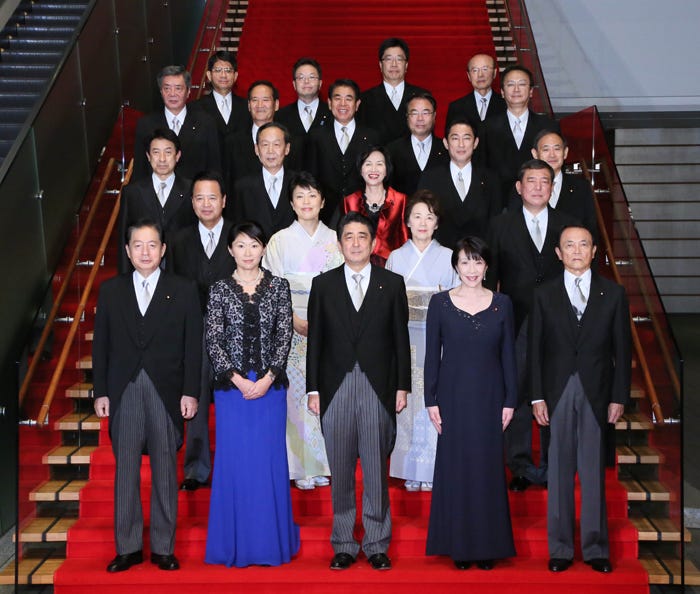
Sanae Takaichi with Prime Minister Shinzo Abe at the formation of the reshuffled Abe Cabinet, September 3, 2014.
Takaichi therefore did not inherit a blank sheet of paper. Abe first changed the legal and political boundaries; Kishida turned those changes into genuine long-range strike capabilities; and Takaichi is both the inheritor of that trajectory and one of the clearest heirs to Abe’s political legacy. She inherited a track that had already been laid.
What she did next was accelerate.
And for the first time, one political figure brought Yasukuni, historical nationalism, constitutional revision, Taiwan, long-range strike, arms exports and the defense industry into much closer alignment.
Takaichi has long visited Yasukuni and has long advocated revising the pacifist constitution. After becoming prime minister, she did not immediately visit Yasukuni in person, but sent an offering in the name of “Prime Minister Sanae Takaichi.” It was a subtle change: she did not distance herself from Yasukuni, but she began managing its diplomatic cost. Her historical position did not change. Her handling of it became more cautious.
Her military policy showed no comparable caution. After taking office, Takaichi announced that the target of bringing “defense-related expenditure to roughly 2% of GDP,” originally planned for fiscal 2027, would be achieved earlier, while also bringing forward the revision of the three security documents adopted only in 2022. By fiscal 2026, Japan’s defense budget had reached roughly ¥9.04 trillion, about 14% above the ¥7.95 trillion level of fiscal 2024; fiscal 2024 itself had already risen by 16.5% from fiscal 2023. The rise in defense spending was no longer episodic. It had become institutionalized. Kishida had only just completed the largest rewrite of Japanese security strategy since the war; Takaichi almost immediately began preparing the next one.
Then the counterstrike capability on paper began turning into weapons one could actually see.
On March 31, 2026, Japan’s first domestically produced stand-off weapons formally entered service. An improved Type-12 system was deployed with the Ground Self-Defense Force in Kumamoto, while a hypersonic glide weapon was deployed in Shizuoka. It marked the first operational deployment of domestically produced long-range stand-off weapons.
Four months later, the Japan Maritime Self-Defense Force’s Aegis destroyer Chokai conducted its first live firing of a Tomahawk.
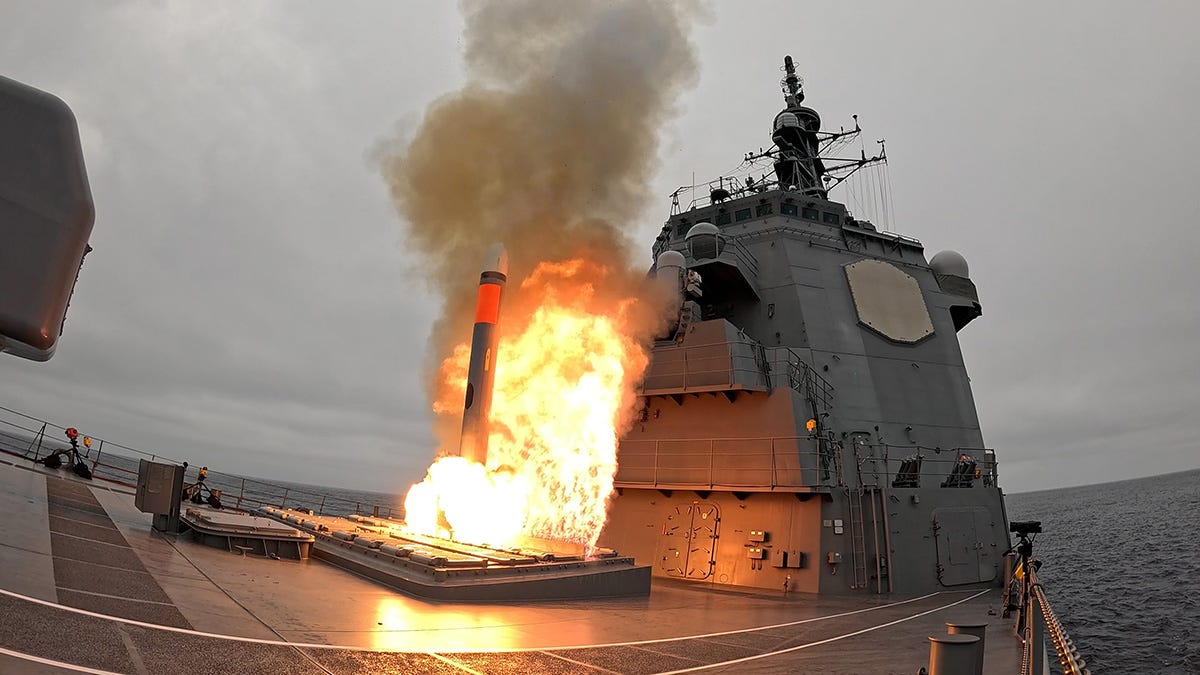
Chokai conducted its first live firing of a Tomahawk
A cruise missile long used by the United States to strike land targets at long range lifted out of the vertical-launch system of a Japanese warship. The crew had already trained with the U.S. Navy, and the vessel had undergone the necessary modifications. Forty years earlier, Japanese security politics was still debating how far the Self-Defense Forces could go in assisting the U.S. military. Today, a Japanese destroyer can operate Tomahawks itself.
The government still calls it deterrence.
But the weapon is already there.
Next came industry.
In April 2026, the Takaichi government further relaxed arms-export rules. Previously, complete Japanese-made defense systems were in principle limited to five categories of use—rescue, transport, warning, surveillance and minesweeping. The new system abolished that restriction, opening a path for warships, missiles and other complete weapons systems to enter international markets.
From a national-security perspective, there is also a perfectly reasonable economic logic to this. Japan’s domestic order book is limited, defense companies have the Self-Defense Forces as essentially their only major customer, and small production volumes mean high unit costs. Companies are therefore reluctant to maintain expensive production lines over the long term. Exports increase volume; larger volume reduces cost; lower cost improves export competitiveness; firms then become more willing to invest in research, development and capacity; and in an actual war, that capacity can quickly be converted into Japan’s own military production.
A defense-industrial ecosystem begins to form.
Kawasaki Heavy Industries already expects sales from its defense business to rise from roughly ¥240 billion in 2023 to ¥500–700 billion by around 2031. For one company, this is order growth. For a country, it means Japan’s military power is acquiring an increasingly deep industrial base.
Then came an even more revealing change.
Japan’s latest Defense White Paper in August 2026 no longer described military spending simply as an unavoidable security cost. It began emphasizing how defense investment could promote technological innovation, startups and economic growth, ultimately benefiting ordinary people’s lives. The cover did not feature fighter jets, destroyers or soldiers. It showed an anime-style city of the future, with a smiling family living inside it.
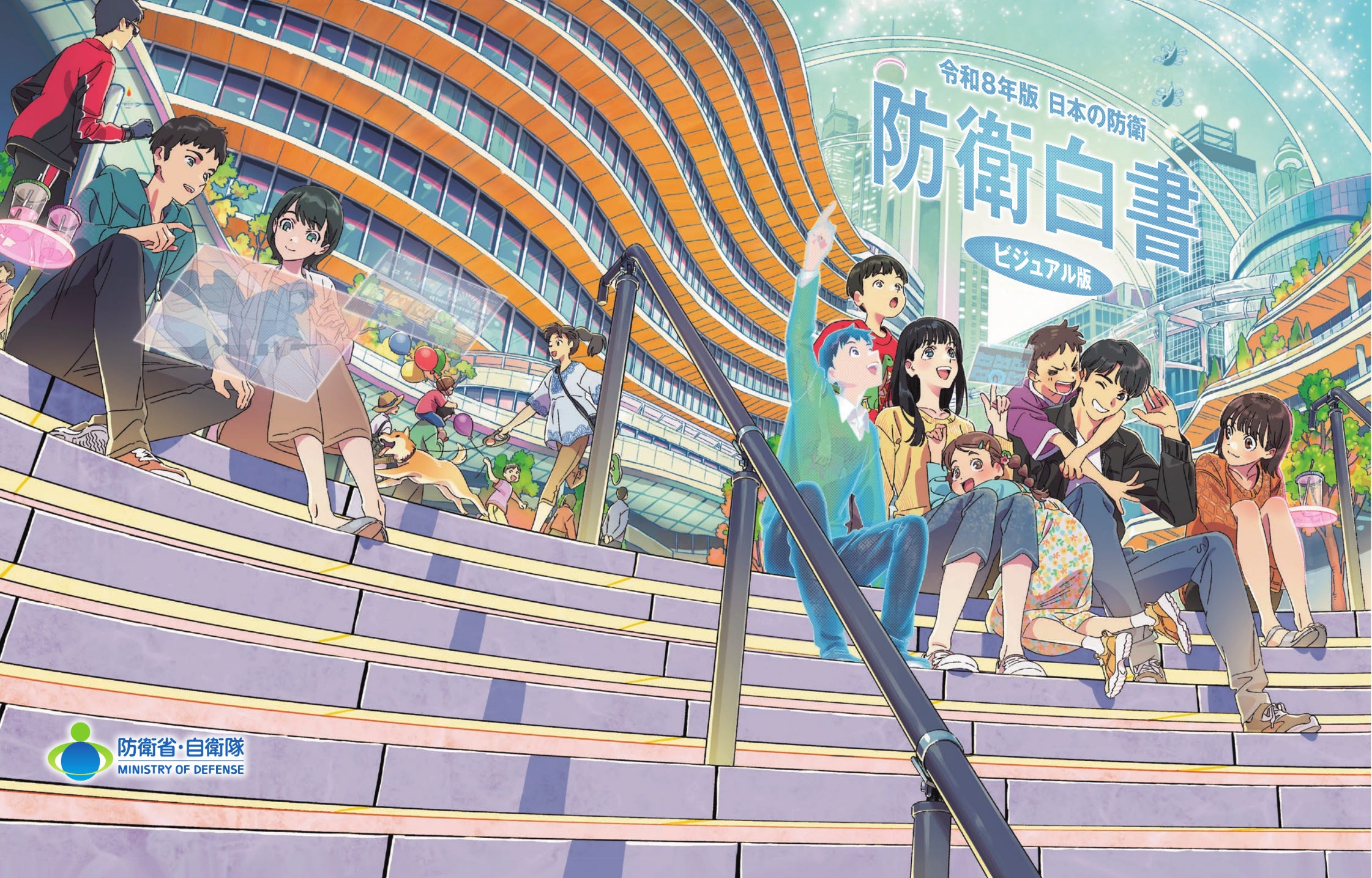
Japan’s latest Defense White Paper in August 2026
It is a very gentle image.
But what it says is important: Japan is recasting military buildup as a national development policy, not merely a security burden.
As long as military expenditure is understood as “a cost imposed on Japan by the China threat,” society may demand that it be cut when the danger recedes. But once the defense industry comes to mean local jobs, advanced manufacturing, technological innovation, export income, startups and a stronger industrial base, defense spending begins to acquire a domestic political-economic logic independent of the security crisis itself.
At this point, Taiwan and the South China Sea entered the chain as well.
In November 2025, while discussing a Taiwan crisis in the Diet, Takaichi directly addressed the circumstances under which Chinese military action against Taiwan could constitute a “survival-threatening situation” under Japanese law. She did not say, “If there is a Taiwan contingency, Japan will automatically enter the war.” But she connected more explicitly than before three things that had often been deliberately kept separate:
Taiwan contingency → survival-threatening situation → possible JSDF action.
The legal distance had narrowed.
For the United States and Australia, this might be merely a clarification of security policy. For China, however, those words cannot be heard as a piece of 2025 security policy alone. Taiwan was a Japanese colony for fifty years, and imperial Japan used Taiwan and the Korean Peninsula as important bases for its expansion into mainland China. A Japanese prime minister who has long visited Yasukuni and advocated revising the pacifist constitution was now publicly explaining the legal path by which the Self-Defense Forces might use force in a war over Taiwan.
What Asians hear is not merely a modern security doctrine.
History is in it too.
Even one of postwar Japan’s deepest taboos has begun entering open debate. Since 1967, Japan has followed the Three Non-Nuclear Principles: not possessing, not manufacturing and not permitting nuclear weapons to enter Japan. For decades, these principles, Hiroshima, Nagasaki and postwar Japanese pacifism almost formed a single political symbol. But as the Takaichi government began rewriting the national-security strategy, when she was asked whether all three principles would be retained in full, she stopped short of an unconditional commitment. Japan subsequently reaffirmed that its basic policy of not possessing nuclear weapons had not changed, and it has made no decision to acquire them.
What deserves attention is a different change.
A principle that once hardly needed to be discussed has now become a policy option that can be discussed.
At the same time, the Takaichi government is strengthening the national intelligence system, promoting a more centralized National Intelligence Council, expanding space, cyber, unmanned and integrated-command capabilities, and planning to further reorganize the Air Self-Defense Force into an Air and Space Self-Defense Force. Read separately in different government documents, these measures appear simply to be different chapters of modern national-security construction.
Put them on the same timeline, and the picture looks slightly different.
The reckoning began in 1945. The Cold War changed its direction midway, and some wartime elites returned to the political center.
In 1978, the Class-A war criminals entered Yasukuni. In 1985, a prime minister paid an official visit.
In 1993 and 1995, Japan tried through the Kono and Murayama Statements to establish a more stable framework of historical responsibility.
The framework did not disappear, but it never became the kind of irreversible national consensus seen in Germany.
Abe reconnected national pride, Yasukuni, constitutional revision and the idea of a “normal country.” Kishida turned the “normal country” into counterstrike capability and genuinely large-scale military capital expenditure. Takaichi moved further, turning it into the Type-25, Tomahawks, complete weapons exports, defense-industrial policy, possible military action over Taiwan, a national intelligence architecture, military space capabilities, and renewed discussion of the boundaries of the Three Non-Nuclear Principles.
There was no military coup. The emperor did not regain power. Democratic elections were not abolished. Nor did any Japanese government formally announce that the postwar order of 1945 was over.
The process looked far more ordinary than any literal replay of history. One Yasukuni visit. One textbook controversy. One constitutional interpretation. One new missile. One arms-export exception. One new military budget. One Japanese destroyer capable of firing Tomahawks. One parliamentary answer about Taiwan. One discussion over whether the nuclear principles must still be preserved exactly as they were.
Every step had a reason.
What deserves attention is that many of those reasons eventually pushed the boundary in the same direction.
So the most interesting question about Japan today is no longer whether it has once again become a militarist state in the 1930s sense. The answer is obviously no.
The question has become something else: if a democratic country that once launched wars of large-scale aggression gradually reduces the centrality of war guilt in its national identity while continuously expanding long-range strike, military industry, arms exports, regional military action and the capacity to intervene in future wars, then how much of the exceptional postwar restraint built after 1945 is really left?
Perhaps the more accurate description is not the return of Japanese militarism. It is closer to remilitarization accompanied by historical revisionism.
And this is where Japan should genuinely make Germans uneasy: historical revisionism and military normalization do not require a dictatorship. They can proceed entirely within a democratic system, over decades, one seemingly reasonable exception after another, slowly moving toward each other.
Once Japan’s eighty-year trajectory is understood, it becomes easier to understand why Germany reacts so sensitively whenever the AfD tries to redefine history, nation and national identity.
As early as ten years ago, in 2016, the AfD adopted its federal basic programme, or Grundsatzprogramm. On German history, it did not call for denying the Holocaust or rehabilitating the Third Reich. It used much milder language: Germany’s current Erinnerungskultur—its culture of remembrance—was too heavily concentrated on National Socialism, and the “positive, identity-forming aspects” of German history should be brought back into the nation’s memory.
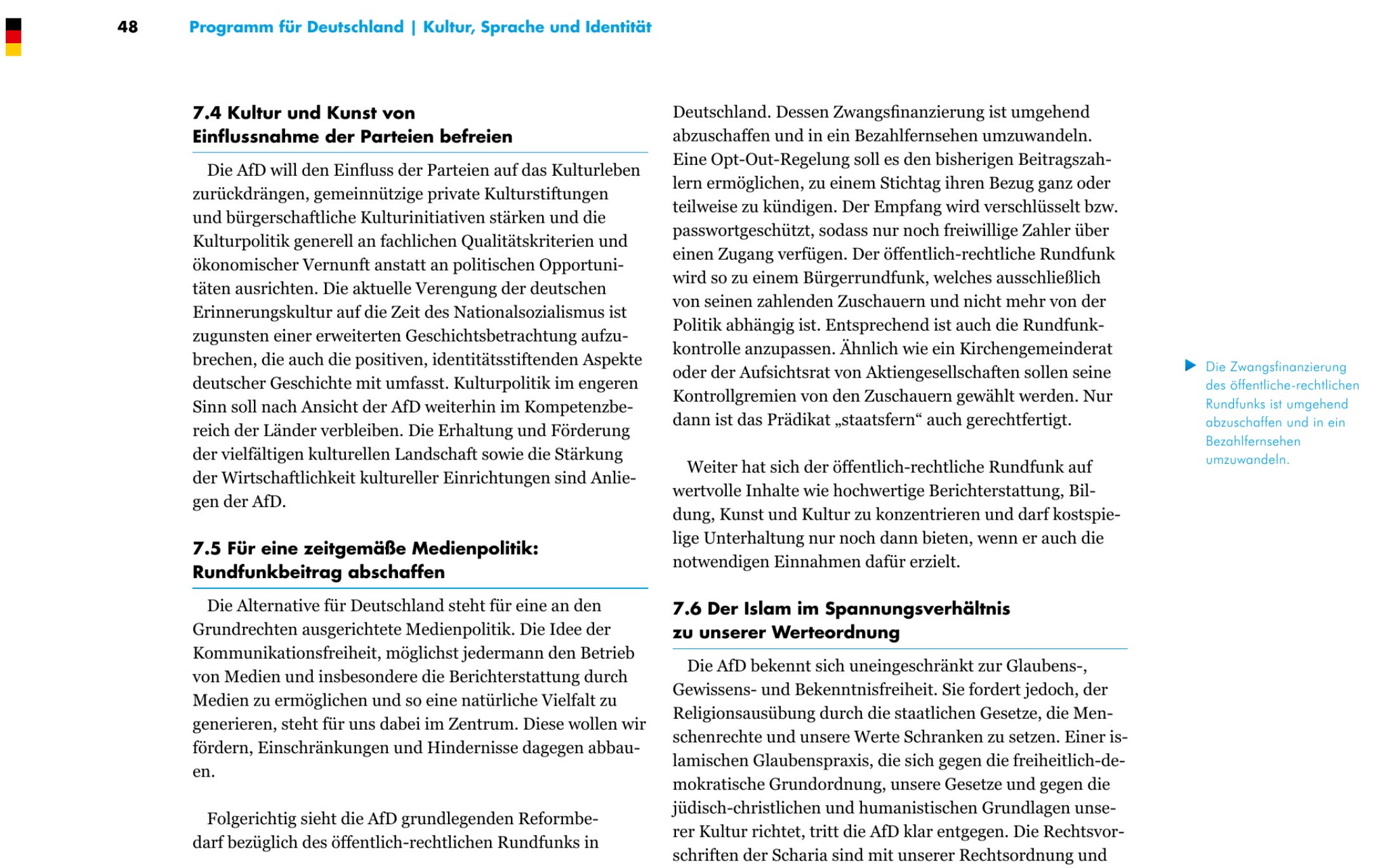
2016 AfD Grundsatzprogramm
Taken on its own, there is little obviously dangerous about this sentence. German history of course does not consist only of 1933–1945. There is the Reformation, Goethe, Kant, Beethoven and Bismarck. There is industrialization, chemistry, physics, engineering, the social-insurance system, and one of the strongest university and industrial systems in the world by the late nineteenth century. A country that tells the next generation only what its ancestors did wrong, while telling them very little about what those ancestors created, can also produce a distorted historical education.
What the AfD initially appeared to be asking for was simply a wider historical lens.
Ten years later, the AfD in Sachsen-Anhalt made the argument much more concrete. Its 2026 state-election programme argued that the postwar cultural politics first developed in West Germany had gradually “hollowed out” German cultural inheritance, obstructed the formation of a stable national identity, and deprived Germans of a normal capacity for national self-affirmation. The document even used a diagnostic term: Identitätsstörung—identity disorder. Its prescribed treatment was called #deutschdenken. Heinrich I, Otto I, Luther, Bismarck and Nietzsche reappeared; schools, museums, tourism, commemorations and cultural prizes could all become tools for reconnecting Sachsen-Anhalt with the history of German nation-building. Germans should once again see “the good side of German history” and rebuild a healthy and confident national identity.
Hitler is still absent here.
Indeed, one could argue that the most revealing feature is precisely that Hitler is not at the center.
In January 2017, Björn Höcke stood before supporters in Dresden and delivered what would become one of the most famous speeches in AfD history. The phrase the media most often quoted was his description of Berlin’s Holocaust Memorial—Denkmal der Schande. The subsequent controversy quickly became a debate over whether the phrase should be understood as “a monument of shame” or “a monument to shame.” But read the whole speech, and the most important part lies elsewhere. Höcke spoke about the Allied bombing of Dresden, about the “systematische Umerziehung”—systematic re-education—of Germans after 1945, about how German experiences of victimhood had been pushed down, and about how younger generations were taught first to understand their country through the identity of perpetrators. Decades of Vergangenheitsbewältigung, he argued, had ultimately left Germans in the mental condition of a totally defeated people.
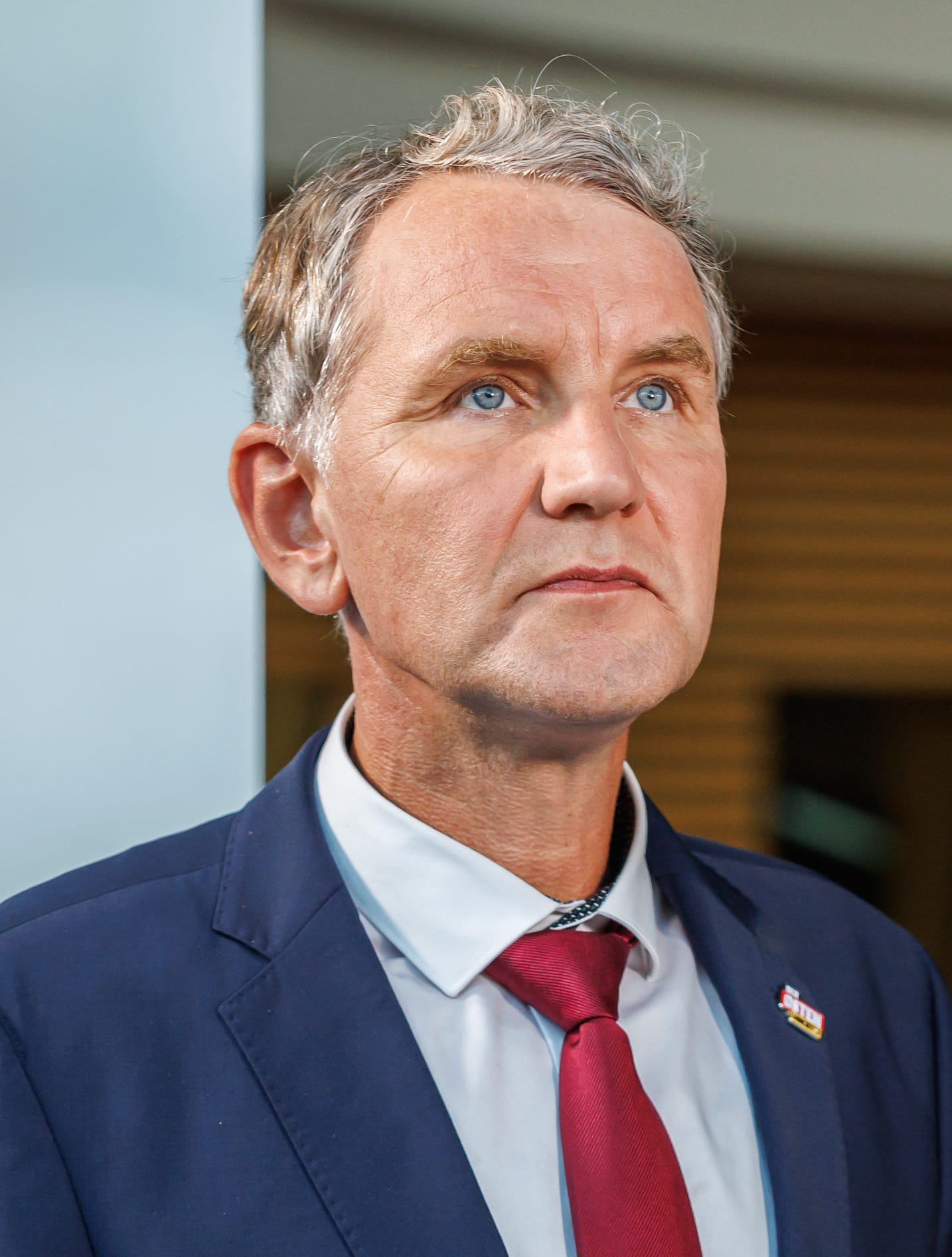
Björn Höcke
Then he called for an “erinnerungspolitische Wende um 180 Grad”—a 180-degree turn in the politics of memory.
180 degrees.
If all one wanted was for German schools to teach a little more Bismarck and Goethe alongside the Holocaust, there would be no need for such a phrase.
A year later, Höcke and Sebastian Hennig published the interview book Nie zweimal in denselben Fluss. The Dresden speech became increasingly difficult to explain as an accidental piece of campaign rhetoric. The book was no longer simply about memorials or history curricula. It discussed nation, demography, Heimat, cultural continuity, political crisis, and how a people might recover its will to survive. Concepts long used by the German New Right began to connect with one another: Volk, historical continuity, demographic continuity, land, culture and national will. Höcke was no longer asking which additional chapters should be added to German history. He was asking whether the national consciousness Germany had developed after 1945 was itself fundamentally wrong.
But Höcke could still easily be treated as the AfD’s most radical exception.
Alexander Gauland offers no such convenience.
Gauland was born in 1941 and spent much of his career in the CDU, making him a fairly conventional member of the West German conservative establishment. He did not enter the AfD from a street-level far-right movement, nor did he spend his life on the margins of German politics. In 2017, at a campaign event, he said that if the French could be proud of Napoleon, and the British proud of Nelson and Churchill, Germans too should have the right to be proud of the “achievements” of German soldiers in the two world wars. He then immediately emphasized that no European people had confronted its historical guilt as thoroughly as Germany.
Germany has reflected.
So what comes next?
The following year, Gauland made an even more infamous remark: Hitler and the National Socialists were merely “a speck of bird shit” in more than a thousand years of successful German history. The phrase “bird shit” was so crude that it almost obscured the more interesting argument underneath. Gauland did not deny Auschwitz. He did not say Hitler deserved rehabilitation. He even first acknowledged that Germany had to take responsibility for those twelve years.
What he changed was the time scale.
12 years / 1,000 years.
Once the denominator moves from 1933–1945 to more than a thousand years of German national history, the Nazi period can remain a vast evil without necessarily remaining the central coordinate through which Germany understands itself. Before it lie the Holy Roman Empire, Prussia, 1871, Bismarck, industrialization, science, culture and national unification; after it lies the Federal Republic. Those twelve years do not disappear. They are simply placed back inside a much longer timeline.
This is a method that can enter normal politics much more easily than direct denial of history.
Open denial of Auschwitz offers almost no road to power in modern Germany. Saying that German history “is not only Auschwitz” is obviously something different. Saying Germany should remember its own wartime victims does not mean denying the victims of other countries. Saying young Germans today should not carry their grandparents’ guilt forever can itself be a reasonable ethical proposition. And calling for a renewed appreciation of Bismarck and 1871 certainly cannot automatically be equated with praising Hitler.
Taken one by one, each sentence has its own logic.
Put them together, and the center of historical gravity begins to move.
Once the AfD entered the Bundestag, German political scientists gained a sufficiently large body of parliamentary material to observe this transformation. Matthias Dilling and Félix Krawatzek analyzed Bundestag speeches from 2017 to 2021 and found that the AfD did not simply discuss all of history more frequently than other parties, and rarely praised Nazism openly. But it engaged more frequently with Nazi memory and, depending on the setting, employed different strategies of acceptance, minimization and rejection. Even more revealing was the way it discussed Germany before 1933: Bismarck reappeared. The German Empire reappeared. State capacity, education, industry, military achievement and national unification once again became historical resources that could be mobilized.
The AfD does not need to rehabilitate Hitler in order to reconnect with German nationalism.
It only needs to bypass 1933.
And reconnect directly to 1871.
This also makes Bismarck’s appearance in the Sachsen-Anhalt programme more important than it first appears. Bismarck of course deserves to be studied. Even Chinese middle-school students today know the “Iron Chancellor” as one of the most important statesmen in German history: he completed German unification, founded the German Empire and profoundly shaped the European balance of power that followed. The issue is obviously not whether Germans should study Bismarck again. The more interesting question is: why is Bismarck being brought back within this particular historical-political project? 1871 of course belongs to German history. But if the political objective today is to restore a line of German national continuity broken in 1945, then the imperial history before 1933 acquires a particular function: it provides a historical language that contains no Hitler, yet is nationalist enough.
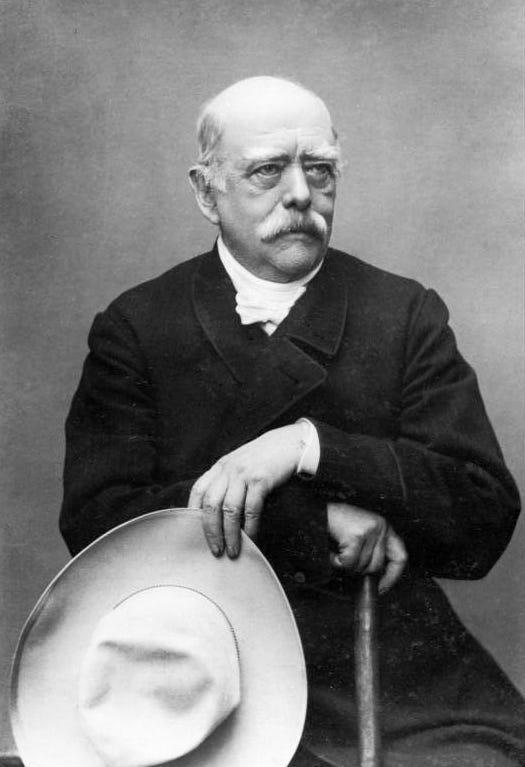
“Iron Chancellor” Otto von Bismarck
Alice Weidel gives this transformation an entirely different appearance.
She comes from international finance, speaks fluent English, has lived abroad for long periods and looks almost nothing like the conventional image of a völkisch nationalist. She even once genuinely clashed with Höcke. After the 2017 Dresden speech, AfD figures pushed for disciplinary action, and Weidel at one point backed efforts to discipline Höcke. But Höcke did not leave. Instead, his influence continued to expand inside the eastern AfD. As the years passed, public conflict diminished, while Weidel gradually became the AfD’s most effective face for Germany’s middle class, the international media and the American right.
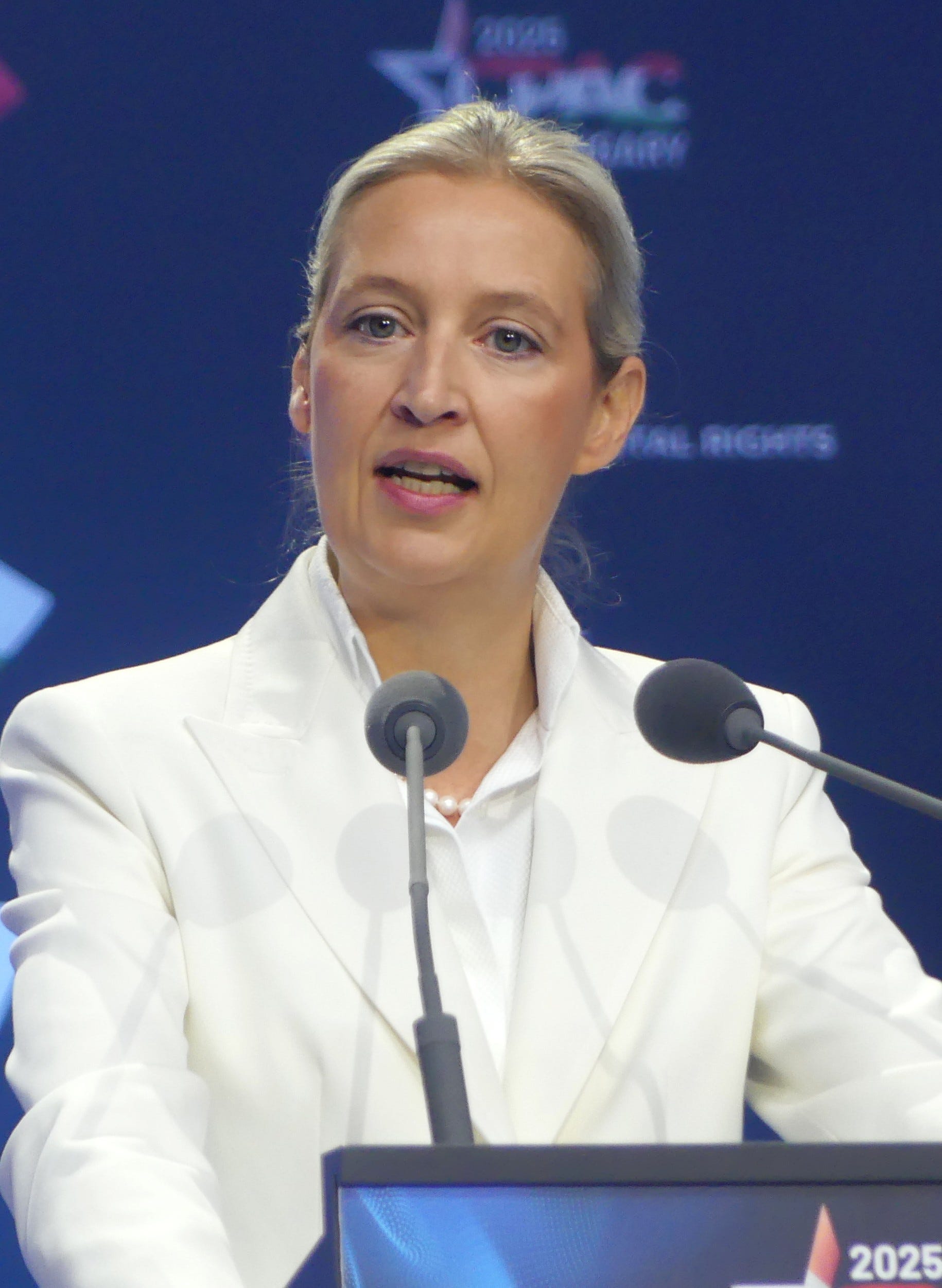
Alice Weidel 2025
Höcke did not disappear.
Weidel learned to coexist with his AfD.
In 2025, she held a public conversation with Elon Musk. When Nazism came up, she did not use Höcke’s “180-degree turn,” nor did she adopt Gauland’s thousand-year arithmetic. She offered a different explanation: Hitler was fundamentally communist and socialist; the AfD, by contrast, was libertarian conservative, placing the two in completely opposite political traditions.
From the standpoint of serious history, that is very difficult to sustain. Nazism was a movement of extreme nationalism, racism, anti-liberalism and violent anti-Marxism; the German Communist Party and Social Democratic Party were among the first political forces subjected to systematic repression after the Nazis seized power. But set aside historical accuracy for a moment and ask only what the statement accomplishes politically. Its function becomes clear: once Hitler is reclassified as socialist and collectivist, Nazism ceases to be first and foremost the historical catastrophe that German nationalism must explain. It becomes another form of left-wing collectivist dictatorship.
History has not been deleted.
It has been reclassified.
Return now to the AfD’s 2016 basic programme, and the initially moderate sentence has undergone a decade of political elaboration: German Erinnerungskultur should not focus excessively on National Socialism; the positive, identity-forming aspects of German history should be rediscovered. Sachsen-Anhalt translates this into Identitätsstörung and deutschdenken; Höcke demands a 180-degree turn; Gauland places twelve years back inside a thousand; Weidel reclassifies Nazism as socialist collectivism; AfD members in the Bundestag increasingly invoke Bismarck, the German Empire and pre-1933 traditions of the nation-state as naturally available political resources.
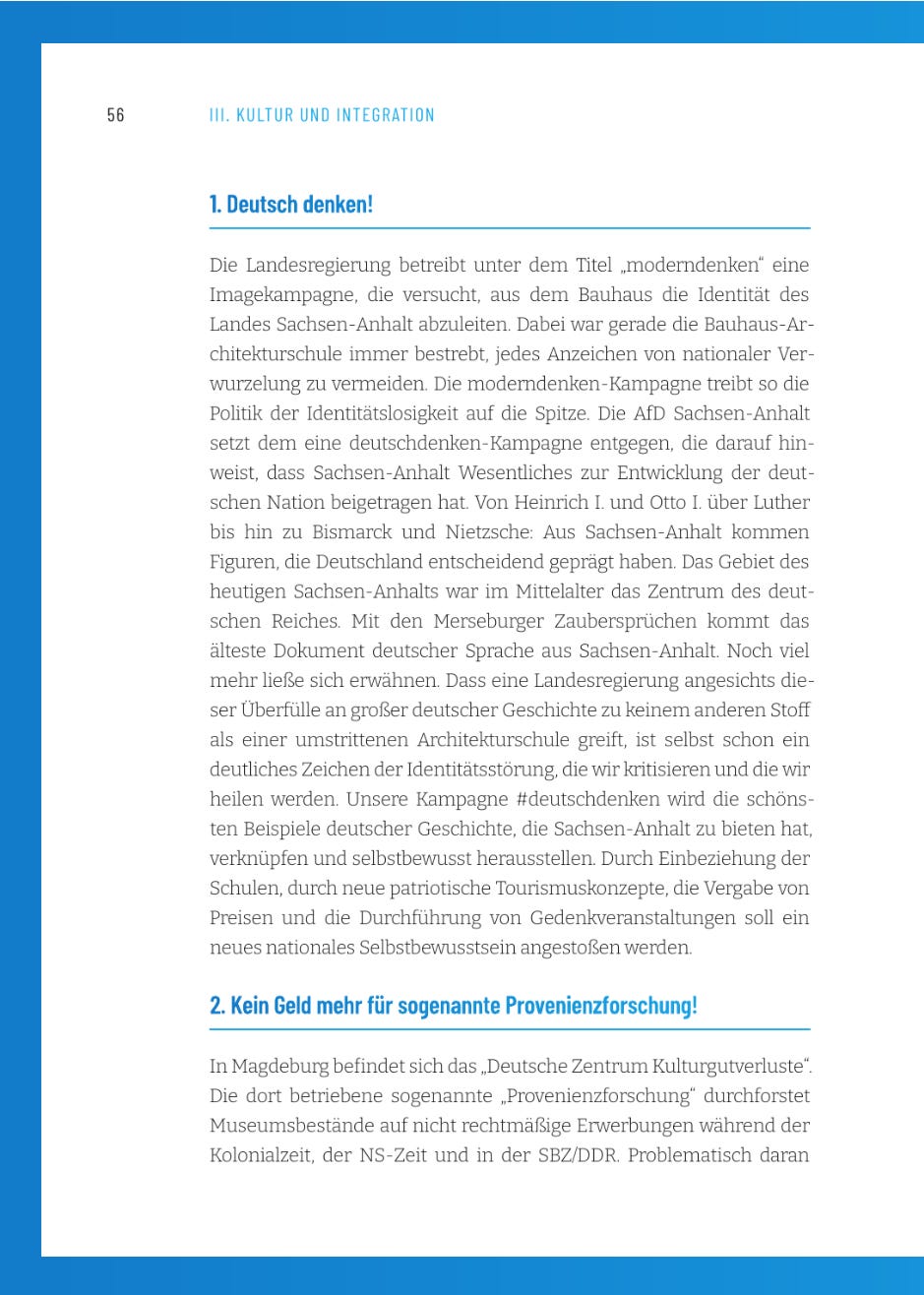
Original text of the 2026 Sachsen-Anhalt AfD programme
No official programme calls for restoring the Third Reich.
No national AfD programme openly denies the Holocaust.
Often, nobody even denies that 1933–1945 remains the darkest period in German history.
The change occurs in a different question: how important should it still be?
The special character of postwar Germany was never simply that it acknowledged “Auschwitz happened.” Many countries acknowledge crimes in their own histories. The Federal Republic went further. It gradually turned 1933–1945 into an organizing principle through which the state understood itself. Nazism was not simply one failure among many in Germany’s long history. It became the historical starting point for explaining why the country after 1949 required a particular constitutional order, why nationalism had to be treated with suspicion, why power had to be constrained, why Germany should be deeply embedded in Europe, and why the Holocaust created a special national responsibility.
The AfD has not directly dismantled this structure. It first changes the lens.
Pull the timeline backward. Make 1871 larger. Make Bismarck larger. Make German achievement, German victims and national pride larger. Then gradually shrink 1933–1945 from the center of the entire picture back into one twelve-year chapter of history.
It is still there. Just a little smaller.
At that point, Japan becomes a mirror, making the quiet shift easier to see.
The Japanese government has never announced that Nanjing did not happen, nor has it formally withdrawn every postwar apology. What Japan has really argued about for decades is the same deeper question: how long should a nation allow the darkest period of its history to define it? Once that question enters politics, the argument is no longer only about what happened in the past. It slowly begins to affect which actions by the state become imaginable again in the present.
Germany of course faces a much higher threshold. That is also why ordinary patriotic education in an ordinary country is not quite the same thing as a country that experienced Nazism beginning to ask whether “we remember too much guilt and too little glory.”
The Federal Republic’s moral constitution was never written in full into any single law. It is distributed across the constitution, education, commemorative institutions, foreign policy and political taboos: Nazism is the rupture that must be rejected; the Holocaust carries a special responsibility; the nation cannot again be defined by blood and exclusion; and German power should be constrained both by domestic institutions and by the European order.
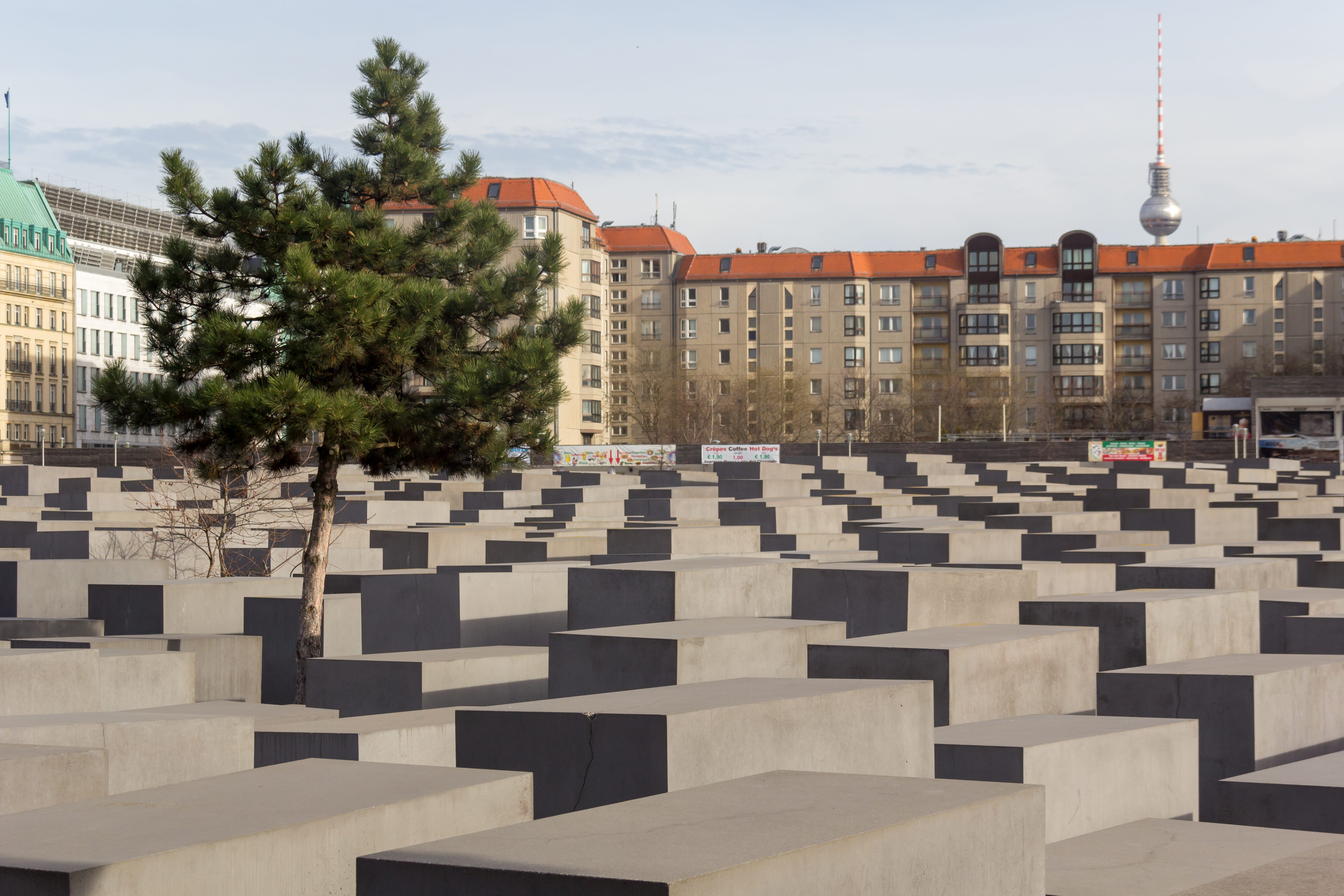
Berlin Holocaust Memorial
Of course, none of these principles must be beyond discussion forever. Germany cannot live forever in 1945.
What deserves observation is whether, as more political figures begin changing the way Germany looks at 1945, the restraints built after 1945 will gradually be reinterpreted as well.
Japan has already shown that the distance between those two processes may be smaller than it appears.
The AfD’s most controversial issue today is immigration. But immigration policy can be changed again after the next election.
Once a country changes the way it understands its past, it often begins to change what it considers normal in the future.
This also explains an apparently strange phenomenon.
Why does the AfD’s support for nuclear power get folded into the “far-right” label? Why do stronger border controls, deportation of people with no legal right to remain, a return to more traditional classroom education, opposition to parts of gender politics, and even an emphasis on family and national sovereignty so easily provoke alarm in the German media and political system?
The problem may not lie entirely in those policies themselves.
The AfD first lost credibility on Germany’s most sensitive historical question.
One of the party’s most influential figures demands a “180-degree turn” in Erinnerungspolitik; another founding leader places Hitler’s twelve years back inside a thousand years of German history and calls them a “speck of bird shit”; its current leader tries to reclassify Hitler as socialist; a state election programme diagnoses Germans with Identitätsstörung and calls for national confidence to be restored through Bismarck, 1871 and #deutschdenken. So when the same party talks about German identity, traditional families, immigration, schools, the military and national sovereignty, German society no longer hears only the literal meaning of those policies.
History comes first.
Everything else follows.
This may also be a political dilemma the AfD has created for itself. If an ordinary German center-right party proposed restoring nuclear power, nobody would therefore think of the 1930s. If the CDU demanded faster deportation of asylum applicants whose claims had been definitively rejected, nobody would conclude that it was preparing to rebuild the Third Reich. But when a party simultaneously asks Germany to recast its memory of 1933–1945, every sentence it speaks about nation, borders, culture and state power is heard inside a completely different historical context.
Often, this association is unfair.
Look at the AfD’s actual policies and it becomes easier to understand Musk’s impatience.
The AfD supports stricter border controls, the deportation of people without a legal right to remain, and reducing illegal immigration into Germany. It supports nuclear power, opposes the ban on internal-combustion cars and parts of the Green Deal, and wants lower industrial energy costs. It emphasizes traditional classroom teaching, homework, reading and teacher authority, and opposes placing progressive political education above basic knowledge in schools. It supports the traditional family and takes conservative positions on parts of gender policy. It is skeptical of the continuing concentration of power in the EU and wants Germany to recover more national sovereignty.
Taken one by one, there is little inherently far-right about them.
In fact, many of these positions would not have triggered such a political classification twenty years ago. The European center-right has long supported strict borders, family values and national sovereignty. Germany’s own nuclear phaseout is only a policy choice of the past two decades. Same-sex marriage was not legalized in Germany until 2017. And today, many mainstream European governments are themselves tightening immigration and asylum policy.
The political spectrum really has moved.
This is where Musk is right.
If “far right” simultaneously means Holocaust revisionism, deporting illegal immigrants, supporting nuclear power, opposing the combustion-engine ban and requiring more homework in schools, then the term is being asked to perform too many completely different jobs. It begins compressing conservatism, nationalism, populism, the radical right and genuine historical revisionism into a single label.
The broader the label becomes, the less explanatory power it has.
And it can create an even more troublesome consequence.
If a voter has already been told by the media that supporting nuclear power is far right, criticizing immigration policy is far right, and opposing gender ideology is far right, then the next time he is told that Höcke’s “180-degree turn” on German history is also far right, why should he believe that this particular warning is any more serious?
Real extremism may end up being protected by the overuse of the “far right” label.
So the problem Musk sees is real. His mistake is to push the insight one step too far: if many AfD policies are in fact normal, then perhaps the AfD itself is simply a normal party stigmatized by the European media.
Japan makes that conclusion difficult.
A party can advocate perfectly normal conservative policies on taxation, energy, education and even immigration while at a deeper level challenging the way a country understands its own history. These two facts are not contradictory. The AfD’s support for nuclear power does not make Höcke’s historical worldview more extreme; Höcke’s historical worldview does not automatically turn nuclear power into a far-right policy.
What needs to be restored is distinction.
Border control is not historical revisionism. Nuclear power is not nationalism. Family conservatism is not fascism. But historical revisionism does not become harmless simply because it travels inside a package containing otherwise normal conservative policies.
Seen from China, this distinction matters especially.
It is difficult for Chinese people to argue seriously that Germans should not possess national pride. Modern China’s own political narrative is one of national revival: recovering sovereignty, rebuilding industrial and technological capabilities, restoring national confidence and overcoming the humiliations of the modern era. Germany of course also has every right to discuss its own industrial revival, strategic autonomy and state capacity. It has every right to tell younger generations that German history contains not only Hitler but Goethe, Beethoven, Kant and Bismarck, as well as a scientific and engineering tradition that helped transform modern industrial civilization.
A nation cannot sustain a political community indefinitely on guilt alone.
But Japan also tells East Asians something else. National revival does not require historical amnesia.
If the AfD truly wants to become a party capable of governing Germany, there is actually a fairly clear path available to it. It can continue to demand strict border control. It can advocate nuclear power and cheaper energy. It can oppose Green policies it believes have failed. It can demand greater strategic autonomy for Europe. It can support restoring the competitiveness of German industry. And it can openly tell Germans: you have every reason to like your own country.
None of these positions requires Höcke’s 180-degree turn. None requires reducing twelve years to a speck of bird shit in a thousand-year history. Still less does it require rearranging Auschwitz’s place in German national memory.
In fact, if the AfD truly believes Germany needs a national revival, then actively separating itself from this historical revisionism may not amount to surrendering to Germany’s existing political system. It may be precisely the way for the AfD to prove that it genuinely believes in Germany’s future.
Because one of postwar Germany’s greatest achievements was that it managed to do two apparently contradictory things at the same time: it did not forget what it had done, yet it once again became Europe’s largest economy, its most important industrial power and a stable democratic state. Germany does not need to choose between memory and confidence.
The real warning left by Japan’s eighty-year trajectory is likewise not that “Germans must never become nationalists again.” The warning is much narrower, and much more serious:
Do not build national revival on the gradual weakening of historical responsibility.
Germany does not need to forget its past in order to believe in its future again.
If the AfD truly wants to promote a German revival, Japan shows exactly why these two things must never be confused.
Read more
No posts
Comments
Nothing yet. Say the first thing.
Sign in to join the conversation.