
China’s robots have raised the threshold for late industrializers. They have not pulled up the ladder. Bangladesh became the world’s second-largest garment exporter while China remained number one, and Vietnam industrialized by embedding itself deeper into China’s supply chain.
This essay is part II of The Myth of the China Squeeze, in the series of Rethinking the China Debates.

绵亿《耕织图册》 / Farming and Weaving Album, Qing Dynasty
Its weaving and garment-making scene recalls an older truth about industrialization: production is built through labor, tools, process discipline and organized supply chains long before it becomes a question of automation.
In the first part of this series I argued that the China Squeeze is Washington’s latest attempt to turn Chinese industrial competitiveness into a moral problem. It treats China’s export strength as an excessive claim on the Global South’s development space, as if global market share should somehow be allocated by population.
The automation version of this argument is more seductive: if Chinese robots can offset rising wages, then labour-intensive industries may no longer need to leave China. But China’s automation is uneven, concentrated far more in electronics, autos and machinery than in garments or footwear. Robots have raised the threshold for late industrializers. They have not pulled up the ladder.
China now operates the world’s largest industrial robot system. In 2024, the number of robots working in Chinese factories exceeded 2mn, while annual installations reached a record 295,000—54 per cent of all new industrial robots deployed worldwide. China is also integrating artificial intelligence into industrial design, production planning, quality inspection, logistics and supply-chain management.
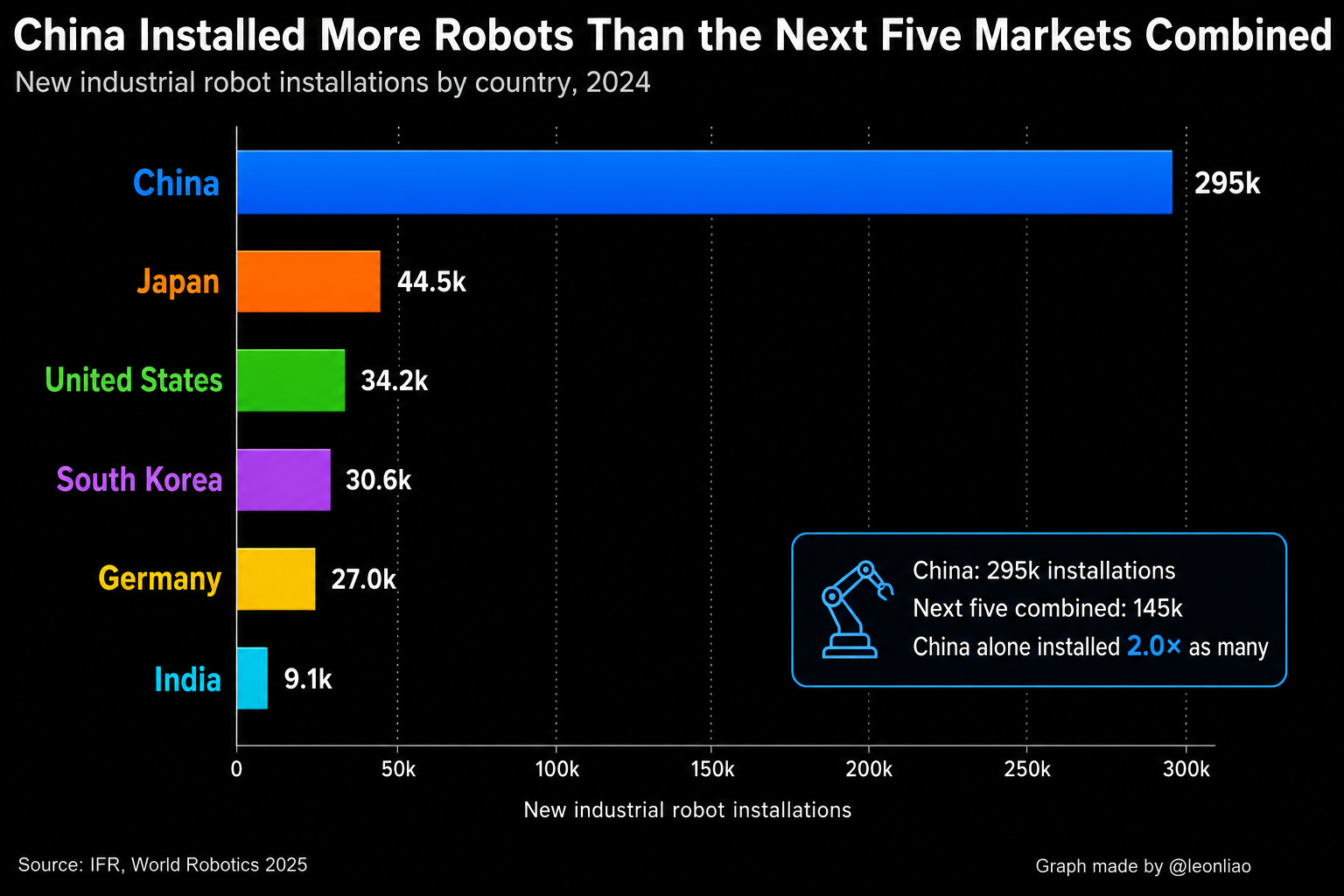
That technological surge has become the central piece of evidence behind the China Squeeze narrative that emerged this year from American thinktank and policy circles. Its core claim is that large-scale automation will allow Chinese factories to retain labour-intensive production at home, effectively halting the migration of such industries to lower-wage economies across the Global South. If robots can neutralise the wage gap, the traditional path of industrial relocation may appear to end in China.
But does the evidence actually support that conclusion?
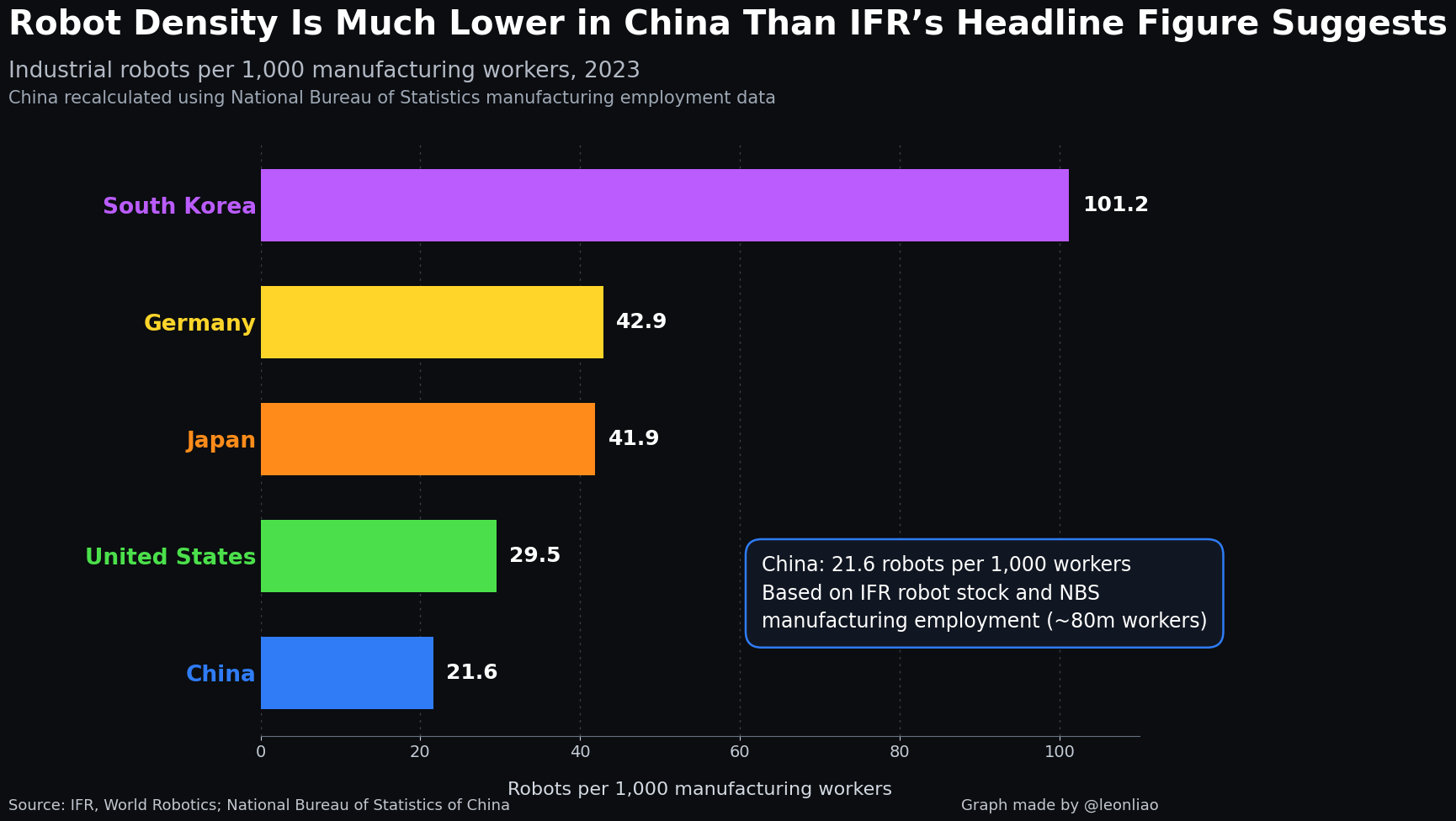
China has the world’s largest installed base of industrial robots, but that reflects the sheer size of its manufacturing system. Once the robot stock is measured against the manufacturing workforce, the picture changes sharply.
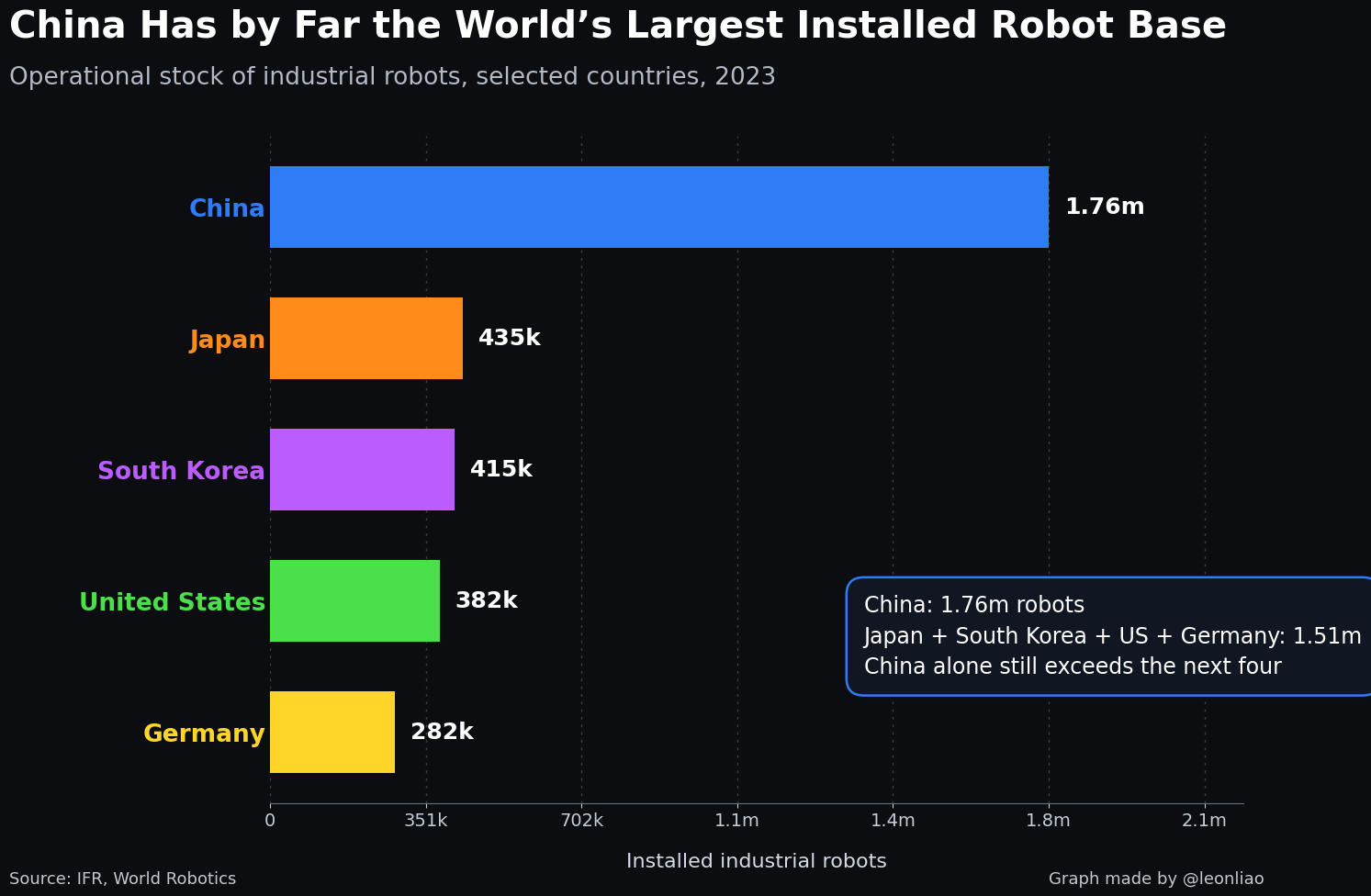
China had only 21.6 industrial robots per 1,000 manufacturing workers in 2023, far below South Korea’s 101.2, Germany’s 42.9 and Japan’s 41.9, and even below the United States at 29.5. If the China Squeeze argument is taken seriously—if a high level of automation allows rich industrial economies to retain production that would otherwise migrate to lower-wage countries—then the Global South, including China should have been “squeezed” first and most severely by South Korea, Germany, Japan and the United States. China’s total robot stock looks exceptional because China has an exceptionally large manufacturing workforce. Its robot intensity remains lower than that of the advanced industrial economies now accusing it of using automation to pull up the ladder.
But this kind of double standard of the China Squeeze narrative is still not the key debute the essay want to emphasize. The conclusion goes much further than the total volume itself.
Automation may allow China to retain more manufacturing. It does not follow that industrial relocation has ended, or that poorer countries have lost the path to industrialisation.
China’s robot statistics conceal large differences between industries. Automation can keep some production at home while expanding demand for overseas suppliers, factories and assembly. The countries that have industrialised most successfully alongside China have often done so by entering its production networks rather than waiting for China to leave entire industries behind.
Bangladesh and Vietnam illustrate three different versions of this process.
China’s robot numbers are often presented as though they describe every factory in the country. They do not.
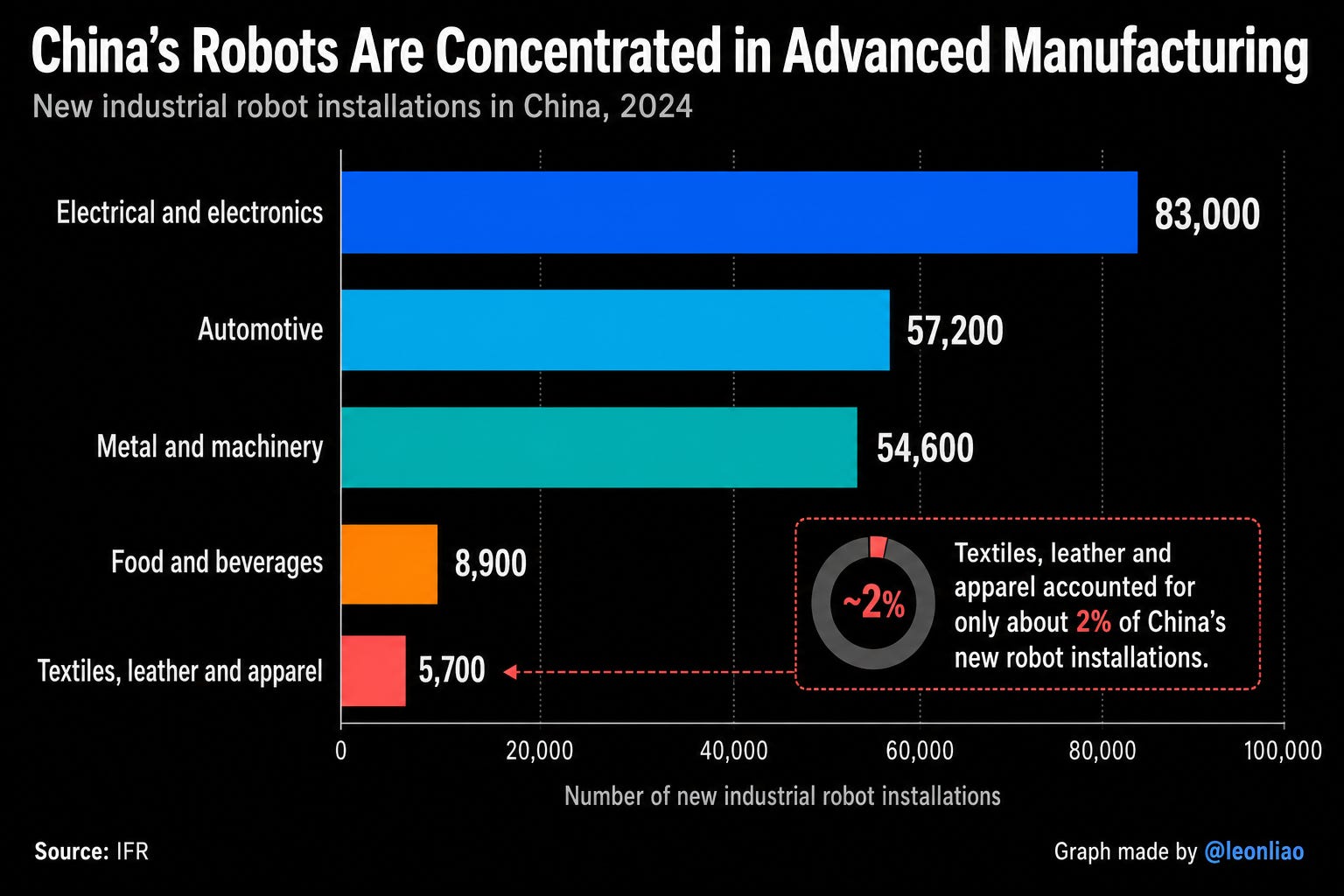
Industrial robots remain highly concentrated in sectors where physical tasks are standardised, repetitive and technically suited to automation. In 2024, China’s electrical and electronics industry installed about 83,000 robots. Automotive manufacturers added 57,200, while metals and machinery accounted for another 54,600. Together, these three industries represented roughly two-thirds of all new robot installations in China.
The picture looks very different in the industries at the centre of the China Squeeze argument.
Textiles, leather and apparel installed about 5,700 robots in 2024—less than 2 per cent of China’s total new installations. China accounted for 95 per cent of global robot deployments in this category, an indication that automation is spreading rapidly even into traditional manufacturing. Yet the absolute scale remains small beside electronics, automobiles and machinery.
China’s national robot density tells us far more about electric vehicles, electronics, batteries and industrial machinery than it does about sewing garments or assembling shoes.
The difference is technological as much as economic. Robots are exceptionally effective at welding car bodies, moving heavy components, loading machine tools, painting standardised surfaces and repeating precise operations. Some stages of traditional manufacturing are also highly automated. Modern textile mills use advanced machinery for spinning, weaving, dyeing and cutting. Warehouses increasingly rely on automated sorting and transport. Machine vision can identify defects more consistently than human inspectors.
Final assembly remains harder. Fabric bends, folds and changes shape when handled. Garment factories switch frequently between sizes, materials and designs. Sewing a complex item involves movements that are simple for experienced workers yet difficult and expensive to reproduce with machines. Footwear presents similar problems: flexible materials, multiple components, short product cycles and frequent changes in style.
Artificial intelligence improves many activities around production. It can forecast demand, optimise inventory, generate designs, schedule factories and identify defects. Those capabilities raise productivity without automatically replacing the physical dexterity required on every production line.
AI can optimise a factory long before it can physically replace every worker inside it.
Cross-country evidence reflects these technological differences. World Bank research found that robot adoption advanced most rapidly in electronics, transport equipment, metals, rubber and plastics, while textiles, apparel and leather remained among the least robot-intensive manufacturing industries. The gap reflected both the technical feasibility and the commercial viability of replacing labour.
The China Squeeze takes a national technology trend, driven primarily by advanced manufacturing, and applies it to the industries where low-cost labour remains most relevant. The resulting picture exaggerates how quickly robots are eliminating the economic case for production in lower-income countries.
The argument also relies on an increasingly dated image of industrial transfer.
The classic flying-geese model is often described as a sequence in which one economy upgrades, exits an industry and leaves the entire production chain to the next country. Modern manufacturing rarely moves so neatly. Industries fragment across borders. Individual stages migrate at different speeds. A country can lose final assembly while expanding exports of machinery, components and materials. The same company may automate production at home and build factories abroad.
Automation affects this process through several channels. Robots replace some labour and can make domestic production more competitive. That is the effect emphasised by the China Squeeze. Higher productivity also reduces costs, expands output and creates additional demand for components, materials, logistics and downstream assembly. Standardised and digitised production can make overseas expansion easier by allowing firms to reproduce processes across multiple locations while retaining capital-intensive and technology-intensive activities at home.
The overall result is not predetermined.
A World Bank study examined whether robot adoption in advanced economies had reduced greenfield manufacturing investment in lower-income countries. It found a non-linear relationship. At very high levels of automation, further robotisation could weaken outward investment. Yet more than two-thirds of the country-industry observations remained below that threshold, where increased robot use was associated with faster growth in manufacturing investment into low- and middle-income economies. Only about 3 per cent of the sample had crossed the level at which additional automation was associated with declining outward investment.
The study covered an earlier stage of automation and should not be treated as a forecast of China today. Its importance lies elsewhere: it demonstrates why the relationship cannot be reduced to “more robots at home, fewer factories abroad”. Productivity growth can support outward investment as well as domestic retention.
China already displays both tendencies. Some highly automated production remains in the country. At the same time, Chinese manufacturers are building factories and industrial parks across Southeast Asia, South Asia, the Middle East, Latin America and Africa. Machinery, components and industrial materials continue to flow from China into those overseas production systems.
The geography of manufacturing is changing. The process increasingly resembles a division of tasks within a cross-border industrial network: China retains scale-intensive upstream production and automated manufacturing; lower-cost economies provide labour, market access and selected assembly; investment and technology move between them.
The ladder has changed shape. It has not disappeared.
Bangladesh is the most direct rebuttal to the idea that robots have pulled up the ladder. Its ready-made garment exports rose from $6.9bn in 2005 to $38.8bn in 2025. When global textile and apparel quotas were abolished in 2005, China’s garment exports were 10.7 times larger than Bangladesh’s. By 2025, the gap had narrowed to 3.9 times, shrinking by nearly two-thirds over two decades. Bangladesh’s garment exports grew at roughly 9 per cent a year, compared with about 3.5 per cent for China. The global shares tell the same story: China’s share of global garment exports fell from about 38 per cent in 2014 to 31.6 per cent in 2025, while Bangladesh’s rose from roughly 2.5 per cent in 2005 to 6.76 per cent in 2025, making it the world’s second-largest garment exporter. If China’s automation had truly sealed off the transfer of labour-intensive manufacturing to the Global South, Bangladesh could not have made such a clear advance while China remained number one. It did not wait for China to leave garments. It became number two while China was still strong.
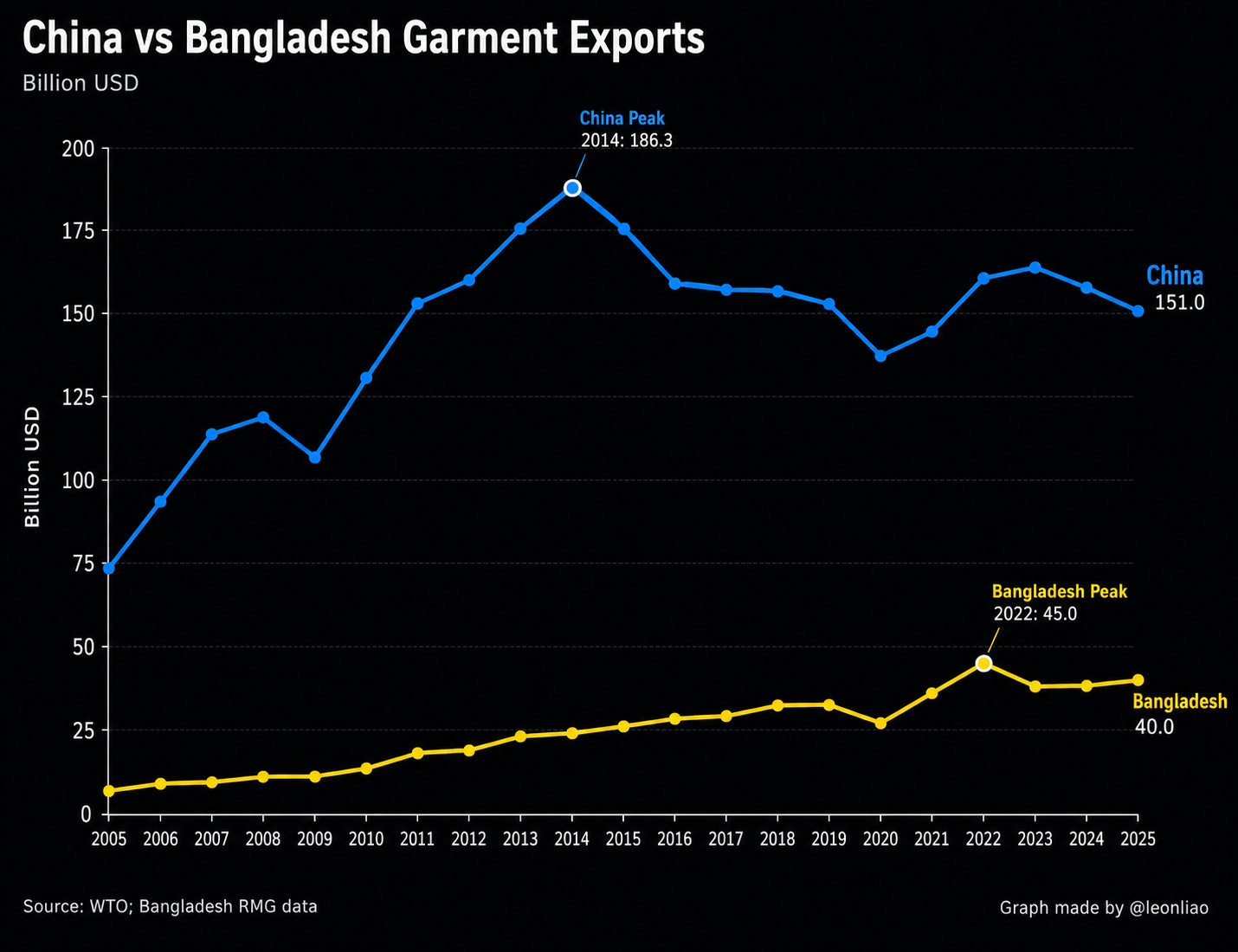
By fiscal year 2023, the sector generated approximately $47bn in export revenue, employed more than 4mn workers, accounted for about 85 per cent of the country’s export earnings and held 7.4 per cent of the global garment market.
This was not a small niche created after China withdrew. It became one of the largest labour-intensive manufacturing systems in the world while China continued to dominate the same industry.
Bangladesh benefited from low labour costs, preferential access to major markets, large-scale domestic entrepreneurship and the purchasing networks of international clothing brands. Its success also reflected the ability of millions of workers—many of them women moving from rural areas—to enter formal industrial employment. The country did not receive a pre-assigned share of global production because of its population. It built capabilities that allowed firms to win orders.
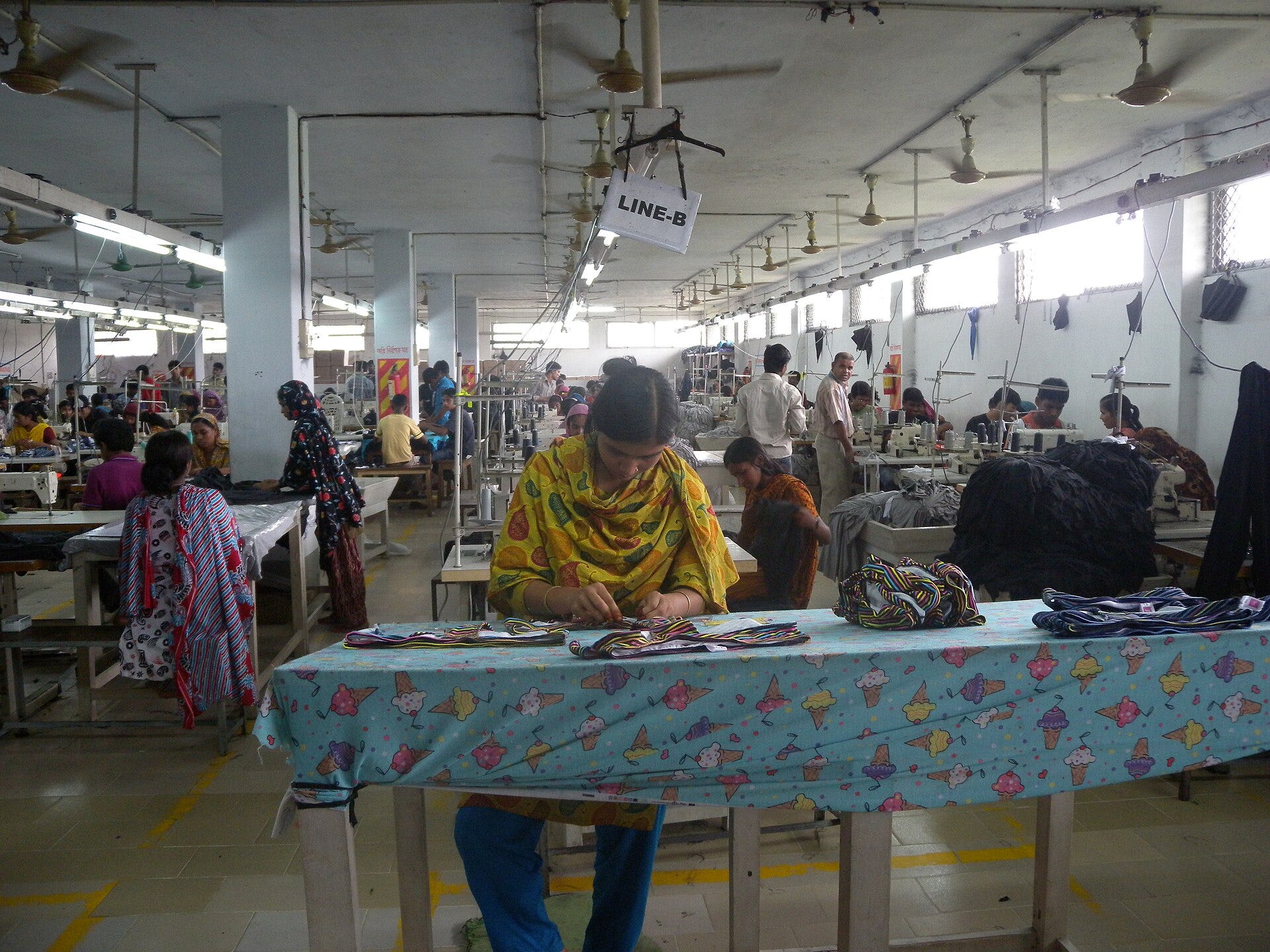
A clothing textile garment factory in Bangladesh, Photo: Tareq Salahuddin / Wikimedia Commonsn
The relationship with China was never entirely zero-sum. Bangladesh imported textile machinery, fabrics, fibres, chemicals and other industrial inputs while specialising heavily in garment production. Chinese strength in upstream textiles and machinery could coexist with Bangladeshi strength in labour-intensive final manufacturing.
There were competitive effects as well. As some orders moved away from China, Bangladesh gained market share. The country’s recent export performance has benefited in part from international buyers diversifying production. The point is precisely that such movement continued even while China automated.
Bangladesh became number two without waiting for China to stop being number one.
Vietnam presents a different challenge to the China Squeeze.
Bangladesh shows that a later entrant can grow while China remains dominant in the same industry. Vietnam shows that manufacturing expansion can be accelerated by deeper integration with Chinese production.
The timing is striking. The past two decades were the period in which China became the world’s largest industrial robot market. They were also the period in which Vietnam became one of the world’s most successful manufacturing economies. Its export volume rose from less than 4 per cent of GDP in 1988 to nearly 100 per cent in 2023. Foreign investment transformed the country into a major producer of electronics, machinery, garments, footwear and furniture.
Vietnam did not achieve this by building a wall around China.
China supplies roughly one-third of Vietnam’s imports. Machinery, electronics, components, fabrics and industrial materials cross the border into Vietnamese factories. The United States, meanwhile, purchases about 30 per cent of Vietnam’s exports. This creates a production structure in which Chinese inputs, Vietnamese labour and foreign investment combine to serve global markets.
The relationship became especially visible after US tariffs redirected some final production away from China. Vietnam gained American market share in products facing restrictions on Chinese imports. Yet its purchases of Chinese components rose at the same time. World Bank data show that the correlation between Vietnam’s monthly imports from China and its exports to the United States increased from 84 per cent in 2013–16 to 96 per cent between late 2016 and early 2024. The correlation does not by itself establish causation, but product-level analysis points in the same direction: exports of final goods to America expanded alongside rapid growth in component imports from China.
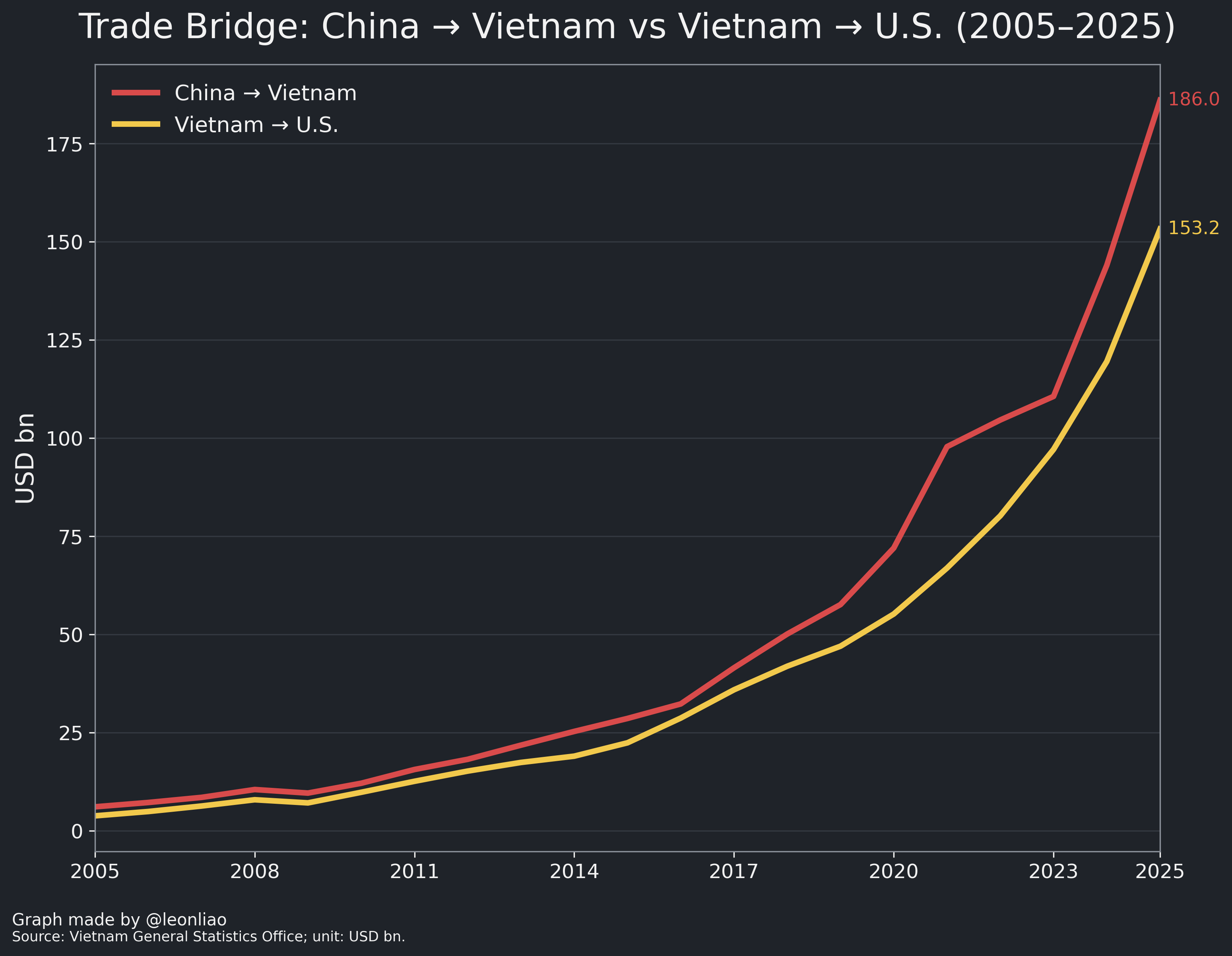
The result was neither complete substitution nor simple dependence. Some assembly moved to Vietnam. China retained and expanded upstream production. Vietnamese factories created employment and export income. Chinese producers supplied machinery and intermediate goods. Over time, Vietnam also attracted investment into more local component production.
World Bank research describes Vietnam’s current position as highly concentrated in final assembly and lower-value segments of global value chains. That remains a development challenge, but it has still created millions of manufacturing jobs. About 85 per cent of employment linked to Vietnamese exports remains in production activities, including craft work and machine operation. Even in electrical and optical equipment, roughly three-quarters of export-related jobs are tied to production.
Industrial employment has therefore survived the simultaneous rise of Chinese automation. It has expanded through a regional division of labour.
Vietnam did not industrialise by escaping China’s supply chain. It industrialised by finding a profitable position inside it.
Automation is making industrialisation more demanding.
The traditional model of competing primarily through low wages will become less reliable. Robots will keep some production in high-wage locations. Artificial intelligence will reduce labour requirements in design, administration, logistics and parts of manufacturing. Countries entering global production will need better infrastructure, stronger skills and more capable firms earlier in the development process.
None of this supports the claim that China has closed the industrial path behind it.
Bangladesh built the world’s second-largest garment-export industry while China remained the largest. Vietnam became an export manufacturing power by combining its workforce and foreign investment with machinery and intermediate goods from China.
Modern industrial transfer increasingly occurs inside production networks. China may retain automated upstream industries while exporting machinery, components and materials. Chinese companies may automate factories at home and invest abroad. Lower-income economies can specialise in assembly, processing or selected manufacturing stages, then attempt to deepen domestic capabilities over time.
The result is less orderly than the old flying-geese metaphor. Countries do not wait in line for an entire industry to be vacated. They compete for individual stages of production, connect with existing industrial centres and try to convert those connections into local productivity, employment and technological capability.
China’s automation changes those conditions. It raises the value of infrastructure, skills, institutional competence and supply-chain integration. Countries unable to provide them will find industrialisation harder.
Robots have raised the threshold for industrialisation. They have not pulled up the ladder.
Read more:
No posts
Comments
Nothing yet. Say the first thing.
Sign in to join the conversation.