
👋 Hey, Leo here. Antifragile Intelligence is where I explore how leaders think, decide, and build in uncertain environments shaped by technology and change.
Each edition is a reflection, a principle, or a field note from the work itself.
Hey Friends,
Welcome to the 170th edition of Antifragile Intelligence.
A few weeks ago, I had a conversation with someone who runs a genuinely large agentic AI business. Before I got on the call, I already knew the interviewer’s full career arc, what he’d said publicly about presales and enablement, the languages he was speaking, and roughly what the company had been shipping in the months before.
Not because I’m naturally that thorough. I’m not.
It’s because I have a system that does the reading for me, and by the time I sit down, the awkward part of a first meeting, the part where you’re both feeling out who the other person actually is, is already done. Or at least for me.
Meeting prep is one of the scenarios in which AI has helped the most, as described in this edition:
So here’s the full process (it’s a long edition, but it comes with the prompt I use if you stick to the end)
Most meeting prep is a five-minute LinkedIn skim thirty minutes before the call. You catch the current job title, maybe the last company, and you walk in, hoping the conversation carries itself. And sometimes it does, but at times when it matters most: a sales conversation, a workshop pitch, a job interview, an investor call, those five minutes won’t tell you what someone actually believes or what their company is doing right now versus what the homepage says.
I got tired of walking into those conversations at the same information level as everyone else, so I built something that goes deeper, automatically, and files what it learns somewhere I can find it again.
A Claude Code “/skill” that lives inside my Obsidian Second Brain.
I drop in a LinkedIn PDF export, or just say I have a meeting with someone, and it runs a four-phase research process before writing a single word. The output is a case file on the person I am meeting with.
Here’s the whole thing.
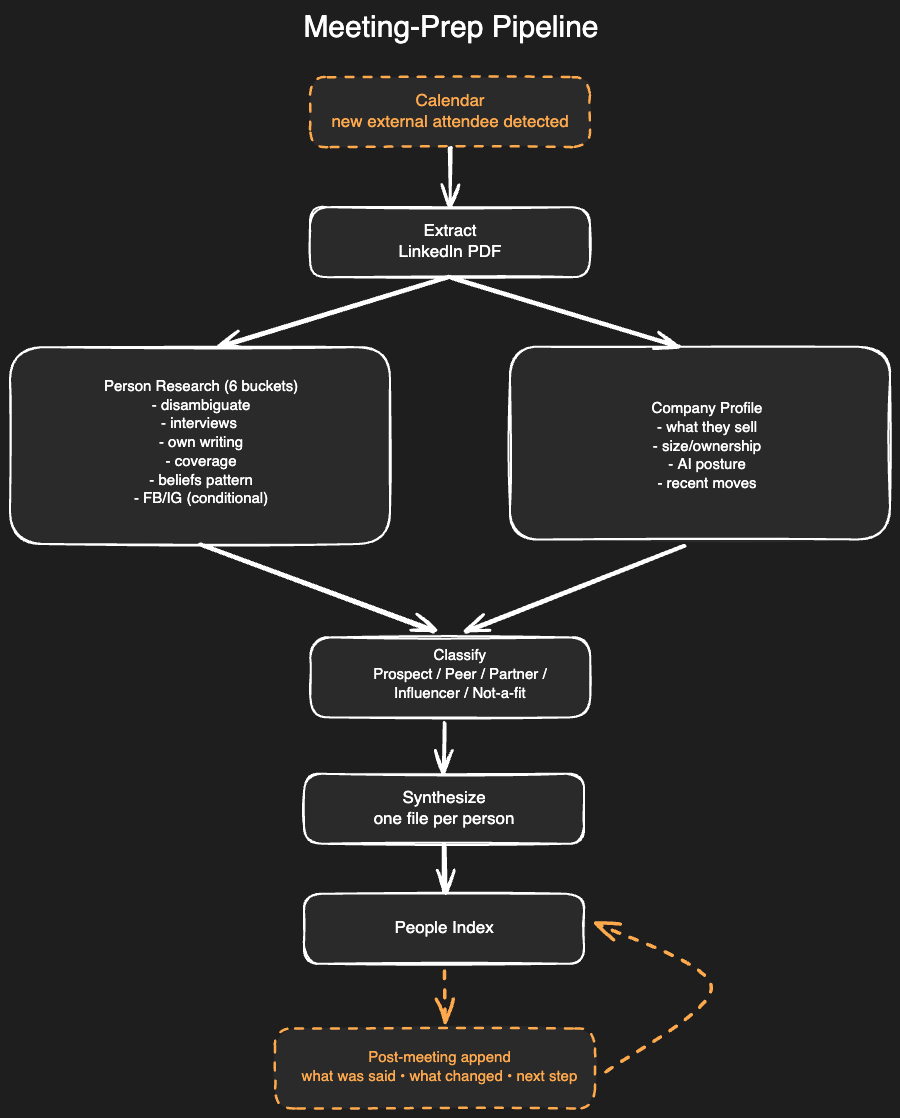
The first pass is just reading what the person chose to put on LinkedIn. Full name, headline, current role, the career arc in order with dates, education, declared skills, or languages. I take the declared skills with a grain of salt; they’re self-reported, but they tell you what someone thinks their own identity is, which is its own kind of signal.
This is the easy part and also the least useful part on its own. A LinkedIn profile is a snapshot of how someone wants to be seen. The real work starts next.
This is the step most people skip entirely, and it’s the one that actually changes the conversation. Instead of one vague search of a person’s name, I run five separate, narrow searches, each aimed at a different kind of evidence.
Three of the buckets are just different places to look.
One disambiguates, making sure I’ve got the right person and not someone with the same name at a different company.
One hunts specifically for podcasts, interviews, and talks because long-form conversation is where people actually argue a position instead of reciting a bio.
One goes after their own writing. If they have a Substack or a blog, I read the About page and the three most recent posts end to end, not just the headlines.
One more looks for coverage about them, third-party profiles, and features written by other people.
The fifth bucket isn’t really a new place to look; it’s what I do once I’ve already read the other four. I go back through everything I found and hunt specifically for the two or three ideas the person keeps repeating, across different platforms, in different words, plus what they consistently argue against. I also add one genuinely new source at this stage, their short-form LinkedIn and X posts, because that’s usually where people say the blunt version of the thing they hedge in a podcast.
That fifth pass is where you find out someone believes operators should build automations themselves instead of outsourcing them, or that they think most AI pilots fail because nobody redesigned the process underneath. That’s a sentence you can open a real conversation with. “Their job title is VP of Ops” is not.
That last bucket is where you find out someone believes operators should build automations themselves instead of outsourcing them, or that they think most AI pilots fail because nobody redesigned the process underneath. That’s a sentence you can open a real conversation with. “Their job title is VP of Ops” is not.
There’s a sixth bucket too, but it only runs sometimes. Facebook and Instagram are dead weight for a corporate profile; nobody’s arguing strategy in an Instagram caption, but they’re not dead weight for everyone. A solo creator’s Instagram is sometimes their actual storefront, ahead of LinkedIn. And for a Romanian small business, the Instagram page is often more alive than the website. I only spend the searches there when the person or company actually fits one of those two shapes.
While I’m researching the person, I’m also building out a real profile of where they work.
What do they actually sell, and to whom?
What’s their size and ownership situation?
And critically, what’s their AI posture: are they building AI into the product, buying tools for internal use, partnering with a vendor, or just talking about AI in a press release with nothing behind it?
The careers page is usually more honest than anything else on the site; open roles tell you what a company is actually investing in right now, not what they say they’re investing in.
This matters because the same person means something completely different depending on the company they work at. A curious, AI-fluent leader at a company that hasn’t touched AI yet is a very different conversation from the same leader at a company three years into a real AI transformation.
This is the part I’d steal even if you never build a tool like this. Before writing anything down, I force myself to pick exactly one label for who this person is to me: a prospect, a peer or competitor, a partner who could open doors, someone worth knowing for influence but not commerce, or honestly, not a fit at all.
The label changes everything that follows. A prospect gets training and workshop angles.
A peer gets competitive intel and possibly a collaboration idea, and absolutely never a pitch (walking in like a salesperson closes the conversation with a peer immediately). A partner gets a small, specific first ask, not “let’s partner.” And if someone genuinely isn’t a fit, I write one honest paragraph saying so and stop padding the file to justify the research time.
Most meeting prep skips this entirely and treats every contact the same way, which is how you end up pitching a workshop to someone who was never going to buy one and would have been a much better referral source.
Once the research is done, the temptation is to just paste in everything you found. I don’t. Every section of the final file has to answer a question I could actually get asked in the meeting tomorrow. A short snapshot of who they are and why they matter. One paragraph on the actual angle, tied to the classification from Step 4.
Five to seven conversation hooks, specific enough that mentioning one proves I read their work instead of just googling their name.
Five real questions to ask.
And a risk section, job hopping, a recent layoff, a vendor relationship that competes with what I offer, anything that could make me walk into a wall.
The last step is the one that turns this from a one-off cheat sheet into an asset. Each person gets exactly one file in my Second Brain, and if I’ve met them before, I read the existing note first and update it rather than starting over. Every new profile gets linked from a running index of people, so six months from now, I’m not asking “have I met this person before?” I’m reading what I already learned.
Here’s what I actually think this is about, underneath the tooling. The advantage in most meetings was never charisma, and it was never being the smartest person at the table. It’s information asymmetry, quietly earned before you ever sat down. Almost nobody builds this, not because it’s technically hard, it genuinely isn’t anymore, but because it’s boring enough and invisible enough that it never feels urgent until the meeting where it would have mattered most.
That’s also exactly why it’s a MOAT instead of a party trick. Anyone can spend one evening skimming a profile before a big meeting. Almost nobody builds the version that runs itself every single time, on the small meetings too, the ones that don’t feel important until eighteen months later, when the person you barely prepped for turns out to be the one who mattered.
The question I’ll leave you with:
How many opportunities did you miss because you came unprepared to a meeting?
You don’t need my Second Brain setup to use any of this. Here’s the whole workflow condensed into one prompt, paste it into ChatGPT or Claude before your next important meeting. Swap in the person’s name and whatever you know about them.
I have a meeting coming up with [NAME], [THEIR ROLE] at [COMPANY].Here’s what I already know: [PASTE LINKEDIN INFO, AN EMAIL SIGNATURE,OR JUST WHAT YOU KNOW].
Research this person and their company in these passes, and tell me what you find after each one:
Confirm identity — make sure we have the right person, not someone else with the same name.Find long-form content — podcasts, interviews, talks they’ve given.What do they say when they’re not just reciting a bio?Find their own writing — a blog, newsletter, LinkedIn articles. Read the actual content, not just titles.Find coverage about them — profiles, features, press mentions.Now go back through everything above and tell me: what are the 2-3 ideas this person keeps repeating in different words, and what do they consistently argue against? Also check their short-form LinkedIn/X posts for the blunt version of the same opinions.Only if they’re a solo creator/personal brand, or a local small business: check Instagram (creators often sell there before LinkedIn) or Facebook (local businesses are often more active there than on their website). Skip this pass for a normal corporate profile, it won’t return anything useful.
Then do the same for their company: what do they actually sell, to whom, and what’s their real AI/tech posture (check the careers page, open roles say more than press releases).
Finally, classify this person as one of: someone who could buy from me, a peer/competitor, someone who could refer me business, or someone worth knowing but not a commercial fit. Based on that, give me:
a 3-line snapshot of who they are and why they matter to me5 conversation hooks specific enough to prove I did the reading5 real questions to ask themany red flags I should know before the meeting
If you do this more than once or twice, save the output somewhere searchable, a notes app, a doc, whatever you already use, so the next time you meet the same person, you’re building on what you learned instead of starting cold again.
A nice walkthrough of a personal AgentOS.
In his latest article (The Future is for Everyone), more like a manifesto, Zuckerberg argues Meta’s AI strategy rests on the belief that superintelligence stays safe not through alignment or centralized control, but by putting it in everyone’s hands so competing individuals and institutions check each other, the same balance-of-power logic that underpins markets and democracy.
I finished the third book in the “Red Rising” series. I found it very good (4/5), but not as good as the first two. I will take a break from the series before moving on to the last three books.


Thank you for reading.
If this resonated, forward it to someone who might benefit from it.
Stay antifragile.
Leo
If you enjoyed this piece and want to support my writing, please consider sharing it and becoming a paid subscriber.
Comments
Nothing yet. Say the first thing.
Sign in to join the conversation.