
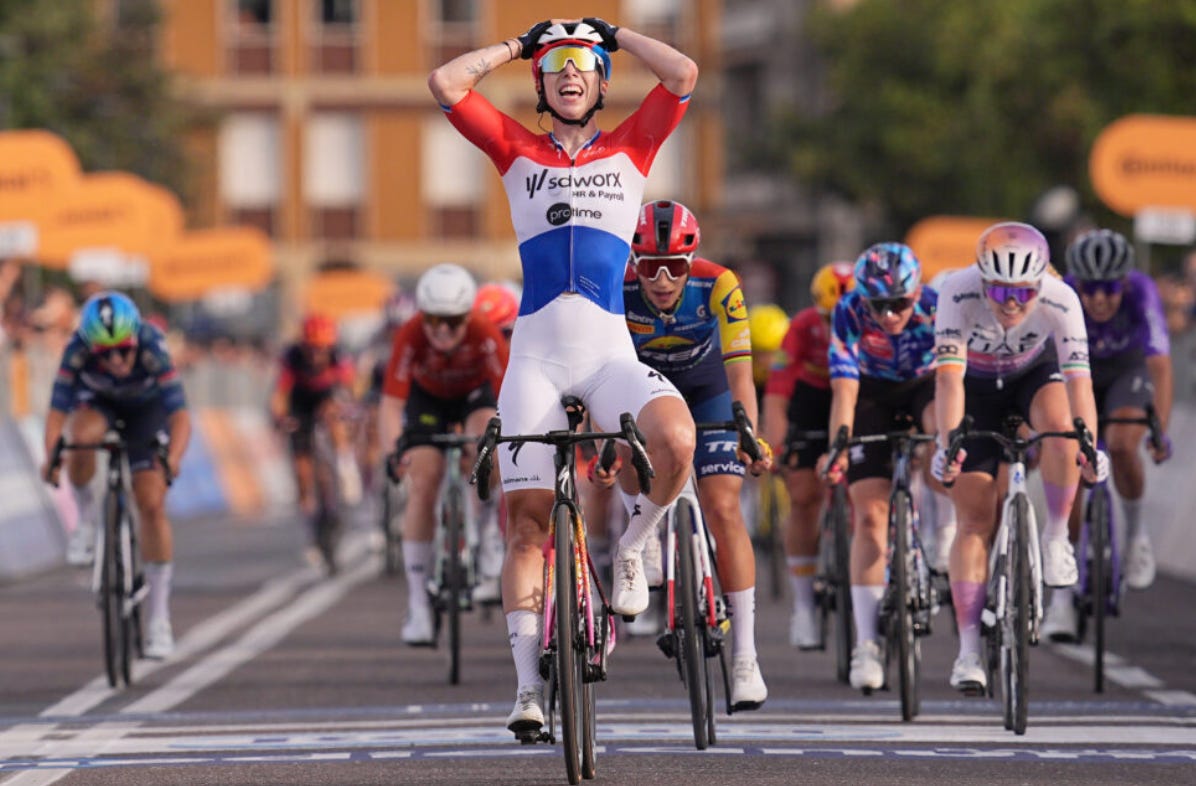
These first four Q&A items regard the disqualification of Lorena Wiebes from the Giro d’Italia Women for a bike claimed by the UCI jury to be 20 grams under the minimum allowed 6.8kg and the subsequent discussion of the origin of the rule and possible ways that it could have innocently ended up measuring those 20 grams under.
Dear Lennard,
Just on this one thing I haven’t heard raised yet just re: scale accuracy,
It has been reported that the scale measures in 20g increments – and so the 20 grams reported under weight was then just the one minimum measure increment under.
If that is the case, it is plausible that the underweight was only 11grams, and the scale then rounded this to the closest increment, in this case – 20 grams under. In likely the same way, if it was 11grams heavier than 6.8kg, the scale would likely round it to 6.82kg.
Since the underweight could literally be as low as only 11grams, this opens up even further the number of possible factors behind missing by such a small margin.
Adam Kerin, founder, Zero Friction Cycling
Dear Adam,
Thanks. If it were only 11 grams under, it would have been even more possible to come up underweight with something as simple as a tire change.
― Lennard
Dear Lennard,
I felt compelled to “weigh in” on Ms. Wiebes’ 20 gm DQ. First, I assume that all of the bikes were weighed at the end of the race, or at least all podium finishers’, and none of the others were underweight. If that’s the case, it puts a pretty big hole in the “wear and tear” theory of bike weight loss, but even if not, it’s hard to imagine that a professional racing team would fail to compensate for that factor in the bike’s starting weight.
But the wear and tear theory is also suspect on its face. If a teaspoon (volume) of salt is 3.7 gms (accepting John’s assertion), it would take another 4.4 teaspoons of microlosses to add up to 20 gr., assuming that the average weight to volume ratio of all microloss contributors combined is approximately the same as salt. That’s a significant volume to account for, and the theory fails to account for the amount of road and environmental microdebris that a race bike accumulates over the course of a race, which would offset wear and tear losses.
However, I’m sure that the question piques your curiosity, and you will eventually work an easy hands-on test into what sounds like a fun ride. But getting back to your original question: “Wuz Lorena Wiebes robbed?”...um, I mean, “Does the UCI 15-pound bike weight rule make any sense today?”; I don’t think that’s the right question for the Wiebes case. The weight limit is what it is, and everyone has the same weight target, so I submit that your question is moot in relation to the Wiebes DQ. Having said that, however, automatic DQ does seem inappropriate for Wiebes.
I think that a more cogent question would be “Why doesn’t the UCI have an equitable penalty rule for this innocent and minor infraction?” An equitable penalty would be to measure the bike weight advantage Ms. Wiebes held over her closest rival, then use an appropriate formula to translate that into a calculated time advantage, and add the result inversely to Wiebes’ time. She may still be declared the winner if the calculated result does not place her behind her closest rivals, or relegated to a different ranking if it does.
By the way, I still have my Y2K copy of Zinn & The Art of Road Bike Maintenance, which has served me well for 26 years. I bought a new bike locally in 2003 and have accomplished a multitude of modifications to it over the years, as well as routine maintenance, all with your help; thank you!
Jack
Dear Jack,
The UCI does not weigh every bike at the end of a pro road race. Instead, commissaires typically target the stage winner, the race leader (e.g., the wearer of a leader’s jersey), and a few other random riders.
Also, if the actual underweight were 11 grams and rounded up to 20 grams by the scale as Adam posited, then your calculation would come out to an additional 2 tablespoons of salt, not 4.4…
I like your idea of calculating the penalty based on a formula for how much difference the underweight could actually make.
Another thing we haven’t discussed is that Wiebes rode a single chainring (and hence no front derailleur) in the Giro stage 1. Road.cc wrote: “Wiebes’ SD Worx-Protime team said in a statement that the Dutch rider used the same bicycle on multiple occasions this season, although it has been noted by numerous observers online today that her bike for stage 1 of the Giro had a single chainring, rather than a double set-up. Case closed, surely? Not exactly, because Wiebes has in fact already used the bike with a 1x setup already this season, suggesting it couldn’t (or shouldn’t) have been the sole reason for the underweight bike.”
― Lennard
Dear Lennard,
Your weight variation argument (effect of altitude):
For a 15 lb. bike, it is in fact 18g, sea level to Mt. Everest.
Only 6 g for a 10,000’ difference.
Alan
Dear Alan,
I think it’s one gram more!
Since the acceleration of gravity (“g”) at sea level is 9.80665 m/s2, 6.8kg mass at sea level weighs:
6.8kg X 9.80665 m/s2 = 66.68522 N,
where N = Newtons = kg*m/s2, which, like weight, is a measure of force and F=ma, or in this case, F=mg (see below regarding weight vs. mass).
However, since the acceleration of gravity at 10,000 feet above sea level is 9.797 m/s2, a 6.8kg mass at 10,000 feet elevation weighs:
6.8kg X 9.797 m/s2 = 66.6196 N
The scale that the UCI would use on the bikes measures weight and not mass. (Mass is a fundamental property of matter that never changes, regardless of position in the universe. Weight, however, is the force exerted on that mass by gravity.) Since the scale would be calibrated for sea level and would read in kilograms, we must convert that weight at elevation back to the weight that the scale would measure by dividing it by the acceleration of gravity at sea level. So, we get:
66.6196 N/9.80665 m/s2 = 6.793kg,
So the delta in measured weight at 10,000 feet is:
6.8kg - 6.793kg = 0.007kg, or 7 grams.
In the upcoming 2026 Tour de France, the maximum delta in elevation from the start to the finish will be on Stage 6. The elevation difference from 200 meters in Pau to 1,360 meters at the finish in Gavarnie-Gèdre is 1,160 meters (3,805’).
7g * 3,805’/10,000’ = 2.7g,
So the bikes in stage 6 of this year’s Tour will weigh about 3 grams less in Gavarnie-Gèdre than at the stage start in Pau. That’s close to one of those above-mentioned 3.7g tablespoons of salt.
― Lennard
Dear Lennard,
I recall that the UCI established the 15 lb. weight limit with the logic that affluent teams/nations were able to afford technology that let them have bikes that were much lighter than poorer countries, which was valid at the time. The USA and others had no problem putting riders on 12-14 lb. bikes years ago, but they were pricey even then.
This rule was aimed at Worlds/Olympics to level the playing field for all nations, feeling that 15 pounds was readily attainable without being a huge financial burden to poorer teams.
To eject a rider over a 20g error is pretty heavy - handed in my opinion.
I like your idea to have the bikes individually weighed and examined BEFORE the event, so if needed a weight could be added into the seat post or bb spindle to bring it into compliance, ditto bar width/ levers, motors, all the stuff they are looking for, and allow for pre-competition changes instead of penalties or D.Q. after the event.
Eric
Dear Lennard,
I have burnt 2 rolls of Carogna tubular tape trying to mount a Challenge Chicane tubular(new from Challenge) to new true rims.
Both times I have tried the tire tread ends up looking “rolled” to one side, like the tread was mounted off axis from the bead.
Have you ever had this problem and if not, can you recommend a shop that can mount this for me. Getting pretty pricy on the tape.
Clark
Dear Clark,
This is what Alberto De Gioannini of Effetto Mariposa said about it:
“When you inflate a handmade tubular without mounting it on a rim, the base tape will end up on the outside.
This tendency remains even when the tubular is mounted on the rim: you align it when it’s at low pressure, but you have to make sure it doesn’t roll when increasing the pressure.
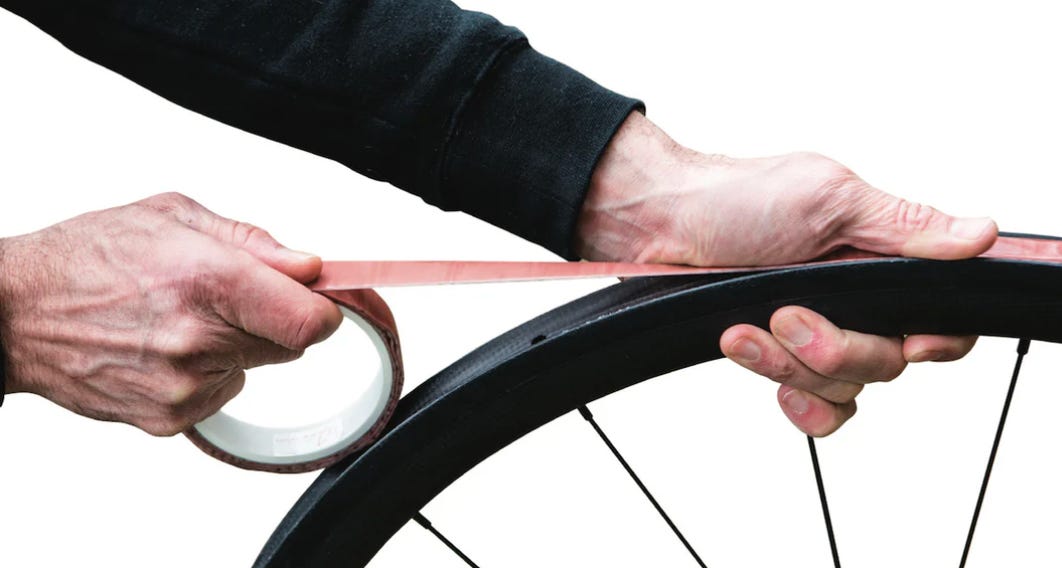
Removing the release tape of Carogna is a critical moment, as the tubular has its last chance of rolling out of alignment before adhesion happens. The issue you describe doesn’t manifest very often... and there’re ways to minimize it even further and prevent it.
After aligning the tubular on the wheel, I suggest to slightly reduce the inflating pressure before removing the release tape, and be very vigilant that the tubular stays in place while you pull the tape to the side. Pull the tape slowly, keeping your hand on the tubular while you pull the tape and move the hand following the tape. When the release tape is off, refrain from inflating the tubular at max pressure for some hours, so that initial adhesion happens and the position of the tubular is set... then increase the pressure to achieve full adhesive strength.
I remember from my years at Vittoria that - even with mastic - there were some tubulars with a nasty tendency of creep-rolling, ending with the tread rolled to one side by the time mastic had set. Reducing the inflating pressure while mastic was setting was the usual solution for tubulars belonging to that batch.
Alberto De Gioannini, Effetto Mariposa Sagl”
And Clark, I’m sure you’ve had the experience of inflating an unmounted tubular and having it twist inside out. I wonder if you were to inflate it unmounted and twist it the opposite way from the way it naturally twists, and leave it that way for a while, if it would be less likely to twist so strongly the way it did when mounted…
― Lennard
Subscribers can send brief technical questions to Lennard at: veloqna@comcast.net.
Lennard Zinn has been designing and building custom bicycles for over 45 years; he founded Zinn Cycles in 1982 and co-founded Clydesdale Bicycles in 2017 and Tui Bikes in 2022. His Tech Q&A column on Substack follows his 35-year stint as a technical writer for VeloNews (from 1987 through 2022). He is a former U.S. National Cycling Team member and author of many bicycle books including Zinn and the Art of Mountain Bike Maintenance, Zinn and the Art of Road Bike Maintenance, and The Haywire Heart. He holds a bachelor’s degree in physics from Colorado College.
Follow Lennard Zinn on Substack, Strava, X, Instagram, LinkedIn, or Facebook.
No posts
Comments
Nothing yet. Say the first thing.
Sign in to join the conversation.