
Dear Lennard,
I’m 67 years old, live in Fayetteville Arkansas and have been riding and racing bikes since my late 20’s. I read your book “The Haywire Heart” about 10 years ago and have probably re-read it twice since then. I have also recommended it to many of my fellow cyclists.
Masters nationals are in 10 days. I participated last year and did pretty well, so I continued my training and actually increased it so I would be peaking out around this time. I’ve been averaging about 15 hours a week with 3 days of intensity (about 250 mile/week with 10k of elevation).
Last Saturday in an intense training ride I noticed my heart rate was not coming down much under 150. My max was around 170. That was unusual for me because typically when I slack off, it would go down to 100-120. So I pulled back around 2/3 through the ride and rode in. My HR came down, but it was hanging out around 100, which it should have been around 80. That night I noticed my resting HR was high, around 80, and then my Apple Watch went off and said I was in AFib. I looked at the detail, and my HR was 60 one second and 90 the next - just all over the place but not over 120. I also noticed my HRV went from a typical 44 to 180. So I got up in the morning (7am) and went to the ER.
They admitted me, and by noon my rhythm was sinus. They kept me overnight and did a stress test on me the next day with a lot of imaging.
My doc was an Electrophysiologist, and he stated that I had a Left Bundle Branch Block on my EKG, and he noticed that it had also showed up on some of my previous annual cardiologist visits but other visits it was normal. So sometimes it was showing up and sometimes not.
It was extremely warm the day of this ride and I sweated a ton - way more than usual. So, after all the testing, he didn’t make it back to visit with me and on my discharge notes said resume normal lifestyle.
I asked him about participating in this upcoming national championship earlier in the day, and when they discharged me, I asked the nurse about it, and she reached out to him, and he said I was cleared to compete. So after all that, the only thing they did was put me on Eliquis (blood thinner).
The Electrophysiologist said I needed ablation, and he put me on the schedule for November (he has 300 patients in front of me).
Needless to say, I still have many questions, and I’ve reached out to my doctor 3 times and have yet to hear from him. I’m contemplating getting another opinion and preferably from someone who understands cycling and how cyclists live and ride. I have been out of the hospital 3 days now, and I’ve been riding each day gradually getting back. So far all is good. Each day I have upped the intensity. My plan was to do an intense ride here in the next day or two to see how it goes. (It’s been 7 days now and I have pushed - have done a couple of rides that have been intense - without complications).
Any insight you could provide would be greatly appreciated. And if there was a physician there in Boulder that is a specialist in this area I may reach out to get another opinion.
PS - I have since found out that my stress test came out normal and imaging was good.
David
Dear David,
I can relate. I am also 67 years old (only for today; birthday tomorrow!), and I, too, had been riding and racing bikes for over 40 years when diagnosed with a cardiac arrhythmia. Like you, my arrhythmia also first appeared while preparing for Nationals; Cyclocross Nationals in my case, which were here in Boulder in January 2014.
An increase in heart rate variability (HRV) from 44 milliseconds to 180 ms is a huge spike and to me indicates that you overcooked it, as I did in the summer of 2013 building toward ‛cross natz. Like you, after it first happened, I went back to my training regimen. As you’ll see below, that didn’t last long.
First off, a BIG red flag for me is bike racing while on an anticoagulant like Eliquis. The dangers of a brain bleed or internal hemorrhage are huge—too great, IMHO. Andexxa, which was the only antidote to Eliquis (apixaban) and Xarelto (rivaroxaban), has been pulled off the market. The oldest anticoagulant, Warfarin (Coumadin), on the other hand, is reversible with Vitamin K in the case of a bleed. However, Coumadin requires monthly monitoring of your blood coagulation and frequent dosage adjustments. That is why doctors tend to prescribe ones like Eliquis and Xarelto instead, because they require no monitoring; you just take one pill. Very simple for the doctor (and much more profitable for the drug companies since they are pricey, whereas the patent on Warfarin ran out ages ago).
Here’s the second of a couple of posts I did in VeloNews long ago about riding while on anticoagulants. In those posts you can find scary stories from riders who had minor crashes on anticoagulants and ended up with massive complications.
I look at things like competing in Nationals from a different perspective than I did when I was racing. When first diagnosed with arrhythmia, I would have, like you, asked for the okay from my doctor to compete and then probably would have raced with that somewhat vague okay that you received.
Now, there’s not a way in the world I would do that race if I had your circumstances. The possibility of big downsides is too great for me to consider it, ESPECIALLY if I were on Eliquis (which I WAS on for a while, and later, Xarelto). If you were to crash and have internal bleeding, you would wonder what could have possibly made doing the race worth that risk, even if you felt you were a lock to make it onto the podium.
The other downside I see is that, if the level of inflammation and stress in your heart and body has risen to the point where you developed AF (atrial fibrillation, or AFib) and Left Bundle Branch Block, doing Nationals can do nothing but worsen them. Any of the underlying causes of either of those conditions are nothing to take lightly, IMHO. There are worse arrhythmias that can develop besides the ones you currently have, and continuing to push a heart that has those conditions can also lead to structural heart diseases.
Your electrophysiologist did well by ordering the stress test and heart imaging (presumably with an echocardiogram and perhaps other scans). He would have wanted to determine whether you have the presence or absence of structural heart disease.
That you had a normal stress-test result is not a surprise to me. (A cardiac stress test is done on a treadmill or an ergometer while hooked up to a 12-lead ECG to look at the heart from all angles.) I had a normal stress test during a time when I had a 100% certainty of going into arrhythmia on a hard ride. The technician stopped the test with a big thumbs up when I had reached the intensity on the treadmill she had been trained to have the subject reach. It was a total waste of time, because it provided none of the information I wanted.
I knew I could go moderately hard without the arrhythmia occurring; I didn’t need a stress test to tell me that my heart would behave normally throughout such an effort. However, what I wanted to know was, what would happen when I really went deep, which is not what the technician was trained for.
It took my electrophysiologist to instruct the technician on my subsequent stress test not to stop the test until I said to stop it—which was when the treadmill had become so steep that it took everything I had not to fly off the back of it and my heart went haywire. That’s when I finally got the ECG record that could give some insight into what my heart might do in a race.
As for your heart imaging being good, that’s great news! It means that your test found no structural defects and no significant blockages in your heart, that it has healthy blood flow, and that your heart muscle function is normal. You can rejoice in that. And if your ablation is successful, perhaps, after truly sufficient recovery period, you can resume racing without further excursions out of sinus rhythm.
AF like yours in the absence of structural heart disease or other risk factors, which your stress test and imaging have ruled out, used to be called “lone” AF, implying that it happened for no reason. However, perhaps you recall from The Haywire Heart (thanks for reading it and recommending it to your friends, by the way) that research has shown that AF does not occur for no reason. I personally know athletes with AF who continued to train hard and ended up with scary structural heart problems requiring extensive surgery.
Picking up the story of my Nationals prep following diagnosis with a heart arrhythmia, I began racing ‛cross again when the 2013-2014 season started. Whenever I had an incident of arrhythmia, I had an explanation for it, like dehydration or stress, or inadequate warmup or sleep. I began making a priority of hydration and electrolyte replacement and supplements I thought would best fuel my heart. I switched to only doing races that I could ride to, which ensured that I had a proper warmup and eliminated the time and stress of prepping two bikes and multiple sets of wheels and tires, loading all that gear in car, parking, unloading, and delivering my spare bike to the pits. It also generally ensured that I only did one race per weekend.
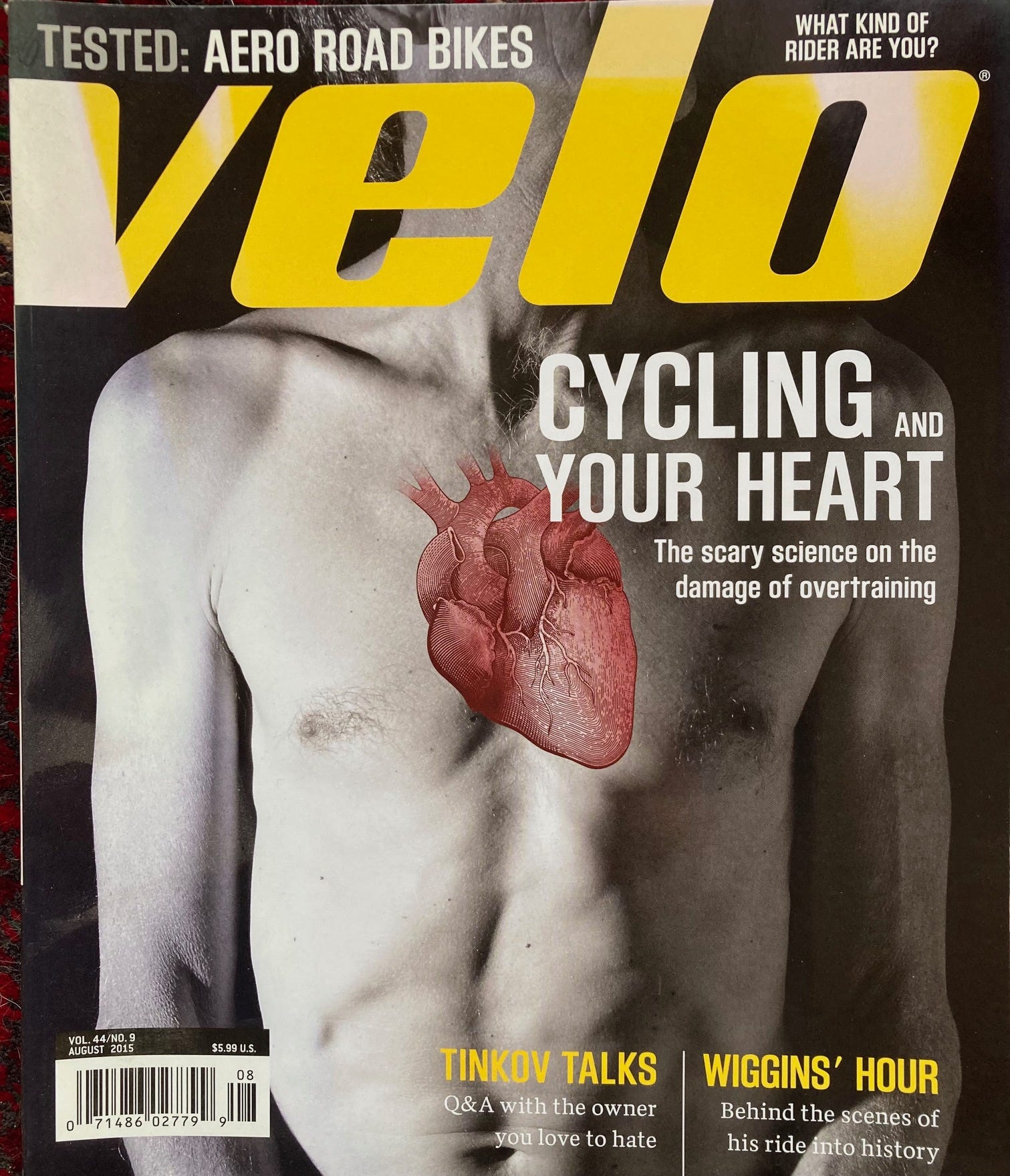
That all ended one October weekend when both races were in Boulder. Since I could ride to both, I raced them both. Arrhythmia hit right after the finish of the second one, which was a U.S. Grand Prix of Cyclocross race on the same Valmont Park course that Nationals would be on three months hence. While standing on the podium, I gave up the denial and declared that would be my final bike race. Almost two years later and nearly a year after my first of two failed ablations, Chris Case and I wrote this cover article for Velo that ultimately resulted in us writing The Haywire Heart along with cardiac electrophysiologist Dr. John Mandrola.
From my perspective now, I see that nobody gives a crap about anyone’s masters racing results besides other masters in the same age category. I now stand in amazement that I used to care so much about it. Knowing what I know now and coming from where I now come from, if this story you laid out were my story, I would call it a learning experience that I am glad to have come through without ventricular tachycardia or ventricular fibrillation and would give up racing right now. I can accept the arrhythmia I have and be thankful for the opportunity to change my lifestyle and lead an enriching life without racing. I don’t want to further stress my heart enough to develop a worse condition and potentially go back on anticoagulants, end up with an implanted defibrillator, or face heart valve replacement or open-heart surgery.
I don’t expect you to be able to hear this and follow this advice. I doubt I would have been able to do so when I was first diagnosed. However, you did ask me for my insight… (In my email back to David, I also provided some athlete-knowledgeable cardiologist recommendations.)
Best wishes to you.
― Lennard
Subscribers can send brief technical questions to Lennard at: veloqna@comcast.net.
Lennard Zinn has been designing and building custom bicycles for over 45 years; he founded Zinn Cycles in 1982 and co-founded Clydesdale Bicycles in 2017 and Tui Bikes in 2022. His Tech Q&A column on Substack follows his 35-year stint as a technical writer for VeloNews (from 1987 through 2022). He is a former U.S. National Cycling Team member and author of many bicycle books including Zinn and the Art of Mountain Bike Maintenance, Zinn and the Art of Road Bike Maintenance, and The Haywire Heart. He holds a bachelor’s degree in physics from Colorado College.
Follow Lennard Zinn on Substack, Strava, X, Instagram, LinkedIn, or Facebook.
No posts
Comments
Nothing yet. Say the first thing.
Sign in to join the conversation.