
Four years after the death of her lover, King Louis XV, Madame du Barry, the notorious courtesan and “royal whore”1, did something surprising; she fell in love - for free.

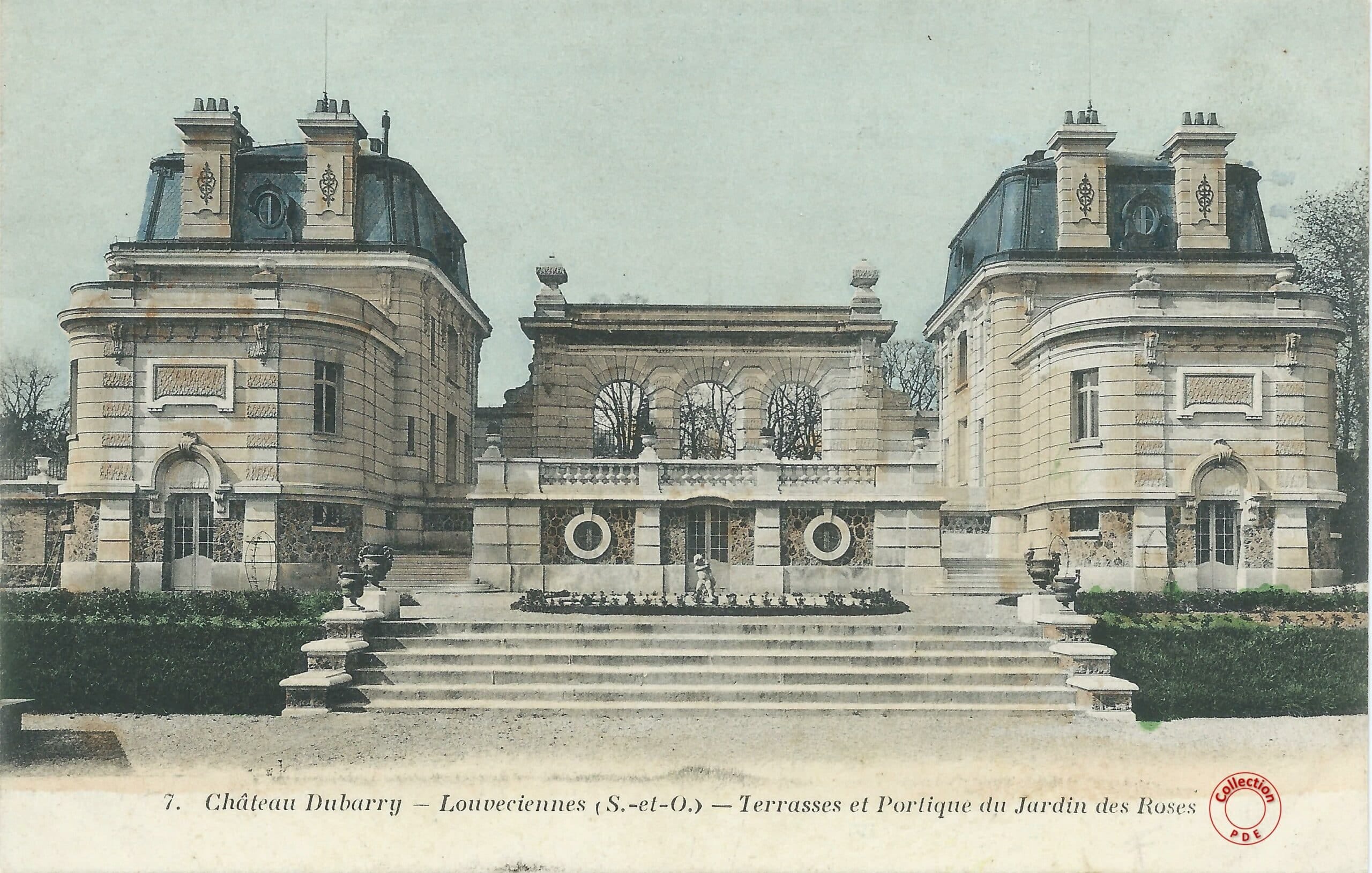
Du Barry was 35 and living grandly, not far from Paris, at her Château de Louveciennes, when she met her next-door neighbour, Henry Seymour. Seymour was a handsome and intelligent 50-year-old Englishman and a walking, talking red flag. He was “moody and temperamental, cold and passionate in turn.”2 You know the type.
Seymour was the nephew of a duke and the half-brother of an earl, but even those powerful connections hadn’t helped him much, as “his insufferable arrogance and uncontrollable temper rendered him unfit for public life and after quarrelling with every member of his family and running into debt… he decided to live in France.”3
Madame du Barry’s strictly transactional relationships may have taken her from selling trinkets on the streets of Paris to the grandest apartments at Versailles, but she had fallen hard for Mr Seymour for no cash money or jewels at all. The beauty who had once been showered in diamonds and châteaux was now the one buying gifts and sending passionate letters.
‘I have a thousand things to tell you, a thousand things to communicate, never have I felt so much as at this moment how necessary you have become to me, what happiness if I could be with you always.”
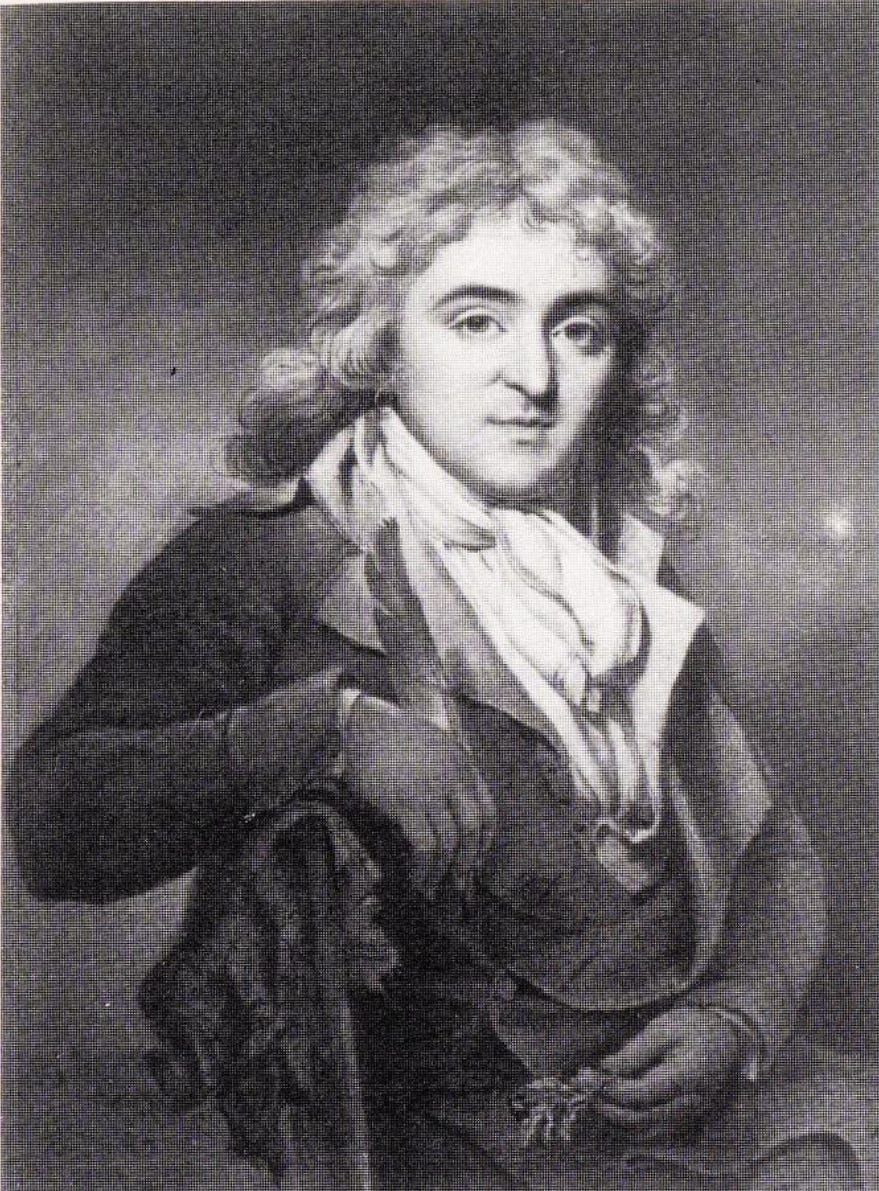
At 35 years old, du Barry was still a beauty, with her wide-set eyes, thick fair ringlets, and her gentle flirtatiousness. But, you know what married-Henry-next-door didn’t like about her? The fact that she received visitors from Paris instead of sitting around on her own, just waiting for him to drop by. We don’t have his angry, jealous letters, but we do have her plaintive replies, which claim her soul has been torn apart.
“How cruel and unjust you are. Why must you torment a heart that cannot and shall not belong to anyone but you?…I cannot live without you”4
To his credit, Henry didn’t ghost her, but he did the equivalent of sending a text message – returning to Madame du Barry a miniature portrait that he had commissioned of her on one side, and himself on the other. Below his picture, he had written three words: Leave me alone.
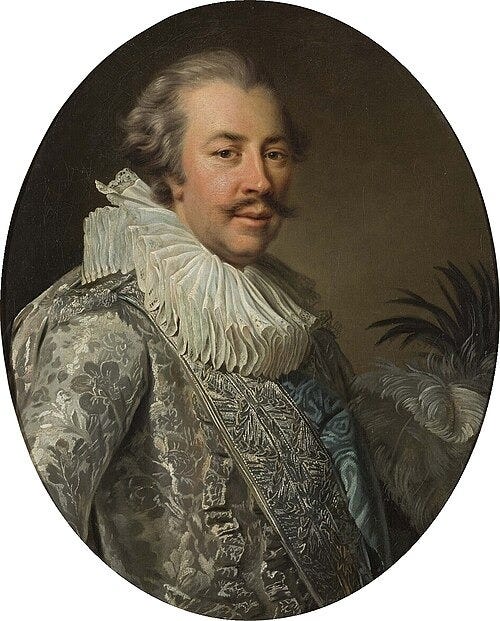
As it turns out, she could, in fact, live without him. You don’t get to be a 35-year-old survivor of both the sex trade and a vicious royal court without resilience and a backup plan, and Madame du Barry had both. A chap called Louis Hercule Timoléon de Cossé had always been devoted to her, and by a stroke of good fortune, his father had just died, making him the 8th Duc de Brissac and one of the wealthiest men in France. By 1782, Madame du Barry was his acknowledged mistress, and he began to take her to grand dinners and shower her with art and jewellery.
Hercule commissioned the court painter Élisabeth Vigée Le Brun to paint his lover, and luckily for History’s Fly on the Wall, she was both observant and a writer, and recalled that Madame du Barry received her,
“…with great grace, and seemed to have excellent manners… her gaze was that of a coquette, for her long eyes were never fully open, [and] her pronunciation had something childish about it that no longer suited her age.”5
Le Brun found a very cosy couple in du Barry and the Duc, who had replaced Louis XV on the magnificent sofas of the chateau, and she wrote,
“We often left him there because he liked to take his siesta. The Duke of Brissac lived as if he were a resident at Louveciennes, … it was easy to see that a tender affection bound these two people, and perhaps this affection cost them their lives.”
You see, in January of 1791, 18 months into the revolution, thieves broke into the chateau and robbed du Barry of many of her precious jewels. A month later, when she learned they were being hawked around London, she went there to identify and claim them. It’s easy to see, in hindsight, that Madame du Barry should have stayed there. But the revolution was yet to turn into the Reign of Terror. Her English friends did everything they could to get her to stay, including unharnessing her horses – which was the 18th-century equivalent of hiding the car keys, but du Barry was determined to go home.
Just over a year later, in May 1792, the Duc de Brissac, an honourable, upstanding, and possibly dull man, was arrested for being the commander of the King’s Constitutional Guard. Three months later, as he was being transferred to another prison, a crowd of assassins “rushed upon all the wagons at once and slaughtered, almost simultaneously, those inside.”6 Madame du Barry’s last love and 43 of his fellow prisoners were killed in a matter of minutes, watched impassively by the 1800 armed men who were supposed to be guarding them but who were under the command of a passionate revolutionary.
The Duc must have suspected he wouldn’t survive the journey. He wrote his will, and then a last letter to du Barry, “I kiss you a thousand times, and you will be my last thought. Oh my dearest heart, why can’t I be alone with you in a desert?”7
That night at Louveciennes, Madame du Barry was waiting for news of him when she heard the approach of a loud and drunken crowd; a gleeful mob was on its way up the drive to the chateau carrying the head of the Duc on a pike.
It was at this point that du Barry might reasonably have been expected to flee. Perhaps she stayed for the love of her home and her possessions; perhaps she felt safe in the community where she was genuinely loved for her care and generosity. What she didn’t know was that an Englishman who had moved into town was determined to bring her down. George Grieve was either a rabid revolutionary or a greedy opportunist, or both. Louveciennes was an ideal place to plunder, where there was “a defenceless woman, isolated by reason of her past, a handful of simple-minded peasants, and treasure which could easily be stolen.”8
Grieve befriended her servants, including a young man from Bangladesh who had been given to Madame du Barry by King Louis XV as an enslaved 7-year-old boy. It was the testimony of Grieve and Zamor that would lead to her arrest and trial. They said she’d given money to fleeing aristocrats, that she’d burned papers and entertained guests who openly rejoiced in the defeats of republican armies. She’d travelled to England as a spy against the revolution. They said her jewellery had never even been stolen; Madame du Barry suspected that they’d been the ones who’d taken it.
None of it mattered. Her real crimes were enumerated in the radical revolutionary newspapers.
“As long as she was allowed to live, could we flatter ourselves that morals were regenerated in France? Could we leave unpunished the prostitute of the penultimate of our tyrants, who had honest citizens thrown into dungeons and left to rot, for having had the courage to say that Madame du Barry was a prostitute… It was fitting that the Revolutionary Tribunal condemn to the scaffold this deity of depravity.”9
The verdict was given in a silent room; a whimper was heard, and the convicted woman was found to have passed out. She was carried to her cell. The next morning, she desperately bartered for her life, offering up all the hiding places of her jewels and treasures. Maybe she even thought she could buy her freedom. But as evening fell, the back of her head was shaved, her hands were tied, and she was lifted into the cart and taken to the Place de la Révolution.
The British newspapers were characteristically understated about her execution; they reported that “her behaviour was by no means firm”. The sensational French revolutionary newspapers said, “She died as she had lived, and, like so many scoundrels of her kind, could not find within herself the strength to conceal her remorse beneath the deceptive veil of a forced resolve.” What they both amount to is the fact that she was obviously terrified.
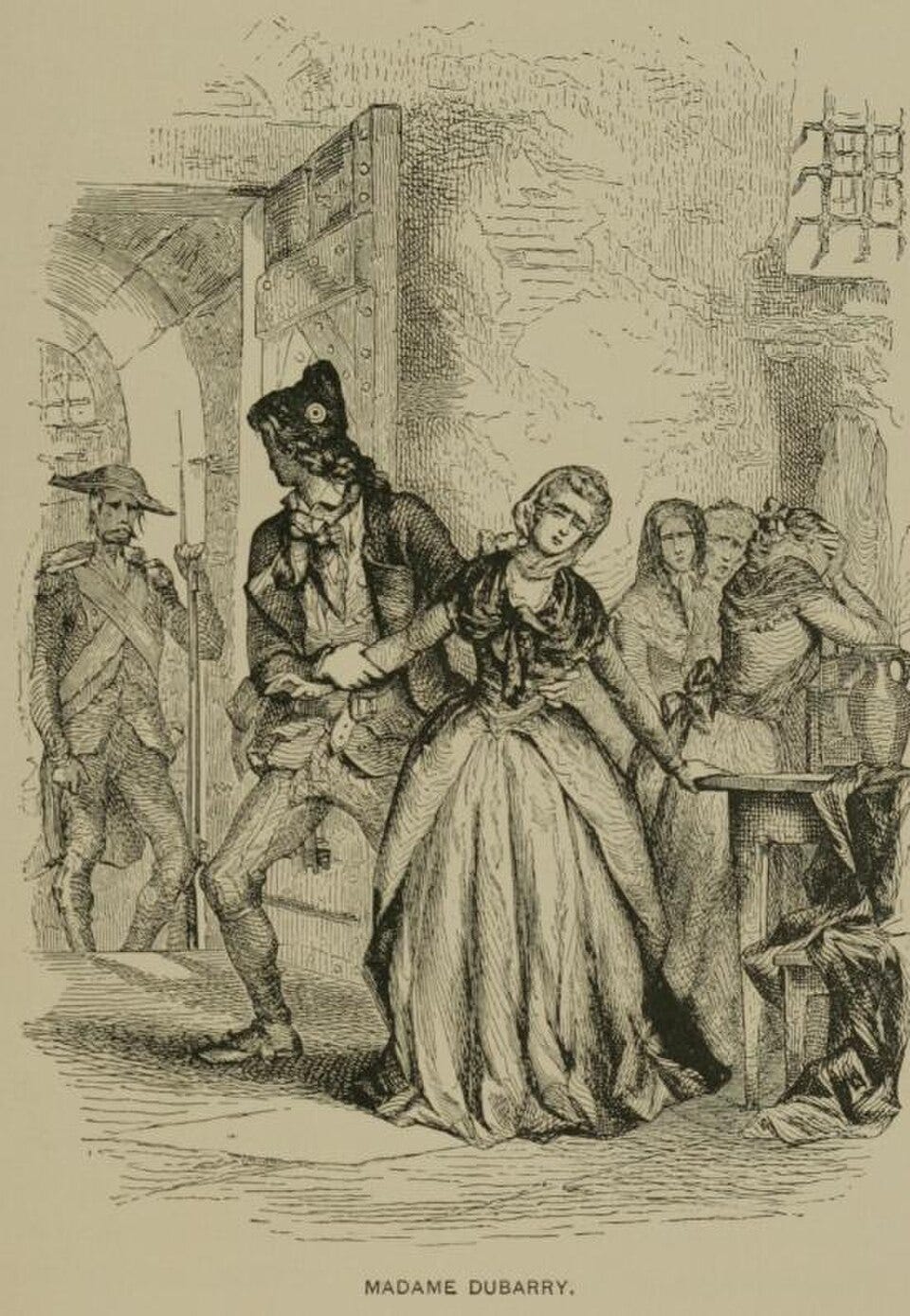
Two men had to lift her up the scaffold's stairs. She managed to slip away from them and run to the other side. She was brought back and tied, and as the blade dropped, she screamed a terrible cry.
As the painter Élisabeth Vigée Lebrun saw it,
“The crowd was so moved that the executioner hastened to end the torture. This has always convinced me that, if the victims of that time of execrable memory had not had the noble pride to die courageously, the terror would have ended much sooner. It is far easier to arouse the pity of the people than their admiration.”10
Perhaps it did kill the vibe that day, but would more terrified screams have stopped the slaughter? Probably not. The executions became more frequent, and the crowds kept coming.
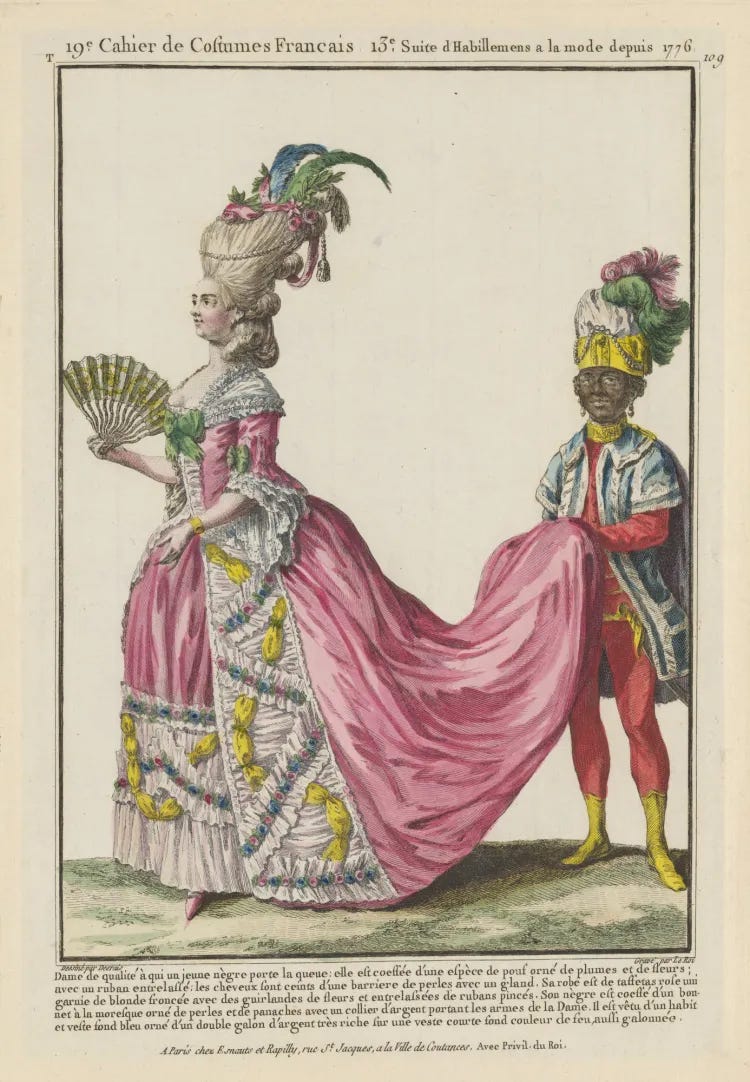
Years later, a writer tracked down a woman who had known Madame du Barry’s servant Zamor and asked what he had said about her death. She told him, “He said that if she had taken him in and raised him, it was to make him her plaything, that she suffered him to be humiliated in her own home… He was subjected to the insulting mockery and ridicule of the courtiers. He still harboured feelings of hatred for the old regime.”11
Grieve terrorised the inhabitants of Louveciennes for another year, until his own arrest in December 1794. Twenty-two witnesses testified against him, but he was released and left the country, boasting that he had been responsible for the deaths of 17 people, including the woman who had risen from nothing to have everything, and then lost her head.
“La Du Barry,” Révolutions de Paris, no. 214 (1793): 361, quoted in Charles Vatel, Histoire de Madame Du Barry: d’après ses papiers personnels et les documents des archives publiques, vol. 3 (Versailles: L. Bernard, 1883), 295.
Joan Haslip, Madame du Barry: The Wages of Beauty (New York: Grove Weidenfeld, 1992), 121
Vatel, Histoire de Madame Du Barry, 3:295.
Vigée-Lebrun, Souvenirs, 1
Vatel, Histoire de Madame Du Barry, 3:367.
No posts
Comments
Nothing yet. Say the first thing.
Sign in to join the conversation.