
If you think of cause and effect you probably imagine the good ol’ classic IF A THEN B scenario
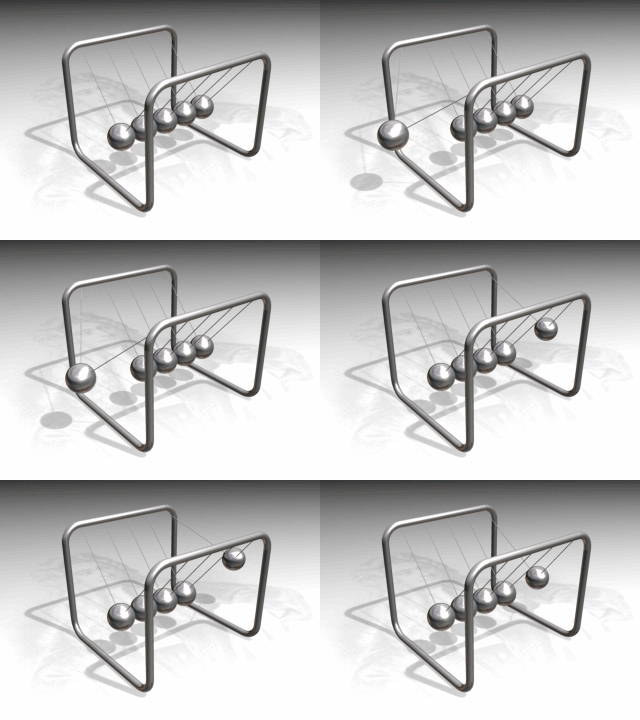
A determined cause leading to a determined outcome.
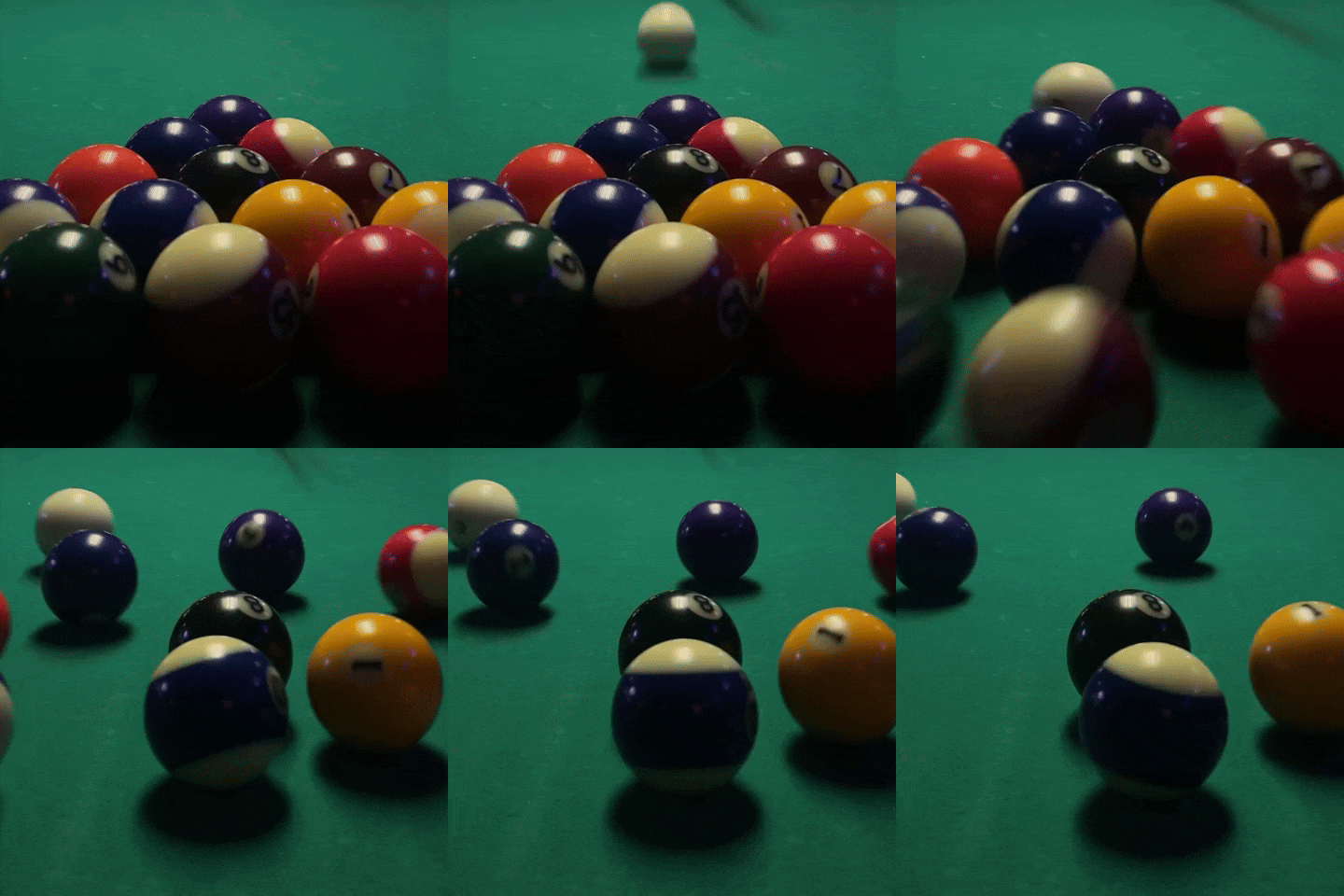
This idea isn’t wrong. It obviously works. But I would vehemently argue that its incomplete. The question remaining is two fold.
Why has Cause A outcome B & What determines that outcome?
Notice how the cause cannot be the full answer. Within every (inter-)action hides a structural preference. There in not just a passive situation unfolding but a criterial consequence that fits the situation.
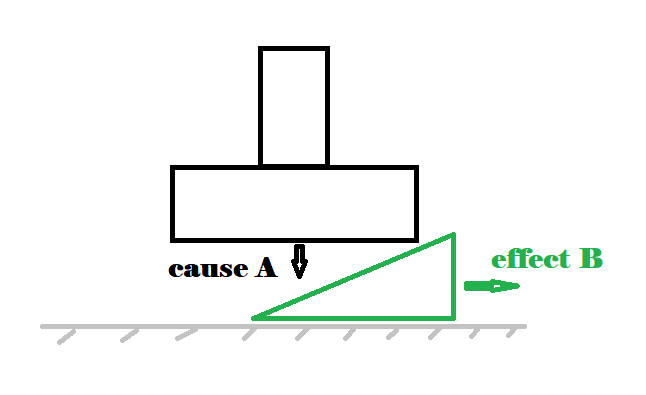
The shape of the event codetermines the outcome. You have an object/subject A effecting an object or subject B in a way that is both depended on A and on B. In fact it is even depended on the environment and situation C.
This multifactorial perspective disrupts the newtonian picture by deepening it. And it naturally includes a certain preferential outcome given a cause within a situation affecting something that is itself not inert. This preference in its most complex form appears in our minds operating system. Prof. Dr. Peter Tse describes it as criterial causation. The capacity of our mind to choose a selection principle that makes our caused reaction to “Cause A” aligned with our preferences by shaping our neurological situation into one that favors a chosen outcome B.
Now you might accurately respond that in its simple form (like in the beautiful drawing I made) it isn’t at all the human like preference we experience as free will. The triangle has not chosen its own shape and the outcome is fully predetermined. And I would (mostly) agree. Even if we can, if we want, say this kind of shape has the preference to go to the right when pressed from the top, it would be the kind of “as if” preference that at best fits a kind of compatibilist picture of free will.
To truly speak of free will, we need more than to establish a kind of morphological, static preference.
Make the free choice to tip? ☕❤️
But lets sit for a second with the significance of this very simple example to fully appreciate its implications. The Outcome B is not just determined by the external Cause A. That alone is the basis on which compatibilism actually begins to bear legitimacy.
Who we ARE determines how we respond to any external stimulus. To label this free we have to look out how we became who we are.
There is of course nature and nurture shaping you externally. But there are also the sum total of inner contemplations that take place. Just imagine how the parts of the triangle (it’s atoms) have a certain preference to bond, resulting in the structural form of a triangle under the bombardment of external influences.
There is a trajectory that could have been otherwise backed into the end result.
Remember that the ingredients we are made of are not separate from us. A huge mistake we make when saying: Our behavior is not determined by us but by our genes is assuming that we are not our genes.
We sneak in a dualism where mister (or misses xD) conscious soul is a slave to their material bodies properties. We ARE our body just as the triangle IS the triangle and its atoms. Our behavior is the consequence of our structure relative to our environment.
The word we can give to the causal force applied from the outside are the constraints.
But we also hold inner resistances that are far from free. Those are our habits. behavioral inertia so to speak.
We have constraints, inertia, forces that push and pull on us. All those do determine a huge chunk of our behavior. And yet they do not determine everything.
So the only thing that remains free is the little cherry on top. That cherry is what we do with the remaining indeterminacy. There is genuinen freedom there. Freedom that could be said to bubble up from the very bottom. Quantum indeterminacy if you will.
Hold on! please don’t leave. I promise I am not saying we quantum woo our way into free choises.
Many people rightfully rebut that just because quantum effects are not deterministic doesn’t mean they affect our macro decisions in any way. That is correct. But once again misses the point.
Indeterminacy doesn’t do anything. It is not a cause. Randomness is not a power in itself. And as long as we think of it that way we will be confused about this.
If you throw a die. it is not randomness that decides the outcome. in fact the outcome isn’t random at all. we merely label our own uncertainty as randomness.
So Quantum Uncertainty while likely genuinely indeterministic is NOT necessarily causally random. It can and likely does remain unresolved in superposition. It keeps being undetermined as long as it doesnt have to commit to any outcome.
There is no need for an exotic Quantum Mechanism to bubble up and cause us to have free will. I think that ideas attempting to find quantum systems in the brain are pretty much doomed to fail. And yet.
We already know that superpositions are essentially a list of possible outcomes and many theories already treat them as non ontological entities.
We simply have to navigate underdetermined potential to remain free. That we have discovered potential at the quantum level doesn’t mean it only exists there.
Actions that force Options from this superposition to melt away and shrink down the list of possible outcomes are exactly of the kind we have discussed. External constraints, internal inertia and well… a possibly free causal power?
Enter the Argument of Hedda Hassel Mørch. The idea I want to introduce here is that of phenomenal causal power. A kind of phenomenal criterion through which a part within its environment resolves or disambiguates remaining potential into determined outcomes. This actualizing of specific events is causally efficacious and follows the active intent of the subject. It is therefore genuinely free and consciously agentic.

The way this freedom scales despite being heavily constraint:
A network holds the power to infer its own structure and alter it in a way to bias it toward intended outcome.
A neural circuit sets criteria — conditions that future inputs must satisfy to trigger a response. The synaptic weights of a network encode a standard. One that defines the shaping of future responses.
What fires the neuron isn’t just the raw magnitude of the input but whether it meets the criterion the network has established. And crucially, that criterion can be reset by prior learning — the network revises what counts as a trigger based on experience.
This is an inherently normative process. The conscious agent qualifies and with that determines how to change itself to change its environment in a desired direction. The system evaluates its situation.
And by that we create the capacity to act according to our will. External Stimuli no longer hold full control over our reactions. That is what makes our choices genuinely ours. We take in information and evaluate them. And then we both react to it and decide how we want to react to it. We are a triangle that can decide the direction it will slide towards when the press comes down by altering its own angles.
I really want to hit this point home. There is no Luck that determines anything. I really reaaaally hate that this misconception took root.
“What if the outcome is just random?” Like what? Have you ever seen randomness do something? What even is randomness? Can I touch it?
So you think Quantum Physics is deterministic? Why do you think those are the only two options. This whole stick is really a false dichotomy created in the minds of a society obsessed with a newtonian world view.
My answer is that this objection against free will smuggles in an assumption I want to reject outright: that luck, or randomness, is a cause at all. It isn’t. Randomness doesn’t do anything. It is not a force sitting alongside gravity and electromagnetism, waiting its turn to push something around. Randomness is a label for our ignorance, not a power in the world. Indeterminacy however is real. It means something is not pre-determined.
Which means: if a gap is genuinely undetermined, genuinely open, then nothing is going to close that gap on its own. An undetermined gap with no determining cause simply does not resolve into an event. It stays open. Something has to close it, or it never gets closed, full stop.
So the gap needs a closer. And free will is the best candidate we have for that job. We already experience potential collapsing into actuality as chosen action. That experience is the root of disambiguation and cannot be random. At least we definitely do not observe it that way.
We observe it as both preferred and constrained by the very structure that’s doing the choosing and the environment forcing a choice.
The How and the Why
Bateson defines Information like this: A difference that makes a difference.
To make a difference to something it has to mean something to what it affects. otherwise we cannot resolve the plurality of possible outcomes in the certainty of a specific one.
A leaf falling makes plenty of physical difference to the air around it, displaced molecules, tiny pressure waves, If those do not mean anything to the leaf or the air it’s path would remain in superposition of possible sways. This does not seem to be the case however. Reality is set up to care which way it falls.
The laws of Nature are themselves results of preferential patterns.
Horizontal causation is the How. It’s Newton’s picture, the billiard-ball chain,
A pushes B and B moves — full stop, no further questions asked.
But why does the billiard ball move the way it does? Why does Gravity pull down and why does Evolution result in adaptations?
That’s the job of vertical causation — the Why.
Why is where Mørch comes in, because the Why is evaluative, not mechanical. It requires valence. A spectrum of good and bad running underneath the options, such that given the exact same constraints, one outcome gets favored over its neighbors. You cannot get a preference out of a purely horizontal system. Preference needs something for which outcomes matter differently. That’s what phenomenality is, structurally. The fact of there being a for-something-ness to being any particular part of the world. It the way Any Point in reality relates to any other. A temperature of 20C° means vastly different things to different structures and their reactions to it differ accordingly.
So here’s the actual shape of the argument: Tse gives you the How — the machinery that sets and revises the criteria. Mørch gives you the Why — the phenomenal valence that decides which criterion satisfies the agent.
Universalize this as much structurally reasonable and the end result is a world that is both fully self- and co-determined AND fully agentic.
No matter where the remaining freedom comes from. Its consequence is simple.
An open future.
There is no pre-written unchangeable script. At least not one ever accessible within reality. For me as agent living in and not outside of this game we call life, the implications are self evident.
My choices are the result of my past, the present situation and my preferences for the future. There is no need for a mechanism linking my choices to the quantum realm… I am the structure that I am. And I am just as much my parts as I am the whole. If my actions are determined through any part of myself the compatibilists already won. And if on top of that, there is a part not determined by any prior but truly born in the present, free will has a chance to shine.
If that part emerges from the quality of being me here and now. This emerging act is as free as an act of God.
Here I see us co-creating reality.
But I guess that is better left for a future essay…
Comments
Nothing yet. Say the first thing.
Sign in to join the conversation.