
A field report of my experience of seeing the end, and feeling overwhelming purpose and peace.
The idea is simple:
For those seeking enlightenment, it might result in radiation poisoning.
Light does illuminate, but it also holds potential to blind and harm. While this essay is meant as a little bit of a joke, their is an actual warning this essay is trying to deliver. What follows is me describing something I experienced. Not a claim to knowledge that applies to you. I don’t think it’s the kind of thing that can apply to you.
And yet I think it will land for a lot of people who’ve stood near the same light and never had the words for what they saw. That’s the whole tension of this essay, really: I’m handing you something I think is true and simultaneously telling you not to trust it too much.
To understand the point of a sentence is to see its end.
What sounds a bit like something Wittgenstein could have said regarding the structure of language, I see as ontological foundation of meaning. A final cause cannot be seen through without seeing the final act.
Literally — you don’t know what a sentence means until you’ve arrived at the period. Everything before it is held in suspension, waiting to be resolved by where it lands. This is also, I think, exactly what makes every enlightened person sound a little bit like an end-times prophet. They saw the end of the sentence. The sentence in question was their life, or life itself, or being — and once you see how something terminates, you can’t un-know it, and you can’t talk about anything else without sounding like you think the world is ending. In a sense, for you, it did. You just weren’t the one who died.
Once you see through life — once you see its final cause — you’re met with something close to the experience of death. You see the whole arc and its end at once, in a way that makes deep sense to you. Instant, total, and somewhat useless to describe to people wh haven’t seen it.
Your interpretation of it depends on you, which means it isn’t the kind of structural prediction science makes. It also has no meaningful timescale attached. It always feels like it’s just about to happen. But that feeling is itself the illusion. Being infinitely close to the end, in an asymptotic approach, is the constant experience. You don’t arrive. Jesus thought the end was about to come and since then 2000 years have passed.
The end times are always just around the corner.
This is the ultimate essence of an enlightenment experience, as far as I can tell: you experience viscerally, (and let me put equal weight on every single word in that sentence) Why you are here.
It gives you the qualitative experience of the forces of fate pushing you into the locus of here and now. Every move you make suddenly feels like both a choice and a natural conclusion, simultaneously, with no seam between the two. It also tells you, through that same pathway, why you are you — what it means to be you, and what you are not. I experienced this myself as a vivid and ineffable sense of how my parts form a whole, and how that whole is a representation of me. It’s not that I exist as some indivisible soul persisting for eternity. It’s closer to this:
“I am a commitment the universe made to act as one, through me, for the purpose of contributing something of my particular shape to the place in time where that shape was most needed.”
Here and now stop being distinguishable from the mind and matter located there. It’s as if being itself is nothing more than the what-it’s-likeness of being here-now — while also, in the absolute sense, being nowhere at all. Being becomes self-evident. And, in the same motion, entirely empty of anything intrinsic that would separate it from, or elevate it above, anyone else’s version of the same experience.
This last part, the emptiness, the lack of anything separating your view from someone else’s, is where the variation shows up. You can trace it across the different cultural costumes this ideal wore throughout history. Buddha, Diogenes, and Jesus are, in this sense, three faces of the same thing.
At first they look nothing alike:
Seeing reality clearly (Buddha)
Living truthfully (Diogenes)
Loving courageously (Jesus)
But look a little longer and the seams start to show. Wu wei and detachment from the material show up in Diogenes as much as in Buddha. Compassion shows up in Buddha the way it shows up, differently dressed, in Jesus’s love. And eudaimonia, the Dao, and Christian apotheosis turn out to be the same destination approached from three different roads — all of them, notably, roads that never quite arrive…
Yes, these three are arbitrary examples. But that’s kind of the point. The same ideal reveals itself every single time someone gets close enough to “see through the veil”, regardless of which century or vocabulary they happen to be standing in when it happens.
And yet — this experience needs to be handled carefully, because I see no real reason to assume it’s any more objectively true than its opposite.
Interpretations differ because people interpret their enlightenment through their own particular perspective. They bring their own values to it, relate it to their own life, in a way that can’t be universalized. And this is exactly where the danger lives. Enlightenment can deceive precisely as well as it can reveal, using the exact same machinery.
Your ultimate truth should never be mistaken for the universal truth. It should never be treated as more important than it actually is.
And here’s the harder part. Gnosis is highly addictive. Chasing the high of enlightenment devalues its own insights, turns them into radiation, slowly growing a small cancer of superiority in the mind of whoever’s trying to understand more than they need to.
I don’t think this is a moral failing so much as a structural trap. The asymptote I described earlier — always approaching, never arriving — means the feeling of the experience is available for repeat use in a way the actual insight isn’t. You can’t re-arrive at understanding. But you can absolutely re-chase the sensation of almost-arriving.
Part of what makes this so wicked is something also captured in terror management theory. Enlightenment means facing death. That’s terrifying. Getting through it makes you genuinely at peace with it — for a while. But once the high fades, you’re arguably worse off than before you started. You’re still mortal. Now you’ve also seen the point of your mortality, which your nervous system was not asking for. That produces a pretty severe sense of cognitive dissonance.
Detachment is the solution, in theory. But it has its own costs. Some people are able to detach but not willing to. Some are willing but not able. The second group is the one I worry about most, because they’re the ones most likely to mistake healthy detachment for unhealthy dissociation, and go looking for peace down a road that just numbs them instead.
I sometimes wonder if I am part of this group..
Enlightenment isn’t really a gain. It always also comes with a loss. The ego loses its central position. Certainty dissolves. Social conventions that used to feel like bedrock suddenly reveal themselves as constructions — agreed-upon fictions that were never load-bearing in the first place.
For some people, that’s liberation. For others, it’s existential exposure, full stop. Truth can free you. It can also demolish the comforting illusions you were, reasonably, depending on. Both of those are true responses to the same event. Neither one is the “correct” one.
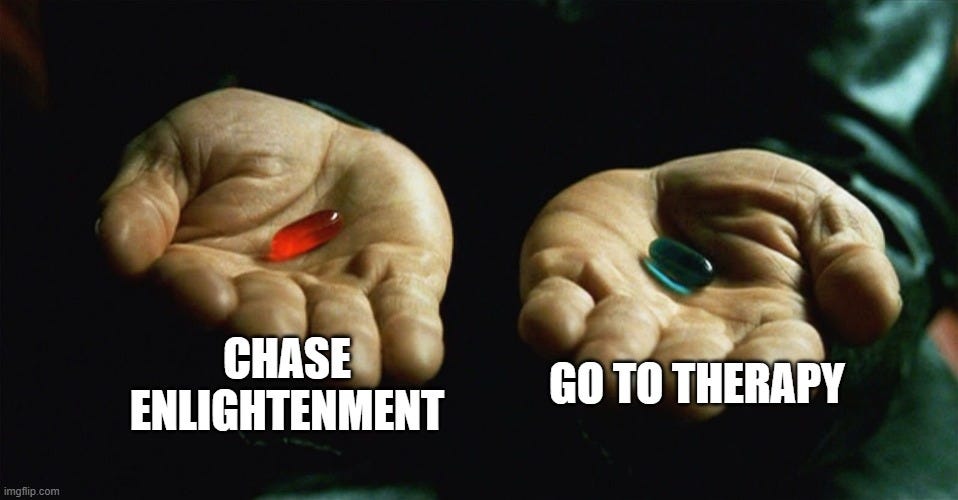
In a way Enlightenment is a lot like The Matrix, with one crucial difference. We are all Neo.
So learning that you’re “the chosen one,” without also realizing this doesn’t make you unique, that it applies, structurally, to every single piece of being, is the entire distance between becoming an enlightened prick and becoming a compassionate member of reality.
So remember kids. Gnosis is fun but be sure to find a trustworthy source.
And don’t overdose on your own supply! 😁
So: radiation poisoning, or enlightenment? I genuinely don’t know which one I have. I suspect the honest answer is that it depends entirely on what you do with it afterward — whether you let the light illuminate the room, or just stand in it, admiring your own glow.
Comments
Nothing yet. Say the first thing.
Sign in to join the conversation.