
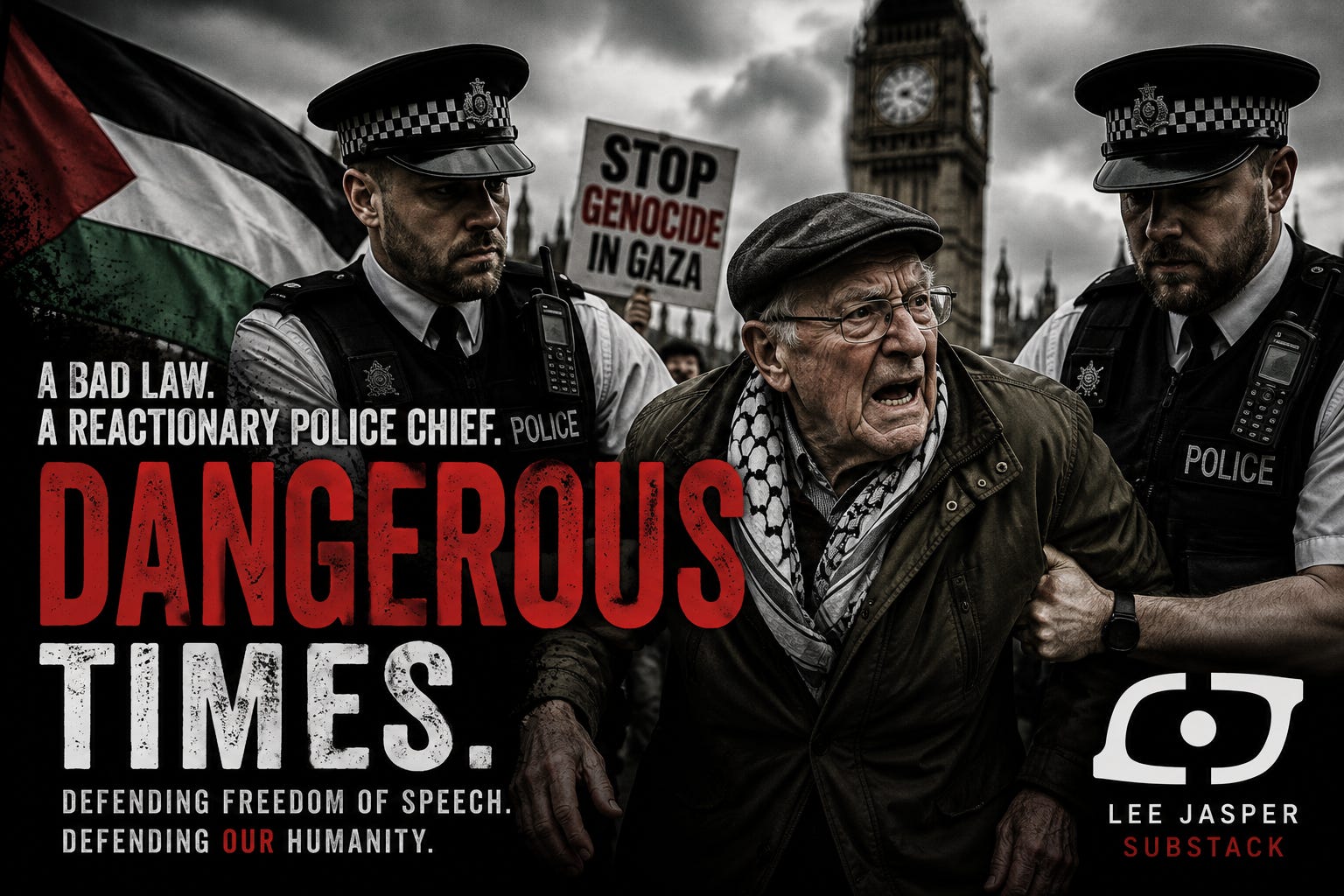
There is something profoundly disturbing about watching elderly citizens being arrested under terrorism legislation because they oppose the destruction of Gaza and publicly express support for an organisation the Government has proscribed. We should be precise about who these people are. I do not know whether any of those arrested were decorated war veterans, nor whether their parents or immediate relatives fought Hitler’s Third Reich, and there is no need to invent biographies to strengthen an argument already powerful enough. What is plainly visible is that many belong to generations formed by the Second World War and its immediate aftermath: people raised on the proposition that fascism must be resisted, abusive state power must be constrained and ordinary citizens have a moral responsibility to speak when governments commit, excuse or enable grave injustice.
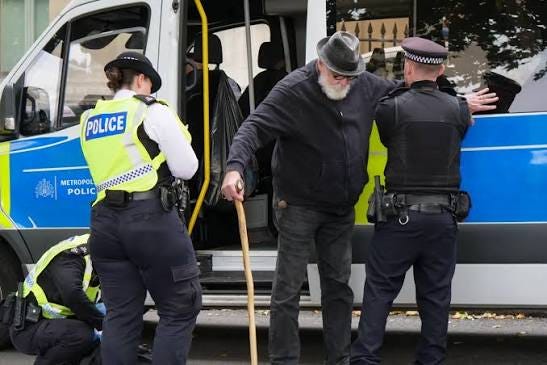
That history matters because Britain has spent eight decades presenting the defeat of fascism not simply as a military victory but as the foundation of its modern democratic identity. We honour that generation at memorials, invoke its courage in political speeches and teach its sacrifice as evidence of a supposedly distinctive British commitment to liberty. Yet elderly men and women, some walking with sticks and others requiring physical assistance, are now being processed as terrorism suspects because words written on their placards are alleged to express support for Palestine Action. They are our parents, grandparents and great-grandparents, ordinary British citizens invoking principles that successive governments have repeatedly described as essential to the British way of life. The irony is no longer merely bitter. It has become Orwellian.
Beyond the political establishments of Israel and the United States, much of the world looks on with understandable bewilderment. Burly Metropolitan Police officers are seen gently but firmly escorting pensioners away for holding placards, while Britain continues to present itself as the mother of parliaments, a bastion of law and a historic guardian of freedom of speech.
The image carries its own indictment. A country that commemorates resistance to fascism as national mythology is deploying counter-terrorism law against people whose alleged offence is an act of public conscience. Whatever diplomatic language ministers may use, no appeal to procedure can cleanse that spectacle of its moral obscenity.
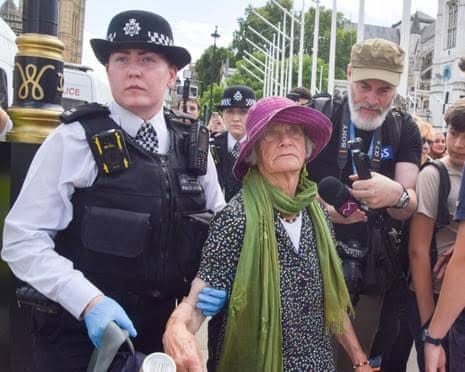
At the latest Defend Our Juries demonstration outside Westminster Magistrates’ Court, the Metropolitan Police reported 152 arrests, 134 of them for alleged expressions of support for Palestine Action under section 12 of the Terrorism Act 2000. These arrests form part of an enforcement operation of exceptional scale, extending well beyond those accused of damaging property and deep into the realm of peaceful political expression. The protesters in question are not alleged to have planted bombs, planned attacks or threatened members of the public. Their alleged offence lies in words written on cardboard which the police and prosecutors contend amount to support for a proscribed organisation.
The distinction between supporting Palestinian freedom, opposing Israel’s conduct in Gaza and supporting Palestine Action remains legally important. Nevertheless, the central fact cannot be evaded. Britain has moved from prosecuting specific acts of criminal damage to processing ordinary citizens as terrorism suspects because of the political meaning attributed to their speech. That is not conventional public-order policing. It is the use of counter-terrorism law to regulate political conscience.
This is how creeping authoritarianism develops inside a formally democratic state. It rarely announces itself through the cancellation of elections or the sudden appearance of jackboots in Whitehall. It advances through widened statutory definitions, exceptional police powers, procedural innovation and repeated assurances that only dangerous extremists need be concerned. The category of threat then expands. Extraordinary powers become operational routine, while citizens who pose no credible danger to the public discover that machinery built to confront political violence has been redirected towards the suppression of dissent.
Palestine Action was proscribed in July 2025 following actions involving serious criminal damage at military and defence-related sites. Under the Terrorism Act 2000, politically motivated action involving serious damage to property may fall within the statutory definition of terrorism. The breadth of that definition allows the state to collapse distinctions which remain morally, legally and politically essential. Criminal damage is an offence and should be prosecuted as such. Trespass, assault, conspiracy and damage to military property can all be dealt with under ordinary criminal law. None of that logically requires the Government to transform peaceful expressions of political solidarity into terrorism offences.
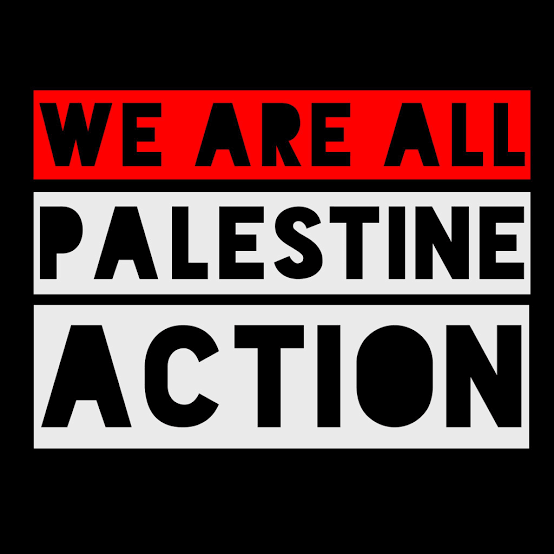
The consequences of proscription travel far beyond those accused of damaging property. Once an organisation is placed on the prohibited list, expressions of support, invitations of support and particular displays become potential terrorism offences. Parliament has thereby constructed a bridge between direct action undertaken by some individuals and political speech expressed by others. That bridge is now carrying pensioners, clergy, retired professionals, environmentalists and citizens with no history of political violence into police custody and the criminal courts.
The political responsibility for this cannot be abandoned at the door of Scotland Yard. Shabana Mahmood, as Home Secretary, controls the machinery of proscription, oversees counter-terrorism policy and carries responsibility for the Government’s defence of its decisions before the courts. Sir Mark Rowley determines how Metropolitan Police officers enforce the law on London’s streets, but the architecture within which those arrests occur is ministerial. Mahmood cannot present herself as a distant observer of a controversy produced solely by police discretion. The Home Office owns this policy and must answer for its constitutional consequences.
Those consequences are now extending beyond protesters to the legal profession itself. The proceedings against Rajiv Menon KC should cause alarm far beyond the circle of lawyers who know him. Rajiv is accused of contempt arising from parts of a closing speech delivered while defending Charlotte Head in the trial of six Palestine Action activists accused of offences connected to an action at the Elbit Systems factory in Filton. The allegations concern whether he breached judicial directions and misled the jury when speaking about its independence, its constitutional function and the historic principle established through Bushell’s Case. No court has found him guilty of contempt, and his substantive hearing has been stayed while a further jurisdictional challenge is determined. The procedural history has already passed through multiple judicial stages, including a successful Court of Appeal challenge to an earlier attempt to institute proceedings.
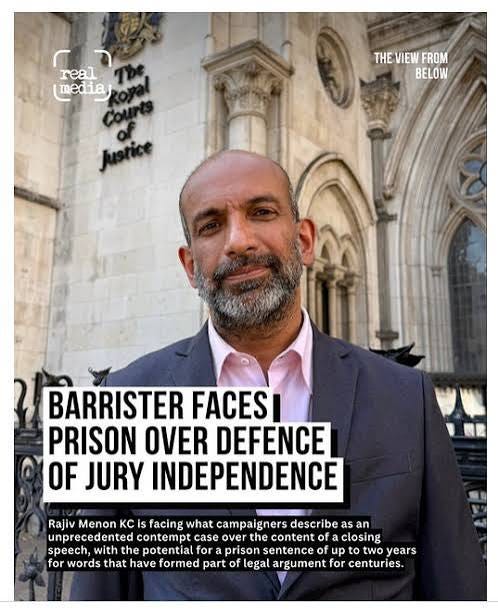
I have known Rajiv since the 1980s, when he worked with the Newham Monitoring Project, first as a law student and then as part of that remarkable generation of anti-racist legal activists who stood beside families facing racist violence, police harassment and institutional indifference. Newham Monitoring Project was not a finishing school for comfortable legal careers. It was a frontline organisation operating where the promises of equal justice routinely collapsed under the weight of racism and state power. Rajiv carried that formation into the law. He became a barrister of conscience because he first learnt, in the streets and advice rooms of east London, that law without courage can become little more than procedure in the service of power.
His subsequent career bears that out. He has represented Hillsborough families, people bereaved by deaths in police custody, victims of racist and malicious prosecution, participants in the undercover policing inquiry and defendants whose causes attracted public hostility long before they received a fair hearing. His chambers record more than one hundred actions against police and public authorities, many involving allegations of racism or malicious prosecution, as well as his earlier work at Newham Monitoring Project. Former clients including Margaret Aspinall and Sue Roberts of the Hillsborough families, Tariq Ali, Marieha Hussain, Tippa Naphtali and the King’s Cross Three have publicly described him as a lawyer of professionalism, integrity and compassion and warned that the proceedings threaten the trust between clients and those who represent them.
This is typical of the man I have known for decades: a man of ethics, principle and conscience. That personal testimony does not determine the legal questions before the courts, and Rajiv would be the first to insist that those questions must be addressed rigorously. It does, however, expose the wider danger. When one of the country’s most experienced human-rights barristers can face proceedings carrying the possibility of punishment because of submissions made while representing his client, every defence lawyer must ask whether fearless advocacy now comes with a personal price.
The concern is not confined to Rajiv’s friends or political allies. The chair of the Criminal Bar Association has said that barristers are already changing speeches or being advised to change them because they fear that, after faithfully representing a client, they may themselves face criminal contempt proceedings. Senior figures including Shami Chakrabarti, Helena Kennedy KC, Gareth Peirce and Michael Mansfield KC have raised grave concerns, with critics describing the process as chilling and potentially unprecedented in modern legal practice.
That chilling effect is not an unfortunate side issue. It is central to the administration of justice. A defendant does not receive a fair trial merely because a lawyer is physically present beside them. The right means little unless that advocate can test the prosecution case, advance lawful arguments, address the jury fearlessly and perform their professional duty without wondering whether a forceful closing speech might place their own liberty or career at risk. A silenced advocate is not an advocate at all, but an ornamental participant in a process whose outcome is increasingly controlled from above.
The speech at the centre of the allegations drew upon Bushell’s Case, the celebrated seventeenth-century judgment establishing that jurors could not be punished for returning a verdict according to their convictions. Rajiv told the jury of William Penn and William Mead, the Quakers prosecuted for unlawful assembly in 1670, and of the jurors who refused repeated demands to convict despite being detained without food and water. He referred to the Old Bailey plaque commemorating their courage and to the enduring independence of the jury’s verdict. The transcript records that he then urged the jury to consider an acquittal as a lawful verdict available to it, while acknowledging that the factual conclusions were ultimately theirs.
The courts must determine whether particular words crossed the boundary between legitimate advocacy and contempt. That is a serious question, and the authority of judges to direct juries on the law cannot simply be ignored. Yet the manner in which the state has pursued Rajiv is itself revealing. An initial process was overturned because the Administrative Court lacked jurisdiction to institute the proceedings in the way it had attempted. The matter was then returned to the trial judge, referred onwards to another judge, reconstituted as Crown Court contempt proceedings and subsequently stayed by the Court of Appeal so that yet another jurisdictional challenge could be resolved. The system seeking to accuse a defence barrister of undermining legal order has itself struggled to identify the lawful procedure by which that accusation should be tried.
That procedural labyrinth matters because it mirrors the wider chaos surrounding the treatment of Palestine Action. The state proceeds with the confidence of absolute authority while the courts remain engaged in fundamental disputes about jurisdiction, proportionality, proscription, free expression and the independence of juries. Protesters are arrested under a contested legal framework; lawyers are threatened with contempt under a process repeatedly challenged for want of jurisdiction; and the principle of jury independence is narrowed while ministers continue to proclaim Britain’s devotion to the rule of law. The more closely one examines the machinery, the less coherent it appears.
The issue is no longer simply whether the Government has drawn the legal boundary in the wrong place. It is whether the state is constructing a closed system in which protest is criminalised, juries are prevented from hearing the moral and political context of alleged offences, and defence lawyers are disciplined when their advocacy threatens to reopen that context. Each element may be defended as a distinct legal measure. Taken together, they disclose something more troubling: an architecture of political control operating through the ordinary institutions of criminal justice.
The role of juries is crucial here. Jury independence is not a sentimental relic or an eccentric loophole. It has historically served as a constitutional barrier between the coercive power of the state and the individual accused. Governments prosecute, judges direct on the law, but twelve citizens determine guilt. Their verdict cannot be dictated by ministers, prosecutors or judges, nor can jurors be punished because the state dislikes the conclusion they reach. That independence has protected religious dissenters, political campaigners and defendants prosecuted under laws subsequently recognised as unjust.
There is, of course, no formal legal right for advocates to invite juries to ignore the law, and Bushell’s Case does not confer a licence upon counsel to disregard judicial rulings. Yet the growing determination to prevent juries from hearing why defendants acted, what they sought to prevent and how their conduct relates to questions of conscience carries profound democratic consequences. A jury asked to judge political action while being denied its political meaning is not being given neutrality. It is being given an edited reality.
The emerging pattern is therefore unmistakable. The citizen holding a placard faces terrorism law. The activist accused of damaging the property of an arms company is prevented from fully placing their actions within the horror unfolding in Gaza. The jury is tightly constrained in what it may hear about motive and conscience. The barrister who invokes the historic independence of that jury finds himself threatened with contempt. This is not the confident administration of impartial justice. It is a state becoming increasingly anxious about every institution through which moral judgment might interrupt political power.
That anxiety is also visible in the deeply unsettled litigation over proscription itself. The Government is pursuing mass enforcement while the legality and proportionality of its approach remain the subject of continuing judicial contest. Strict legality may permit arrests and prosecutions while appeals continue, but legal power does not exhaust ministerial responsibility. Wisdom, restraint and proportionality remain political obligations, particularly when the people being arrested present no plausible threat to public safety.
A cautious Home Secretary would recognise the danger of inflicting lasting injustice while these fundamental questions remain unresolved. Mahmood instead appears prepared to allow the enforcement machinery to proceed at full force, creating consequences that cannot simply be reversed: arrests made, fingerprints taken, reputations damaged, investigations prolonged and already overwhelmed courts further burdened. Even where charges are later abandoned or defendants acquitted, the process has performed a disciplinary function. Citizens have been warned that political conscience may bring the counter-terrorism state to their door.
The danger extends far beyond Palestine. Powers constructed in one political moment do not remain confined to the constituency against which they were first deployed. A precedent established against Palestine campaigners can later be directed towards environmental movements, anti-racist organisations, trade unionists, anti-war campaigners and any future movement whose tactics or demands disturb the Government of the day. A precedent established against Rajiv Menon can alter the behaviour of advocates in every politically sensitive trial. Democratic decline proceeds through precisely this transfer of precedent. Today’s controversial exception becomes tomorrow’s accepted instrument of governance.
The irrationality becomes sharper when placed alongside the condition of the criminal justice system. Courts remain burdened by enormous backlogs, victims wait years for justice and prisons have operated under such acute pressure that governments have resorted to emergency release measures. Yet into this exhausted machinery the state is feeding thousands of arrests arising from peaceful political expression, while committing judicial time to unprecedented proceedings against an experienced barrister over his closing speech. Police officers must prepare files, Crown Prosecution Service lawyers must review evidence, magistrates and judges must hear arguments, legal-aid solicitors must advise defendants and court staff must administer proceedings. These are finite public resources.
This does not mean that respectable or middle-class defendants should receive different treatment from anyone else. Equality before the law must remain fundamental. The point is that the presence of the proverbial Mr and Mrs Lexington-Smythe from Tunbridge Wells in the counter-terrorism system reveals the absurdity of the legal overreach. These are not hardened career criminals or people accused of preparing mass violence. They are overwhelmingly ordinary citizens engaged in civil disobedience, being processed through a framework publicly justified as an exceptional defence against grave threats to life and national security.
The contradiction with wider criminal justice policy is stark. The state tells the public that courts cannot process serious cases quickly enough and that prisons cannot accommodate everyone sentenced under existing arrangements; it then generates thousands of additional terrorism investigations involving peaceful speech and pursues a senior defence advocate through a procedural maze because of words spoken to a jury. This is not the rational allocation of criminal justice resources. It is an ideological project consuming the institutional capacity required to deliver justice elsewhere.
The law is being made to look like an ass, but the consequences run deeper than ridicule. Law derives authority not merely from parliamentary enactment but from intelligibility, legitimacy and proportionate application. When terrorism legislation is used in circumstances bearing little resemblance to the public’s ordinary understanding of terrorism, and contempt proceedings are used in a manner that leaves barristers fearful of performing their duty, legal language becomes detached from democratic purpose. That dislocation corrodes confidence not only in this proscription but in courts, counter-terrorism powers and the administration of justice itself.
The international context makes the inversion more grotesque. The International Court of Justice continues to hear South Africa’s case alleging that Israel has breached the Genocide Convention in Gaza and has issued provisional measures while proceedings continue. The Court has not yet made a final determination that genocide has occurred. Separately, the International Criminal Court has issued arrest warrants for Benjamin Netanyahu and Yoav Gallant in relation to alleged war crimes and crimes against humanity. These are allegations rather than convictions, and they are not genocide charges, but their gravity is beyond reasonable dispute.
Britain’s response is morally indefensible. International courts are examining allegations involving war crimes, crimes against humanity and breaches of the Genocide Convention, while British police arrest elderly citizens who publicly oppose the devastation from which those allegations arise. Israeli leaders accused of grave international crimes continue to move through the respectable circuits of diplomacy, while British citizens protesting against their conduct are arrested, fingerprinted and processed through counter-terrorism procedures. Now a barrister who represented one of those campaigners faces proceedings arising from his attempt to address a jury on conscience and constitutional independence. The state does not answer the moral accusation; it narrows the space in which that accusation may be heard.
This is occurring as Britain bends ever further towards the authoritarian political gravity of Donald Trump’s America and the demands of an international order in which Palestinian life is treated as negotiable. The United States has armed, financed and diplomatically protected Israel through the destruction of Gaza, while too much of the British establishment has mistaken subordination to Washington for statesmanship. A country that once claimed an independent commitment to international law now appears prepared to genuflect before American power even when that means compromising its own democratic traditions.
There can be no morally defensible position in which the devastation of a civilian population is treated as a matter of diplomatic complexity while objection to that devastation is treated as potential terrorism. There can be no principled defence of genocide, no respectable neutrality in the face of collective punishment and no credible commitment to human rights that excludes Palestinians from their protection. Moral clarity does not require hatred, dehumanisation or carelessness with facts. It requires the courage to name the inversion by which those accused of grave wrongdoing retain political respectability while those demanding accountability are criminalised.
Sir Mark Rowley will maintain that the Metropolitan Police are enforcing legislation enacted by Parliament and presently in force. That is legally relevant but morally and constitutionally incomplete. Police leaders are not machines into which statutes are inserted and arrests automatically emerge. They retain judgment over operational scale, prioritisation, arrest strategy, public communication and the deployment of scarce resources. Democratic policing requires more than obedience. It demands wisdom, restraint and fidelity to the public interest.
The Met’s suggestion that demonstrators are deliberately diverting officers from serious violence is politically loaded and institutionally evasive. The police cannot deploy hundreds of officers to an operation and then blame those arrested for the resources the institution chose to commit. Such language converts operational choices into moral accusations against protesters while avoiding the central question of whether mass arrest is a proportionate use of counter-terrorism powers against citizens engaged overwhelmingly in peaceful expression.
Britain has always found it easier to celebrate civil disobedience once history has rendered it safe. Suffragettes, anti-apartheid campaigners, anti-racist movements and civil-rights activists are honoured after their disruptive challenge has been absorbed into national mythology. In their own time they were denounced as extremists, agitators and threats to order. The test of democratic principle is not whether governments can praise dissent after it has prevailed, but whether those in power can tolerate moral opposition while it remains inconvenient, unsettling and politically alive.
The same is true of fearless lawyering. Ministers and judges routinely proclaim the importance of an independent legal profession, but independence means little if it survives only in uncontroversial cases. Rajiv Menon has spent his career representing people at the point where state power is most formidable and public sympathy often most scarce. That is precisely where the integrity of an advocate matters. A justice system is not measured by the courtesy it extends to popular defendants. It is measured by whether the unpopular can be represented with courage and without fear.
The first political responsibility now rests with Shabana Mahmood. She must answer not only for the continued use of proscription against peaceful expression but for the broader atmosphere in which counter-terrorism law, judicial restriction and unprecedented proceedings against defence counsel are converging. She should initiate an urgent review of the use of sections 12 and 13 of the Terrorism Act against peaceful protesters, publish the costs and outcomes of the mass enforcement strategy and explain why restraint has not been exercised while foundational legal questions remain contested.
Prime Minister Andy Burnham cannot leave the matter to his Home Secretary. Any promise of democratic renewal is hollow if it does not constrain the coercive authority of the state when fundamental freedoms are endangered. His Government should pause prosecutions resting solely upon peaceful expressions of support pending final judicial determination of the proscription challenge, return acts of criminal damage to ordinary criminal law and commission an independent review of the cumulative impact of these cases upon free speech, jury trial, fearless legal representation and public confidence in justice.
Sadiq Khan must also exercise the responsibilities attached to his office. He cannot direct individual arrests or determine charges, but political oversight cannot be reduced to ceremonial silence. The Mayor should require the Metropolitan Police to publish the officer hours, costs, charging rates, case outcomes and opportunity costs associated with these operations. He should commission an independent assessment of their effect upon freedom of expression, community confidence and policing by consent.
The contempt proceedings against Rajiv should be brought to an end unless a clear, lawful and compelling case can be established that could not properly be addressed through ordinary professional regulation. The threshold for placing a defence advocate in personal jeopardy because of a closing speech must be extraordinarily high. Nothing less is consistent with the public interest in fearless representation and the constitutional right to a fair trial.
The principle at stake is elementary. Terrorism laws exist to protect the public from political violence. They must never become instruments through which governments protect themselves, their allies or their foreign policy from political conscience. Contempt powers exist to safeguard justice, not to intimidate the advocates whose independence makes justice possible. Judicial directions exist to uphold the law, not to erase the historic role of the jury as a safeguard against oppressive state prosecution.
Britain cannot continue to honour resistance in the past while criminalising its moral vocabulary in the present. A country that remembers the defeat of fascism only as ceremony, while forgetting the restraints upon state power that were supposed to follow it, has profoundly misunderstood its own history. When pensioners are arrested for holding placards, juries are denied the full moral context of political trials and a barrister of Rajiv Menon’s standing is placed in jeopardy for defending his client with conviction, we are no longer examining isolated excesses. We are witnessing the construction of an authoritarian logic.
Rajiv, the protesters and their defendants are not above the law. Neither are Shabana Mahmood, Sir Mark Rowley, prosecutors or judges beyond democratic scrutiny merely because they exercise powers conferred by statute or office. The mature constitutional position is that law, policing, judicial authority and ministerial power must remain subject to moral examination, procedural fairness and proportionate restraint. When those safeguards fail together, authoritarianism does not need to storm the gates. It enters through ordinary procedure, is defended as administrative necessity and becomes normal one arrest, one restricted defence and one silenced advocate at a time.
Britain must now decide what it means by freedom. If liberty extends only to speech that comforts ministers, offends no allies and disturbs no entrenched interest, it is not liberty at all. If peaceful citizens can be branded terrorist suspects for opposing the destruction of Gaza, and their lawyers must fear punishment for representing them fearlessly, then the issue before us is no longer confined to Palestine Action. It concerns the democratic character of the country itself.
There must be no hatred in our response and no dehumanisation of those with whom we disagree. But neither can there be euphemism, cowardice or moral retreat. The destruction of Palestinian life demands condemnation equal to the scale of the wrong, and the criminalisation of those who protest against it must be opposed with every democratic, legal and political instrument available. When conscience is treated as terrorism and advocacy becomes a potential contempt, the state has not made democracy safer. It has begun, piece by piece, case by case and voice by voice, to hollow it out.
No posts
Comments
Nothing yet. Say the first thing.
Sign in to join the conversation.