
Welcome back to training. Coach Lee here—today we’re breaking down one of the most fascinating subjects in boxing and sports performance: the science behind punching power.
Few athletic skills are as impressive as a powerful punch. Whether it is Mike Tyson slipping inside with a devastating left hook, Thomas Hearns delivering his legendary right hand, or Deontay Wilder ending a fight with one clean shot, punching power appears almost supernatural.
But punching power is not magic.
It is physics, biomechanics, and years of technical refinement working together in a fraction of a second.
Understanding how power is generated can help boxers, martial artists, and fitness enthusiasts train smarter and hit harder.
In exercise science, power is defined as:
Power = Force \times Velocity
This equation explains why the hardest punchers are both strong and explosive.
A punch thrown with tremendous force but low speed may feel heavy but lack sharp impact. A very fast punch with little force may sting but not cause significant damage. True punching power comes from combining high force with high velocity.
That is why boxing training must develop both maximal strength and explosive speed.
Another way to understand punching power is through momentum:
p = mv
Where momentum equals mass times velocity.
The more body mass transferred into the punch and the faster that mass moves, the greater the momentum delivered to the target.
This is why elite punchers do not rely solely on arm strength. They drive body weight into each shot and accelerate through the target.
The fist is only the final point of contact.
The true source of power begins when the feet push forcefully into the ground. According to Newton’s Third Law of Motion, the ground pushes back with equal force.
Elite punchers use this ground reaction force to launch energy upward through the body.
Without a solid base, even the strongest athlete will struggle to generate meaningful punching power.
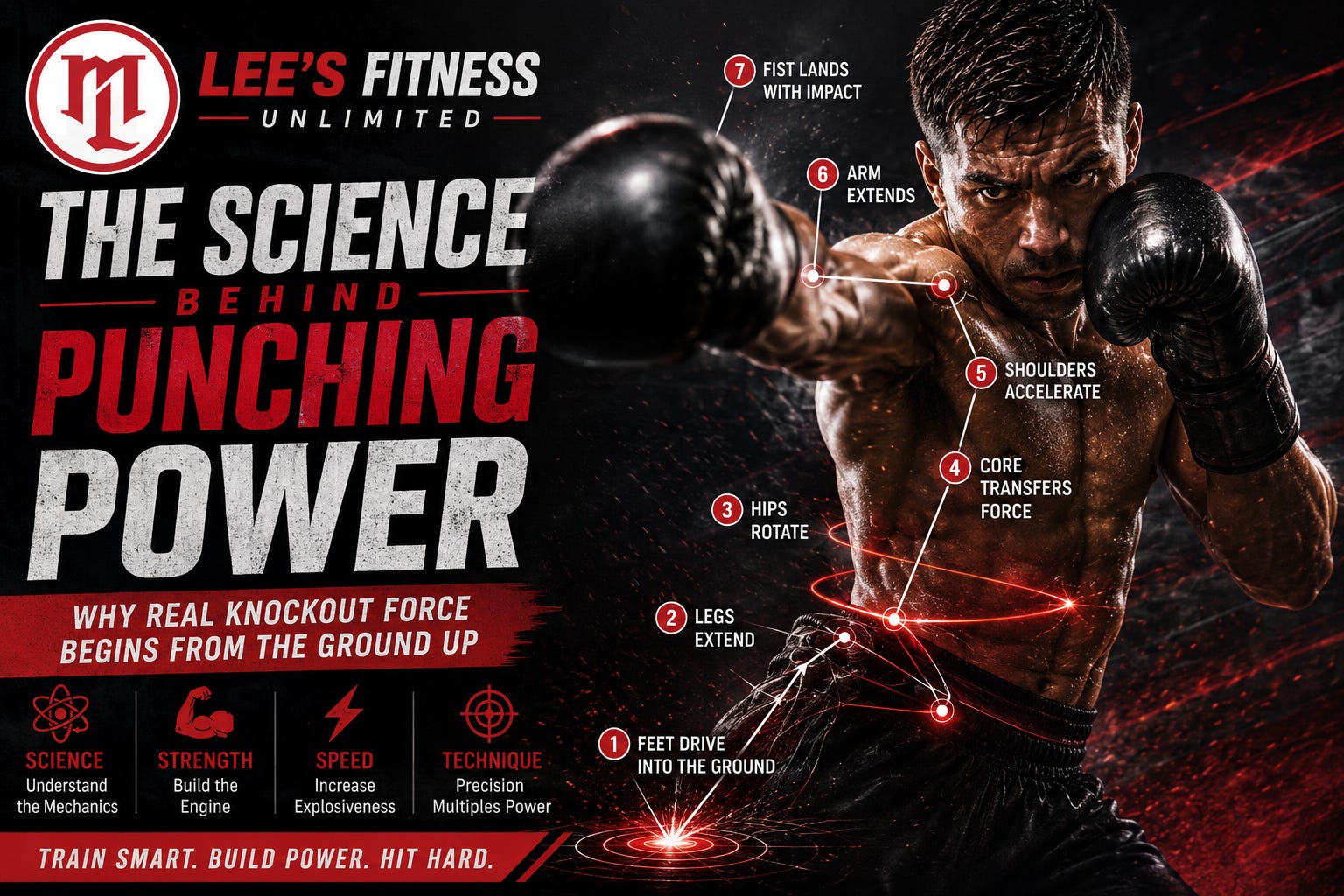
Punching is a full-body movement that relies on the kinetic chain.
Feet drive into the floor
Legs extend explosively
Hips rotate
Core transfers force
Shoulders accelerate
Arm extends
Fist lands on target
When every link fires in sequence, the punch feels effortless yet devastating.
If one link is weak or mistimed, energy leaks occur and the punch loses effectiveness.
This principle applies across all sports, from throwing a football to sprinting out of the blocks.
The hips are the primary engine of punching power.
The glutes and hip rotators generate tremendous torque, rotating the pelvis and trunk at high speed. This rotational force is transferred through the torso and into the upper body.
The best punchers do not “arm punch.” They drive from the ground and rotate through the hips.
This is why exercises like Back squat, Deadlift, and Rotational medicine ball throw are so effective for developing punch force.
In boxing, punches are thrown in milliseconds.
Athletes rarely have time to reach maximum strength during a punch. Instead, they rely on Rate of Force Development (RFD), which measures how quickly force can be produced.
Boxers with superior RFD can generate high levels of force almost instantly.
This is one reason explosive exercises are so valuable:
Plyometric push-up
Jump squat
Landmine punch
Sprint training
The faster force is produced, the harder the punch lands.
Punching power depends heavily on Type II fast-twitch muscle fibers.
These fibers contract rapidly and generate high levels of force. They are responsible for explosive movements such as sprinting, jumping, tackling, and punching.
While genetics influence muscle fiber distribution, training can greatly improve the nervous system’s ability to recruit these fibers efficiently.
This means punching power can be developed with consistent, focused training.
One of the biggest secrets to punching power is relaxation.
Many beginners tense up and try to muscle every punch. This actually slows movement and reduces speed.
Elite boxers stay relaxed during acceleration and tighten only at the instant of impact.
This sequence allows the fist to travel faster and strike with greater force.
In boxing, timing often matters more than brute strength.
A perfectly placed punch can be more effective than a wild, powerful swing.
Shots to the chin, liver, and solar plexus can end fights even when thrown by smaller athletes.
This is why boxing is known as The Sweet Science.
Precision, timing, and technique allow athletes to maximize the effectiveness of every punch.
A complete punching power program should include:
Back squat
Deadlift
Bench press
Rotational medicine ball throw
Plyometric push-up
Sprint work
Heavy bag training
Focus mitt work
Shadowboxing
Sleep
Nutrition
Mobility
Strategic rest
Punching power is not an inborn gift reserved for a select few.
It is the result of strength, speed, biomechanics, coordination, and technical mastery working together as one seamless movement.
The most powerful punchers are not simply muscular athletes. They are highly skilled practitioners who have trained their bodies to generate force from the ground, transfer it efficiently through the kinetic chain, and deliver it with perfect timing.
Master the mechanics.
Build the engine.
Refine the technique.
Then let your hands go.
That’s the work for today. Train smart, stay disciplined, and keep building power from the ground up.
Coach Lee
Founder, Lee’s Fitness Unlimited
Lee’s Fitness Unlimited
No posts
Comments
Nothing yet. Say the first thing.
Sign in to join the conversation.