

A running back finds the crease. A corner has to close on a receiver. A linebacker reads the play late and has to make up ground. In that moment, the athlete who understands how to run — not just how fast they run — wins.
Speed is not one thing. It’s a sequence of four distinct phases, and most athletes only train one of them. Elite athletes train all four. More importantly, elite athletes understand what each phase demands and why breaking down under pressure in any one of them costs reps, yards, and games.
This breakdown is for athletes, parents of athletes, and coaches who want to stop guessing and start developing speed with a purpose.
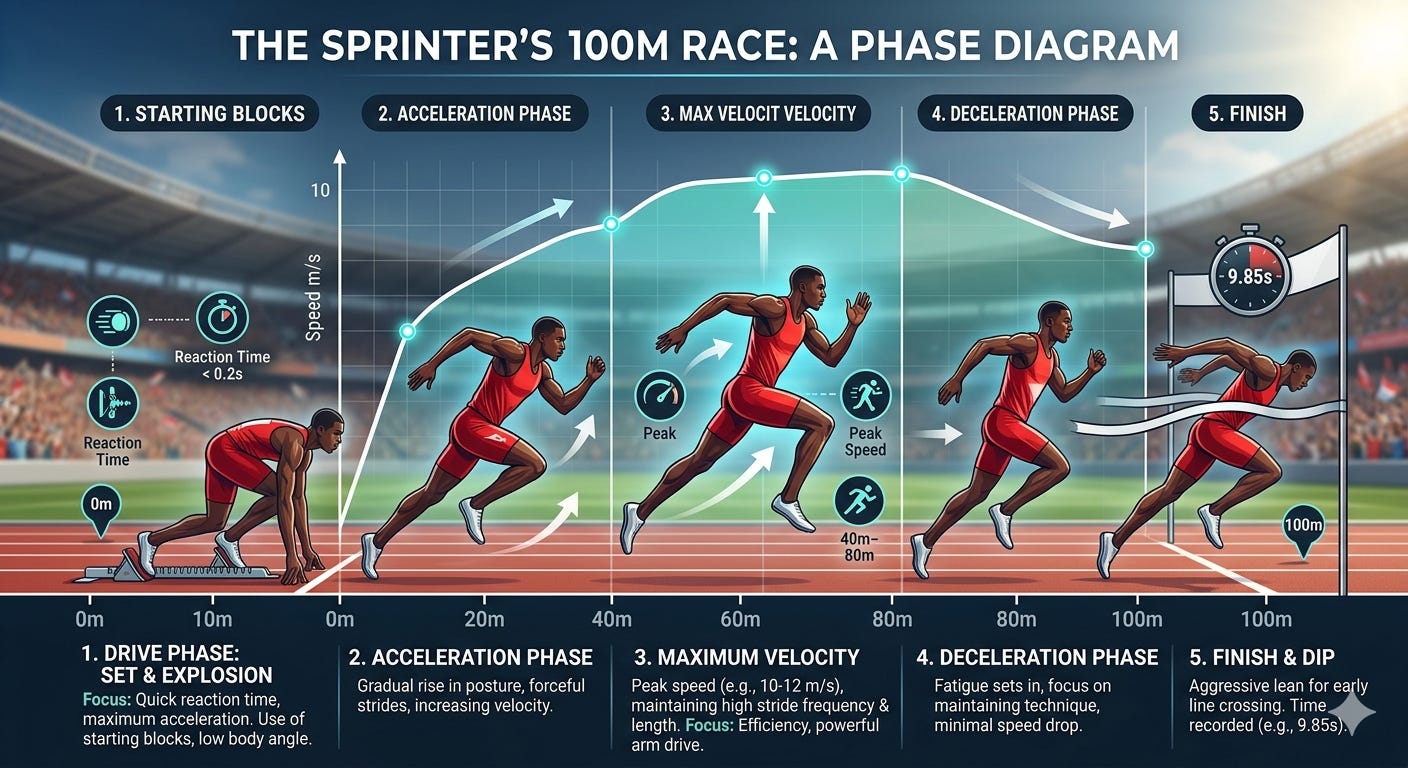
Everything begins here, and most athletes get it wrong before they’ve taken three steps.
At the start, your goal is not to run upright. Your goal is to drive into the ground at an angle. Think 45 degrees. The first step should be powerful and low — pushing back and down, not forward and up. Athletes who pop upright too early lose all the force they just generated. They’re essentially slamming the brakes while trying to accelerate.
Key mechanics:
Forward lean from the ankles, not the waist
Drive phase — knees pumping forward and down
Arms working aggressively in opposition to legs
Short, powerful ground contacts
Football translation:
This is your RB reading a gap and hitting it. This is your DB breaking on a route before the receiver makes their cut. First-step quickness is Phase 1 in real time. A back with poor start mechanics telegraphs hesitation. A DB who rises too soon gets beat off the line every time. The start isn’t just a track concept — it’s the difference between creating separation and giving it up.
Once the athlete has created their initial drive, the body needs to rise — gradually. This is the most misunderstood phase because athletes either rush the transition (standing up too fast) or never transition at all (staying too low too long).
Proper acceleration is a gradual, progressive rise. By the 20-meter mark, the torso should be approaching near-upright, stride length is increasing, and ground contact is becoming more powerful but also more efficient.
Key mechanics:
Progressive posture — not a sudden pop
Stride length increasing with each step
Powerful hip extension through the push-off
Arms still driving hard to support leg turnover
Application to game speed:
Most football plays live in this zone. A wide receiver running a 15-yard dig route. A linebacker in pursuit. A safety crossing the field. The athletes who accelerate with proper mechanics reach top speed earlier — meaning they have more controlled, efficient speed when they arrive at the ball. Athletes who rush the transition arrive at the play tighter, more tense, and often slower than their potential.
This is the phase that looks the most natural but requires the most deliberate training. At max velocity, the athlete should be tall, relaxed, and efficient. Tension is the enemy here. Clenched fists, tight shoulders, and a rigid face all signal wasted energy — energy that should be going into the ground.
Key mechanics:
Upright posture — head neutral, hips tall
High knee drive with active foot strike (not reaching forward)
Quick, elastic ground contacts — not stomping
Relaxed upper body, especially the jaw, shoulders, and hands
Stride frequency and stride length working together
Why speed maintenance matters:
Football is not a pure sprint sport, but the athletes who maintain their top speed the longest — especially late in games, late in drives — are the ones who separate. A receiver who relaxes into their top-end speed on a post route is harder to catch. A corner who can hold their max velocity through a 40-yard chase prevents the big play. Training this phase is also about mental composure under pressure. Relaxation at max speed is a trained skill, not a personality trait.
Nobody talks about this phase. It gets skipped in training plans, ignored in speed work, and overlooked until an athlete pulls a hamstring in week three of the season.
Deceleration is the body’s ability to manage fatigue and absorb force after max effort. When mechanics break down here — and they will break down when athletes are untrained — the hamstrings are vulnerable, the knees take excessive load, and the hips lose their position. This is a mechanics problem as much as it is a conditioning problem.
Key mechanics:
Controlled reduction of stride length
Maintaining hip height — don’t collapse
Bracing through the core to protect the lower back and hamstrings
Eyes up, posture maintained
Injury prevention + conditioning tie-in:
Training deceleration is not separate from conditioning — it IS conditioning. Your athletes need to be able to sprint, slow down, reset, and sprint again. That’s football. That’s sport. If the deceleration phase is sloppy and uncontrolled, repetitive stress accumulates fast. Incorporate flying 10s, controlled sprint-to-stop drills, and tempo runs specifically designed to train the mechanical demands of slowing down safely.
You don’t need a track and you don’t need fancy equipment. You need a plan.
Phase 1 — Start:
Resisted sled pushes (5–10m)
Wall drives — 3 sets of 10 reps each leg
Block starts or two-point stance acceleration starts
Focus: low angle, first step power
Comments
Nothing yet. Say the first thing.
Sign in to join the conversation.