

A much needed tonic for heart burn.
More HERE.
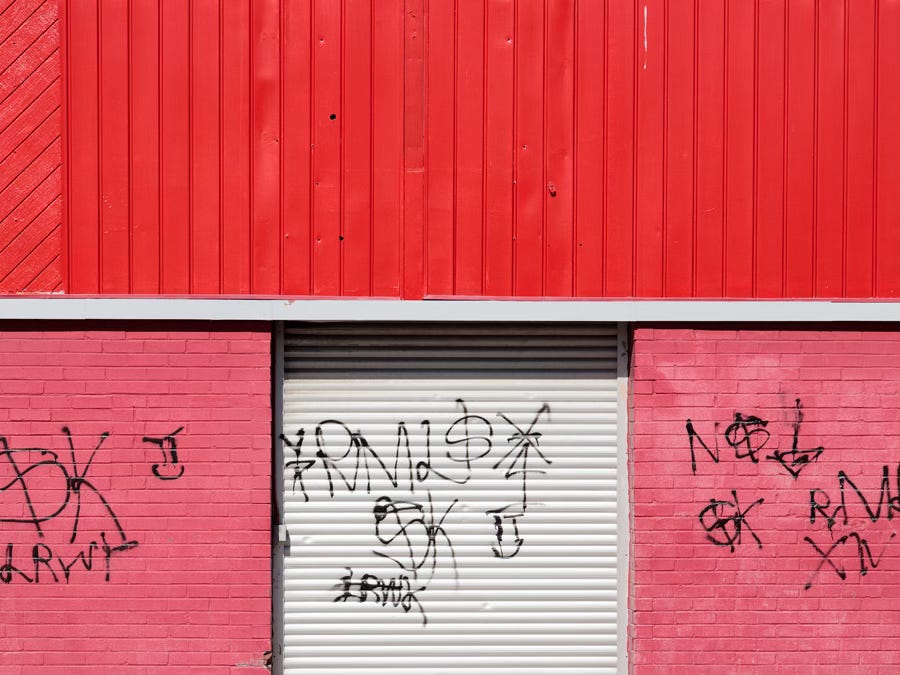
You might have seen this one already, I’ve cropped it a little closer and removed a couple distracting spots of glare. Much improved I think.
More Incidental HERE.
A warning: this one is deeply, desperately wonkish. No kidding.
Not so much an exhaustive camera review as it is my own 1st impressions of an entirely new-to-me camera format.
Some background: Doing proper architectural photography requires tilt-and-shift lenses. Not a lot of choices available, but for me that means Canon’s TSE 24 and 17mm. Tilt-and-shift lenses require full-frame cameras. Professional work requires a back-up camera with the same sensor size as the primary, so two full-frame bodies. An APS-C body is basically useless to me as a back-up.
Full-frame cameras are not small. Nothing wrong with that, but more and more I’m liking ‘street’ photography, and a full-size professional looking camera held to the eye ‘paparazzi style’ just causes people to duck and hide, or glare at me. And I’m wanting be able to carry an actual camera with me (as opposed to a phone-camera) while riding a bike. A 4lb. camera is just too much to drag up a mountain road when getting my own self to the top is challenge enough. And of course, a smaller camera would be ideal for travel.
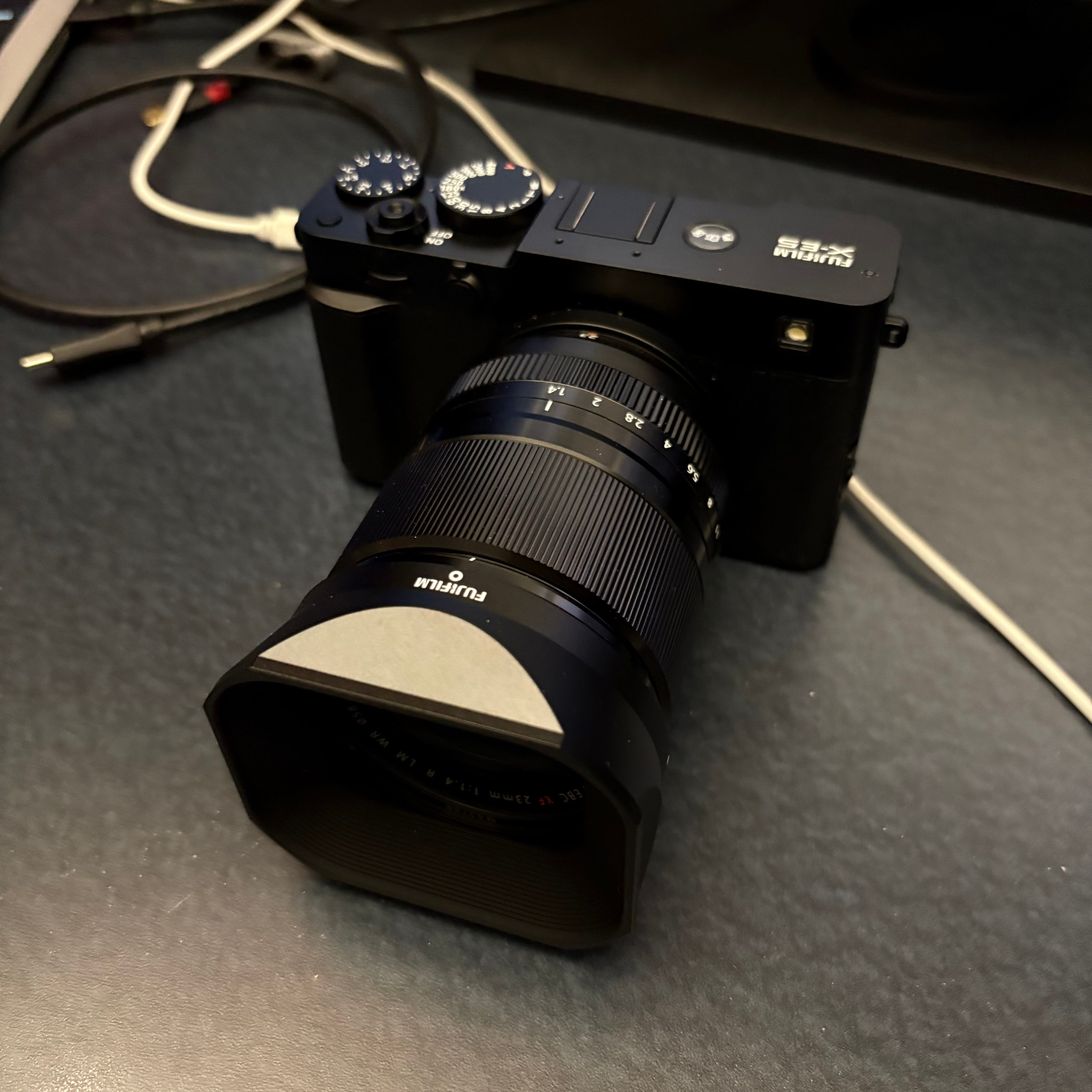
So a new, purpose-built compact camera has become increasingly attractive. After researching obsessively for a lot of weeks I finally pulled the trigger on a Fujifilm X-E5. I’ll spare you the list of contenders.
First the positive: This is a gorgeous little thing and is built solid as a fire hydrant. It looks and feels of super high quality. I’ve done only a very few photos with it so far, and have run those few through a couple different editing processes. I have no doubt that E5 can make rich, razor sharp, brilliant images.
While I love the camera and have no regrets about buying it, there are many annoyances. This rant might be helpful to a prospective shopper, but it’s more specifically intended for the engineers who design ’em.
I wanted a small camera because I wanted one I could carry with me everywhere: not because I have teeny little fingers. I don’t: I have full-sized adult fingers. I wanted compact, not miniaturized! I lodge this gripe at the on-off switch and the lever-button on the front in particular. I can barely feel these braille-bump sized protrusions under my fat, arthritic American fingers, and I can barely feel them ‘click’. A proper switch doesn’t have to be huge, just adequate.
A minor complaint — and I know these tiny shoulder-strap eyelets are everywhere on multiple cameras made by multiple manufacturers — but it’s ridiculous having to add metal rings and body-scratch protecters where a simple loop would suffice.
And here I take a deep breath. I never thought the menu logic employed by Canon was especially great, but boy do I have a new appreciation.
There are at least three different ways to screw up what your rear command dial does: FUNCTION (Fn) SETTING, COMMAND DIAL SETTING, and the top shutter speed dial are the ones I’ve found. The latter needs to be set on T. All I want is for the rear command dial to change shutter speeds. OH AND there is at least one hidden way to LOCK the dial altogether. Never mind that some other seemingly unrelated settings seem to override what you think you’ve set and don’t tell you how or why. For a while I was fooling around, and changing shutter speeds sometimes caused the aperture setting to change itself! even though the lens was set — meaning rotated manually — to f/1.4!
I’m certainly not saying it’s impossible to make this work, and I know many people do (or give up trying) but why does it have to be so friggin’ obtuse and unintuitive? It makes me think now that those lovely dials on top the camera are there strictly for nostalgia and fond memories of simpler times. And marketing. Lord knows I fell for it. But if we’re going to honest with ourselves, the shutter speed dial and the exposure compensating dials are not wonderful. Each require two fingers to operate, and they both include settings — A, P, B and T on one, and C on the other along with numbers— that all but require you to pull the camera away from your eye to adjust.
And I am increasingly of the mind that film-style settings don’t deserve their own dial. Maybe it should have been an ISO dial instead. Though it’s infuriating the way ISOA1, 2 and 3 and all the H and L settings can’t be avoided or removed for normal manual usage; only when you’re choosing an auto range. How tough would it be to offer the option to limit the ISO range assigned to say, the rear command dial? When I scroll down, I want the damed thing to bottom out at the bottom! meaning ISO 125, not ISOA1 or 2 or 3!
Enough venting, you get the drift. In the end I really do think I’ll love using the thing, once I get through the learning curve and gain some familiarity. Immediately I’m seeing wonderful rendering of colors and light. And my worries about peering through a tiny EVF hole were mostly unfounded. The tilt-down screen really is a joy to use.
Last few issues are more requests than complaints: Let me assign ‘Return Focus to Center’ to a button. Add choices to the front command dial function list, specifically ISO and None. Make it clear what the push-click command dial functions are, and how or where to change or stop them.
Thank you. Thank you very much.
Update: I sent it back.
I tried for a week to get two different custom settings saved in the camera: one would assign ISO adjustment to the back dial, one would assign no functions at all, because it was just so easy to accidentally hit that little wheel and unintentionally throw it into some weird mode I’d have to stop and figure out and then correct before I could carry on with taking photos for Chrissakes. After spending way too much time standing on a sidewalk hurling obscenities at poor little E5, I went home and surfed the internet; consulted the menu-customizing-geniuses resident in the blog-o-sphere. No luck. I even went so far as to write Fuji Support who — once he understood what I was trying to do — admitted, “No, you can’t do that.” And this, after I’d already accepted not being able to limit the range of ISO values! Outside of the auto ISO’s, that is…
Too much to bear.
The whole point of this adventure — this new camera — was to have one that would meld as one with my eye, disappearing from notice and distraction between me and the outer world; come with me everywhere and become a life-long companion. Sigh.
So ends the Fujifilm experiment. I wanted it to work.
Up next: Sony’s A7Cii! Stay tuned...
Comments
Nothing yet. Say the first thing.
Sign in to join the conversation.