
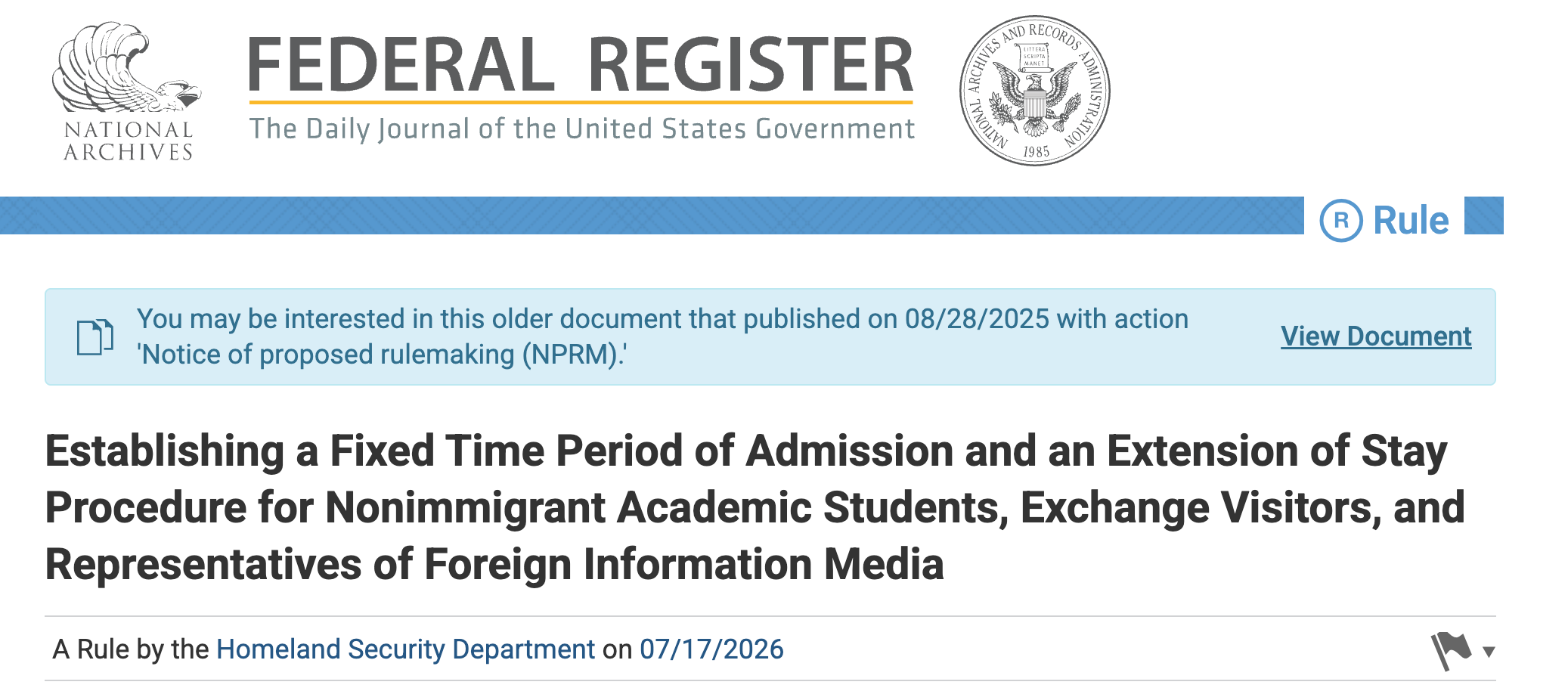
The Trump administration has issued (16 July 2026) revised guidelines governing the duration of visas issued to students for study in the United States. The guidelines apply to visas of type F (non-immigrant students) and J (approved work-and-study exchange visitors).
The new rule goes into effect on 15 September 2026. Students and journalists issued visas under the previous “duration of status” rule will be automatically transitioned to the new rule on that date.
Under the new Final Rule, students will be admitted only for the duration of their planned programme of study, up to a maximum of four years. Should completion of the programme require additional time, an Extension of Stay (EOS) application must be submitted through the U.S. Citizenship and Immigration Services (USCIS); this would previously have been handled by the host institution. Students will also be required to undergo “biometric vetting, background checks, and fraud screenings.”
Students completing a course of studies will also be granted a 30-day grace period for departure from the country, whereas previously 60 days was granted.
DHS Secretary Markwayne Mullin clarified the rationale of the DHS in implementing these changes as follows:
For nearly half a century, the outdated ‘duration of status’ system has compromised national security and created an environment ripe for immigration fraud,” said . “For decades, foreign students have been admitted into the U.S. indefinitely, allowing thousands to abuse our immigration system by perpetually enrolling in courses to avoid having to leave the U.S. By implementing clear, finite limits on these visas, the United States is reclaiming its ability to properly screen, vet, and monitor individuals within our borders. This final rule ensures that foreign students remain focused on their primary purpose: completing their studies and returning home.
In addition, new restrictions apply to foreign journalists (and their dependents) issued visas in the “I” category as well, limiting initial stays to 240 days, or 90 days for Chinese nationals (but not Hong Kong SAR or Macau SAR passport holders). The comment text of the Final Rule suggests that journalists requiring longer stays with management responsibilities consider applying for the L-1 visa.
For noting: the Secretary’s comments about abuse do not apply to journalists.
If you enjoyed this post or found it useful in some way, please feel free to …

Comments
Nothing yet. Say the first thing.
Sign in to join the conversation.