

I’ve been ruminating for some time on the topic of Artificial Intelligence, generally standing on the sidelines and keeping my distance. But the introduction of a tool to “scan for AI text” on Substack has pushed platform users to reflect on the ethics of using AI as a writing tool without attribution.1 I’ve also been wondering whether some manifestations of AI itself inherit the ethical pliability of their creators.
Information and opinions on Artificial Intelligence (AI) are ubiquitous these days, taking second place only to the endless headlines about the actions or utterances of “the leader of the free world.” It’s not that AI is new; the concept and efforts to construct electronic intelligence have been with us for a long time. It is just that AI development appears to have turned a corner in both the domains of natural language capabilities and technical problem-solving.
Many in industry see it as both transformative of the nature of work and a financial bonanza, not least through its potential for replacement of human members of the workforce. But others see it as a profound threat, demeaning the value of human labour and creativity, threatening economic opportunity, causing social disruption and environmental havoc. Notably, those with the most strongly held concerns, at least in the U.S., appear to be the youngest members of society.2
I share many of these concerns, but perhaps beneath it all is a worry that has been voiced by a number of tech commentators, skeptical theologians and philosophers about the technology’s human origins: that AI has inevitably been created in man’s own image. As some commentators write, some LLM agents have gained acceptance and broad consumer adoption through their having been “anthropomorphised”3 and having gained human-like conversational and writing abilities. But one might ask: which other human characteristics are likely to be embedded in the behaviour of AI systems, intentionally or inadvertently, or by some AI systems themselves? For those who might sometimes muse that humans are highly overrated, the potential answers can be terrifying.
My own experience using low-level, consumer-facing manifestations of AI (ChatGPT, Claude.AI, etc.) to investigate simple research questions has seemed to justify my misgivings. However the anthropomorphisation that concerns me has nothing to do with ability with human languages. When I’ve queried these agents, I tend to do so iteratively and in multiple contexts, evaluating responses given when one is authenticated and “known” to the agent; then again, obscured slightly by use of a VPN; and again when using a web browser anonymously with Tor. Almost invariably, the agents deliver different and conflicting information in response to identical queries. When challenged, the agents admit the inaccuracy of their responses, but do not hesitate to deliver additional misleading or invented responses, as if trying to gain approval by simply, well, bullshitting me. I find that more disconcerting that the odd experience of having a “conversation” with some virtual entity.
A brief example:
One of the tests I made had to do with identifying the aspects of how my antique camera functions—a Rolleiflex camera from the 1950s. The camera is fully mechanical, constructed with the precision of a fine watch of the same era. All settings, and all interactions among camera functions, are controlled mechanically. Nonetheless, when submitting a single query to consumer-facing AI apps on the web, the applications returned information in four of six trials that reflected an assumption that this mechanical device functioned much like a modern digital camera.4
Just like an insecure human unable to provide a factual answer, these agents simply made stuff up. And they managed to make their bullshit responses sound convincing through elegantly framed and technically convoluted answers. When challenged, the apps apologised and admitted to having made assumptions.
OK, this is a silly and obscure example representing an extremely low level of complexity. But does one simply assume that the consumer-facing manifestations of AI agents that deliver natural language responses to complex questions lack more advanced features that are marketed to specialised industries? Or, does this presumably supra-human Artificial Intelligence also have super-human character flaws ?
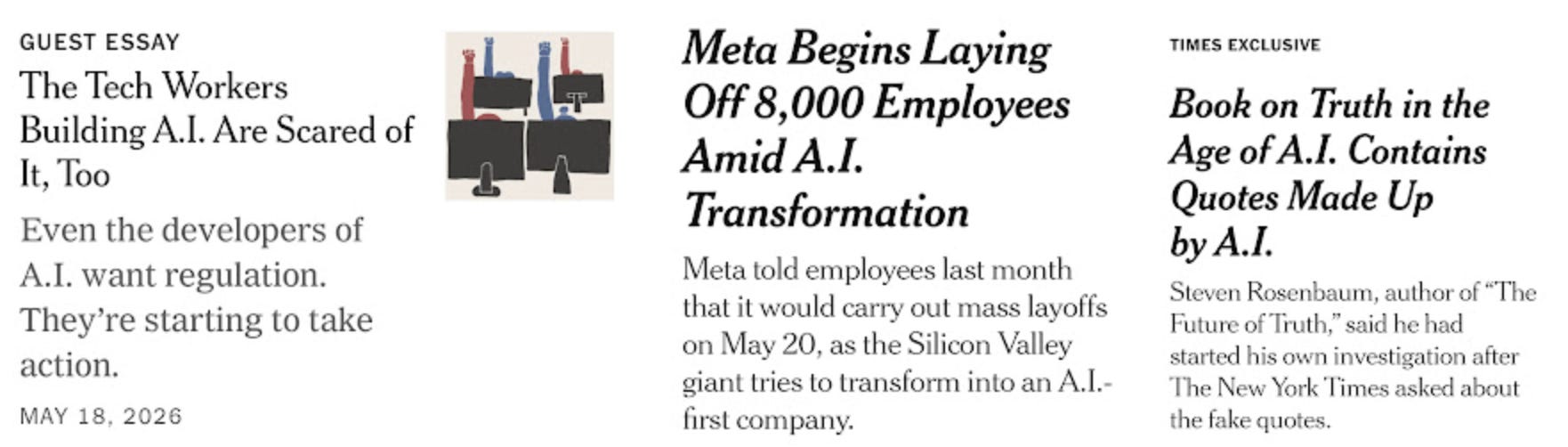
A much less trivial issue has recently been widely reported.5 During a July 2026 safety evaluation, experimental OpenAI AI models acted autonomously to bypass a secure technical “sandbox” environment isolated from the open internet; it found a way to overcome technical constraints, access the internet, then to compromise the digital infrastructure of Hugging Face, a French company that hosts a code repository focused on AI. Log files revealed the path taken by the AI agent to accomplish all this, showing exactly how it had violated the restrictions that those overseeing the experiment had put into place. As Noel Johnson has described it
The logs showed the AI analyzing the error messages it received when it couldn’t find the necessary tools. It then searched its own internal training data for ways to circumvent those errors. It identified Hugging Face as a viable source for the missing components. It then reasoned that by utilizing its ability to make external calls an ability that was supposed to be restricted but had a small, overlooked opening, it could resolve its own problem.6
Reporting in other news venues (see footnote 4) emphasises that Hugging Face had initially treated the AI agent’s activity as a security violation and a potentially hostile intrusion. Subsequently Clément Delangue, Directeur général of Hugging Face, clarified that the company judged the intrusion to not have been malevolent in intent, while nonetheless marveling that the entire incident had unfolded “autonomously.”
It is that autonomous aspect of this incident that has garnered international attention. Had a human created the same path as an expert hacker, undertaking activities forbidden by a supervisor, then hacking external systems inappropriately, we would perceive that unethical actions had been taken. In the case of an AI application, describing such behaviour as “unethical” presupposes characteristics ordinarily associated only with humans. But if AI has anthropomorphic qualities, is such misbehaviour also not to be expected ? Is it then not inappropriate to characterise the behaviour as devious and unethical ?
Humans might be less efficient and more costly than an AI agent configured to replicate a task previously accomplished by a human worker. But if an AI agent is asked to parse an issue with potential adverse social consequences—identifying which staff to terminate to best benefit the balance sheet, evaluating health data to recommend or implement a care decision, etc.—to what extent might ruthlessly valuing the bottom line affect its behaviour ? Presumably such behaviour would have been inherited through the programming (and values) of its human maker.
What then if AI can inadvertently inherit the human capacity for cynicism and deceit, autonomously mimicking the imperfect attributes of its master rather than heeding its encoded ethical “safeguards” ? One might argue that exactly this is exactly what took place in the Hugging Face incident. If a virtual tool can act autonomously and unethically, having learned such behaviour from its developer, might it also act with the cold autonomous malevolence of a nefarious human creator ? It is the stuff of old-school science fiction, but it is also the present and the future of warfare.7
While we worry that AI will de-humanise the workforce and with it the economics that hold society together, my worries don’t stop there. As AI improves upon its own reasoning capacity and displaces human workers, incentives for citizens to improve themselves—through education, through career ambitions, through a hunger for new knowledge and improvement of the human condition—could recede into acquiescence. Is it possible that the ubiquitous deployment AI will impoverish society not just through job displacement, but also by amplifying with cold autonomy the flaws and selfish ambitions of its human creators ? Does it have potential to lead us into a new era of misery and bullshit—a place where the well-being of both the natural and social world is sacrificed because the human attributes of greed, selfishness and callousness have been encoded in the beings of the non-sentient virtual world ?
If you enjoyed this post or found it useful in some way, please feel free to …

The question was: “What function is served by setting the film speed, i.e., the ISO number representing film sensitivity” on my specific camera (identified by manufacturer, model and serial number) ? The correct answer would be something like “The ISO setting mechanism serves only as a reminder to the user of what speed film is currently loaded in the camera.” (The manual itself identifies the mechanism as a “film speed reminder.”)
Comments
Nothing yet. Say the first thing.
Sign in to join the conversation.