
In this Latin lesson, we learn the names of the four cardinal virtues (quattuor virtūtēs cardinālēs), accompanied by a poster illustrating the traditional symbols associated with each of them.
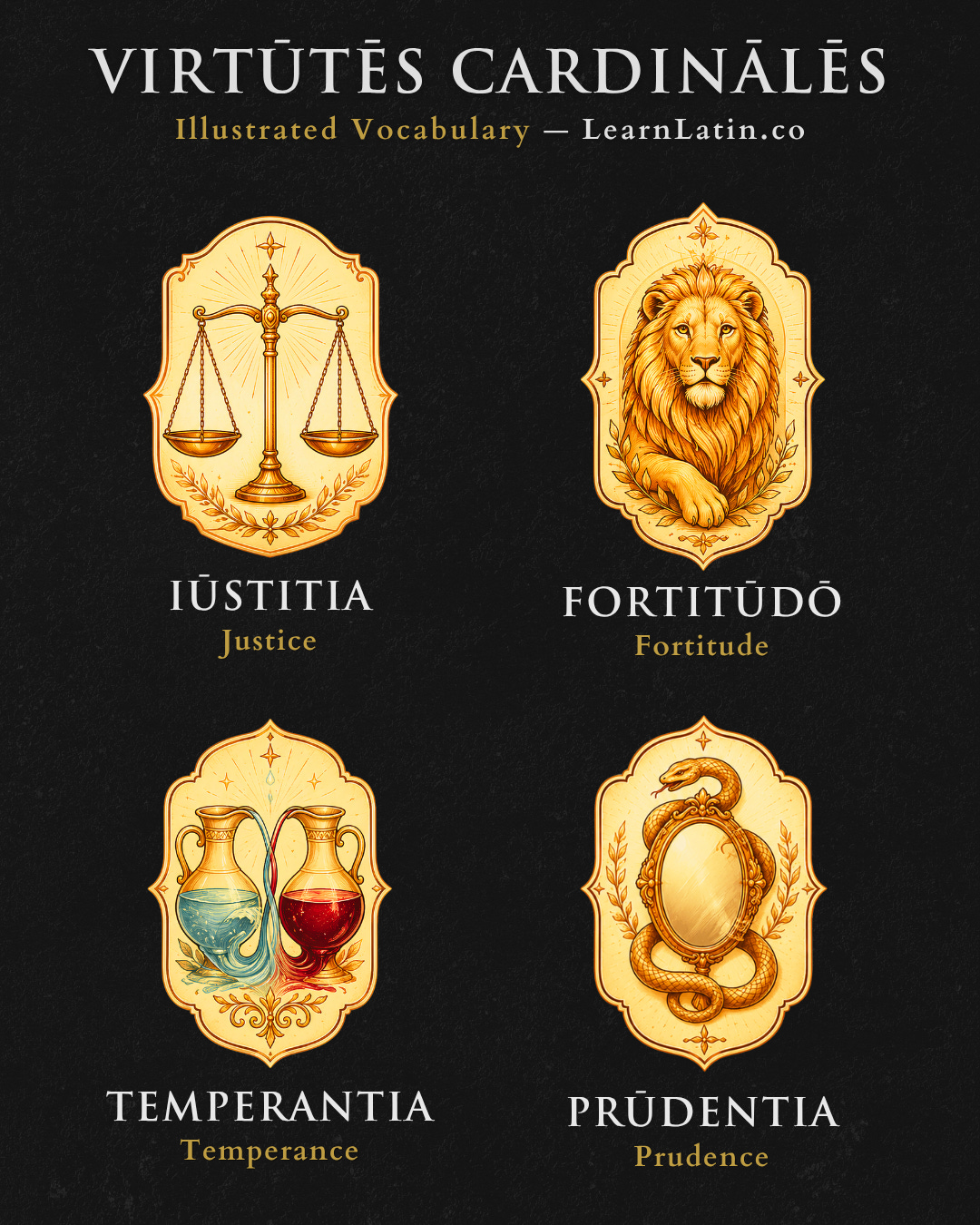
Iūstitia — Justice, traditionally represented by a sword or scales. It is the virtue of giving each person what is due.
Fortitūdō — Fortitude, often symbolized by a lion, armor, or a club. It is the courage to endure hardship and persevere in the pursuit of what is right.
Temperantia — Temperance, commonly represented by two jugs mixing water and wine. It is the virtue of moderation and self-control.
Prūdentia — Prudence, traditionally symbolized by a book, scroll, mirror, or serpent. It is the practical wisdom to judge rightly and choose the best course of action.
These four virtues form one of the great moral foundations of Western civilization. They appear throughout its most influential philosophical, literary, and religious traditions.
The first systematic account is found in Plato, while Cicero confirms both their number and their Latin names in De Inventione:
“Virtue may be defined as a habit of mind in harmony with reason and the order of nature. It has four parts: prudence, justice, fortitude, and temperance.”
They also occupy a central place in Christian moral thought. St. Ambrose, commenting on the Gospel of Luke, recognizes them as part of the shared Greco-Roman moral inheritance:
“And we know that there are four cardinal virtues—temperance, justice, prudence, and fortitude.”
Even earlier, they appear in the Old Testament, in Wisdom 8:7:
“She [Sapientia] teaches temperance, and prudence, and justice, and fortitude, which are such things as men can have nothing more profitable in life.”
Learn Latin from Scratch This Summer
·
May 31

With the start of the Latin for Beginners — Summer Course 2026 now just one week away, this is a brief reminder for those who are still considering joining the new live cohort.
The cardinal virtues are equally prominent in medieval and Renaissance art, where they are frequently personified with their traditional attributes. One beautiful example is Cenni di Francesco’s fresco Virgin and Child Surrounded by the Allegories of the Cardinal Virtues (14th century), which vividly illustrates the deep connection between the classical virtues and the Christian tradition.

The four cardinal virtues represent a common moral language shared across the principal intellectual traditions of the West. Together, they express the four fundamental pillars of a virtuous life.
And now, you know them in Latin.
Comments
Nothing yet. Say the first thing.
Sign in to join the conversation.