

I had written an entirely different draft of this newsletter closer to the beginning of the month. Unfortunately, this month took a swift and tragic turn when our beloved pet pigeon, Cocoa Puff, died over Valentine’s Day weekend. There is a pigeon-shaped hole in my heart and I have been quite bereft for the past week.
You don’t realize the small things you’ll miss about a pet until they’re gone, but I especially miss her companionship in the morning, and I can’t help but feel like her passing on the one-year anniversary of our arrival here was something like a gesture of faith. Like she believed in us succeeding in this new place on our own.
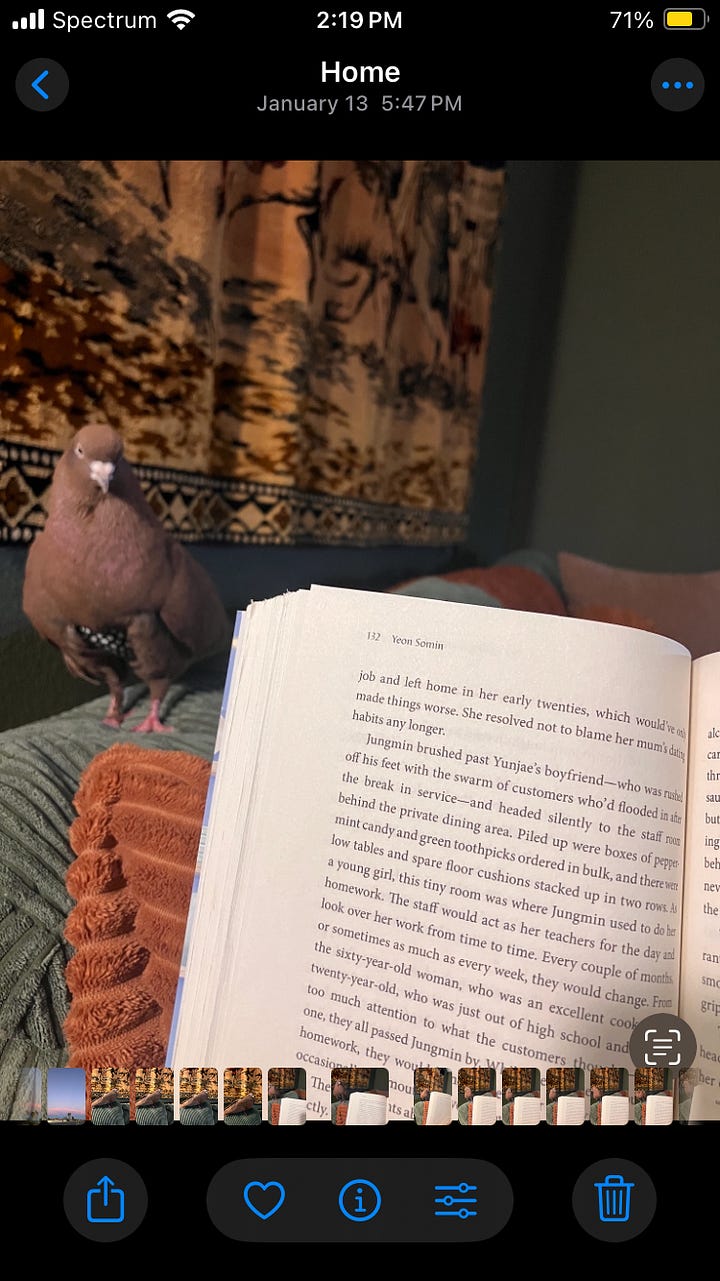
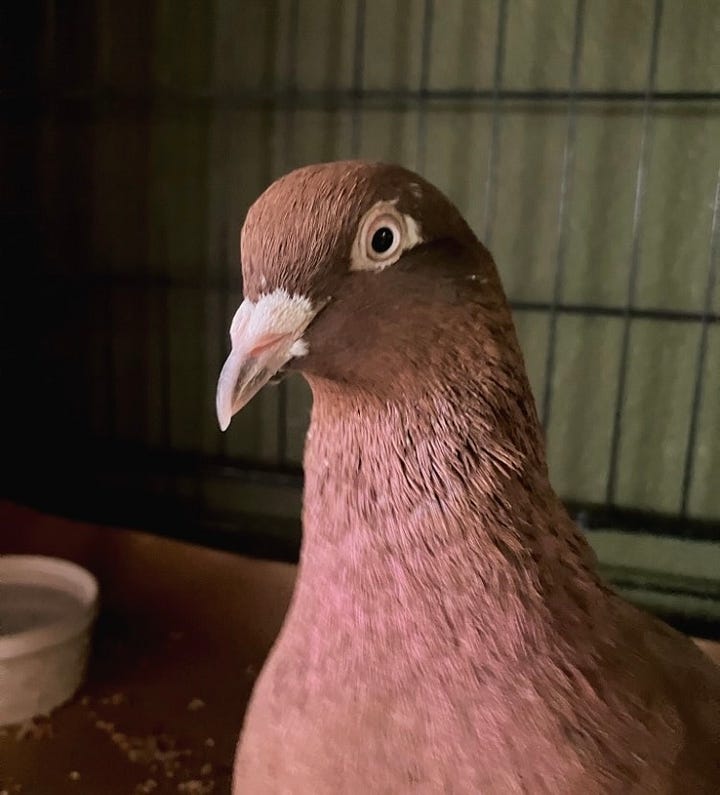
We moved to the desert last year on Valentine’s Day. For our dinner date, we stopped at a gas station in some town between Berkeley and Joshua Tree where we ate chicken tenders, fries, and fountain drinks sitting atop a cement parking barrier with a distant view of the mountains and a more proximal view of the cigarette butts at our feet. Remembering that day, I wanted to write something celebratory, or at least hopeful. Then, Ash Wednesday came and went, and I found myself thinking an awful lot about death instead.
I recently read Blowfish by Kyung-ran Jo, a Korean novel originally published in 2010 and only recently translated for the first time into English. I hadn’t read anything by the author before, but I recognized the translator, Chi-Young Kim, as the one who also translated Please Look After Mom. Both of these novels share some similarities in that they deal with intense familial trauma and have formatting I would imagine is quite challenging to translate. Please Look After Mom is written in the second person, while Blowfish has brief chapters that alternate between the pov of two characters. I am always in awe of a good translator, and I really enjoyed both of these books, so I intend to seek out more of Kim’s work (Whale is currently in my cart).
Blowfish is a dual perspective novel with chapters from a female artist’s perspective and a male architect’s perspective. Although their lives only gently brush up against one another, first at a party, then again unexpectedly, they leave a lasting impression. Both the sculptor and the architect have experienced the trauma that comes with losing a family member to suicide, though their reactions to it differ. The sculptor wants to die and the architect wants to go back in time and save his brother, whose haunted eyes looked just like hers.
The novel has some postmodern tendencies to it, we are never told either character’s name and the vignette style chapters propel the reader into different moments while some important actions happen ‘off screen.’ I can see how this might annoy a 2026 reader, when many books nowadays over-describe each character’s reaction and every single step they take must also be cinematically present in the narrative. Personally, I liked the format, but I acknowledge it might not be for everyone.
This is actually my favorite type of novel because it feels languid, the descriptions of art and architecture are forefront, the plot is secondary. I am more than happy to get lost in the ponderous prose of an artistic mind and walk alongside the characters as they navigate Tokyo and Seoul.
“Some things were difficult to classify. Like abstraction and materiality, regularity and irregularity. The gradually lightening early morning sky. Now a crimson glow ribboned up between buildings, as if pulled from deep underground. Dark pink and light blue bled over dawn, and above that, a blue tinged with yellow spread out like pigment in water. Standing at the entrance to the fish market, she watched and felt deeply the many layers of colors, colors stacked below a sky that was still mostly gray. It wouldn’t be possible to depict what she was seeing. What the colors connected to might not even be part of this world.”
The sculptor’s grandmother, who she never met, killed herself by drinking poisonous blowfish soup she prepared herself from the deadly fish her grandfather caught. She drank the soup in front of her family. Now, years later, the sculptor walks across the floor of Tokyo’s fish market to catch a glimpse of the fish that cursed her family. She wants to learn how to make the soup herself.
The architect, at loose ends after seeing his brother die, is trying to make a decision on what might propel his life forward — a life still steeped in death — his father unable to move beyond his window for these past years, his mother in something akin to denial. The architect feels frozen in place, under glass.
“Death should be something that comes to you once in a while, not something you drag around with you all day long — What made you want to make art? You have to get a grip on yourself — You can’t come back to life once you’re dead. Nobody else can keep you safe.”
Blowfish is a bleak but beautifully written (and translated) novel that moves at its own pace, taut and careful, while navigating the complex reality of two broken souls meeting. Ultimately, all the dualities presented by the author, and embodied within these characters, are teased out through the end of the novel. And, while the back synopsis might suggest a thriller, this is a literary slow burn.
While I am still somewhat on the subject of translation, I was thrilled to see the Booker International longlist come out this week! I have been a member of Peirene Press’s book club for a few years now, and I was so glad to see them get their flowers with She Who Remains. Olga Ravn, Marie NDiaye, and Ia Genberg are all authors who I’ve enjoyed previously, but haven’t read these new books. I also love this prize because it also honors books that are just now getting their English debut (one from this list was originally published in 1989, another in 1996). Even though now my TBR load out is looking slightly daunting, I do hope March is a lighter month, filled with good books.
No posts
Comments
Nothing yet. Say the first thing.
Sign in to join the conversation.