
Do you ever feel like you are not getting a fast enough return on the time, money, or energy investment you are putting into something?
I think we all do! Especially in this current market.
We put our all into what we do and believe so much in the transformation and results we can get for our clients that we want to see an immediate ROI.
And sometimes we get one! But sometimes we don't... Or don't we?
There is a term I came up with a few years back called the Wisteria effect that I think it is important to keep in mind during periods of doubt or frustration in your business.
Or during periods where it can feel like what works is a constantly moving target.
I know that many are realizing that they aren’t where they envisioned when kicking off this year. For some, things are still good but different, and for others, things are in a major period of WTF!.
To explain the wisteria effect, we need to rewind to 2006.
My then-fiancé and I were planning our backyard wedding for August and had just installed this gorgeous gazebo.
I took one look at it and thought how beautiful it would be with wisteria cascading down from it. While it wouldn’t be in season for the wedding, I planted it anyway so I could enjoy it the following Spring.
Spring 2007 came and... no wisteria blooms. I was disappointed but that’s okay - I figured it would bloom the next year.
Spring 2008 came and... no wisteria blooms. At this point, I started to doubt that it would ever bloom.
Spring 2009 came and... I honestly completely forgot about the wisteria and moved on.
Then Spring 2021 came and my now ex-husband and I were enjoying our first time in the pool that year.
It was a windy day and we were relaxing in the sunshine and watching the trees swaying in the breeze over the backyard. He pointed up and said - “what’s all that purple up at the top of the trees?”.
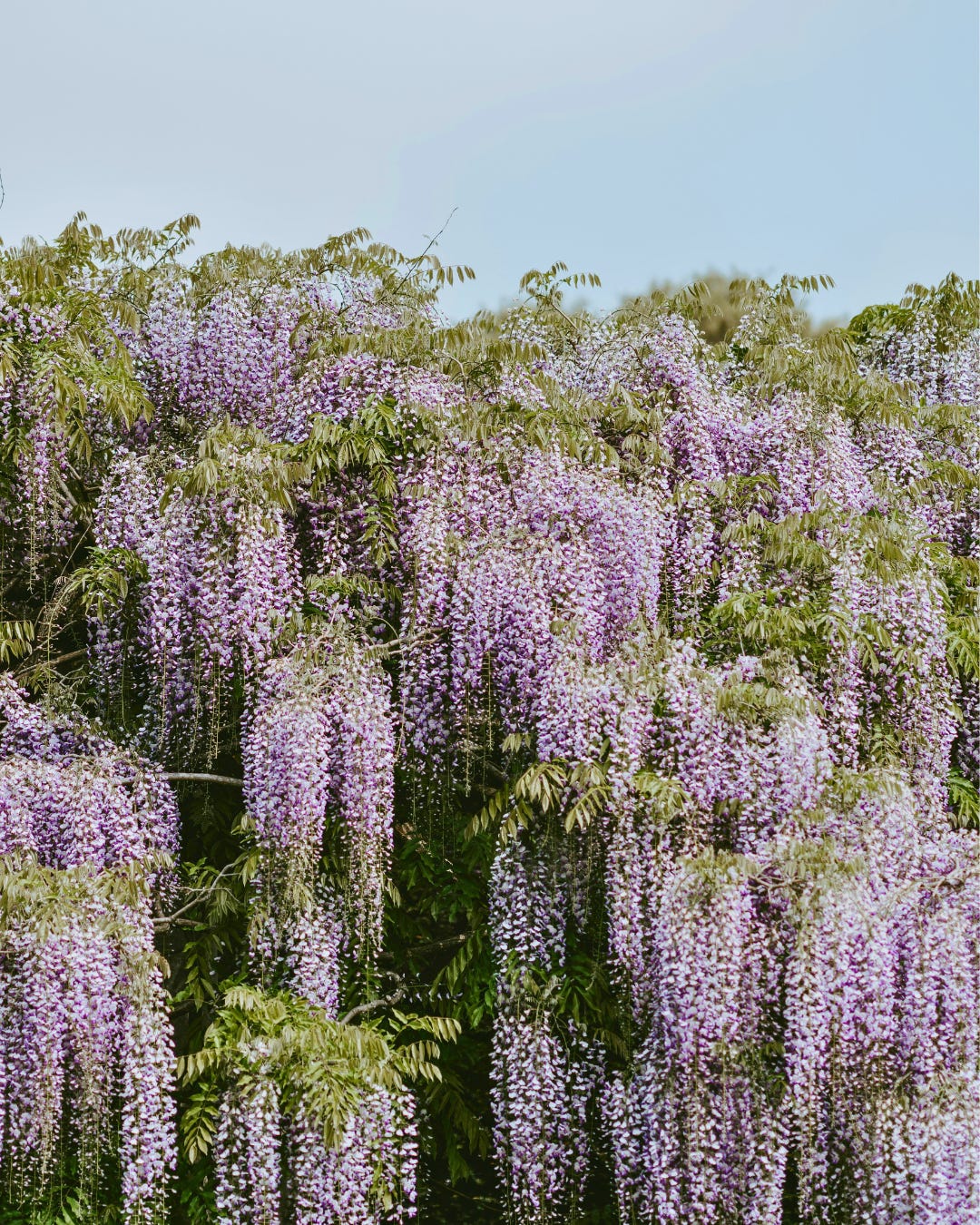
It was my wisteria that I planted 15 years earlier.
Eventually it climbed high enough to get the sunshine it needed to bloom.
And boy did it bloom. The entire top of the tree was covered in cascading purple wisteria blooms. It was beautiful!
Are you seeing the parallels with your business?
The Wisteria Effect is what happens when the work you put in continues to grow and compound beneath the surface, even when you cannot see it, until the conditions are right for it to bloom. It is the return on investment that does not show up on your timeline, but shows up anyway, often bigger and more impactful than you expected.
Sometimes things work quickly (and we love when they do!).
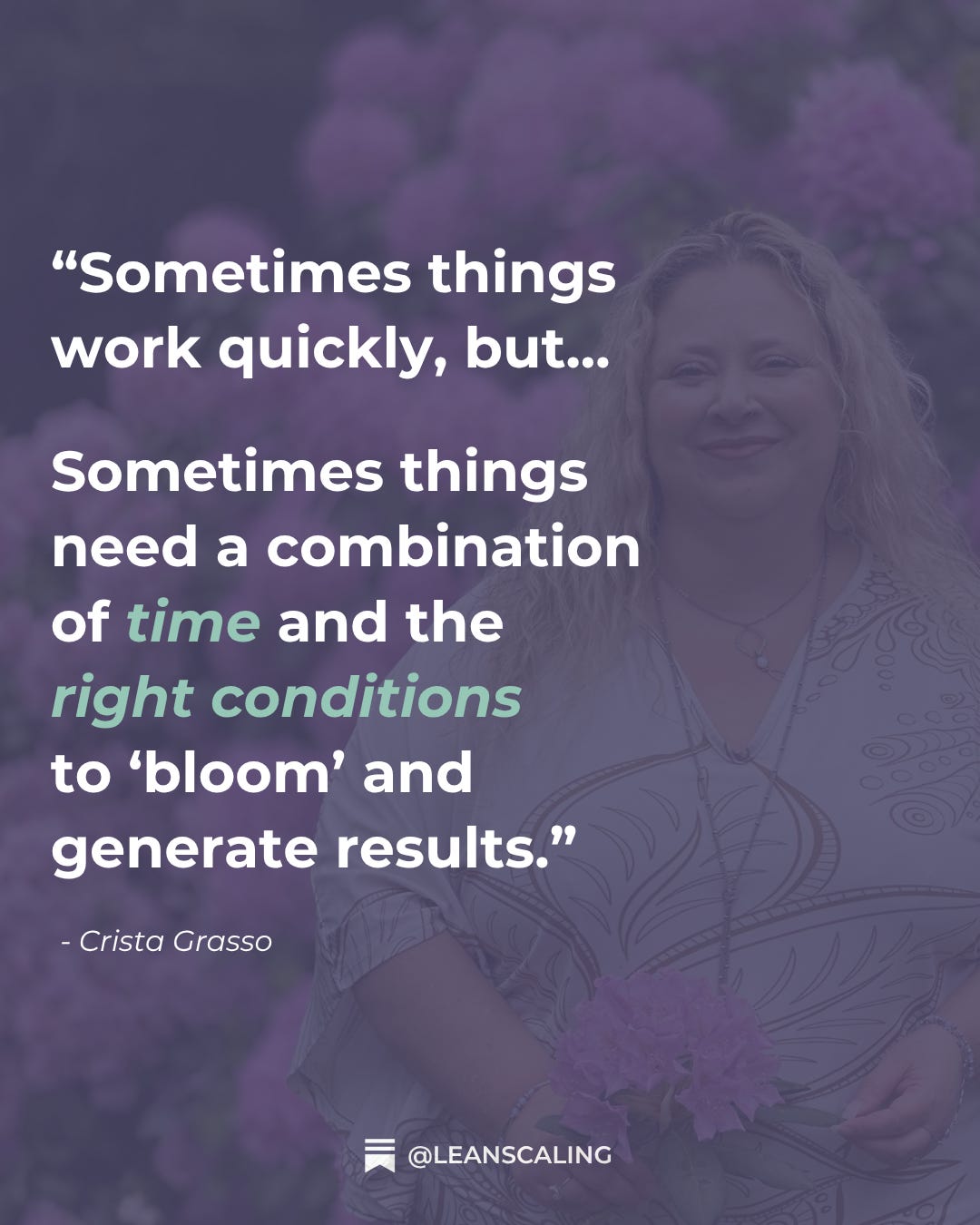
I have experienced this time and time again in my business.
My top source of organic traffic used to be blog posts I wrote years ago. Now it is podcast interviews I was on years ago that AI is leveraging to recommend me.
My most successful piece of content I ever produced? A YouTube video that went viral 2 years after I published it and now has over 1 million views.
The list goes on and on.
And in a market where things are changing quickly and still highly unpredictable, I am seeing this more and more.
Yes, we need to continuously make changes to find what works and keep it working, and yes, we need to embrace an experimentation mindset this year.
But we rarely need to throw something out completely or pivot so dramatically that what we are doing is no longer recognizable as what it once was.
What we need instead is consistency combined with ‘kaizen’ where we make small continuous improvements and changes for the better.
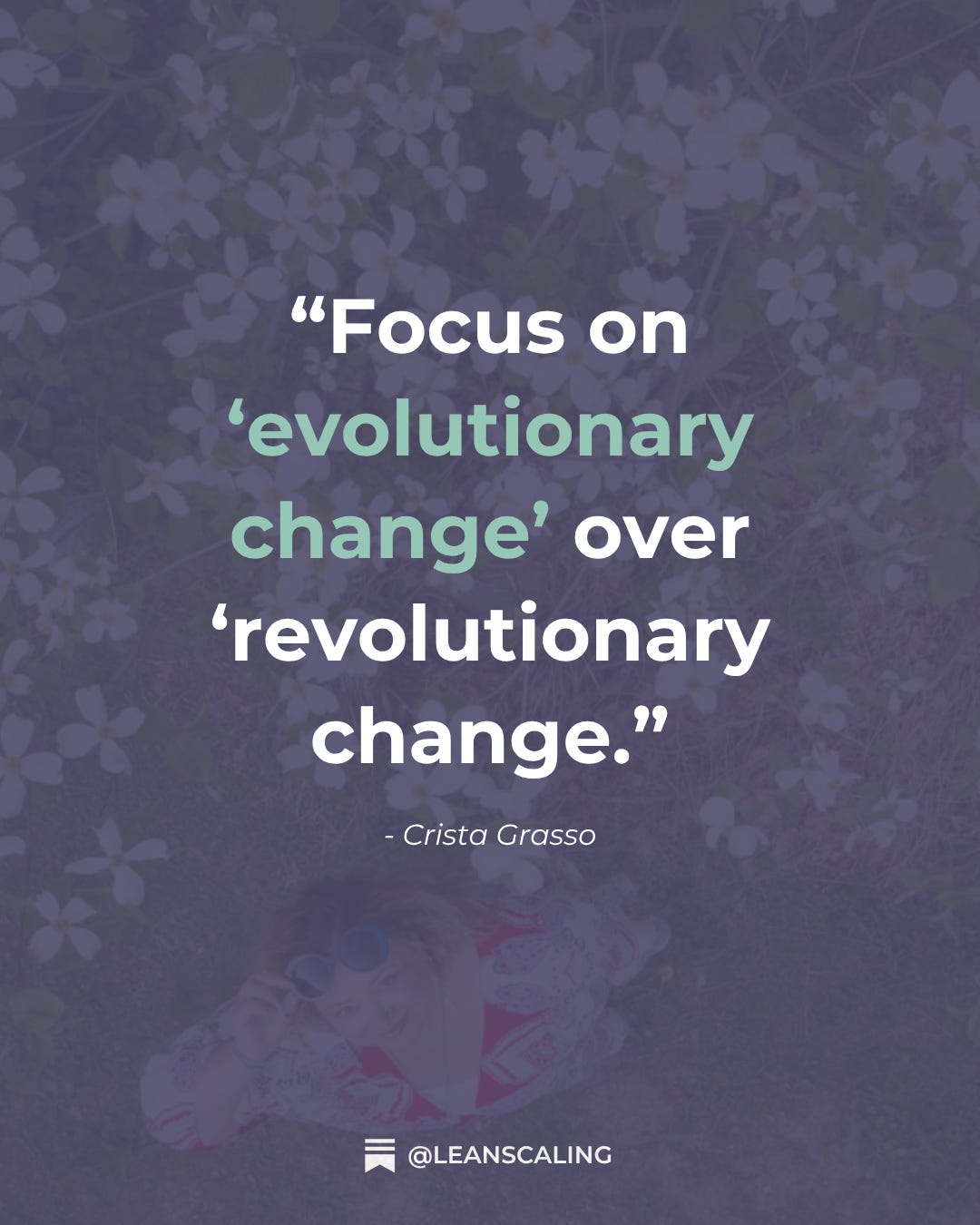
First, appreciate that things can take time and don’t get discouraged when you don’t see an immediate return on the time, money, or energy investment you are putting into something.
Instead, you want to assess, adapt, commit, and amplify.
If I had recognized that I planted the wisteria in a spot that was too shady and moved it, or cleared out some of the tree cover, it would have bloomed much faster instead of working so hard to get to the sunlight it needed to thrive.
It’s often not that what you are doing won’t work. It’s that the conditions needed for success, internal or external, have changed and you may need to make a 5-degree shift to what you are currently doing.
Seek to understand what’s not working and why so you can adapt accordingly.
This is rarely the time to reactively pivot in an extreme way.
It’s not always the first adaptation that delivers the results you want so leverage kaizen to continuously make small changes and run experiments without completely throwing things out and starting over.
One of the biggest mistakes businesses make is pulling back right before something gains the traction it needs to take off.
There is a commitment and continuous recommitment required.
Consistency is what creates the conditions for the Wisteria Effect to work in your favor. Keep showing up for what you have planted, even when you cannot see it growing yet.
Because even when something starts working, it will eventually need to be adapted to keep working. And that cycle keeps getting shorter and shorter.
Give it more focus, more energy, more intention. Continue experimenting, however the focus shifts from figuring it out to maximizing results.
This is where the subtraction then multiplication math that I shared in my last article on sustainable scaling comes in.
You stop spreading effort across everything and start directing it toward what’s working best.
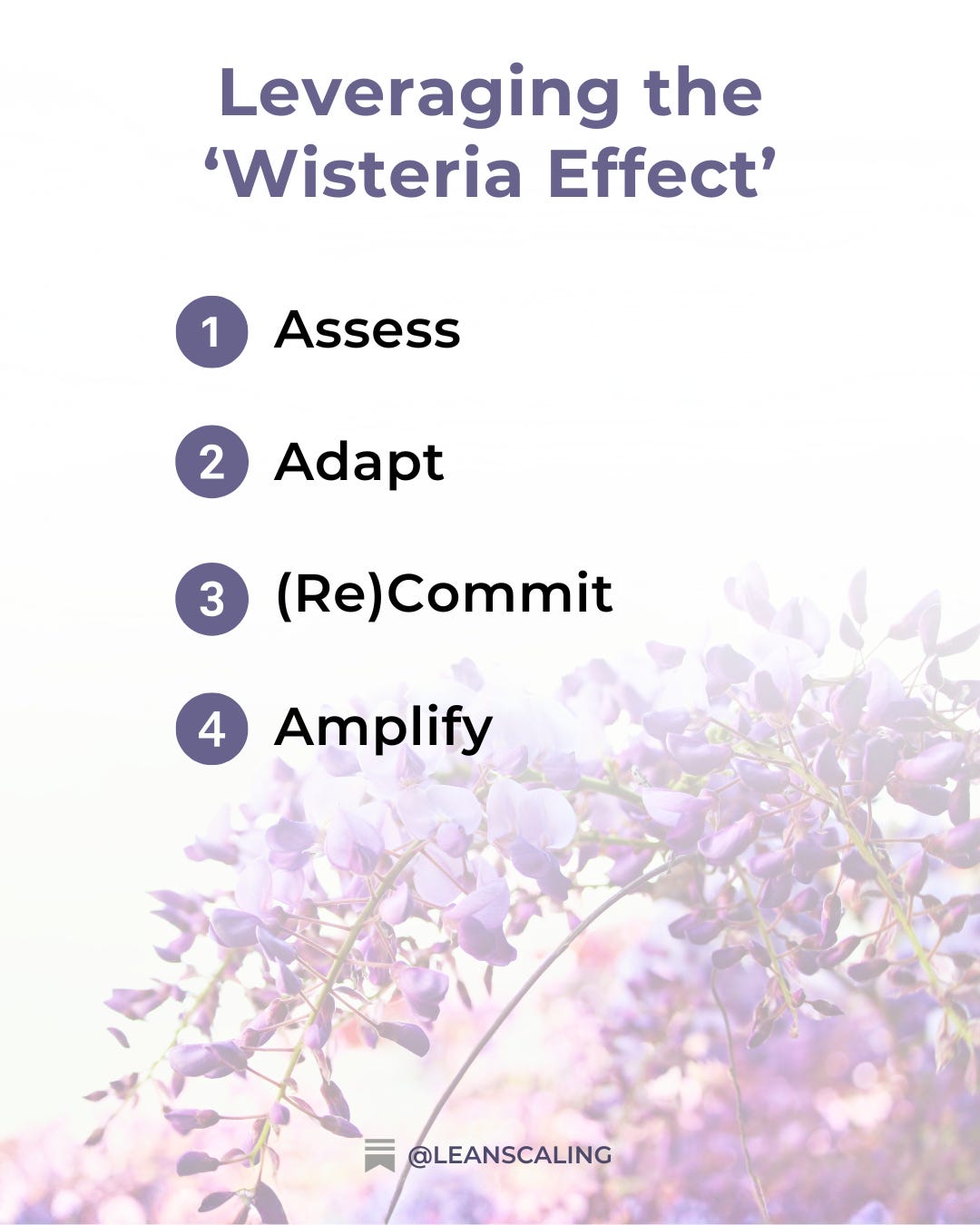
Then, look at how you can use the wisteria effect strategically.
Because here’s the thing... your business needs a combination of short-term wins and long-term strategies.
You can’t only focus on things that will generate an immediate ROI or you stay stuck on the revenue rollercoaster and end up overworked and overstressed.
But you also can’t only plant seeds and wait, because the business needs to generate results now. The goal is to have both running at the same time.
Short-term strategies are the ones designed to generate results quickly. Conversations, offers, follow-ups, launches, and anything that moves someone from interest to decision in a relatively short window of time.
Long-term strategies are the ones that take time to bloom but create compounding returns. Content, relationships, referral systems, thought leadership, podcast interviews, email lists. Things that may feel slow at first but become your most powerful growth drivers over time.
When I started working with one of my private clients 6 months ago, her goal was driving revenue right away (like it is for most)… but instead of only focusing on the ‘now’, we outlined a blend of both short-term and long-term strategies.
I got an elated Voxer saying “I don’t understand what’s happening but all of a sudden we are getting so many new leads! We are growing by hundreds of new followers on LinkedIn every day, even when we aren’t posting; people are sharing our diagnostic; and new people are reaching out to us even though I haven’t met them. I have posted about this before and didn’t get this kind of response. What’s happening??”
As part of her scaling roadmap, we had refined her offer suite to include a free diagnostic that naturally led to her signature services, mapped out crystal clear buyer journeys that fit the realities of today’s market, and defined a supporting content and thought leadership structure to guide it all.
This was a longer-term strategy that we combined with other short-term ones.
Instead, she committed to sticking with it, we assessed and adapted her approach as needed, and she is currently amplifying it now that it’s working.
Here are some questions for you and your team to reflect on to ensure you have a good balance of both long-term and short-term strategies:
Are we so focused on immediate results that we have no seeds planted for the future?
Or are we planting so much for the future that we have nothing driving growth today?
When you get that balance right, and you combine it with the assess, adapt, commit, and amplify approach, you stop feeling like you are starting from scratch every time something does not work immediately.
Invest in building and nurturing relationships, upleveling your leadership, learning new skills, and doing the things that are an investment in the future, not only focused on right now.

Here is what is important to take away from this…
The work you’ve put into your business isn’t wasted, even when it does not feel like it is producing results fast enough. There is growth beneath the surface, just waiting for and climbing towards the conditions it needs to fully bloom.
You don’t want to rip things out and start over every time the timeline does not go the way you expected. You want to assess the conditions, make the right adjustments, keep showing up, and amplify what starts to work.
I’m curious… where in your business have you experienced the Wisteria Effect?
And where might you be walking away too soon from something that just needs a little more time and the right conditions to take off?
No posts
Comments
Nothing yet. Say the first thing.
Sign in to join the conversation.