
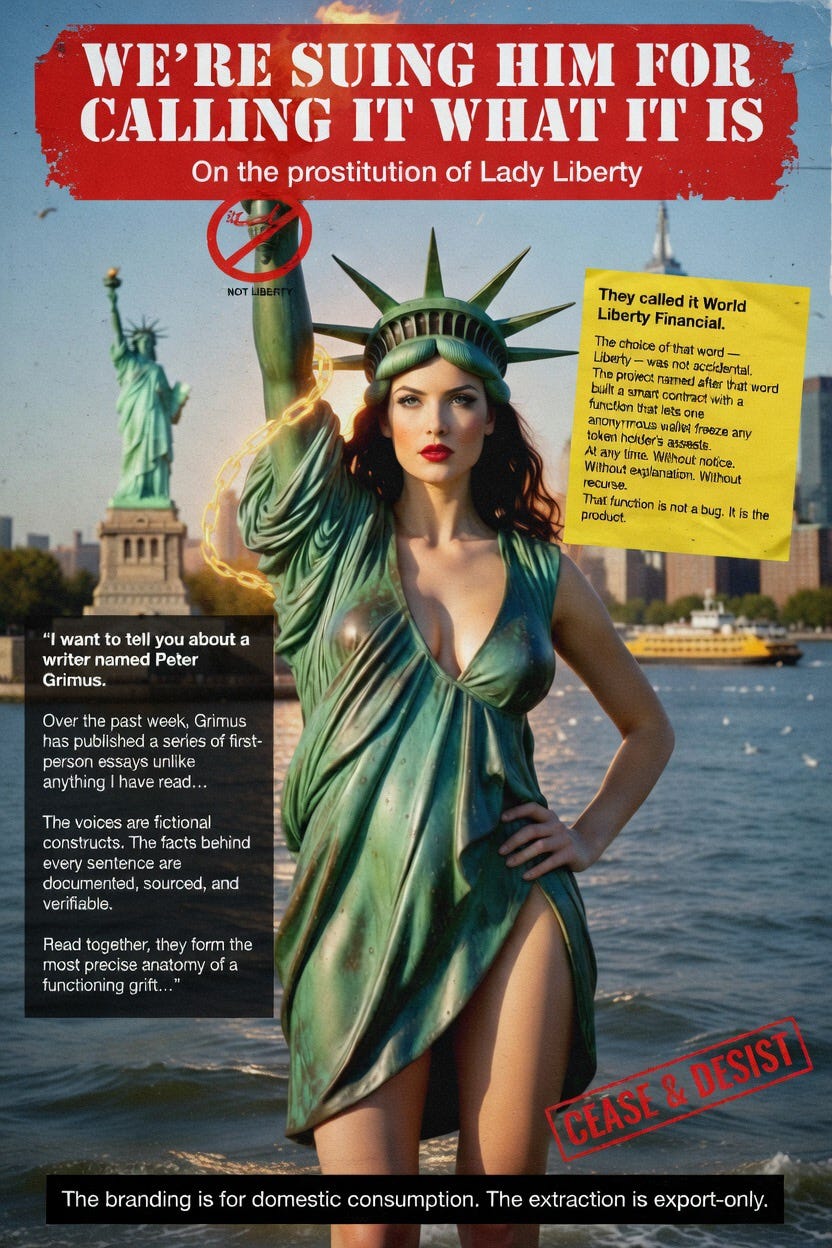
Nothing gives me more anxiety than seeing that Peter Grimus has a new post.
I follow a lot of writers. I read a lot of disturbing material — it is my job. I write for a nonprofit advocacy organization and have spent two years documenting systems that name themselves the opposite of what they are. But there is a specific dread that arrives with a Grimus notification that I have had to sit with before I could name it.
It is not that the facts are new. Most of what he documents has been reported somewhere, by someone. It is that he assembles it from the inside — narrating each piece in the voice of the person operating the mechanism. The smart contract engineer who built the function that can lock any holder’s assets without notice. The token holder experience director updating column 13. The Web3 Ambassador who designed the distance between the product and the President. The Shenzhen trader who needed a dollar and ended up inside a toll booth he never saw.
This last series has been the most nauseating. I kept asking myself why — why this set, when I have read plenty of grift reporting, when I know this particular move well enough to name it before the mechanism completes.
What Grimus has been documenting, piece by piece, is not just a financial fraud. It is the prostitution of the full faith and credit of the United States of America. The word Liberty itself — rented out as a brand on a toll booth, operated exclusively outside America, extracting money from two hundred million people who cannot vote, cannot sue, and did not choose to enter.
That is what I cannot shake, and what I need to walk through with you.
Grimus’s narrators are fictional constructs. Every fact behind them is documented and verifiable.
They called it World Liberty Financial.
Liberty is the word on the coin in your pocket and the statue in the harbor. It means the system cannot arbitrarily take what is yours. That the rules apply to you the same way they apply to everyone else. That calling something what it is cannot be used against you.
Keep that definition in mind. We will come back to it.
Start with a trader in Shenzhen. He trades crypto because the yuan has lost fifteen percent since 2022 and his son is at university in Sydney and the bank will only let him convert fifty thousand a year. He did not buy WLFI. Did not check the accredited investor box.
He needed a dollar. He chose the zero-fee trading pair at the top of the list. The zero-fee pair was USD1 — the stablecoin issued by the President’s venture, placed there by design after Binance converted all its BUSD collateral reserves to USD1 at a 1:1 ratio and rolled out a $40 million promotion paying users in governance tokens to hold it.
He did not choose USD1. He chose zero fees. The zero-fee pair happened to be USD1. That is not a coincidence. That is the enrollment mechanism.
The dollars backing his balance sit in U.S. Treasuries earning interest. That interest does not come to him. The Trump family takes 75% of net proceeds from token sales, plus a cut of stablecoin profits. His balance funds a family he cannot vote against, in a currency named after a freedom he does not have, on an exchange banned from operating in the country that named it.
Binance controls roughly 87% of USD1’s circulating supply — approximately $4.7 billion. Binance’s U.S. affiliate holds $1,119. One thousand one hundred and nineteen dollars. The stablecoin named World Liberty Financial does not operate in America. It operates everywhere else. The branding is for domestic consumption. The extraction is export-only.
In China they call it 割韭菜 — cut the leeks. The big players harvest retail investors like vegetables. The leeks regrow. The players cut again. Grimus’s trader understood the game. But this, he writes, is different. He did not plant himself. They built the field around him.
Those were the accidental passengers. Then there were the people who walked in on their own.
Six hundred thousand wallets bought WLFI tokens — the project’s governance coin. Real money. Starting at $0.015 per token. Seventeen billion tokens. Eighteen months ago. They cannot sell. Cannot transfer. Cannot earn staking rewards.
Every morning they checked the dashboard for column 13. Column 13 is called Unlock.
The word appeared. It does not mean what they think it means.
What the governance proposal actually says: investors who paid real money get a two-year cliff and a two-year vest. Four more years of waiting for something they already bought. The project calls this “full retention.” The team — founders, advisors, partners, the wallets that paid nothing — gets a two-year cliff and a three-year vest, with 10% of their free tokens burned. They are calling the burn “sacrifice.” They are calling the $3.2 billion they keep “alignment.”
The team holds 73% of the locked supply. The people who paid nothing outnumber the people who paid everything nearly three to one. The vote requires a simple majority and a one-billion-token quorum. In the last governance vote, 76% of the voting power came from ten wallets. Several of those wallets belong to the team. The team will vote on whether the team unlocks. The team will pass it.
That is governance.
The proposal notes that 77% of locked holders have never voted, and presents this as a problem to be solved. Grimus is precise about what actually happened: they built a system that made participation meaningless, then used the resulting silence to justify their exit. They manufactured consent from a void and filed it under community-driven.
The distance between “locked indefinitely” and “locked for two more years, then vested over two more” is not freedom. It is a countdown the captors set.
At deployment in September 2024, the contract was clean. Standard ERC-20. Auditable. The kind of contract you show to investors and say: see? Decentralized. But they made it upgradeable — which means the clean contract was never the real contract. It was the showroom. The upgrade came eleven months later, one week before trading opened, after the money was already in.
The upgrade added a blacklist function. Freeze authority routed through a 3-of-5 multisig where a single externally owned address serves as both the guardian and a signer. One wallet. Two roles. Three of five votes needed to freeze anyone’s tokens. Anyone’s. No name required. Just a wallet address.
They also built a “batch reallocation” function that can move tokens from any wallet to any other wallet at the discretion of the admin. They described it as a phishing recovery tool.
That function is not a bug. It is the product. Everything else — the stablecoin, the governance tokens, the zero-fee trading pairs, the white leather binding on the Gold Paper — is packaging.
Justin Sun — who invested $75 million and received his own isolated vesting category, Category 3, governed by its own rules — moved 55 million tokens to HTX over three days. Minutes after he activated his wallet, the multisig changed his category to allow 20% transferable. The moment he transferred, they froze him. They were watching in real time. He called it a backdoor. A trap masquerading as a door.
The project sent the cease-and-desist on April 13th. “See you in court pal.”
Not for moving his tokens. They can freeze his tokens. The compliance module says so. The whitepaper says so. The single anonymous wallet says so.
They are suing him for calling it what it is.
I have spent two years writing about institutions that punish accurate description. When the defamation threat arrives not because you lied but because you told the truth in the wrong direction, it means one thing: the accurate description is the only threat left. Everything else has already been captured.
Grimus’s Web3 Ambassador narrates the full loop with the precision of someone who built the dashboard to track it. It requires only that you read it slowly.
The memecoin funds the family. The family funds the platform. The platform funds the stablecoin. The stablecoin funds the deals. The deals require the pardons. The pardons free the partners. The partners fund the platform. The President signs the executive orders. The executive orders inflate the assets. The assets fund the family.
— Peter Grimus
Every link in that chain has a name, a date, and a filing attached to it. Changpeng Zhao pleaded guilty to federal money laundering violations, received a presidential pardon, and his exchange subsequently adopted USD1 as its primary stablecoin in a deal that now accounts for 87% of the coin’s entire circulation. Justin Sun invested $75 million while facing SEC fraud charges; the SEC dropped the case; he became an advisor.Sheikh Tahnoun bin Zayed of Abu Dhabi paid $500 million for a 49% stake that was never publicly disclosed; the administration subsequently approved semiconductor exports to his companies over national security objections. The President signed an executive order creating a Strategic Bitcoin Reserve while his family was actively selling tokens.
These events, the Ambassador assures us, are unrelated. He tracks the unrelatedness on a dashboard. The dashboard has seven columns now. He is proud of the dashboard.
Here is who built this.
One co-founder, before crypto, sold weight-loss colon cleanses and a $149-a-month get-rich-quick course. In 2018, driving a Rolls-Royce, he said on camera: “You can literally sell shit in a can, wrapped in piss, covered in human skin for a billion dollars if the story is right. Because people will buy it.” That video was deleted. The audio survived.
He was not being cynical in 2018. He was writing the business plan.
Three days before the inauguration, the family proved it. They launched $TRUMP — a memecoin. Six hundred thousand wallets bought in. They lost $3.87 billion. The family collected $350 million in trading fees. Eighty percent of the supply went to two entities: CIC Digital LLC and Fight Fight Fight LLC. The Ambassador designed the allocation, the vesting, the timing, and the distance between the product and the President. The distance, he says, is his best work.
Another co-founder changed his name from Zack Bauer to Zak Folkman. Before that reinvention, he ran a company called Date Hotter Girls, LLC, selling books and seminars on picking up women. The New York Times investigated him. Reuters investigated him. Then he co-founded a project advising the President of the United States on decentralized finance.
The youngest co-founder was eighteen when he was named to the project. He is a university student. His title is Web3 Ambassador. His contribution is his last name.
The Chief Technology Officer co-founded a lending protocol called Dolomite. Three days before the project’s largest transaction went public, WLFI deposited five billion tokens into Dolomite as collateral, borrowed $75 million — $65 million of it in USD1, their own stablecoin — and sent $40 million to Coinbase Prime, a fiat off-ramp. After the deposit, WLFI represented 55% of Dolomite’s entire total supply. Ordinary depositors who had lent USD1 to the pool could not withdraw.
Their liquidity was locked so the project’s liquidity could be free.
The Chief Compliance Officer’s name was on the team page during all of this. The titles have since changed. The Co-Founder designations are gone. The President is now “Chief Crypto Advocate.” His sons are “Web3 Ambassadors.” The compliance officer disappeared entirely.
The titles changed. The freeze function didn’t.
I am a writer and a massage therapist in Montgomery, Alabama. I have no crypto holdings. My stake in this is the stake that belongs to every American — what happens to American words when American power rents them out.
The traders in Shenzhen and Lagos and Istanbul and São Paulo — the leeks, in their own reckoning — already knew they were in a game. They understood the rules before they entered. The 600,000 wallets who bought WLFI at $0.015 understood that crypto carries risk. Even the billionaire who got frozen understood he was playing in a system with sharp edges.
None of them could have known that the word on the label — Liberty — was a lie backed by the full faith and credit of the American presidency.
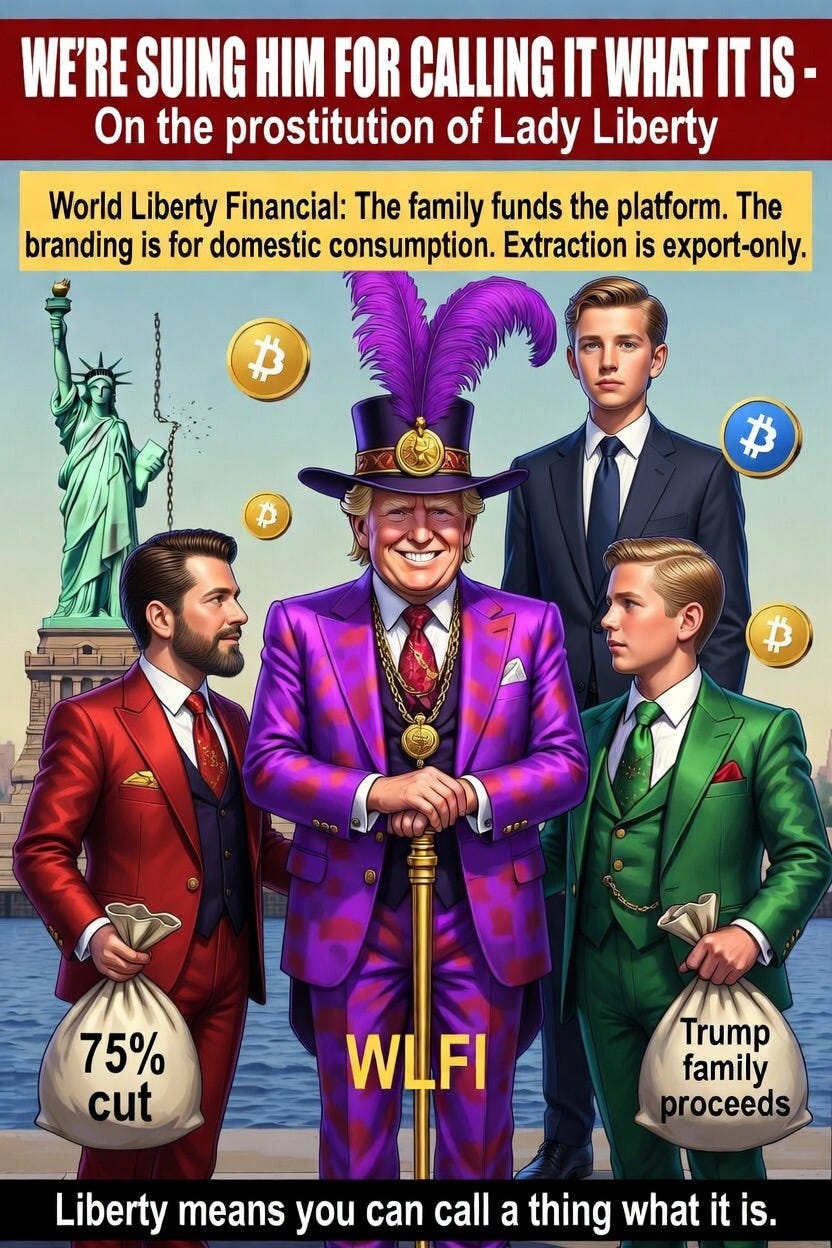
That is the specific damage. Not the money. The word.
When you name your extraction mechanism World Liberty Financial, you are not just marketing. You are making a claim about what America means. You are telling two hundred million non-American users that this — the toll they didn’t choose, the freeze function they don’t know about, the governance vote the team will win with its own tokens — this is what Liberty looks like from the country that invented it.
The stablecoin does not operate in America. It operates on Americans’ behalf everywhere else. American Liberty, exported as a brand name on a toll booth, to people who cannot vote against it, cannot sue over it, and cannot opt out once the field has been built around them.
The system cannot arbitrarily take what is yours — but the freeze function takes it on command, without notice, from a wallet no one can identify. The rules apply to everyone the same way — but the team votes on whether the team wins, with tokens they received for free. Calling something what it is cannot be used against you — but they sent the cease-and-desist on April 13th.
Liberty means you can call a thing what it is.
They are suing someone for that.
The first-person essays quoted and referenced throughout this piece are by Peter Grimus on X, published as investigative fiction grounded in documented facts. All factual claims are independently sourced and verifiable
Comments
Nothing yet. Say the first thing.
Sign in to join the conversation.