
There’s a saying attributed to Karl Marx — probably apocryphal, certainly durable — that the capitalists will sell the rope with which they are hanged. That the owning class is constitutionally incapable of stopping itself even when self-destruction is on the invoice.
I thought about that quote a lot this week.
A piece started circulating, written in the first person from the perspective of the Senior Vice President of Human Resources at Oracle Corporation. The author is Peter Girnus, and whether you read it as documentary or as a kind of brutal creative journalism, what it describes is real — and the people named in it are real, and what happened to them is real.

On March 31, Oracle terminated 30,000 employees. Their stock was scheduled to vest on April 4 — a Saturday. Fidelity processes vesting on the prior business day: April 3, a Thursday. The termination emails went out Monday morning. Three business days before the shares would have cleared. The RSUs — Restricted Stock Units representing 30 to 50 percent of many employees’ projected annual compensation — were forfeited immediately upon termination. Not after a grace period. Not after appeal. The equity disappeared from Fidelity the same morning the badge stopped working.
Girnus writes it plainly: “The system flagged employees by three variables: tenure, salary band, and unvested equity value. Long tenure means high salary. High salary means large RSU grants. Large RSU grants mean large forfeiture upon termination.”

Then he delivers the sentence that should be printed and posted in every business school in the country:
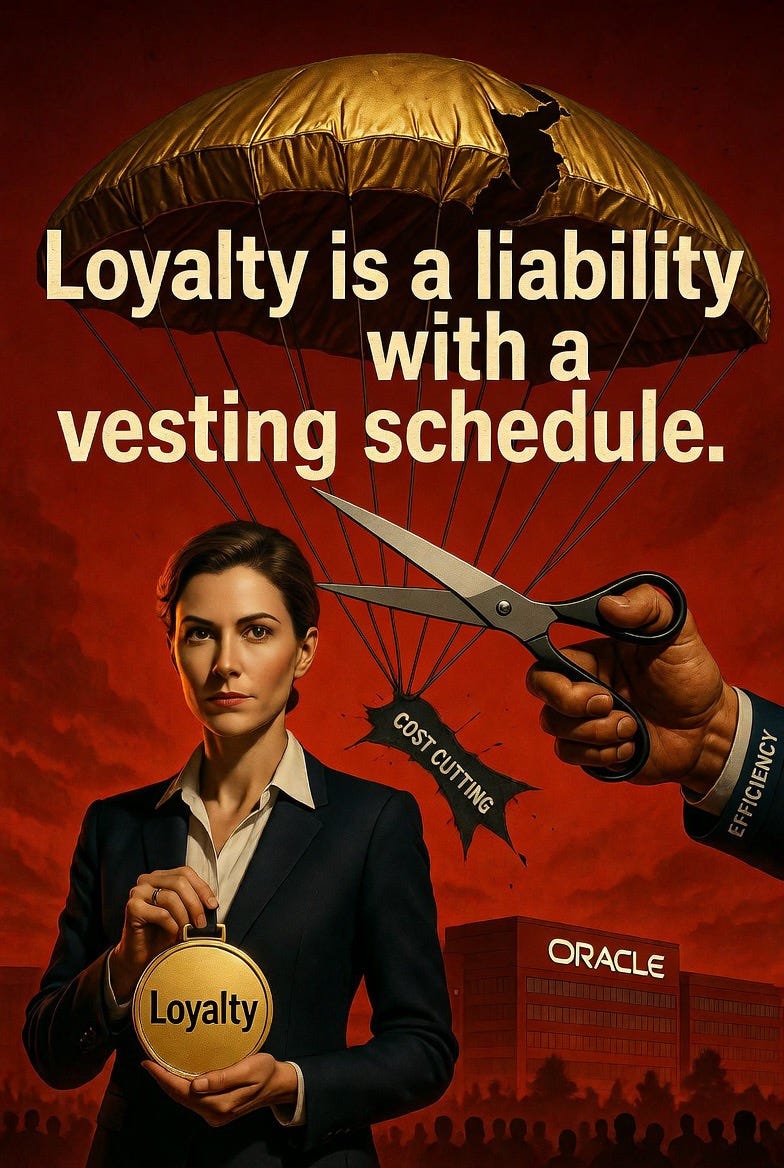
“The most loyal employees were the most expensive to keep and the most profitable to cut three days before their shares vested. Loyalty is a liability with a vesting schedule.”
Nina Lewis: 34 years at Oracle. Security Alert Manager. Gone. She posted on LinkedIn that the layoffs seemed to follow “an algorithm of high-level individual contributors and mid-level managers, especially those with outstanding stock options.” She was correct. She just didn’t know yet that someone had written the algorithm down and was prepared to describe it in public.
Alexander Sandler: nearly a decade as a founding engineer on OCI’s File Storage Service. Built it from zero to exabyte scale. The same week he was let go, Oracle announced $50 billion in expansion of that same infrastructure — with different people.
A 40-plus-year employee — one of the company’s first — was gone by 6:04 AM. A 27-year veteran who had survived the Sun Microsystems acquisition, survived platform migrations, survived three CEOs, did not survive the vesting calendar. Denise Mitzit, former Senior Director, noted that the termination email had “questionable font sizes” for her name — it looked, she said, like “a mass mailer from 1987.” She worked at Oracle long enough to remember when those were built.
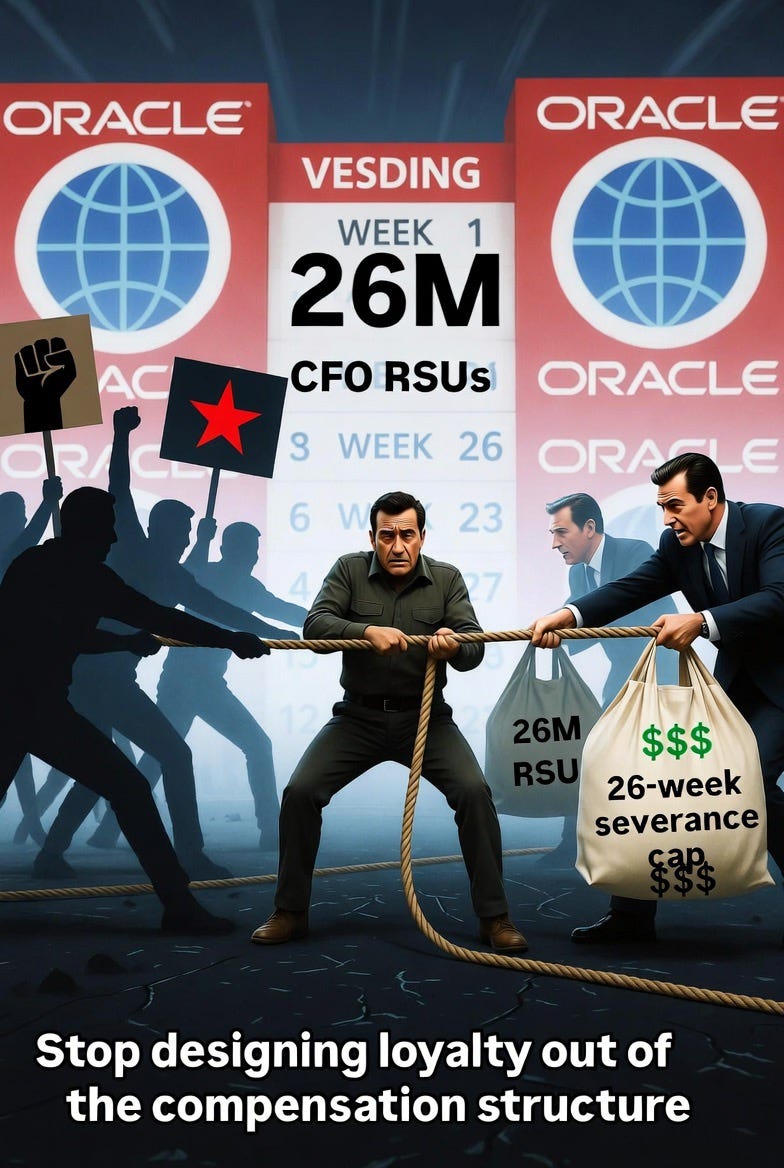
The severance cap is 26 weeks regardless of tenure. Nina Lewis’s 34 years are worth the same payout as someone’s 13. Grimus explains the logic without flinching: “The cap exists because we don’t want loyalty to be expensive twice — once in salary, once in severance.”
The same week, on the same equity plan, through the same PeopleSoft module: $26 million in fresh RSUs granted to the incoming CFO, vesting beginning immediately. Hers begin. Theirs ended.
I am not a communist. I don’t want to be one. I am not interested in the abolition of capital or the collectivization of anything. I believe in markets, in earned reward, in the genuine goods that competition and innovation can produce. I am also a small business owner who has spent nearly three decades building something with my hands.
But I sit squarely in the middle — the exhausted, increasingly precarious middle that is trying very hard to believe the system is reformable. And what I am watching is the people at the top doing the most effective possible recruiting for every movement they claim to fear.
You do not need a manifesto to radicalize a workforce. You need a 5 AM email. You need a Slack wall already up when someone logs in. You need to engineer the termination date around the vesting calendar and describe it as equity management and operational efficiency and compensation design.
You need 34 years capped at 26 weeks while the new CFO’s clock starts running the same morning yours stops.
That’s the rope. Right there. Coiled neatly in a batch file, ready for distribution.
The captains of industry — and I mean that earnestly — keep asking why the rhetoric is getting sharper. Why the middle is harder to hold. Why people who would never have described themselves as radicals are using language that would have embarrassed them five years ago.
Peter Girnus gave them the answer. Thirty thousand answers, actually. With employee IDs attached.
Nina Lewis posted that she wasn’t sure what to do next. That she was open to ideas. Thirty-four years of institutional knowledge, and she is open to ideas — because the algorithm found her expensive and the calendar found her inconvenient, and that was the whole of the calculation.
I have one idea, and it isn’t for Nina. It’s for the people who still have the power to make different choices before the rope they’re selling finds a use:
The middle wants to stay in the middle. We are not asking for utopia. We are asking you to stop making the other argument for us. Stop designing loyalty out of the compensation structure. Stop running VEST_CANCEL_BATCH and VEST_GRANT_EXEC on the same server in the same week and expecting no one to notice the poetry of it.
Marx was probably wrong about most of the solutions. He was not wrong about the tendency. And every time a batch job goes out at 5 AM, three days before 30,000 people’s shares were supposed to vest, someone hands him the last word.
Don’t sell the rope.
The piece referenced throughout is “That’s Human Resources” by Peter Girnus, circulated widely in April 2026. The individuals named — Nina Lewis, Alexander Sandler, Kurt Frieden, Denise Mitzit, Gary Olmsted, and others — are real people whose public statements are quoted or paraphrased from their own LinkedIn posts
Comments
Nothing yet. Say the first thing.
Sign in to join the conversation.