
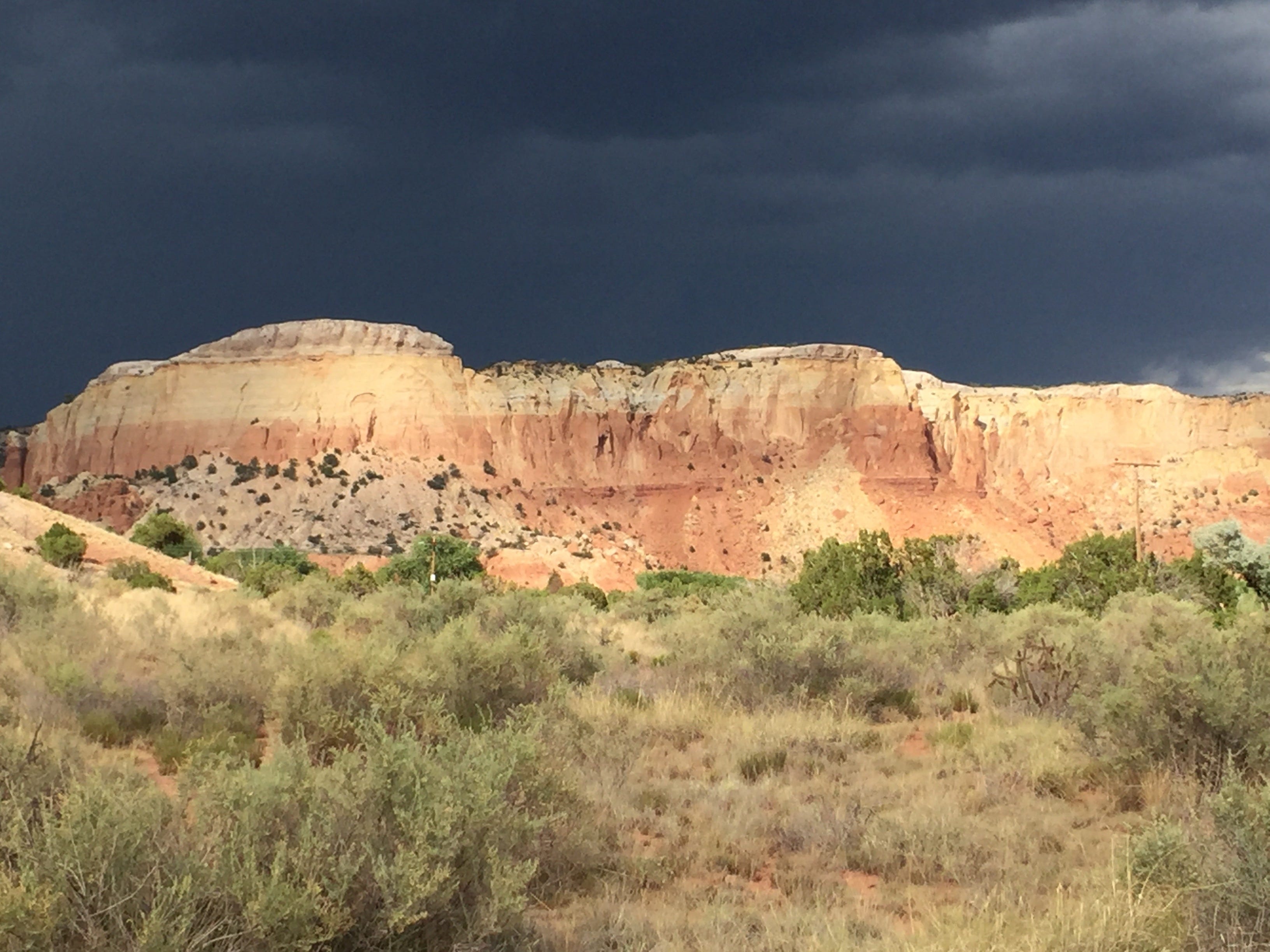
If you don’t sense the many ways we are living on the edge in these times, this may not be the post for you. We begin with a story, a parable that has been shared over the ages. I first heard it from my colleague Beth Norcross at the Center for Spirituality in Nature who heard it from Episcopal priest and teacher, Cynthia Bourgeault. Many storytellers, many versions. Here’s one I’ve written.1
The setting is an acorn village at the base of Grandmother Oak where acorns have gathered for over one hundred years without much out of the ordinary coming to pass. One day, a young acorn happened to catch a glimpse of himself in a nearby by puddle just as the golden sun reflected off his nearly perfect shell.
“Goodness,” he thought. “I look rather handsome.” He wiped off a bit of soil and admired the jaunty tilt of his cap. He couldn’t help but point out how spiffy he looked to several of his friends lying nearby.
Soon they too were gazing admiringly at their reflections. It didn’t take long for this trend to spread throughout Acorn Village and soon “spa days” became all the rage. Grandmother Oak tried to intervene with a reminder of the nature of things, but her wise counsel was overshadowed by buffing and polishing sessions.
One day, however, things changed when a scruffy acorn was dropped by a passing blue jay into the middle of the village. This acorn looked as if he’d been plucked from the mud. His cap was missing. And – horrors! - his shell was cracked.
Most of the shiny acorns of the Village turned away dismissively. But for one little acorn, curiosity overcame her disgust. “Why are you so messy? Why is your cap missing? Why do you have a crack?” she queried the haggard acorn.
“Look up,” the scruffy visitor replied. “Look up. I am on my way to becoming an oak.”
“An oak? A tree like Grandmother? How can you do that?”
“I don’t know exactly. But we each could become like Grandmother. It has something to do with cracking open and being covered in dirt.”
Hidden within each acorn is a majestic destiny. The oak that is to come waits impatiently within, prodding and pushing, longing to fulfill its calling. The acorn holds her “oakness” within. She does not aspire to become a willow nor suddenly decide to sprout pine needles in the winter.
I think this is what priest and mystic Thomas Merton meant when he wrote about hidden wholeness: “There is in all visible things an invisible fecundity, a dimmed light, a meek namelessness, a hidden wholeness.”
Oaks remind us of our own hidden wholeness, our truest selves. Our souls harbor our essence – who we have always been without the layers of expectations, judgments, or circumstances that reshaped us.
It’s unclear what it costs an acorn to crack open and surrender to becoming a tree. However, it’s likely that OUR surrender will cost us something. As we reconnect more fully to our deepest selves and our unique gifts, we may sense a calling that asks more of us than we think we can give.
We may long to keep our protective shells. It might be hard to imagine that cracking open could ultimately benefit us and the world. Still, as much as we appreciate the illusion that we can protect ourselves, we may hear from deep within the persistent whispers of our true essence, waiting to emerge.
And cracking open alone is not enough. If you place an acorn on a sunny windowsill, it will not mature into an oak. An acorn must acquaint itself with winter darkness to grow a taproot – that large, central root from which other, finer roots will eventually grow and branch outward, linking the tree with the beings of the soil community.
And what a community! One teaspoon of healthy soil contains more life forms than there are humans on Earth. This includes 100 million to 1 billion microbes, protozoa, nematodes. Soil is a community, a living entity, a diverse ecosystem that is one of the most complex on the planet. Ground. Soil. Hummus. Human. You might recall that the well-known 20th century theologian Paul Tillich referred to God as the “Ground of our Being.”
Our life journey invites us to open to our deepest, truest selves. This is an inward turning to reclaim our soul’s purpose which in turn illumines our unique role and connects us more fully to the sacred web of life – the ecosystem within which we live.
We realize that our unique gifts matter to the family of things. It’s all connected.
Our ancestors knew that they lived within the web of life. Indigenous peoples have tried to cut through the noise of our colonial, industrial worldview to tell us this. There are records of Native American elders holding deep and extended conversations with Europeans in the 1600s, explaining to them that land is a sacred living presence, that waters hold knowledge, that mountains speak, that trees offer wisdom.
Oak, pine, trout, salmon, bear, beaver, corn, sunflower, rain, and wind – all these are our relatives. Our kin.
Professor and Indigenous scholar Enrique Salmon coined the term kincentric ecology to describe the Indigenous understanding of nature that includes humans as one aspect of the complexity of life, an awareness that life in any environment is viable only when humans view the life surrounding them as kin.
Our Western worldview continues to insist that humans are positioned at the top of a pyramid as the superior being while kinship holds humans in an interwoven relationship with the living world. Kinship recognizes that no life is possible without the lives who have gone before. There is a profound unity to all life, a connection to and dependence upon every being that has ever existed. It is a reminder: we are multispecies beings, made and remade from our ancestors.
Hildegard of Bingen – Benedictine abbess, saint, herbalist, composer, writer, mystic, and polymath born 1098 - drew on ways of knowing beyond scientific knowledge. Hildegard knew the wisdom of the heart, senses, and intuition. “Everything,” she wrote, “that is in the heavens, on earth, and under the earth is penetrated with connectedness, penetrated with relatedness.”
Our dominant Western culture puts a premium on the myth of the self-made person who needs no one; asking for or receiving help is seen as a sign of weakness. So dominant is this theme that the previous U.S. Surgeon General declared loneliness as epidemic in the US.
Sometimes we hardly remember that we live in relationship with other people, and we totally forget that we are in relationship with the living world. Trees, forests, rivers, sparrows, sunflowers, whales, dragonflies, land are considered “other than” - a “resource” that is ours for the taking, an “ecosystem service” to meet out wants and needs. With this mindset of “othering” we destroy Earth, hollow out our souls, and break our hearts.
Of course, we can never separate ourselves from the living world. That is an illusion. We drink the rain and rivers; our breath comes from the phytoplankton and trees; the photosynthesis of plants and the minerals of the soil feed our cells and becomes our bodies; our microbiome determines our health and our emotions. This is fact. Science. And still, we maintain the myth of separation. Why?
Certainly, it’s convenient to “other” Earth, to live as usual, avoiding difficult choices. Yet, it’s more than that for many of us. Even when we see how the dominate story of separation, colonialism, and “power over” is destroying life, even as we long for reconnection and desperately hope for a new way forward, it is difficult. Many of us are trying to shake the dust of this culture from our feet, attempting to see with new eyes, so that we might step into relationships grounded in life-giving ways of thinking and being. It remains a challenge.
I wander the woods, slowing my thoughts, opening my heart, breathing into my intention: open, present, available. I am re-membering that I belong among these lives. I catch glimmers of connecting threads. Then I return indoors. And I lose my way.
Is that how it is for you too? Do you too often find yourself walking mindlessly along old, well-worn pathways when you were intending to embrace a new story of life? (Oh, the many times!)
This is why I’ve come back to the acorn story here. When Beth Norcross and I co-wrote Discovering the Spiritual Wisdom of Trees, I had included something like the story I told here in a chapter I wrote.2 Our first editor raised questions about whether we were talking down to our readers. Sensitive to her criticism, I rewrote the chapter with just a minor nod to the story. I’m sorry now that I did. Some stories hold embedded wisdom; I believe this one does.
If our journey is to become our truest selves and connect more deeply to the living world, the acorn tells us that it’s insufficient to hang out in the woods while holding ourselves as the center of attention. To become the true essence of who we are, we will have to embrace our soul’s purpose and embed ourselves within the Earth community. In other words, our journey is about both going to the depth of our souls and reweaving our frayed connections to the living world. And those are not two separate journeys.
As we release into the well of the soul and recover our essence, we see that we are children of the cosmos. And as we reclaim our place in what the poet Mary Oliver called “the family of things,” we become increasingly aware of who we are. 3
We are acorn, and we are soil; we are oak tree, and we are woodland. There is no duality; there is no other. Acorns do not become oak without soil, water, sunlight, and community. Yet all those other elements are insufficient unless the acorn cracks open to their true oakness within.
I write this essay to remember that spiritual ecology underlies and makes possible the change I long for in this world.
In retreats or Church of the Wild that I lead, I often offer ecological practices that help others and myself connect more deeply to the living world. Perhaps I have not attended sufficiently to cultivating spirituality. Am I missing an emphasis on the need for cracking open to the gift within alongside of reweaving connections? Can we reclaim – or perhaps claim for the first time - the practices that support spiritual ecology?
This post is insufficient for the fullness of such a conversation. For now, we might consider some ways to support our soul journeys such as opening to awe and wonder; allowing our hearts to be broken open by grief; exploring creativity in its many manifestations; contemplation and prayer; being held in community through practice and ritual. This is some of what I know of soul work. This - and allowing grace to break in, gifting us beyond what we can accomplish or even imagine on our own.
I hope you will join me on this journey as I continue to explore spiritual ecology in edge times. Certainly, we will need the community of like-hearted people and the kinship and wisdom of the living world if we are to reweave the frayed fabric of Earth & Soul.4
This story and much of the groundwork for the first part of this essay was developed for the William Birkett Williams lecture I gave in Cleveland Heights, Ohio, in April, 2026. I am grateful to Fairmont Presbyterian Church for their invitation and support.
Beth Norcross and I wrote Discovering the Spiritual Wisdom of Trees , Broadleaf Books, 2025. We are so excited because it just won a Silver Nautilus Award - so maybe the editor who moved on before our book was published was right after all. Who can tell?
In her poem “Wild Geese,” Mary Oliver wrote “… the world offers itself to your imagination/ calls to you like the wild geese, harsh and exciting - / over and over announcing your place / in the family of things.”
This essay begins a further exploration of the themes I developed in Earth & Soul: Reconnecting amid Climate Chaos, Bold Story Press, 2024. You may find that book helpful in exploring spiritual ecology in edge times. If you’ve read it already, thank you.
I greatly appreciate it when you offer a “heart,” leave a comment, or share this post. It’s terrific to know that you are there, and it does help others to find this conversation.
Thank you!
No posts
Comments
Nothing yet. Say the first thing.
Sign in to join the conversation.